Structuring Your Business

I am going to use Triathlon Coaching for this case study but I could easily re-write with a focus on investment analysis.

+++ 

How efficient are you?  I’ve worked with the best coaches in sport and they never brag about how busy they are.  If you’re constantly busy then you need to take an honest look at your efficiency.  Do you spend your time on what the team wants to achieve?  

Strong relationships are built on being effective, not busy.

Productivity happens when we are effective and efficient.  Here are quick hits to improve your productivity:

  1. Training Peaks – template creation for training plans, an pooled workout library, and auto notify for key workouts (via email into a separate mail folder).  If you don’t know what I’m talking about then you need to fix that, now.
  2. Season Planner – I’ve created this in google docs.  It has the year on a single page and I can create a new page for athlete specific information.  I have my team create a short URL (via bit.ly) and access via clickthrough which is embedded in each athlete’s signature file.  Again, if that doesn’t make sense to you then figure out what I’m talking about.  It will save you time.
  3. Team Forum – the big IT investment for 2010 was creation of a team forum.  We copied the market leader (Slowtwitch) so everyone was familiar with the look & feel.  This creates a network effect that is far superior to email tennis.  We help each other; access a greater knowledge base; and the coaches have a single place for integration/education.  [NOTE: One of the things that drives me nuts about email is the lack of scale (1:1).  I’m leveraged over 100:1 on our forum; over 1,000:1 on my blog and over 10,000:1 on my book.  Financial funnels aren’t the only ones that I think about.]
  4. Billing – we are integrated between our accounting, banking and email systems (Intuit/Quickbooks/Chase).  Even though I like receiving money in the mail – I’ve removed myself from most the admin.
  5. Social Networks & Blogs – I’m a read/write guy so I track my crew via twitter and blog RSS.  Athletes, in general, tend to be kinesthetic (Facebook).  Facebook is an effort for me but I’m getting better.

What sort of people do you like working with?  Where are they?  Does your business model let you control growth or are you working as fast as you can to simply stay in the same place?  How do you establish, and retain, your expert credentials?  Better yet, what are your credentials?  How could I find out about them?  How often does your target market think about you?  What do they think?

The public side of EnduranceCorner.Com is our answer to all the questions above.  What’s your answer?

The most common mistake for head coaches/senior partners is to see the junior partners as profit, rather than knowledge, contributors.  Your best people (coaches, sponsors and athletes) will leave if you “feed off them”, rather than work for them.  At EC, I contribute to our overheads on the same basis as everyone else.  We have visibility on the overheads and a shared incentive to manage ourselves effectively.

Who’s winning in your business?  Anyone losing? Lose any people that you would have liked to keep?  Why did they go?

Your strategic position is strengthened when you are sold out. Get to that position and assess your business.  The Endurance Nation guys are sold out on their team and their waiting list is sold out.  You can’t even wait to wait.  Their playbook is effective for their goals.  What are your goals?

Let’s consider two business structures: a team of six athletes paying $1,000 per month vs a team of 60 athletes paying $100 per month. A common mistake is to link value to the headline number.  $1,000 is bigger so that must be better, right?  That depends.  Sixty smart people create a powerful network – especially when they have the demographic profile of triathletes.  The discretionary spending power of sixty average triathletes is over $500,000 per annum.  Sixty highly educated triathletes?  Well over a million dollars per year.  

Consider your contribution to the team’s life experience vs your cost within their overall budget.  Keep your share of fun WAY over your share of wallet.

Remember my question about “who you like to work with”?  Say you’re charging “maximum rate” to coach; be careful of creating co-dependence to justify your fee.  Bigger isn’t always better when it comes to pricing and team size.

Spend time considering the result you want to create.

What incentives are you giving the team, the coaches and yourself with your business structure?  

The incentives will drive the result – might as well point them at the desired result!
Understanding Your Financial Funnel

Financial_funnel

A number of readers have reached out to me saying, essentially… “like the blog but have no idea how to apply it.”  Today, I’ll explain how I allocate time.

The two most precious things in my life are time and personal freedom. I wonder how many more times I’ll have the chance to rake leaves and enjoy Thanksgiving dinner with Monica.  I also realize that life could strip away everything I have at short notice.  With these thoughts in my head, it can be tempting to live in the moment.  That’s a good thing right?  I’m not so sure.  The human condition gives too much weight to the present.  My life today is enjoyable because I’ve made a habit of enjoying (today) preparing for tomorrow.

Yesterday I thought about the five things that had the greatest impact on my financial life.

  1. A childhood habit to save a portion of everything I earned
  2. Selling my best investments early – never squeezing the last dollar
  3. Consistent bad luck with gambling – early negative feedback on speculation
  4. Good luck – starting my career with one of the most successful investment teams in history
  5. A 20-year cycle of declining interest rates

Education, peer group, personal network and work ethic had an impact as well.  I guess that’s a list of nine items.  

How do we use daily action to create our life situation?  The #1 thing for me is optimizing where I spend my time.  I have a very low tolerance for things that don’t advance my personal agenda.  Sounds a bit cold but our agenda can be anything (world peace, matrimonial success, helping our kids).  It need not (and probably should not) be optimizing our bank account.  

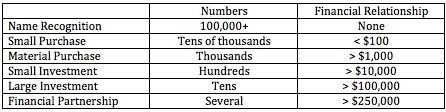
The paradox of financial stability is people that are the most uncomfortable with wealth have the most to gain from improving their relationship with their Financial Funnel.  What’s the funnel?  I drew mine for you above.

The graphic that I produced is an example of comparing reach (people) vs financial relationship (in dollars).  It will change across our lives and well as through the natural ups and downs of our financial situation.

I also think that it would be insightful to add a fourth column that shows where we spend our time on a daily/weekly/annual basis.  Your time is valuable and you increase your return per hour by focusing on the narrow end of your funnel.

Consider where the following fit:

  • Email
  • Facebook, Twitter, YouTube
  • Meetings
  • Social obligations
  • Chat forums
  • Television, video, internet

I often make a list of the key people in my life and make sure that I am responsive to them.  This is very hard to do consistently!  The wide end of the funnel is an easy place to spend low-value reactive time – rather than proactive action at the valuable end.  I could easily spend my entire life on a legacy of chat forum posts and sent mail – while my young family lives downstairs from my home office.

Once in a lifetime…

Life(style) Insurance

Last week I shared ideas about unemployment – while I am not scared of unemployment, being unemployed is really, really inconvenient.  The tips that I offered up are how I minimize the duration of the inconvenience.  I use similar tactics in other areas of my life.

Insurance can appear expensive until something serious happens in your life.  If something serious happens then you want to be focusing on solutions, rather than worrying about details.  Here’s my list of things that are often overlooked by my pals, and peers.

+++

Health Insurance

I use a high deductible policy and pay extra to increase the maximum limit for the policy life.  The plan we are on is $5,000 deductible with $5 million policy limit.  I include the full deductible in my annual budget and that means that any financial surprises are positive.

In most years, we either pay nothing or blow right through the deductible.  Over a lifetime, it would be unusual for a family not to experience large, unexpected, medical payments.  Being surprised is the norm – I know many triathletes that can been caught out by a bike crash.

+++

Liability Protection

Similar to health insurance, it would be unusual for a business not to experience accidents over a long term time horizon.  Accidents can create liabilities and here’s what I do to mitigate:

Operate safely – common sense goes a long way, especially when backed up by appropriate training and written safety policies.  Make an effort to educate your customers about safety procedures.  This isn’t just a CYA exercise – it will result in less accidents and that’s good business.

Professional advice – My approach may be unconventional:

  • List the things could go wrong in your business – think as broadly as possible; 
  • Share that list with an experienced litigation attorney;
  • Disclose your personal/corporate structure to the attorney; and
  • Insure and restructure your operations to address avenues of recovery.

In some cases, you may discover that a certain line of business simply isn’t worth the risk.  I’ve exited a few situations that were great fun but unacceptably run.  By the time the inconvenient truth arrives, it’s too late to exit.  By the way, the same policy works well for speculative bubbles.

As well, insure your clients/employees to protect them from ordinary accidents.  Many professional bodies (USA Triathlon for example) offer protection to members/coaches.  Read the policies and be warned that “for profit” businesses are rarely covered by professional bodies.  I spent quite a bit of time assembling three additional policies for Endurance Corner LLC (D&O, General Liability and Participant Medical).

+++

Death, Disability and Life(style)

At some stage in the future, I’ll be worth more dead than alive – at least financially.  Until that point, I like to self-insure my life.

To protect my family from the effects of an unexpected early exit… I purchased a two-unit income property.  It wouldn’t been all the comfy but Monica could move in and live “free” on the rental income from the other unit.  Living expenses, and my daughters education, would be covered from renting our current house. Not as good as keeping me around but it would reduce the severe inconvenience of my departure.

When making real estate purchases, look for deals that create options for you to live free.  Even better, look for deals that will subsidize your cost of living.  Here’s an example…

Before I had Monica & Lex in my life, my housing set-up in New Zealand was used for lifestyle insurance.  I purchased a large house (5 bedrooms, US$110,000 entry price).  I rented the a few rooms out in the house so my overheads were covered.  Combined with a small coaching business – it was my fallback strategy.  With the mess that we have in many housing markets, similar deals are available today.  

If you didn’t save capital over the last decade to take advantage of today’s opportunities then make changes so you can take advantage tomorrow.  Cycles repeat themselves.  I’ve seen great buying opportunities at least once each decade and we only have to do one good deal, per decade, to have a successful investment career.

Back to life insurance.  For many of us, the worst thing that can happen is permanent disability requiring expensive and on-going medical care.  I haven’t cracked the code on insuring that risk but I do the following to reduce it’s likelihood:

  • Wear a helmet when I ride;
  • Wear a seatbelt when I drive;
  • Don’t drink – and certainly don’t drink & drive; and
  • Don’t speed – people make jokes about my driving speeds.

If you have ideas on the disability insurance front then I’d love to hear them.  It’s a topic that I’ve been considering since I started riding the open roads.

============ 

Follow up Nov 20, 2010: Mark wrote to remind me that the deductible for healthcare should run through an HSA and TR shared that for the self-employed Long-Term Care insurance can be an effective way to insure against unexpected disability.

Being Unemployed

I ended off last week with reference to things-that-scare me.  The thought of being unemployed is often scary, especially against a background of high unemployment in our society.

I’ve been unemployed three times in my adult life:

  • My 20s, transitioning from University to the real world;
  • My 30s, when I decided to take a break from finance; and
  • My 40s, when I took part in the decision to put my employer into bankruptcy.

My most recent experience was the most real.  We had a baby at home and the family’s income went to zero.  At the time, I wasn’t scared but I was stressed and focused.

My periods of unemployment have proven to be transitions between lives.  Across our adult lives, it would be unusual not to transition at least a few times.  I’ve had major changes every decade and four things helped me make the transition:

  • Business Basics
  • Network & Personal Brand
  • Experience Working
  • Capital

Business Basics – understanding the basics of spreadsheets; programming; accounting; finance; market research… I use these most days of my life.  The more you find these intimidating, the greater the gains you’ll receive from improving your fundamentals.  If I had to give you three things to learn: spreadsheets; basic financial accounting and cash flow analysis.

Network – I’m fortunate to know a lot of interesting people.  I also have a blog that enables interesting people to find me.  I spent ten years consistently building my triathlon network before I (really) needed to tap it.  Lots of energy went into connecting with triathletes around the world (my book, articles and emails).  I do it because I enjoy it but it also created an option value which proved extremely valuable.  What’s most interesting to me is my option was in a field that was very distant from my workplace (athletics vs finance; coaching vs capital management).

Personal Brand – all day, every day, we are projecting our personal brand.  It’s a mixture of things we can control (attitude, reliability, integrity) and things we can’t.  The soft-skills of our brand are particularly important and it’s common for intelligent people to undervalue their role in business.  Being polite is smart, not soft.

Experience Working – do you remember when you wrote your first resume?  We’d list out the schools we went to and the job positions that we held.  Totally useless!  What really matters is experience getting stuff done.  Early in your career look for opportunities to get stuff done.  People that can do stuff are valuable!

Capital – Capital offers time.  In late 2008, I gave myself five years to sort out the family’s finances.  If I had been highly leveraged then that would have been impossible.  If you don’t have capital then you can compensate with low personal overheads – both buy you time and time is valuable.

Working on the above when I was employed sure helped when I wasn’t.

Lifestyle Hedging

If all you did was watch TV and read the newspaper then it would be easy to conclude that the main benefit of wealth is stuff.  In fact, people that fail to accumulate wealth often have a preoccupation with acquiring stuff.


In my life, “stuff” works against my goal of maintaining freedom of location and occupation.  I construct my personal strategy to:  


— Maximize freedom

— Protect against things that scare, or can unexpectedly hurt, me

— Play on human idiosyncrasies with regards to rewards


For what follows I’m going to use the word “investment” but what I’m really talking about is a proxy for material amounts of personal energy — it could be a child, a job, a business, a thought you can’t shake, a hobby, a race… ultimately, it all boils down to energy and time.

For now, let’s leave aside ego and envy!

+++

Freedom — My investments exist to support the life I want to lead.  Items that require me to invest large amounts of time, stress, or worry need to be carefully considered.  There are many situations where you could be paid quite well but they aren’t worth your time.  

Ask these questions before you do the deal:

 — how can this deal hurt me;

 — how will I manage this situation;

 — who’s going to monitor this situation.


If the answers point to an impairment of my personal freedom then I won’t invest.  

Remember, what really kills you in a bad deal is all the time (and emotional energy) that you waste trying to sort out a losing situation.  You can earn back the money – you never get back the time!

Fear and Black Swans — collectively, we are poor at estimating the likelihood of adverse events.  We also tend to be blind to unlikely events that would be really bad for us.  A great book that you should read is The Black Swan – Taleb says it very well.

Rewards — lots of little rewards make me happier than single big rewards.  My favorite example is checks in the mail.  I love it – a letter and money!  The psychic value of opening the letter, stamping the check, filling out the deposit slip and riding to the bank… it’s real.

So, when I talk about a Lifestyle Hedge, I’m looking for investments that fit into the above structure.  Collectively, I want my portfolio to maintain my freedom, address my fears, insure against Black Swans and be tilted towards my idiosyncratic reward profile.

Let’s get into a current case study.

+++

The media is all over whether Quantitative Easing will spark inflation or the Great Unwinding will result in Japanese-style deflation.  What to do?

Hopefully, you’ve done your homework from last week.  Start by whipping out your personal financial assessment.

Inflation — how will your essential/discretionary personal expenditure change over the next decade?  

The things that are going to impact me are: my kids & dependents and my personal choices.  Cost of living changes will have some impact but the change in my cost of living will be controlled by my personal choices.  I control my personal inflation rate.

Deflation — typically, deflation is bad for governments, corporations and heavy borrowers.  The media says that deflation is bad for me but… I don’t see it.  Doesn’t scare me (but I’d be terrified if I was highly leveraged).

Given that governments, corporations and heavy borrowers have more say on monetary policy than individuals that rarely spend more than they earn… I think a good burst of inflation is likely.  


The most recent inflationary burst was asset-based (housing, shares, bonds) – we’ve been living in a period of rampant inflation with financial intermediaries leveraging our society to mask its effects. If you think that inflation was under control for the last decade then you weren’t paying attention to your personal financial assessment.

I protect against inflation by:


— Owning my office, easier when you work at home;

— Working for an operating business that caters to high performers; and

— Organizing training camps for people that share my passion for exercise.


I protect against deflation by doing the exact same things and avoiding personal leverage. From an inflation/deflation point of view, my lifestyle is hedged.

I have additional strategies for Things That Scare Me but that’s enough for this week.


Self-Centered Investing – Financial Assessment

A key aspect that is often missing from discussions about valuation is the investor.  Before we can get to valuing an investment, we need to consider what type of investment makes sense for us.

Experts talk about diversification, asset classes, currencies, hedging, inflation, deflation, capital structure… but they rarely talk about you — specifically, your fears, your defensive position and your desired lifestyle.

As well, we tend to have a romantic notion, supported via financial marketing, that investing is designed to make us rich so we can retire to a life a leisure.  

For me, reality is far different

+++ 

Here’s the process I go through to optimize my portfolio structure.  Three types of financial information are required:

#1 – An accurate income statement // clearly lay out the money coming in and the money going out – I like to look forward 12 months and review quarterly to check against actual figures.  

#2 – An accurate balance sheet // lay out all your assets and liabilities – for each of the assets/liabilities note all benefits/costs (financial, time and hassle) in a column beside them.

#3 – Create a cash flow statement that links your income statement with your balance sheet — this will let you understand how you are financing your life. If you are living off borrowings (borrowed time) then best to make that highly visible.

You can find tools for the above with a quick google search.  With my expenses, I write them down as detailed as possible then clump them into three categories: essential, discretionary and luxury.

Ultimately, your expenses and savings goals will drive the amount that you have to work.  Therefore, expense visibility, and control, is an essential step of maintaining your personal freedom.

+++

Now that you have a clear picture of your financial position, consider:

Your Desired Lifestyle – how do you want to live, what’s that going to take // work to convert collecting these experiences into sources of income

Black Swans – unexpected, adverse events (I like to structure my assets to protect myself, and my family) // consider how to hedge these

Macro Trends – what happens to your life if economic trends change (employment, interest rates, inflation, deflation) – focus on mitigating the changes that would impair your quality of life.

I’ll cover my take on these topics next week with a piece on Lifestyle Hedging.

The value in a portfolio comes from peace of mind and the life it enables you to lead.


Finding Winning Investments

Remember that you can have a very successful investment career with a completion rate of less than 1%.  Investing is a strange game in that most of what you work on will never actually happen.  You need a unique personality to cope with that aspect.

In the gaps between deals, your return criteria are tested and you’ll be tempted to dabble just to do something.  Remember the key five from last week and stick with the fundamentals.

When I come across a deal that fits my criteria, there are three questions that I ask myself.

++
#1 – Why sell?
 
What’s the vendor’s motivation and why am I being offered this great deal?  You can not afford to overpay and hope that leveraged asset inflation bails you out – that’s just for professional investors that use other people’s money.

The huge amount of leverage in our society is creating buying opportunities due to people’s need to repay their debts.  Other reasons to sell can be moving cities, relationship breakdown, or change of strategy.  I’ve done deals with all these types of vendors.

When I can’t figure out why I’m being offered a deal – I pause.  

Things that appear to good to be true aren’t as they appear.

++

#2 – Calculate your margin of safety

I’m pretty sure it’s a Warren Buffett saying, “price is what you pay, value is what you get”.  To get me to do a deal, the price needs to be less than the value.  This is mainly because you never get full disclosure and you’ll nearly always end up having to invest more than you expect.

I like to figure out what the value of the asset is an independently as possible.  I also value relative to my current, and future, situation.  When I’m 60, I suspect that I’ll have different needs than when I’m 40.  So I try to take that into consideration.  It’s also why I’m fond of Rule #4 from last week (always be able to exit).

If you don’t have the skills to properly value your deals then wait!  Acquire the skills, learn the fundamentals about valuation and be patient.  Remember that you only have to do a couple of decent deals in your entire life.  Don’t dabble.

++

#3 – What is required for failure?

Most of us do too good of a job convincing ourselves how we’re going to make money.  

Take time and consider what can wipe you out.  Once you have a list of those items then you can perform research to rule them out, insure against them, or accept that they might wipe you out.  Personally, I either rule them out, insure against them, or factor in the cost of mitigation.  

You don’t need to be a genius to figure out what can kill you but you will need to spend some mental effort.  The largest investments that most of us will make in our lives is real estate and a quick google search can give you a list of items to consider.  You can also keep reading my blog as I’ll be laying out the basics for you over the next few months.

On this subject, I recommend Charlie Munger’s book, lots of case studies and practical examples.  Spin the deal, and the world, on it’s head and see what that does to your situation.  

A practical example of inversion is interest rates.  

If you are borrowing significant sums of money that will reset in the next ten years – then what would happen if your cost of borrowing doubled?  What if it tripled?  Quadrupled?  Sounds unlikely?  Have a look at historical interest rates – specifically mortgage and prime rates — you need to scroll down a bit to where you can see the figures around 1980.  

Be sure to leave room for the unexpected as well as saving capital so you’ll be in a position just-in-case the buyer’s market of a lifetime heads our way.  Check out the java chart of the Living Yield Curve and imagine what is going to happen when rates rise to normal levels.

On Capital & The Key Five

When I was in school, they taught me that capital was how a firm chooses to finance itself – two main choices debt or equity.  We learned a lot of different models and theories about the nature of markets and the choices that firms make with regard to their capitalization.  I graduated in 1990; spent a decade in Private Equity; and a further decade in Real Estate investing. The real world is far less tidy than what your finance professor would have you believe.
What about us?  What are the key aspects of capital as they relate to regular folks.  I’m going to outline those and get into more detail in future articles.  I’m going to use my own terminology – like athletics, there is a fair amount of overlap and words used to define different things.  Over time, I’m sure we’ll develop a common language like we did at Endurance Corner.

What is it?
Free Capital is money that you have readily available to make investments — it is available quickly for investment.  What is an investment deserves a separate article – so I’ll save that for later.

Net Worth
Simply put your net worth is your assets less your liabilities.  Because assets are more visible than liabilities, we often make the mistake of assuming people with lots of assets have lots of net worth.  In a crisis, free capital is much more valuable than net worth (also called equity).

Acquiring Capital
You can be the best investor in the world but, if you don’t have any capital to invest… well, you won’t be particularly successful.  So, to create financial stability, the first habit you need is the ability to acquire capital.  The answer is simple, but not easy: always spend less than you earn.

The only time you want to vary that rule is when you make an investment.  

The Key Five on Investments:

  1. Limited in number across our lifetime
  2. Generate a net positive annual return
  3. Preserve capital
  4. Have an ability to sell in all market conditions
  5. Make a positive impact on our life situation

This is the first place where the reality of personal investing differs from human nature and the media.  People will try to convince you that the Key Five don’t apply.  When you hear someone talking like that look for where they make their money.

Ultimately, acquiring capital has to do with not losing capital… the Key Five are essential to remember.  The discipline they impose will rule out many schemes that can get you into trouble.

Some common schemes:

  • Second home – typically cash flow negative annually – therefore a luxury good, not an investment.
  • Cars, bikes, motorized anything – high cost of ownership, depreciating asset – treat as expenses.
  • Gold, commodities – realize that you’re gambling and any positive return is due to chance.
  • Stocks & Bonds – I lack the knowledge and confidence to make a bet large enough to have a material impact on my life.  
Many opportunities fall into the category of tinkering, they won’t make a difference in my life so fail Rule #5 and I don’t materially commit my capital.
To avoid gambling, I need to be honest with myself about what I don’t know as well as my ability to rely on historical information.


#mancamp Day Two Blog – Over 12,000 feet

D2aD2cD2bD2dD2eD2f

Monica suggested that I emphasize photos over text but Petro said that he likes my thoughts.  So I’ll keep rolling with the blogs.

Today was our first really big day of training.  JD suggested that we roll at 6:30am to avoid the road works on Trail Ridge Rd — very good call and we were over 12,000 feet before 9am.  As you’ll see in the photos the views were spectacular.

The pace was solid on the way up the climb and I manage to keep my power average rising from 30-120 minutes on the ride, which isn’t easy when you’re topping out over 12,000 ft.  JD and I worked together really well on the climb (a lot better than BoCO camp when I blew myself up with attacks on Mt Evans).

Petro has decided that we need to sprint for every city limits sign in Colorado — that takes it toll after a while but I did manage to get over 1,000 watts for the Granby sprint.  It was downhill from there for me but I hung on for 2nd on the stage (JD won).

We had a long regroup at the motel then checked out the brand new rec center here in Fraser/Winter Park — big improvement over Snow Mountain Ranch.  JD suggested Monsy 100s (24×100 on various splits) so I ended up with ~3400yds.  We squeezed in the run before the swim.

I had a blog in my head about the why of triathlon for me.  However, I’m pretty beat and Monica told me to keep it short.  So that’s it for today!

g

Ride over Trail Ridge Rd – http://tpks.ws/FHt1

Grand Lake to Winter Park – http://tpks.ws/OljO 

#mancamp Day One Blog – Why?

Aid_stationOriginalsGem_lk_gPetro_gemRmnpRmnp2Rambo

A little bit more about ManCamp — with the strategic review that we’re doing for Endurance Corner, I am getting a clearer idea about what the team and coaches are looking for from EC.  I’ve also been thinking about my role in the business — that’s why I started an personal blog for my non-EC stuff.  We all want EC to be it’s own thing.

I have a good idea shaping up on how I want to adjust my life over the next 12 months (create more freedom) but what I’m not sure of is how much training I really want to do.  So I figured a week, mainly, off the grid with some buddies would let me shake that out.  

Day One was fun and my form is surprisingly good.  All up a little under six hours of training with a lot of quality in there.

++

We have five guys along for the full camp as well as a few day trippers.  We don’t really have a formal structure but we’ve come to some benchmarks that we’re using (3K for a swim, 5 miles for a run, and whatever the ride stage is for the day).

Today’s ride was Boulder to Estes Park via Big Thompson Canyon and Glen Haven.  File is available at this link ( http://tpks.ws/vhzQ ) – Vince, I hit 995w for the Drake City Limits sprint after Petro’s lead out.  The guys told me that I should have hit it a touch harder for 1000w+ but I was worried as the KOM was still 10 miles away.

++

We’ve also decided that we’ll grow the camp slowly so each of the Originals (G, Petro, Doc J, Scot, JD) gets an invite for 2011.  If you invite someone then you’re responsible for them – also the Original needs to come back for the invite to be valid.  At dinner Justin shared a story about a camp where he worked — you had to be invited back as a camper and they mailed you an invite each year with a feather if you could come back.  I think J wants to send feathers out for next year…

++

So the training… 4100 LCM; 100K on the bike and a very hilly five mile run (Lumpy Ridge to Gem Lake) that took us up (and over and down) 8900 ft.  Comfortably 5000+ ft of vertical for the day.

JD said that his bike computer showed we didn’t average 30 km/hr for the ride but my ride showed 29.8 so I’m giving myself the benefit of the doubt.  It was a reasonable effort given a gentle first hour and a 2000 ft net elevation gain for the ride (we are over 7500 ft at our motel tonight).  We had Denny, Taylor and Chris along for DayTripper support – they rode another 100K after dropping us off at Estes.  Alan and Jen are here to help us get through the week — AC raced yesterday so he’s probably at least 36 hours away from hitting the hills in any substantial fashion.

Lots of good memories on this route that we’re using.  Been here with a lot of great friends over the years.

g