
$20 a day

I ended my last article with a question, how long does it take to save $50,000 for a down payment if you save $20 per day and earn 5% per annum on your portfolio?

Remember to change the assumptions and work the answer out by yourself. I have a suggestion at the end if you’re interested in homework.

To ballpark the answer, you could divide the target ($50,000) by the savings rate ($20 per day) and get 2,500 days (50,000 / 20) or about seven years (2,500 / 365 = 6.8).

Throughout this entire series remember that small daily changes can have large long-term effects.

+++

The value of a series of cash flows is tough to calculate by hand but financial calculators and spreadsheets have formulas to help us out. Let’s work through this example:

  • Payment is $20 per day
  • i = 5% per annum

We have a mismatch between the period of the savings (daily) and the return on investment (annual). We need the payment period (daily) to match the investment return period (annual).

The easy way to convert is to divide the annual rate by 365 days to get a daily rate. 5.0% / 365 = 0.014% 

You could go the other way and say that you were saving $7,300 per annum ($20 per day times 365 days) but all of us do better with smaller, frequent targets. $20 day sounds a lot more reasonable than $7,300 per annum – but they are the same!

Side-note: Your finance professor would tell you that, strictly speaking, to get the exact rate you’d need to use the formula [(1+i)^(1/365)] – 1. That equals 0.013% and reflects the compounding effect of interest on your interest across the year. My advice would be keep it simple and divide the annual rate by 365 to get your daily rate. It will be close enough.

Your future target is $50,000 and is called the future value (FV).

You want to calculate how long it will take to get the future value if you save $20 daily. Put differently, how many periods of saving are required to achieve my future value (FV) if I make a payment (PMT) of $20 per period and earn 0.014% per period (i)?

Now we have all the info…

  • PV = $0
  • FV = $50,000
  • PMT = -$20 (notice the negative sign, you are paying out)
  • i = 0.014%

The formula in google docs is =nper(rate,PMT,PV,FV) // and kicks out an answer of 2,150 days. It is easy to be intimidated by these formulas but most software packages have pop-up menus that help you along (nper = tell me the number of periods).

Our original estimate of 2,500 days wasn’t far off but that little bit of interest (0.014% per day) got us to the down payment one year quicker. 

Both the $20 and the 0.014% are an example of how little things can make a big difference over time.

With mortgage rates at a 40-year low, a $50,000 down payment is very useful. In Boulder, it’s now cheaper to own, than to rent – providing you have the down payment and qualify for a low-rate mortgage.

Saving small and frequently creates capital for investment.

+++

If you’re interested in homework then how long will it take to achieve a $75,000 portfolio if I can save $1,000 per month and earn 7.5% per annum on my savings. Bonus points – if your marginal tax rate is 27.5% then how much longer do you have to save to achieve your goal?

+++

Side-note: when I learned all this stuff in the 80s, everybody used 10% as the investment rate assumption. The 70s were a high-inflation period that had a lasting impact on people’s choices. Right now, we’re being skewed by a low-rate, low-inflation environment. I’ll share an inflation case study next week. The impact of high inflation was better understood in the 80s than today.

A Million Dollars of Capital

I made the observation to a friend that a million dollars isn’t a lot of money – she was taken aback and, out of context, my statement certainly sounds flippant. What I should have said was, “the time value of money is poorly understood by most people.”

I’m going to share a few different case studies that, hopefully, will improve your understanding of the relationship between money and time. It is an area where I’ve had a lot of training. Remember that what we think about money can have little basis in reality. Finance is wrapped in mystery, fear and misunderstanding for most of us. Perhaps I can be part of the solution for improving your relationship with money.

Having the tools to sit down and work out financial scenarios gives you an edge and will help prevent costly mistakes. Most people throw their hands up and don’t do the math. Quitting gives finance companies an opening to take advantage of you!

Today’s case study is about my friend’s question on a million dollars – it’s useful not because it is common to receive large sums of cash! It is useful because most everything to do with money happens over time and our brains are lousy at seeing value over time.

To get the most out of this case study, read it then change the assumptions and work the answers out for yourself. The time spent learning financial math pays for itself many times over our lives.

+++ 

To introduce the concept, we return to my conversation with my friend and assume that $1,000,000 dollars has landed on her lap. BOOM!

The present value (PV) of her windfall is $1,000,000.

What’s she’s going to do?

To keep things simple, let’s not get into her specific investment strategy. Let’s merely assume that she expects to earn 5% per annum. A few years back, you could earn that in a savings account. In finance the rate is abbreviated to “i”.

Now we have:

PV = $1,000,000

i = 5%

For the budget forecast, her investment return is assumed to be $1,000,000 * 5% = $50,000 per annum

To celebrate joining the top 1%, our case study plans to make a few small changes in her life:

  • She’s going to increase weekly spending by $300
  • She’s going to lease a car (total cost insurance, fuel, etc) of $1,000 per month
  • She will go on two vacations per annum that cost $5,000

None of these changes would be considered extreme and, in Boulder, they probably wouldn’t even be noticed. A couple people would comment on your car and then it would be forgotten.

In fact, there’s probably a few young adults that get this level of support (annually) from their parents. I’m guessing that their parents didn’t do the math. If you’re the beneficiary then realize that you’re rolling through your inheritance. Use this case study to calculate the family’s capital cost of helping. The number might surprise you. I’ll do a future case study so you can check your math.

Back to the case study…

Adding the spending up, $300 * 52 weeks + $1,000 * 12 months + $5,000 = $32,600 per annum of spending.

$50,000 of investment income and $32,600 of spending – seems totally under control.

We need to factor in taxes. For this case study, let’s assume that her state and federal marginal rate is 30%. That is the rate that she will pay on the extra income she gets.

$50,000 * (1 – .30) = $35,000 (net income) vs $32,600 of spending

So there’s a cushion of $2,400 between investment and spending. That cushion could be added to her portfolio and she would end the year with more capital than she started. Pulling together:

Opening Portfolio = $1,000,000

Investment Return = $50,000

Taxes = -$15,000

Spending = -$32,600

Closing Portfolio = $1,002,400

So what happens over time?

A key change over time is inflation. The cost of her spending is likely to inflate. Also, her baseline is going to reset. In other words, most people find that happiness is dominated by changes, rather than absolute levels. So she might find that she’s tempted to increase spending further to get the positive ‘kick’ that she would have felt in Year One.

Let’s focus on inflation. Rather than work out everything by hand, I made a google doc to do the calculations for me. You can see my worksheet here – you will need to make a copy to tinker with it. I extracted a summary of the first ten years from my sheet:

Cashflow

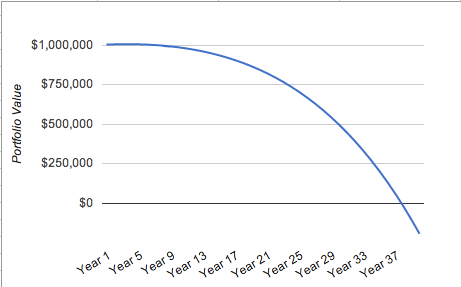
The above example uses an inflation rate of 2.5% per annum. While this rate seems small, it is large enough to start shrinking the portfolio in Year 5. The changes happen very slowly in the first ten years but the compounding effect of inflation (year after year after year) starts to accellerate. Here’s a chart of the portfolio value over time:

Pvchart

The takeaway being that capital will be exhausted in 40 years, not what most would expect from a modest level of spending. She didn’t seem to be “living like a millionaire.”

If you make a copy of my worksheet then you can tinker with the assumptions and you’ll see that the investment return is THE assumption for what’s likely to happen.

When you hear discussions about the discount rate on public pensions, people are talking about the assumed rate of return. This case study is a very simple example of what pension fund managers use to calculate the capital required to meet their obligations. It has a lot of real world uses and trillions of dollars are managed using these principles.

The investment return minus the assumed inflation rate is the real rate of return. In our example, the investment return is 5% and the inflation rate is 2.5% So the real rate of return is 2.5% (5.0 – 2.5). “Real” return is the return after you account for inflation. It is what you really get after you account for changes in prices.

+++

Coming full circle back to my original comment.

$1,000,000 is a lot of money but it buys less than we expect. The ability to drive a nice car, spend $300 per week and go on a couple of vacations per annum is not what we expect from “becoming a millionaire.” If our case study started “living large” then she’d find her capital exhausted very quickly.

The good news is little numbers become big using the same principles that I’ve outlined. I’ll cover an example of that next week and leave you with a problem to solve…

…if I save $20 per day then how long will it take me to save $50,000 for a down payment if I earn 5% per annum on my portfolio?

That’s a lot more realistic than a million dropping in our lap.

A Million Dollars of Education

What first got my attention on education was realizing that a month of my daughter’s pre-school was costing more than a semester of my finance degree at McGill University. Digging a little deeper, the long-term cost of education blew me away when I ran the numbers.

Like most parents, we believe our daughter is a gifted genius and we want the best for her. Since I’m the CFO of my family, I’ve been approached to share my thoughts on private education.

What’s the default option with private education?

  • We want the best for our kids
  • Private education costs more so it must be better
  • I can afford it, today
  • Therefore, let’s start down the path

Duscussing education with parents I see the full range of human misjudgement. We all want our kids to succeed so our most-human tendencies manifest. I won’t give specifics as my sources are good friends. Just ask around and you’ll see what I mean.

Similar to our discussion on housing, let’s run some numbers using actual education costs in 2012 dollars. The first figure is Colorado and the second is California. These are figures for the private track:

  • Pre-school: $6,000/$12,000
  • Elementary/Middle: $15,000/$25,000
  • High School: $25,000/$50,000
  • University: $50,000/$62,500

I did a little research on education inflation and it’s been running at 6% per annum. I created a spreadsheet to look at the cost per kid at a 5% inflation rate, which also matches my forecast portfolio return if I don’t spend that money on education. If you want to play with my assumptions then make a copy of the spreadsheet (file/make a copy).

Depending on where you live, the private track has a future value of $875,000 to $1,375,000 per kid.

Knowing that we won’t be rational when we look at our own kids, think about the brothers and sisters of your peers, spouse’s family and your cousins (that’s your reference group). Would it have been a good investment drop a million bucks (each) on all of their educations?

The questions are worth asking but most of us don’t ask, we default:

  • I love my kids
  • Private is better
  • I can afford today
  • I’ll do it

Stack the education default on top of the housing default and many of my peers are looking at $3-8 million worth of expenditure. That kind of money can make a lasting difference in your city when directed wisely.

Likewise, if you think carefully about your goals (and frame broadly) then you might discover alternative uses for those funds.

…you might enjoy working less and teaching your kids what you know

…you might have superior ethics because you haven’t placed pressure on yourself to earn millions over the next two decades

…you may be a better spouse without all that pressure

…your kids might do better if you back them financially as adults

…if you’re in a weak public school district then your relocation budget might be bigger than you think

A very successful friend of mine always wondered why his father refused to pay for any of his education. My friend got himself through MIT and, as it turned out, didn’t need help from anyone.

Perhaps his Dad ran the numbers.