Upside Strength with Sean Seale – covered season planning, athletic development, personality profiles of elite athletes, individual variation in training response, recovery tactics… and more.
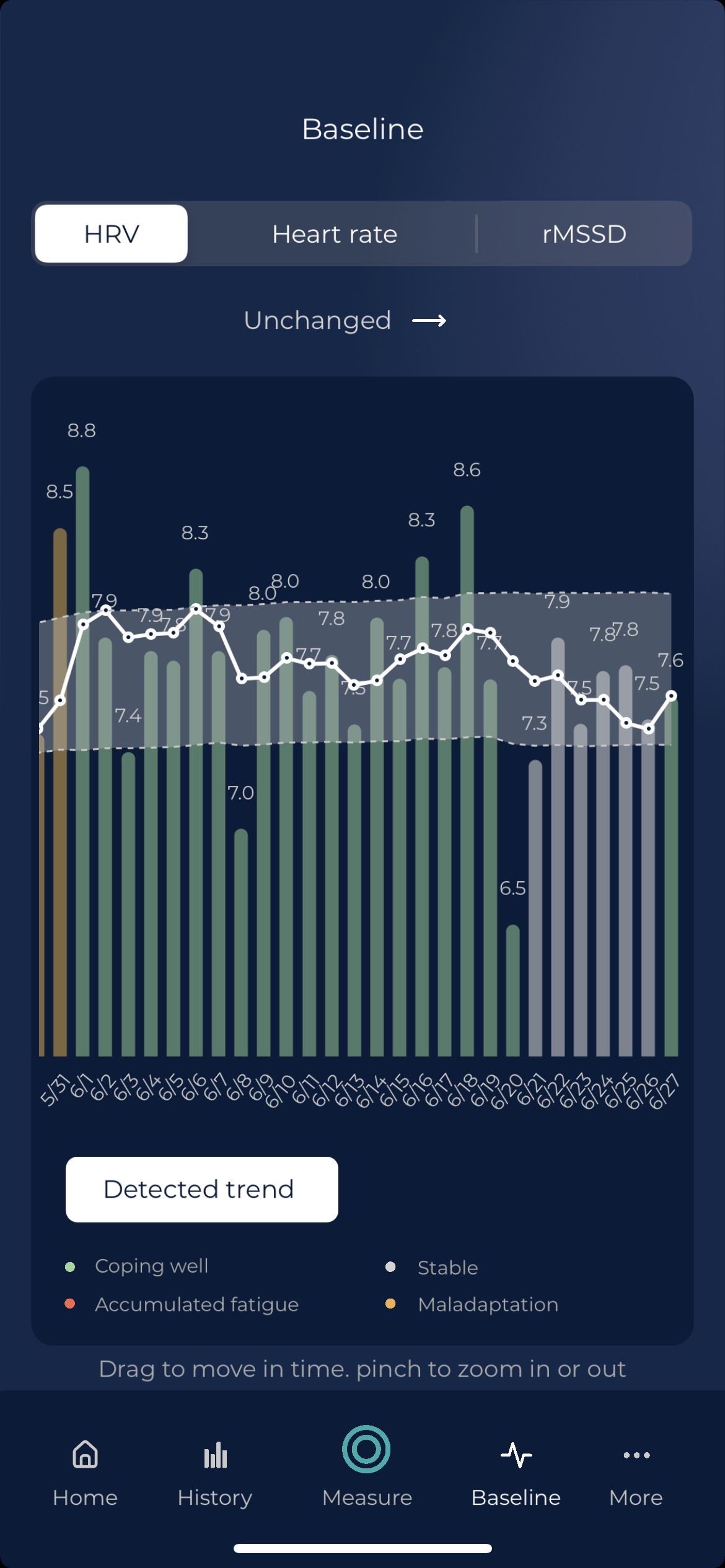
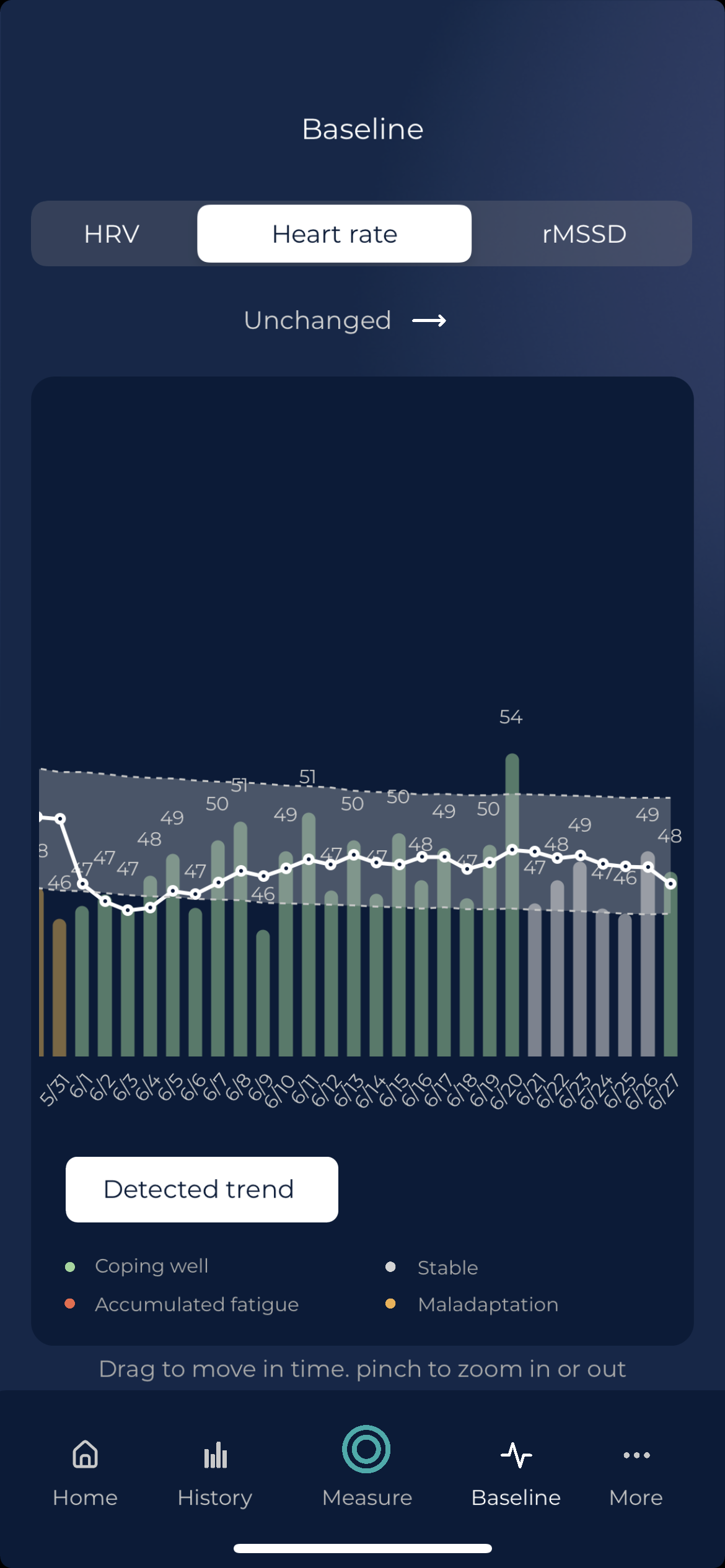
If you pay for the PRO level (HRV app), then normal ranges are calculated and shown with baseline (below).
HRV with trend and normal range – you can pinch to show more daysMorning Resting HR with trend and normal range. COVID recovery was May 25 – June 11
Overnight and Morning are passive metrics – I’m either asleep or lying down. There are good reasons for passive assessments (see Marco’s articles linked at the end).
My advice, start collecting the morning metrics and learn your healthy baseline.
These baseline metrics were a big part of my being able to return to training relatively quickly after catching COVID (link is my day by day return diary).
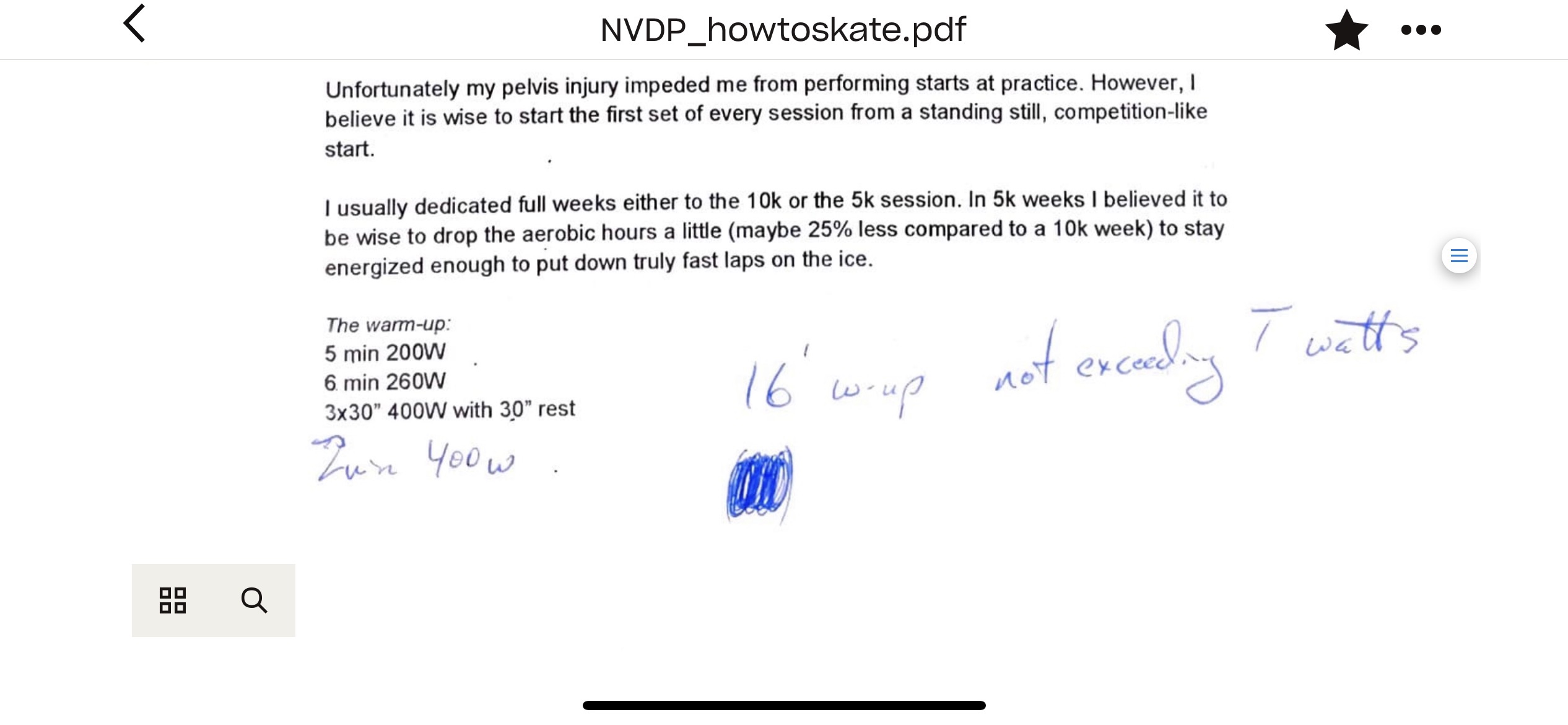
My active readiness test is based on an Olympic Champion’s warm-up routine.
The 400w segments are done only in Threshold & Specific Preparation More in Nils’ Document Linked Below
SWEDISH ACTIVE READINESS TEST (SART)
I have been working with an Olympic Coach, Johan Röjler. Johan had the idea for me to perform a daily assessment based on NVDP’s warm-up.
My bike numbers are FAR below Nils’ level. However, the principles are the same.
Six minute steps
Start at 50% of “fit” Threshold watts
End at 65% of “fit” Threshold watts
Nils did his Threshold at 400 watts. At 53, I picked 300w.
The key isn’t the Threshold number.
What’s important is getting a 50%/65% number that is NOT demanding. You want to have a test you can get through at every level of fitness and fatigue.
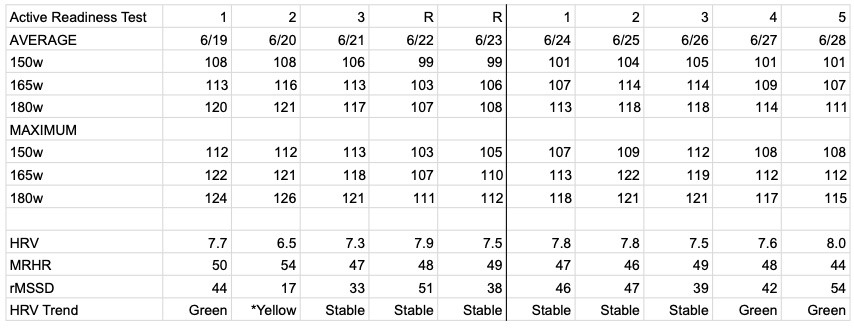
I’m using 3 steps (150w/165w/180w). Power via Favero Assioma Duos and total test takes ~20 minutes. Johan is testing himself with a run-based protocol.
We are looking for heart rate suppression and “jumpiness.”
Day One of the training cycle – we expect HR to be responsive and jumpy following the 2 off days
Across the micro cycle – we expect some HR suppression BUT when there is material suppression, combined with other factors (mood, HRV, MRHR, soreness, energy) we gauge the risk/benefit for loading
The chart shows two cycles – one where I pulled the plug after three days, and the other where I pushed through fatigue (D2 & D4) and finished strong.
The SART is a nice warm up. My total output is 200 kj and no matter how wrecked I am (see June 22 & 23 above) – the test is doable.
With Passive Metrics (HRV, MRHR), the Red & Strong Green days are obvious.
What’s less clear is the signal for the Yellow and Weak Green days. Yellow and Weak Green days are where I make most of my mistakes.
Our hypothesis is fatigue (not-readiness) will manifest via heart rate suppression at submax levels.
By learning my normal response to training, I can decide if I’m in a “better to rest” or “train through” situation. The idea being to back off when my body isn’t in a position to absorb more load.
My readiness metrics, when combined with my training log, let me see the sessions that most kick my butt.
Are those sessions “worth it”?
Could there be a more effective way of loading?
These are judgement calls and part of the art of loading.
Overall => make mistakes visible, and learn from them.

 Feel The Byrn
You must be logged in to post a comment.