Financial Independence

Fear of failure, or looking stupid, holds us back from learning new skills. Whether you are learning to swim, or figuring out the risks with borrowing a certain amount of money, it pays to develop your beginner’s mind.

If you had trouble following this series then get a copy of The Richest Man in Babylon. The book uses stories, rather than case studies, to teach about money. 

+++

When I ask people to define financial independence, most back into their answer based on current spending. Other people have no idea about their spending so they toss out a huge number that they think would enable them to stop working. Both of these methods fall short because the answers they imply are unrealistic.

I started this series by asking you to consider if a million dollars was as much as you thought. To balance that idea, I showed the power of saving $20 per day.

While it seems attractive to have our financial needs covered via passive income (see Four Hour Work Week), the idle rich are poor role models and the active rich are often held in bondage by their spending.

Constantly saving money to have the ability to spend whatever we want at some future date is a lousy goal. First, we might never achieve our goal. Second, it overlooks a much easier, and more valuable, target. Financial independence is about having the ability to choose your location and occupation.

Additionally, financial reserves give you the ability to say yes to what you want to do and, most importantly, make it easier to define what you are unwilling to do. Many wealthy people end up in prison, or dishonored, because they forget that financial wealth makes it easier to say NO to bad ideas

For example:

  • Do I work in a team that shares my personal values?
  • Should I keep my mouth shut when senior management break the law?
  • Should I lie and cheat the bank, tax man, shareholders or government?
  • Should I invest in companies that sell products that hurt my fellow citizens?
  • Should I sell a product that I know is not in the customer’s best interest?

I’ve had to make decisions on all of the above. These choices cost me (a lot of) money in the short term. However, my choices helped maintain my freedom, and honor, over the long term.

When I think back, a few of my ethical decisions appear irrational based on the economics that I learned in school. Perhaps we undervalue self-respect, or fail to capture the rapidly diminishing returns beyond our basic needs. Perhaps there is a value, of freedom, that we’re not capturing in traditional economic analysis.

A reserve fund, and a mantra of being willing to make less, changed my ability to stand for what I believe in. Optimizing for self-respect is easier with the reserves to sustain unemployment! I’ve chosen unemployment more than once. 

If you haven’t created financial freedom for yourself then set a small daily goal and get started. Make time for the financial education of your kids and spouse. In teaching others, you will remind yourself of the basics:

  • Spend less than you earn
  • Protect core capital
  • Be wary of leverage
  • You only need to achieve financial security once
  • Wealth is about freedom, not money

These topics are poorly understood and largely ignored.

Start small and stick with it.


Mortgage Debt As Inflation Insurance

If you’re under 40 years old, and live in the West, then the only world you’ve ever known is one of declining interest rates and reducing inflation expectations. In this world, inflation happens in textbooks and far away places. Last week, I tried to show that it wasn’t always so.

I want to share a case study about how you can use mortgage debt to provide inflation insurance. While I am very cautious with using leverage, mortgage rates are at a level where it made tremendous financial sense for my family to take advantage of the opportunity I’ll outline.

The numbers that follow are based on a deal that I did last month. You can find my workings in my Financial Education spreadsheet.

Inflation_insurance

What I’ve done for this example is adjust the numbers from a December house purchase to reflect actual values per $100,000. These numbers are for Boulder, Colorado so you’d need to crosscheck for your own geography.

I assume a conservative debt:equity ratio of 50%. You might be able to borrow more but the interest rate that you’ll pay might increase.

Our loan provider gives us a single payment for the mortgage, taxes and insurance. 2/3rds of that amount relates directly to the mortgage and is fixed for 30 years. 1/3rd of that amount, as well as 100% of the other ownership costs, are subject to inflation. You’ll find a checklist for the costs of ownership on Page 55 of my book.

Using the scenario from last week, I imagine a decade of mild inflation (2.5% per annum) followed by five years of historically high inflation (7.5% per annum). This increases prices by 84% over 15 years.

Currently, for the type of property that we bought, the cost to rent is similar to the cost to own – about $300 per month per $100,000 of capital value.

What happens if prices rise by 84%?

  • My cost to rent is likely to increase by inflation and rises to $544 per month.
  • My mortgage payment is fixed so inflation only applies to half of my cost of ownership, which we assume rises by 84%. This means that my future cost to own is $424 per month.

In an inflationary environment, borrowers of low-cost fixed rate debt benefit relative to: (a) people that don’t own assets (the poor); and (b) people that aren’t leveraged (debt-free prudent citizens). What concerns me is the largest borrower of low-cost fixed rate debt is my government.

In an environment where public and private debt levels are high, inflation is a politically painless way to reduce the real value of debt. It is an “easy way out” for elected officials (and overleveraged companies/individuals) to deal with high levels of debt.

I have no idea if we’re going to have high inflation. However, if we experience high inflation, then it is valuable to my family to have a strategy where we can stay put with a payment that is lower than our cost to rent.

Additionally, even with moderate borrowing (50:50), the case study projects that the value of our home equity grows at 7.7% versus inflation at 4.1% per annum.

30 years from now, when I’m 74 years old, we will have a debt-free asset. The family will have the option to use this asset to take care of mom/dad in their senior years. If my wife and I pay down this loan over our working life then we remove end-of-life financial pressure on our family. 

The house we bought was the smallest that met our requirements in the one of the best neighborhoods in our city. You will be tempted to size up in a secondary location – this is a mistake. Choose location first then get the smallest place that meets your needs.

Convenience is my #1 criteria for “best.”

+++

Other Considerations

This house is well located – I suspect that real economic growth in Boulder will be higher than the national average – real economic growth is a key driver for local property values.

Make sure that you get your cost of ownership calculations correct – there are many hidden costs of ownership that I cover in my book.

Inflation might not happen – make sure you are comfortable with low, and no, inflation scenarios (prices could even fall).

Make sure you understand what it would take for you to be unable to service your loan. I’ve been unemployed once per decade in my adult life.

Variable debt, especially loans that reset or are linked to the Prime Rate, can bite you in the butt. The 30-year fixed rate loan, effectively offered by the US Government, is an essential part of this case study. The inflation insurance comes from the fixed-rate loan.

+++

Final Notes

The only thing I know for sure is the future will turn out differently than this projection. It will be fun to revisit this post in 15 years!

Prediction is not the purpose of running scenarios. The purpose of looking at alternative outcomes is to provide information so you can ensure that you are comfortable with any outcome.

One of the best decisions I made in my 20s was focusing on my career and maintaining complete geographical flexibility by renting. This allowed rapid career progression. Even in a rapidly rising market, I “made” much more money by excelling at work, than I would have done with real estate ownership.

Understanding Inflation

I’ll kick off this piece with some charts. The first one is historical inflation in the US, UK, Japan, Germany and France (1950-1994).

Inflationchart

The exact numbers aren’t important – what catches my eye is two periods (early 50s & mid-70s) where inflation was at, or over, 7.5% per annum for a few years. To see why this matters, let’s do a case study.

You have $1,000 stashed in your mattress (or yielding close to 0% in a bank account). Across the year, prices go up by 2.5%. With the gradual increase in prices, how does the effective value of your money change over time?

I view inflation like a negative interest rate. Instead of earning money across the year, you “lose” money because your purchasing power goes down.

In our example, $1,000 on January 1st would buy the equivalent of $975.61 on December 31st.

$1,000 divided by (1 + inflation rate)

You can’t buy as much a year later because prices went up, and you didn’t earn anything on your money.

To be able to buy the same amount of stuff, you would need an after tax return of 2.5%. When your investment return is equal to the inflation rate, you stay neutral. In our example, $1,000 times (1+0.25) = $1,025 is required to stay neutral on December 31st.

Real Return = After Tax Return minus Inflation Rate

Most people will feel happy when $1,000 goes to $1,025 over a year. However, in our example, you haven’t moved forward. Your return has let you stay in the same place.

Right now, the return on low-risk assets is small and the inflation rate is small. So parking your money in low-risk / low-return assets has little cost to your purchasing power. However, doing this for many years can be a poor investment strategy. Inflation hurts consumers slowly and, aside from the price of gas, is largely hidden from our collective consciousness.

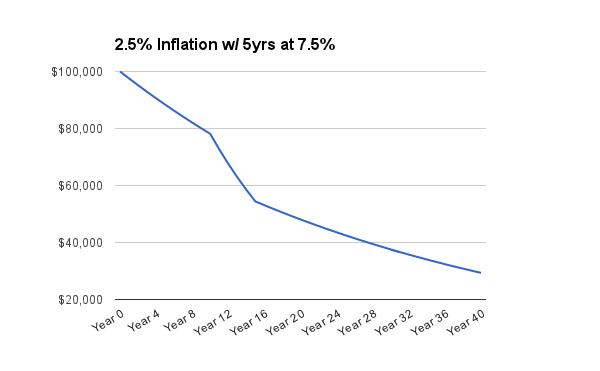
Consider the chart that follows – it assumes a baseline inflation rate of 2.5% per annum and a five-year block where inflation jumps to 7.5%.

Mattressmoney

The chart shows the purchasing power of $100,000 over time. I used $100,000 because that’s the target that I’m going encourage my kids to achieve by the time they’re 30. It’s do-able if they save $20 per day from the time they are 18.

When my balance sheet was largely low-risk, low-return cash equivalent assets, the chart (above) was on my mind. The steep drop in purchasing power due to a five-year period of higher than average inflation would hurt my family’s purchasing power. With extremely low interest rates and rapid Central Bank money creation, I thought (incorrectly) that significant inflation was right around the corner.

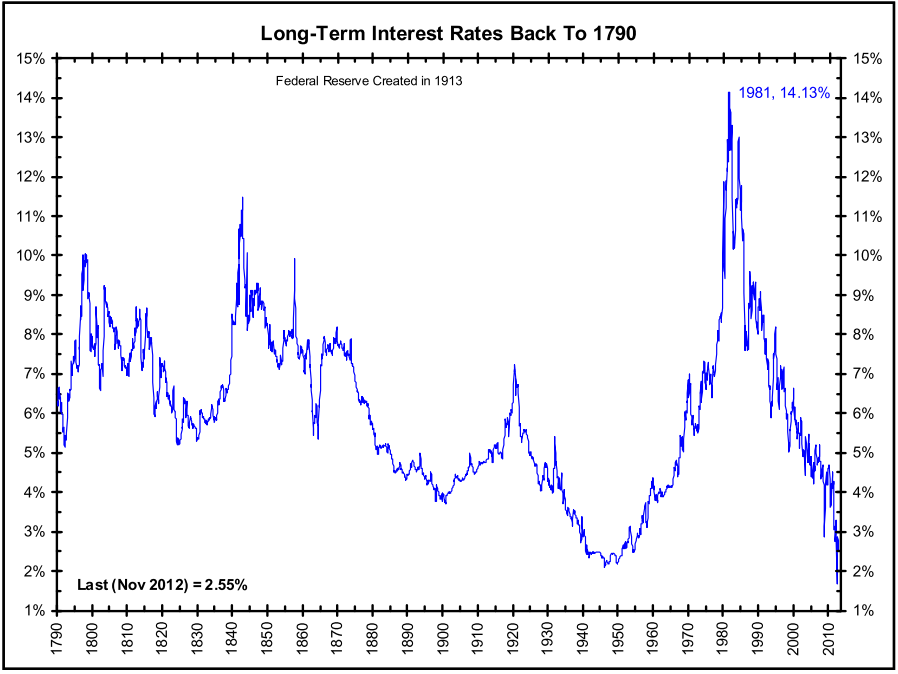
How low are today’s rates? The chart below (posted yesterday by Ritholtz’s blog) gives an idea. Note that the chart goes back to 1790.

Long-term-rates

In 2009/2010, I made a decision to shift into real estate. The market was falling and debt finance wasn’t available. For me, it was the perfect time to buy and I expected Boulder real estate to hold its real purchasing power. In other words, I expected the long-term value of my investment to link closely to the inflation rate. I wasn’t trying to get rich, in a very uncertain time, I wanted an investment that was likely to hold purchasing power. We hear this argument about gold but gold lacks many of the benefits of residential real estate. For an explanation of long-term real estate valuation see Shiller – Irrational Exuberance.

For what it’s worth, an alternative investment that I considered was buying two large-cap stocks (GE/WMT) with attractive dividend yields. I wasn’t able to achieve my target entry price on the stocks so missed that window.

In addition to an expectation that real estate would hold its real purchasing power, the net yield on real estate is attractive if interest rates fall to very low levels. Real estate offers some income protection against prolonged very low inflation and even lower interest rates. I didn’t expect rates to fall as far as they did but considered “what if.”

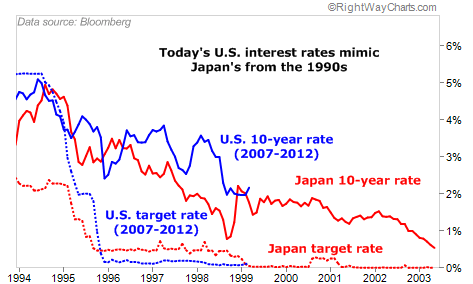
Here’s a chart that plots US rates against the post-bubble history in Japan:

Japan_us_rates

The precise numbers aren’t important. What’s useful is to consider a scenario where low-risk assets have yields under 1% for five, or more, years. What type of investments make sense in that environment? For me, high-quality real estate makes sense. There’s a substantial section in my latest book about real estate.

Other investments that make sense are my kids 529 college accounts and low-cost index funds. The 529 program that we use is has a 0.46% expense ratio and is tax-free, or tax-deferred, depending on use of funds. In 2012, I started small, weekly investments in Vanguard funds for my kids. With Vanguard, the index products (VTSAX/VTIAX) have expense ratios of 0.06% and 0.18% respectively. I’ve only used the US fund so far but am considering adding international.

The index funds have yields that are lower than what I earn on real estate but they are far easier (and less costly) to sell. 

My point: inflation can be a risk, or a benefit, to your family finances. When thinking about portfolio strategy, consider how changes in inflation, and interest rates, will impact your life. Be comfortable with every scenario and remember that we are in a highly unusual situation.

Next week I’ll share a case study of using a mortgage to protect your family from unexpected inflation. I think it’s a much more practical strategy than speculating in commodities, like gold.


Live Long and Prosper

Getting this book out is a form of life insurance for my kids. While I hope I’m around to teach them, ideally by example, there are no guaranties.

The book isn’t perfect but will point them in the right direction. Hopefully, I’ll get a chance to improve over the years to come.

You can download for free here.

All my best for a successful 2013.

gordo


This Is 44

Earlier this month, my grandmother turned 88 which, as a Chinese friend will tell you, is a far more auspicious number than 44. That said, 44 isn’t all that bad.

44 is further than I ever considered in my teens, 20s and 30s – it’s a bit of a shock to arrive, which lets me know that my 50s are going to be here before long. With that in mind, I’ve started reaching out to my smart pals, already in their 50s, to hear their advice. I’ll share their best stuff as I gather it.

At the end of 2011, I realized that it would be possible for me to spend another 20 years living in my own personal Groundhog Day – winning agegroup athletic titles; working at my coaching business; and going on extremely pleasant vacations with my wife.

My blog post on A Life’s Work shared the questions that I asked myself across the year and I’ve been brainstorming ideas for the next phase of my life. I’m fortunate to have world class Universities in Boulder and have been considering taking advantage of those communities.

What follows is an end of year braindump. These articles are my historical record to see how I do with forecasting. 

Health – I feel better than when I was 39/40 and seeking to hang on to elite level fitness. I can remember being sore, tired and exhausted most of those years. The biggest surprise physically is being happy with a level of exercise that’s half of what I previously considered “maintenance.” Many of my peers still continue to “go big” – if they are reading then consider what you might do if your desire for physical expression moderates. You’re going to have a lot of time – unless you replace sport with children!

Family – after my divorce (early 30s), I was openly hostile to the concept of marriage and spent five years completely self-absorbed. I could say that I worked on my suitability to be a spouse but I’m not sure. Either way, I’m glad I gave marriage another chance. My wife and kids have transformed my life.

Something that I failed to anticipate, but heard indirectly from my friends, was how much I would be willing to change for my family. Parenting is filled with frequent moments of misery but so was elite sport! My athletic life was completely focused on convincing myself that doing-what-it-takes was more satisfying than short-term gratification. Great prep for fatherhood.

Business – Four years after the Great Recession of 2008/2009, I’m bothered by a persistent lack of ethics in peers, sport and finance. However, I have the education of my kids to fall back on and human drama provides motivation to remain vigilant with myself.

Finance – I completely missed how low interest rates would go. I think about the impact of a big burst of inflation but wonder if we will follow the post-bubble experience of Japan. We bought a house in December and took out a mortgage (3.25% 30-year fixed) to provide hedging for a burst of inflation. More on that in January. 

Education – Last week, I completed the draft of my next book. I’ll publish on Monday and you can download from this site. In reviewing the book (largely written in November 2011), I realized how much I’ve learned in the last year: mountain biking, family management, babies & toddlers, and international law. Even in my 40s, I can improve my human capital.

Self vs Family – there’s been a shift from optimizing for myself to optimizing for my family. If I had to project into my 60s then I expect my circle will continue expand beyond my relatives. I’d like to improve my participation in community as that’s a practical way to contribute to my kids.

Physical – my calf’s been jacked for a few months, my back is often tight, my eyesight is slowly fading but I can still do neat stuff in nature. A key mistake in 2012 was stopping running. 20 minutes every other day would have saved me a lot of hassle.

An important friend, Henry Simon, passed in 2011 and lived by the motto – Never Stop. It’s been 20 months since Henry died. Wow, that went by quick.

Future – I’ve learned a lot from watching older generations and asking them for advice. Key lessons for 2012:

  • live near your kids
  • give kids space, let them fail and insulate yourself from their failures
  • to keep relationships strong, support the goals of others
  • maintain independence as long as you can
  • plan end of life care & legals far earlier than you think you’ll need

My marriage brings me satisfaction every single day. Three things that Monica brings me: kindness, a shared sense of humor and a desire to be a better man.

I try to live the life that I want for my children.

$75,000 Question

A quick post to update with the answer to last Thursday’s question:

How long will it take to achieve a $75,000 portfolio if I can save $1,000 per month and earn 7.5% per annum on my savings. Bonus points – if your marginal tax rate is 27.5% then how much longer do you have to save to achieve your goal?

  • Future Value = $75,000
  • PMT = $1,000 per month
  • rate = 7.5% per annum or 0.625% per month (7.5 / 12)

Answer is 5 years and 2 months – you can find my workings in the google doc that I’ve created for this series.

+++

To calculate the bonus answer a simple solution is to “tax” the investment return using 73.5% (1 – tax rate) to get an annual rate of 5.4375% and a monthly rate of 0.453125%.

This extends the time required to achieve $75,000 by about three months.

$20 a day

I ended my last article with a question, how long does it take to save $50,000 for a down payment if you save $20 per day and earn 5% per annum on your portfolio?

Remember to change the assumptions and work the answer out by yourself. I have a suggestion at the end if you’re interested in homework.

To ballpark the answer, you could divide the target ($50,000) by the savings rate ($20 per day) and get 2,500 days (50,000 / 20) or about seven years (2,500 / 365 = 6.8).

Throughout this entire series remember that small daily changes can have large long-term effects.

+++

The value of a series of cash flows is tough to calculate by hand but financial calculators and spreadsheets have formulas to help us out. Let’s work through this example:

  • Payment is $20 per day
  • i = 5% per annum

We have a mismatch between the period of the savings (daily) and the return on investment (annual). We need the payment period (daily) to match the investment return period (annual).

The easy way to convert is to divide the annual rate by 365 days to get a daily rate. 5.0% / 365 = 0.014% 

You could go the other way and say that you were saving $7,300 per annum ($20 per day times 365 days) but all of us do better with smaller, frequent targets. $20 day sounds a lot more reasonable than $7,300 per annum – but they are the same!

Side-note: Your finance professor would tell you that, strictly speaking, to get the exact rate you’d need to use the formula [(1+i)^(1/365)] – 1. That equals 0.013% and reflects the compounding effect of interest on your interest across the year. My advice would be keep it simple and divide the annual rate by 365 to get your daily rate. It will be close enough.

Your future target is $50,000 and is called the future value (FV).

You want to calculate how long it will take to get the future value if you save $20 daily. Put differently, how many periods of saving are required to achieve my future value (FV) if I make a payment (PMT) of $20 per period and earn 0.014% per period (i)?

Now we have all the info…

  • PV = $0
  • FV = $50,000
  • PMT = -$20 (notice the negative sign, you are paying out)
  • i = 0.014%

The formula in google docs is =nper(rate,PMT,PV,FV) // and kicks out an answer of 2,150 days. It is easy to be intimidated by these formulas but most software packages have pop-up menus that help you along (nper = tell me the number of periods).

Our original estimate of 2,500 days wasn’t far off but that little bit of interest (0.014% per day) got us to the down payment one year quicker. 

Both the $20 and the 0.014% are an example of how little things can make a big difference over time.

With mortgage rates at a 40-year low, a $50,000 down payment is very useful. In Boulder, it’s now cheaper to own, than to rent – providing you have the down payment and qualify for a low-rate mortgage.

Saving small and frequently creates capital for investment.

+++

If you’re interested in homework then how long will it take to achieve a $75,000 portfolio if I can save $1,000 per month and earn 7.5% per annum on my savings. Bonus points – if your marginal tax rate is 27.5% then how much longer do you have to save to achieve your goal?

+++

Side-note: when I learned all this stuff in the 80s, everybody used 10% as the investment rate assumption. The 70s were a high-inflation period that had a lasting impact on people’s choices. Right now, we’re being skewed by a low-rate, low-inflation environment. I’ll share an inflation case study next week. The impact of high inflation was better understood in the 80s than today.

A Million Dollars of Capital

I made the observation to a friend that a million dollars isn’t a lot of money – she was taken aback and, out of context, my statement certainly sounds flippant. What I should have said was, “the time value of money is poorly understood by most people.”

I’m going to share a few different case studies that, hopefully, will improve your understanding of the relationship between money and time. It is an area where I’ve had a lot of training. Remember that what we think about money can have little basis in reality. Finance is wrapped in mystery, fear and misunderstanding for most of us. Perhaps I can be part of the solution for improving your relationship with money.

Having the tools to sit down and work out financial scenarios gives you an edge and will help prevent costly mistakes. Most people throw their hands up and don’t do the math. Quitting gives finance companies an opening to take advantage of you!

Today’s case study is about my friend’s question on a million dollars – it’s useful not because it is common to receive large sums of cash! It is useful because most everything to do with money happens over time and our brains are lousy at seeing value over time.

To get the most out of this case study, read it then change the assumptions and work the answers out for yourself. The time spent learning financial math pays for itself many times over our lives.

+++ 

To introduce the concept, we return to my conversation with my friend and assume that $1,000,000 dollars has landed on her lap. BOOM!

The present value (PV) of her windfall is $1,000,000.

What’s she’s going to do?

To keep things simple, let’s not get into her specific investment strategy. Let’s merely assume that she expects to earn 5% per annum. A few years back, you could earn that in a savings account. In finance the rate is abbreviated to “i”.

Now we have:

PV = $1,000,000

i = 5%

For the budget forecast, her investment return is assumed to be $1,000,000 * 5% = $50,000 per annum

To celebrate joining the top 1%, our case study plans to make a few small changes in her life:

  • She’s going to increase weekly spending by $300
  • She’s going to lease a car (total cost insurance, fuel, etc) of $1,000 per month
  • She will go on two vacations per annum that cost $5,000

None of these changes would be considered extreme and, in Boulder, they probably wouldn’t even be noticed. A couple people would comment on your car and then it would be forgotten.

In fact, there’s probably a few young adults that get this level of support (annually) from their parents. I’m guessing that their parents didn’t do the math. If you’re the beneficiary then realize that you’re rolling through your inheritance. Use this case study to calculate the family’s capital cost of helping. The number might surprise you. I’ll do a future case study so you can check your math.

Back to the case study…

Adding the spending up, $300 * 52 weeks + $1,000 * 12 months + $5,000 = $32,600 per annum of spending.

$50,000 of investment income and $32,600 of spending – seems totally under control.

We need to factor in taxes. For this case study, let’s assume that her state and federal marginal rate is 30%. That is the rate that she will pay on the extra income she gets.

$50,000 * (1 – .30) = $35,000 (net income) vs $32,600 of spending

So there’s a cushion of $2,400 between investment and spending. That cushion could be added to her portfolio and she would end the year with more capital than she started. Pulling together:

Opening Portfolio = $1,000,000

Investment Return = $50,000

Taxes = -$15,000

Spending = -$32,600

Closing Portfolio = $1,002,400

So what happens over time?

A key change over time is inflation. The cost of her spending is likely to inflate. Also, her baseline is going to reset. In other words, most people find that happiness is dominated by changes, rather than absolute levels. So she might find that she’s tempted to increase spending further to get the positive ‘kick’ that she would have felt in Year One.

Let’s focus on inflation. Rather than work out everything by hand, I made a google doc to do the calculations for me. You can see my worksheet here – you will need to make a copy to tinker with it. I extracted a summary of the first ten years from my sheet:

Cashflow

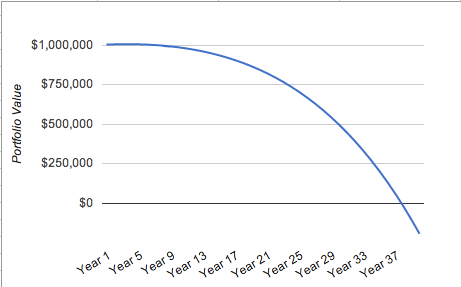
The above example uses an inflation rate of 2.5% per annum. While this rate seems small, it is large enough to start shrinking the portfolio in Year 5. The changes happen very slowly in the first ten years but the compounding effect of inflation (year after year after year) starts to accellerate. Here’s a chart of the portfolio value over time:

Pvchart

The takeaway being that capital will be exhausted in 40 years, not what most would expect from a modest level of spending. She didn’t seem to be “living like a millionaire.”

If you make a copy of my worksheet then you can tinker with the assumptions and you’ll see that the investment return is THE assumption for what’s likely to happen.

When you hear discussions about the discount rate on public pensions, people are talking about the assumed rate of return. This case study is a very simple example of what pension fund managers use to calculate the capital required to meet their obligations. It has a lot of real world uses and trillions of dollars are managed using these principles.

The investment return minus the assumed inflation rate is the real rate of return. In our example, the investment return is 5% and the inflation rate is 2.5% So the real rate of return is 2.5% (5.0 – 2.5). “Real” return is the return after you account for inflation. It is what you really get after you account for changes in prices.

+++

Coming full circle back to my original comment.

$1,000,000 is a lot of money but it buys less than we expect. The ability to drive a nice car, spend $300 per week and go on a couple of vacations per annum is not what we expect from “becoming a millionaire.” If our case study started “living large” then she’d find her capital exhausted very quickly.

The good news is little numbers become big using the same principles that I’ve outlined. I’ll cover an example of that next week and leave you with a problem to solve…

…if I save $20 per day then how long will it take me to save $50,000 for a down payment if I earn 5% per annum on my portfolio?

That’s a lot more realistic than a million dropping in our lap.

Money in Families

Recently I finished a book called Preparing Heirs (URL) that estimated the chance of a successful generational transition at 30%, success being defined as a transition of the family’s total capital (family values, human capital and financial wealth). 


After I read the book, I drew as much of my family tree as I could remember and discussed with my key family. They helped me flesh out the tree and reminded me of various successes, and failures, that I’d forgotten. 


When I ran the numbers, I saw that our family is below average for success with transitions, we usually get wiped out every third generation (all but once). One bright spot is a four generation streak down one side of the family. Interestingly, in our family education/opportunity are much more important than financial support.


Back to my observation about $1 million. With a 30% success rate, what’s left for your grandkids, on average?


$1 million lands on your lap

– 70% of that goes (on average) by the time you die

– So $300,000 goes to your kids

– 70% of that goes (on average) by the time they die

– So $90,000 goes to your grandkids


My family is well under the above but nobody is suffering, or complaining. Goes to show that there’s a lot more to human capital than financial capital.


So $1 million IS a lot of money for the lucky recipient (or hard working saver) but it IS NOT a lot of money for most families. Human nature, and my family experience, shows that the capital will be gone in fifty years.


Why is that?


If I spend an extra $25 per day then how long will my $1 million dollars last if my after tax return on investment is 3.75%?


ANSWER


BOOM


Your kids won’t even get the $300,000.

Keeping It Real

My various careers have provided insight into the men and women that have significant influence over our societies (our leaders, our elites, and the very wealthy). Over time, contemplating their lives has made me grateful, rather than envious.

If I could choose one trait that protects me from envy, it is a desire for freedom over consumption. My key family finds living beyond our means painful. These feelings run deep and across the full socioeconomic spectrum we have in our family tree.

Separate from being biased towards “free and frugal”, I’ve been careful to set my life up with daily “wins” 

  • in my school days I had favorite subjects
  • in my early business career I worked with passion on project after project
  • as an elite athlete each training session completed was a small victory
  • as a father, there is pride from creating a life where I work towards being a world-class parent

Arriving at my mid-40s – I see how one can create a deep satisfaction from the basic goodness of one’s life. Service to my marriage, my kids, my family, my athletic team… is deeply satisfying.

It wasn’t always so.

+++

In 2006, I was advising a friend who was having trouble fitting his triathlon training into a busy life. He was a partner of his firm and had a long commute most days. The solution seemed obvious, I recommended that he hire a driver. The driver would enable him to start his work day when he got in the car, rather than when he arrived at the office. I figured that it was worth at least 9 hours per week and I recommended that he add that time to his triathlon training.

A couple months later, he got back to me and said that he had applied my advice with one slight adjustment…

he was taking the bus!

He thanked me for getting him thinking. His reply got me thinking… …somewhere between 28 and 38, I had lost my real-world perspective.

When I started my career, I was the most efficient employee in the firm.

How did I lose my way?

+++

The Great Recession of 2008 was extremely useful to me as it highlighted (somewhat embarrassing) inefficiencies about the way I was living. 

I spent twenty years in the financial services industry. A polite way of describing our role to society is that we are excellent at extracting the value we create for ourselves. A less charitable observation is that chronically overpaying people detaches them from reality. A recent US election provided numerous examples of this point.

Like my friend, who takes the bus, the recession provided me with a wake-up call.

+++

At four my daughter is showing encouraging signs with regard to understanding what I’m writing about this week. 

She has developed a habit of picking up spare change and sticking in her piggy bank (which is actually a bunny bank). Putting “money in the bunny” makes her, and me, happy. 

The other skill is saving ice cream “for next time” – when I eat ice cream with her, we can make a single pint last over a week vs 12 minutes when I’m left alone!

Happiness from saving and a desire for delayed gratification. These two points reduced the scale, and negative impact, of the mistakes I made in my 20s and 30s.

+++

In Boulder, we live in a bubble (fitness fanatics), inside a bubble (Boulder socioeconomic level), inside a bubble (Colorado’s limited diversity), inside a bubble (U. S. A. – U. S. A.).

Our life is separate from the reality of the rest the planet – you have to experience the Boulder Bubble to appreciate just how different it is. One of my local role models, makes frequent efforts to get his kids (and himself) out of the bubble. I’m starting to make these efforts with my oldest daughter.

Fortunately, we don’t have to leave the continent for a dose of reality, we merely have to drive to the mountains. We don’t go to Vail (the 1%), or Aspen (the 0.001%). We’ve been going to Leadville – real people, working daily to take care of their families. Some making ends meet, some struggling and some not making it. By way of example, there’s double the level of foreclosures (and far less homes) in Leadville than Boulder.

I’m not sure what they think of us – the guy that’s always wearing bike clothes and his hyperactive little daughter. The locals are welcoming and Lex loves them as much as I do. In fact, she’s working on getting all the guys (coffee shop, bike shop, pizza place) to know her by name.

I’ve been trying to figure out why I love Leadville:

  • sits high in an open valley 
  • looks down on water
  • trees, but not dense forest
  • bright light and blue sky, backed by mountains
  • the thin air making me a bit high
  • a traditional, conservative population
  • the fact that I’m so busy with Lex that I severely limit my time online
  • a simple routine with a kid that’s giving me hugs all the time

I think about the perceived drawbacks (guns, violence and drunks). Looking deeply, I realize that conditioning is creeping in. We have all those hazards in Boulder and a lot more sexual crime.

In Leadville, our routine is swimming, picnics, pizza, playgrounds and riding. We spend all day together. In some ways it is far from life in the bubble (Buddhist preschool, yoga, swim team, babysitters and gymnastics). In other ways, it is exactly the same – eat, sleep, play, love.

An older buddy, with teenage kids, shared a central truth about family – kids want to spend time, not money. 

I think that a more accurate description would be that his kids want to spend his time, not his money. My pal has done an excellent job of passing along a love of the outdoors to his children (while living humbly in one of the wealthiest zip codes in the world).

I’m unlikely to override the influences of Boulder peers, the media and a toxic popular culture towards young women. However, I can lead by example and share alternatives to what may seem to be a fixed reality.

(Trying to) keep it real.