Am I Ready?

The video below is five minutes long and covers Ric’s answer to the title of this week’s blog.

My most recent read was Tuesdays with Morrie, the story of a man dying of ALS.  The book is a case study of “dying with class”, which is an effective way of dealing with a slow death.  If you enjoyed The Last Lecture then you’ll enjoy the book.

Reflecting on the book, I was left with three strategies to apply in my life.

Start each day by asking “Am I Ready?”  To me, the question means… if today turned out to be my last day then do I have things sorted out?  At times, I have a powerful desire to write more and more to “help my kids.” However, looking at my batting average at work, and considering the hundreds of articles on the internet, I have done enough.  The main thing would be leaving them proof that I loved them.

That’s Steve Larsen with his kids. I bet they treasure that photo.  We take a lot of photos.

“Is this how I want to be remembered?” is a question that comes to me during the day.  The question used to imply positioning my personal brand and worrying about my image.  Focusing on image can serve us well; it creates habits, that create emotions, that reinforce values.

The question helps me pause when I find myself swinging to an automatic response, or judgement.  With experience, I’m getting better at filtering my public responses but noise remains in my head.  I’d like my family to remember me as kind, so pausing (before a reflexive rejection) is making me easier to deal with on a day-to-day basis.

My time horizon is short on “being remembered” – the furthest out I consider is dinner time.  My wife is very forgiving and my two-year old daughter can only hold emotions for an hour.  I could get away with being a pain in the ass… …but that’s not how I want to be remembered.

The final tip from Morrie is complete acceptance.  Dying of ALS is a lousy way to go and he talks about the wide range of emotions he goes through at the end of his life.  He shares that he often feels a deep despair about dying.  When these feelings hits, he accepts them and gives himself a few minutes to deeply experience them.  If that means he’s crying in deep despair then that’s OK – for a few minutes.  After completely accepting, he gets back to living his life.  

When I think about the powerful emotions that flow through me, the ones that stick around are the one’s that I resist.  Fear, anger, sadness… by clinging to them, they stick around.  Morrie’s tip about temporarily falling apart, to emerge cleansed, is a great one.

If you get a chance to read the book then I recommend it.
 

Macca and Me

May was a tough month for role-models and I wondered if I was setting myself up for disappointment when I picked up Macca’s new book. The first thing I noticed was Mark Allen did the forward and I was wondering why Mark would give energy to Chris. I had to read the book to find out!

When I write, I provide you with insight into how I want you to see me. Even when I’m talking about others, it is all coming through the filter of my life, so reveals a lot about me. Similarly, when I sit down and read Macca’s book, I see him through my own eyes. What did I see?

Fear.

If you get the chance to listen to Mark Allen talk about breaking through in Hawaii then he’ll likely touch on fear. Fear of the heat, fear of the wind, and fear of Dave Scott. I love listening to Mark share his stories but, despite trying for a decade, I couldn’t figure out my own fears… until Chris told me.

  • Fear of leading then losing.
  • Fear of fast starts.
  • Fear of going fast.
  • Fear of lacking the character to ethically survive putting winning first.

Now you know why I have more silvers, than golds. Wish I’d figured this out seven years ago! Still, I have a few goals left and this is valuable knowledge.

Change.

If you want to achieve a goal then you must be willing to change. Change your approach; change your body; change your tactics. Greg Bennett told me this; Mark told me this; and Macca writes about it. Macca shares stories about highly successful people letting their egos dig them deeper into their patterns – rather than change to new realities. You don’t need to be a champion athlete to be led astray by the pattern of past successes.

Respect.

Most my best performances (and a few of my worst) have come when I get so jacked up that I forget about the limits I tell myself. Chris has a number of stories that share his personal experience with being the underdog. Mark told me to train my mind to get used to going faster than what I’d have to do to win. Looking back on my fears – you can see why that was difficult for me.

+++ 

Fear, Change and Respect – regardless of your sport, or level of fitness, there are valuable lessons available in Chris’ book.

Love the art…

Less Success, More Successful

In 2011, I’ve made changes that are likely to cut my business income by 25%.  Why?

I made the changes to feel more successful.  Time will tell if I actually am more successful.

As I wrote last week, personal freedom is essential to me.  However, I’m searching for more than the freedom to do what I choose.  To create a sense of well-being, I’ve noticed that I need:

  • A couple hours of daily exercise;
  • Connection to a community; and
  • A sense that I am spending my time effectively.

Workingmerely to buy more stuff, being busy, multitasking… when I find myself caught up in those goals, I am stressed.  That said, creating space so that I can sit around in a coffee shop all day, doesn’t leave me satisfied.  I need a mission that I can do well.  It’s why I am suited to endurance athletics and project based consulting.

  • Have a mission
  • Experience social connection
  • Do it well

In my life, exercise is my meditation – it integrates my thoughts with my body; let’s me release stress/noise and stimulates my brain.  When I listen to others talk about prayer, it sounds a lot like how I feel about my training.  That’s a lot way of saying that exercise might not be for everyone but having a way to integrate/process thoughts seems essential.

+++ 

I struggle with outside forces (family illness, financial problems, relationship struggles) getting in the way of my goals. I lose focus on my fitness, business, and financial objectives, I avoid my personal problems, and I disengage socially when I encounter too much personal stress. I can be incredibly focused, disciplined and logical when things are going well. So I can use some advice – how do you stay focused? I refuse to accept that this is just the way I am wired. I know I just need to approach life differently in a consistent manner.  I’d love to hear your thoughts.

The first tip that I’ll offer is a question I ask myself every-single-day. How would I live my life if I knew that I was going to die? As I think about that (trick) question, I remind myself:

Acceptance – I will not be able to get everything done in my life.  That’s OK, I’ve acknowledged that being busy works against my personal goals.

Choose – Because I won’t be able to get to everything, it is wise to make choices.  Given that “doing well” is important for my sense of well being, I’m going to identify the #1 goal that I can do well.  Given that setbacks are inevitable, I’m going to pick a defensive goal as well.  Some examples:

  • Learn Finance — Accumulate Capital 
  • Learn Athletics — Preserve Income/Expense Ratio 
  • Build Fitness — Create A Successful Marriage 

Priorities will change and shift over time.  What’s useful for me is: limiting focus; being clear about what I am seeking to achieve; and what’s requried to achieve it.

Say No — we are lousy at saying “no” – to ourselves and to our communities. That’s why the first two steps are so important – realize that you can’t (and don’t want to) do everything then choose what you want to do. Then create a habit of saying “no” to attractive opportunites that distract you from your mission. My main strategies are avoidance and routine. Around my wife, I build myself up as being able to make the tough decisions. The equivalent in my blogs is hammering on about the need to be fit for leadership. My public life is a game to put social pressure on myself to have backbone, when required.

Most of our friends, clients and competition, will not be able to pull off what I outlined and that is OK.  However, when you come across people that can pull it off then keep them in your life — they are valuable additions to your peer group. Likewise, when it’s clear that someone isn’t fully aligned with your mission then you’ll want to phase them out — with compassion, as we never know where life will take us.

Don’t try to be perfect, just keep chipping away towards your goals.  When I find myself stressed out, I back off, rest a bit and remember my mortality.


Marriage Material

Two weeks ago, I asked my wife why we get along so well.  From four hours of discussion, two things stood out:

  • You put me first
  • I trust you

+++ 

I’ve been divorced, unemployed, overtrained, stressed out, and overweight — generally not at the same time, thankfully.  So my advice, is no guarantee of smooth sailing.  However, by applying these tips, I’ve become comfortable with my choices and successful in my most important relationship.

What do you want? I am driven by a desire to feel free. If you pay attention to your actions then you’ll be able to see what gives you this sense of freedom.  For me, it tends to involve nature and new experiences.  I’m not about winning, I’m about exploring.  

Highly stressed people can gravitate to intensity of experience to compensate for a lack of freedom.  Perhaps that’s why drugs are so popular in our culture?  It used to be a big part of the kick for my drinking.  In athletics the equivalent might be an athlete craving training load to the point of repeated self-injury.

Expectations can lead me to make decisions that inhibit my ability to explore (and feel free).

  • Desk jobs;
  • Long term commitments;
  • Marriage;
  • Kids;
  • Debt; and
  • Traditional corporate employment.

All of the above have played an important role in my life – commitments themselves are not a problem. The problem arises when I try to do too much at one time.  So, I phase my commitments based on my near, medium and long term goals.

+++ 

Today, I’m going to focus on marriage and the choices I make to give us the best chance of making our 50th wedding anniversary together.

What are the areas where you can have potential friction?

Travel – We’ve found that having me on the road for a week a month works best.  Once a year, I do a two-week trip.  That puts a strain on the home so I use it sparingly.  My travel is mainly for work but my work enables me to feel free.  This sense of freedom has endured from investing in Asia to riding my bike in Arizona.  So I don’t think it’s what I’m doing — rather it’s doing something outside the box.

Finances – If you want freedom then make sure that you keep your personal expenses as low as possible.  Consuming a lot of the family’s resources, while away, is a recipe for friction.  Be visible with your financial choices – the way I live my life financially is visible to my spouse’s peer group.  Quick Tip: make sure your spouse is rolling in a superior ride to you.

Be Reliable on Little Things – turn up on time; always beat your budget; do it right the first time.  In order to pull this off I need systems.  I’m constantly asking my family to write it down; make a list; send me a note… This lets me plan my schedule and batch process their needs. I focus on big ticket items but what truly matters is consistently taking care of the little things.  For the explorers reading, this is the essential path to creating the trust required to be granted freedom.  Take care of the little things when you’re home.

Upgrade Your Peer Group – The devil is probably a fun wingman for a weekend in Vegas.  However… if you want a quality spouse in your life, and personal freedom, then you’ll need to upgrade your associates.  It’s not a case of right/wrong.  We need friends that mirror the values that we want to live. Choose your business, and training, partners very carefully.

I resist being pushed so it’s best that I make the choices to do all of the above.  That brings me to the biggest tip of all – be the change you want to see in your life.

  • If you want a fit spouse then be a fit spouse.
  • If you want support then be supportive.
  • If you want to be in charge then make yourself fit for leadership.

The above start with the little things in our day to day living.  We can’t fool the people that we live with – so best to be open, consistent and true to the mission.

Don’t confuse your desire for freedom with a desire to be served.  When I am feeling overburdened, I want the world to cater to me. The freedom we seek will not arrive by oppressing those around us.  The solution (for me) is to simplify my life so I can focus on the fundamentals of my marriage and get back out on my bike.  Creating an enjoyable private life requires a willingness to be less “successful” publicly.

It took me 25+ years to make myself marriage material and I’m still working on it.

Pushing My Buttons

Knowing others is intelligence; knowing one’s self is wisdom

– the Tao Te Ching

Last week, I went to sea level and absolutely blasted myself for four days.  Most days had moments of true-max training, which is something I usually avoid.

Most athletes expect a physical payoff from extreme overload.  However, the physical differences between top athletes are marginal.  The performance benefit comes from capacity to persist and the ability to think clearly under duress.  Emotional maturity, mental conditioning, performance psychology… whatever the name you give it… you can’t become spiritually resilient in a textbook.  It happens in the field under progressive duress.

At a training camp, I can keep myself together in public. So the opportunity for self-discovery comes through my internal dialogue.  When I put myself back in my normal routine, I’m tired and my guard is down.  It’s probably why a lot of us are tougher on our families than we are with our co-workers!

When the noise of my life returns it’s interesting to listen to my response.

  • I need to get away more.
  • I need to cut obligations.
  • They need to change.

Cutting obligations tends to be a good idea for performance enhancement but I can’t escape myself and control is an illusion.  So the value comes from understanding the emotional triggers that are driving my internal dialogue:

  • Criticism from people I respect – triggers more work
  • Under performance within my team – triggers a desire to withdraw

Those are my own versions of fight/flight – consider your own.  My habits have served me well but our automatic responses can be self-limiting in high-performance situations.  Specifically, I need to work smart, not more.  As well, I need to remain engaged with my personal mission.

When I realize that I am auto-responding there are three questions that I ask myself:

  • Am I sure? I ask this because stress fogs my perception.
  • What is my desired outcome?  Be willing to trade “being right” for “being effective.”
  • Is this response what I need to get my outcome?  When pushed, I default to being right, rather than being effective.

As a coach, I ask athletes these questions a lot.  To be fit for leadership, I must live my own answers.

When you feel hurt, or angry, pay attention.  There’s information there for you.

Death of a Mentor

In his book (No True Glory), Bing West shares that to remember is to honor. One of my first mentors, Dr. Henry Simon, died recently so I thought I’d share the three best things he taught me.

+++ 

Learn, Then Leave

Henry was a senior partner when I joined Schroder Ventures in London and was the quintessential German gentleman.

There was an informal tradition at the firm of the “Henry Breakfast.” As a junior member of the team, when you left the group, Dr. Simon took you out to breakfast. At the breakfast, he asked you what you thought about the firm dynamics; tips for your replacement and shared one thing for you to remember as you continued on your career. It was also a really nice breakfast!  

Henry took me to the Savoy Hotel in London. I can’t remember what I told Henry but I can remember exactly what he told me about my transfer to Asia.

“You’re going to learn a tremendous amount and make a lot of money.  
Remember to leave.”

That’s it.

At the time, it was like a Zen Koan for me. I liked the part about the money, didn’t worry about learning and thought that anyone would be crazy to leave a high paying job. This month is 18 years since the Henry Breakfast and my life has turned out as Dr. Simon predicted.

Learn, Then Leave.

+++ 

Never Stop

I hit peak weight in London and was not healthy. My Fat Gordo picture was taken from that time (and that’s me looking good in that era).

Henry was the fittest guy in the office, quite the achievement for the oldest partner worldwide. In triathlon circles, we wouldn’t consider him fast but he was strong, lean and able to take weeklong trips whenever he had the time. When asked for his secret, he replied:

“Never Stop.”

I use that advice in my own life (no zeroes) as well as my approach to coaching (never sacrifice tomorrow – consistency trumps – nothing is worth a running injury).

Never Stop.

+++ 

Success Is Not A Democracy

When I joined the firm, our investment committee consisted of the entire professional staff. Whenever there was an investment to be made, we would meet in the boardroom and share ideas. Picture 25 type-A personalities packed in a boardroom deciding how to allocate capital.

Not many of my current friends knew me in my 20s. Suffice to say that my lack of tact, combined with exuberant confidence, resulted in a change to the way we made decisions! I suppose a 21-year-old Canadian going toe-to-toe with the firm’s Chairman (Baker Scholar, family friend, investing since I was born) – highlighted that it might make sense to consolidate decision making.

Henry put his hand up and pointed out that things weren’t working.  So power was consolidated into the hands of the three Senior Partners and the Investment Committee was restructured.  There was a lot of grumbling and a few bruised egos. But… we made better decisions, everyone made more money, and our lives were more simple.  Henry was ok with being unpopular for the sake of collective benefit, a unique trait.

I’m in charge because I’ve demonstrated that I’m fit for leadership and we will all do better with clear decisions.

+++ 

To high officials given glory, much from them is expected.

Henry exceeded my expectations.

Thanks.

If I Owned Ironman

The WTC have been on roll the last two years. Last Sunday, on my flight from San Diego to Denver, I asked myself what I’d tweak if I owned Ironman.  Having spent two decades in Private Equity, I guess old habits die hard.  Here are a few things that I think would improve the strategic position of the company.

+++ 

Maintain Brand Integrity

Wave starts have been an excellent change for 70.3 racing.  They make the swim safer (and less frightening for new athletes).  Waves also spread the fast agegroup men throughout the field – historically we have skewed the female, and our own, results by offering drafting opportunities. Two ideas:

A – test wave starts with full distance racing.  I haven’t raced Louisville but its TT start seems to work.  Challenge Roth moves a lot of people safely through a looped course.  Mass swim starts with 2,600 people are dangerous – even if everyone signs a waiver, do you really want to make the call when an athlete dies.

B – continue to drop hoax races.  Dropping Clearwater for the 70.3 Champs was a good move – a championship series should have hills with a non-wetsuit swim to spread out the best athletes.  If the championship brand identity is truly “the best of the best” then be willing to make less money to preserve the market position.  I’d let the competition run long distance events on flat courses.  Ironman is a great brand.  Ironman Florida is a joke.

I have my doubts about the ability to run non-drafting short course events with integrity.  Unless you’re going uphill for eight miles from the swim start (Boulder 5150), it always packs up.  For this reason, I’d limit the investment in 5150.  Let others struggle with ‘fixing’ short course racing.  Drafting might be a structural feature of that event distance with large field sizes.

+++ 

The Best of the Best

Sticking with this theme, extend the points system to agegroup racing.  I’ll never race head to head with Andy Potts but I could score as many points as him.  Athletes love rankings and you’ll enjoy the benefits of owning the races that feed into the ranking system.  You can create:

A – an incentive for athletes to race more of your events

B – a barrier to entry for both federations (your ranking competition) and event directors (your race competition)

This keeps Kona special and gives you World Champions & World Ranked athletes.  Better for you and your best ambassadors.  This will increase your revenue per relationship.

+++ 

Don’t Be Evil

The largest agegroup in last weekend’s Cali 70.3 was the men’s 40-44.  We have jobs, kids and other things to do with our time.  We don’t mind paying $250 to enter the race.  However, taking extra vacation and time away from our families limits the number of events we can do each year.

Reduce the time I spend on site.  Time is my most valuable resource.  Get me in/out of your race with limited overnights.  How to do this:

A – mail shot my registration package // I’ll pay a premium for this

B – speed up awards // There is a lot of deadtime on race day.  See if you can speed that up. // Boise 70.3 seems like an interesting model with all the action on the same day (sign up, race, awards).

+++ 

When thinking business – consider both your share of time and share of wallet.  Also remember that the complainers will complain regardless of what you do.  Solve the problems of the people you want to retain.

The product is great and its been fun to watch it develop.

Gaining Expert Knowledge

My last piece may have left you thinking that expert knowledge is over-rated.  What I wanted to get you thinking about was:
  • the way that we make decisions about experts — often independent of their knowledge and ability to assist us;
  • situations where knowledge is not decisive — mass market businesses;
  • the folly of justifying a point of view to the general public.
When does expert knowledge matter?
As individuals, we operate in a tight circle of contacts.  Within my life, there are a hundred people with whom I interact frequently and about a thousand that I come across annually.  Every single week I’m working with people in Singapore, Norway, Hong Kong, Switzerland, the UK and North America.  While the location of my team is interesting, the value of being a knowledge-based worker is my location.  All I need is a telephone and a computer that’s hooked up to the internet.  That’s good but also means that there are very low barriers to entry.

I never set out to become an expert in the fields where I have specific competency.  I was fortunate to stumble into areas where I could work really, really hard with world class people.  With both finance, and triathlon, I worked for a decade before going truly independent.  In finance, I helped establish an investment management business.  In triathlon, I founded Endurance Corner (coaching, training camps and adventure travel).  Both those start-up opportunities were rewarding and resulted from a decade of acquiring expert knowledge.

What does it mean to be an expert?
An expert differs from a pundit.  Experts help people get stuff done — raise money, invest capital, communicate with others, focus on what matters, deliver results.  Pundits are viewed as experts due to our human bias towards people that make a lot of noise and critisize others. An easy way to spot this bias in action is write a list of “the smartest people” on a public chat forum.  Our minds will default to what stands out (noise, negativity, scandal).  If you want to appear smart then get out in public and criticize.  It’s not a healthy way to live but it is effective for one’s market position.

How can I acquire specific, unique, world class knowledge?
  • Train yourself to be world class – be the brand
  • Associate with world class individuals – everyone loves talking about themselves, learn from the best
  • Share your knowledge, and hone your market position, by sharing and teaching
  • Specialize — focus where you can be uniquely world class
  • Complete a thousand of case studies — you will be deeply biased by your personal successes (and failures); counteract bias by working against your preference
  • Write a thousand blog posts on your passion
  • Write a book based on the twenty five posts that most responded with others
That’s the road map that I followed.  Accidentally at first, then, intentionally.

If that seems daunting (and it would have been for me) then do this:
  • Daily – help one person in your area of passion (chat forums are golden for this)
  • Weekly – write a short article (300-400 words), or make a video clip, about something that you recently learned
  • Monthly – read a best seller, or watch a documentary, about your passion
  • Annually – attend a seminar from a world leader in your field
While you are doing your “homework” (above), become extremely proficient at doing what you hope to teach.  If you want to make a living then you need to be balanced in your approach between learning, doing and teaching.  Each of us will have a weak link.  Get help for your weakest link. It’s a lot easier to partner with an expert in your weak area than try to change the way you are.  That’s why Endurance Corner is a team of coaches and we work with really smart athletes — we are all better off together.

Becoming Independent
Does the above result in a job, a business, a career?  It does but only if you are willing to work at the business of helping others.  Finance is a field that’s weighted to helping one’s self and I didn’t make the leap.  In triathlon, once I (truly, and honestly) made the jump the results were immediate and material.

Consider:
  • What do others think you do well?
  • How/when do people respond to you?
  • Where do these people spend time?
  • How do people find out about you?
If you listen then the market (and your circle) will give you feedback on the above.  Pay attention to what you do well, do more of it, and expose yourself in areas where people can see you performing well.

Be ruthless in your evaluation of the competitive position of your knowledge.  Here’s my knowledge funnel:
  • Valuing businesses and investments (competition is tens of thousands)
  • Coaching endurance sport (competition is thousands)
  • Coaching triathlon (competition is hundreds)
  • Coaching Ironman (competition is tens)
  • Coaching high performing amateurs for long course triathlon (competition is a handful)

While there is a lot of margin available in finance, my competition is tens of thousands and I’m probably going to be tied down geographically.  By narrowing my niche, I reduce my competition but make sure you’re left with a market!

Daily, Weekly, Monthly, Annually — focus on that.

gordo

    ==========

    NOTES:

    A – Here’s an article on a Thousand True Fans as well as a counter argument.  The articles, and comments, will offer insight.  A comment in the counter argument points out that it takes a decade to build a viable market position (as an expert).  Ten years to become world class at a unique niche… that seems fast to me.  Helps to enjoy the journey!


    Understanding Expert Credentials

    I gave a talk recently on success.  Within that talk, I spoke about what to look for when choosing an advisor.

    A – Success in multiple fields (to reduce the role of chance)

    B – Experience helping people like you, achieve goals like yours (specific advisory competency)

    C – Alignment of values (we trend towards our role models)

    That’s all fine and dandy but I get hired on that basis less than 5% of the time!

    Here’s what most people look for in an advisor:

    • Tall
    • Good looking
    • Well dressed
    • Specific personal success.  For example: wealthy (financial advisor), fast (athletic advisor), intelligent (academic advisor)
    • Well known in personal peer group

    The above are what generate initial enquiries (and why this blog is light on photos – I prefer to stack up on my merits).  If you don’t believe me then invert (short, ugly, poorly dressed, visible personal failures, unknown in your peer group).  The five points are what get you a chance to bid on the business.  The fact that this has nothing to do with ability to perform, isn’t important (until you have to start working with the individual).

    Firms, and people, with an understanding of bias create systems to help them balance their programming.  The ABCs that started this article are a good checklist.  You’ll probably still choose the best looking candidate but at least they are likely to have something to offer.

    Fortunately, the reasons that we stay with an adviser are significantly different:

    • Cares about me;
    • Is responsive to my needs;
    • I’m getting results; and
    • Brand image.

    If you consider why you stay in a relationship, at a firm, in a team… then you’ll likely find your reasons fall into those categories.  To those I’d add: fear of change; and switching costs.  

    Remember that we score everything in relative terms – if you want to score well then you need to be relatively better.  It’s also why you should think very careful about the choices you make in your relative environment.  If you have a desire to feel fast, rich, educated, well dressed or successful then your choice of relative environment will be an essential factor.

    Advisers can waste a huge amount of time on focusing on “being right”.  If you think through the dynamics of a successful relationship then only a small part of the life cycle will be due to specific knowledge.  Only a little hinges on being an expert (but, at the sharp end, a little means a lot).  The more mass-market your positioning, the less actual knowledge plays in success (it only takes a little knowledge to be an expert relative to the mean).  

    Choose wisely.

    g

    ====

    NOTES

    A – Tim Ferriss is the best example I know on creating a perception of expert credentials.  He is a master of the mass market and worth studying.

    B – Read Influence: The Psychology of Persuasion to better understand how we make decisions

    C – The roadmap doesn’t matter until you’ve established an ability to control your direction.  Focus on creating habits of consistent self-direction and work – your coaches, parents, teachers, colleagues… they will serve you best when they help you learn to control the impulses that work against success.  

    D – I strongly believe in the value of world-class knowledge and will share ideas on it’s acquisition in a future piece.


    Building A Working Pension

    This article in the WSJ reminded me that, most of us, are going to be working for a very long time.  So the goal is to optimize, rather than remove, work.

    What to do?  Since I left traditional employment in 2000, I’ve been focusing on:

    • Building a career that supports how I like to live.
    • Work for, and with, people I admire.
    • Protect my competitive position.

    I need a career that’s true to who I am.  That’s why I left financial services — I didn’t share my mentors’ passion for it.

    +++ 

    When I consult on finances, most people believe that they are limited by two things:

    • Revenue: money in
    • Capital: current wealth

    You can spend a lifetime waiting to have enough.  

    I’m very similar to my inner circle.  Each day, I am focused on one long-term goal… How can I set my life up to train more.  It dominates the strategic planning of my life.  Here’s an article by Chrissie on the subject. Perhaps my “enough” is figuring out how much exercise is enough!  I’m working on that, too.

    What I really, really like to do is explore.  Amundsen, Fiennes, Messner and Shackleton — their travels excite me.  My triathlon life is a socially acceptable way for me to satisfy this deep enjoyment of being outside.  That’s my basic motivation.  Create freedom to explore the natural world.  

    Run new trails, climb new passes, explore new terrain.

    A long way of saying, start with the end in mind.

    +++ 

    What limits me?

    • Spending: driven by my choices
    • Productivity: the speed that I can deliver value

    I choose to build my family, I choose to live in Boulder, I choose to travel internationally… my spending is under my control but unlikely to reduce.  So I focus on my productivity.

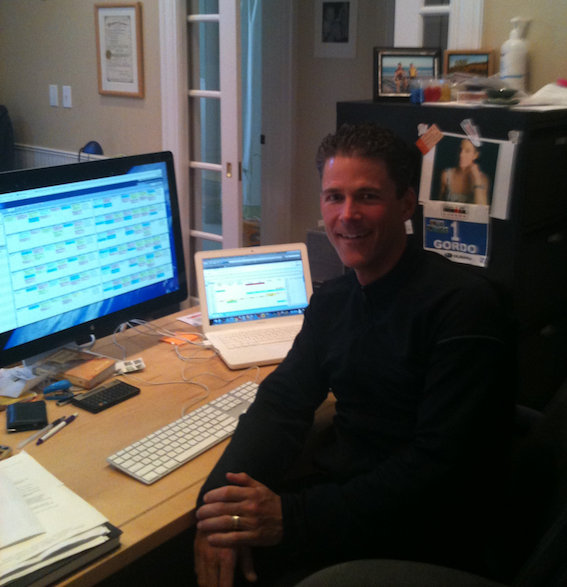
    Work_station

    This week’s photo is my coaching workstation: Apple LED Cinema Display; MacBook; Fujitsu high speed scanner; and HP all-in-one — $2,750 worth of hardware that saves me hours every single week.  

    When I’m building training plans for my crew, I have six weeks showing on the Apple Display; one of my templates live beside it; and a google doc of the athlete’s year visible on my MacBook.  I have all my plans, workouts and data entered into TrainingPeaks and can build a personalized Ironman training program faster than that the people that designed the software.  If you are a coach and don’t understand what I just wrote then you have a major competitive issue that you should address.  There will be highly organized competition coming in the next few years.  

    To have the life I want to lead, I must be world class in the delivery of my world class knowledge.  That’s the source of productivity and what, ultimately, provides the freedom, and serenity, that I desire.  When I read Ferriss, I can be fooled into creating a model where I outsource “Coach Gordo.”  Sounds great but totally lacks authenticity for the people that I want in my life.  I want to work for world class people.  Leverage comes from becoming world class in delivery of what I have to offer.  

    +++ 

    The Money

    This is where Ferriss is spot on.  Classic financial advice is to calculate the capital required to generate your income and save towards that target.  Saving is good advice.  Waiting to start living your life until you have a million bucks in the bank is horrible advice.

    What’s the level of value that you can deliver?  My coaching peers charge 3-8x my rates for a similar service.  Price is a competitive advantage for me.  Where do you stack up with your peers? Remember that you want long term stability.  Be ruthlessly honest with yourself.  

    If you lack the ability to efficiently create value then your competition will have an edge over you.  Value added, productivity, pricing dynamics — these, and other attributes, create what Warren Buffett calls “moats and castles.”  You don’t need to be IBM to have a competitive position.  Each of us, as individuals, has a position in all areas of our life.  If your position is weak then fix it.  

    Once you’ve reached your financial goals — focus on living — don’t get trapped thinking that you need ever increasing revenue, and capital, to be happy.  

    Figure out what’s required to live, sort it and get living.

    Choose Wisely.