
Survivor Strategies

A few months ago, I asked Monica her game plan if something happened to me unexpectedly. Despite thinking that I’d laid everything out, she didn’t have one!

So I wrote out a plan that would take care of her and the kids. The plan seemed like a good idea, so I decided to execute it immediately, rather than waiting for something unpleasant to happen to me, or the family’s financial position forcing us to make changes when we weren’t in a position of strength. 

+++

When my grandmother moved into assisted care, she was amazed (and a little depressed) at how little value was placed on her possessions. Having downsized a number of times, I could relate. While I’m downsizing for myself, an added bonus for my family is not having to worry about sorting through all my gear. I’ve had relatives that end their lives with multiple 40-foot containers of stuff, which places a burden on their spouses who have to sort through everything.

If we are fortunate to live long and prosper then, gradually, everything is striped away from us. As an athlete, I suspect that physical decline will prove challenging (but I’m coping so far). Keeping my world as large as possible, for as long as possible, is a big motivator for me to exercise and stay strong. Assuming that I keep at it for 40 years, I’m hoping to be in decent shape in my 80s. In Boulder, we have many active role models in their 60s, 70s and 80s.

The risk, to my family and young wife, is my mind leaves before I do.To help the survivors, I’ve chosen to insure my “living dead” risk via a long-term care policy. My policy is indexed to inflation and set at 120% of the current cost for me to go into long-term care. This benefits my family, if I live a very long time, and benefits me, if I’m incapacitated. It seemed like very good value as the expected payout for the insurance company is low but the potential liability for me could be very large.

The other thing I did was create a living trust that holds most of my assets. This simplifies the management of my affairs for the survivors. You don’t need to be a 1%’er for this structure to make sense. I linked up an FAQ to provide you with additional info. Combined with the living trust, my will dumps any remainder of my estate into the trust.

There are benefits available to your family from the above structure – so worth a review with an estate planner that understands your situation.

So I insured the main risk that could wipe out my family’s financial position and set up an efficient legal structure for my estate. The next step was to provide my wife with a copy of the family’s balance sheet with contact details and account numbers. In the event that I was incapacitated, my wife has a power of attorney so she can manage everything on our behalf. A similar power of attorney comes back to me, from her. As a side note, be very careful with granting power of attorneys as they are very powerful legal documents and I have seen them misused on multiple occasions.

Now, when I ask the question, Monica says she will pull out “the paper” (a single sheet) and follow along. With a couple more years to chip away, I hope to make my life structure even more straightforward for her.


Life After Death

When I was born, my paternal grandparents were 44 years old. 2012 marks my 44th year and my grandparents are nearing the end of their lives. For them, life is coming full circle and I’ve been helping with their end of life care.

Last month, I visited my grandfather. In advance, I’d been told that his memory wasn’t great – probably due to a combination of age, a recent injury and either Alzheimer’s or Dementia.

Facing a reduction in our mental capacity carries all sorts of biases and stigmas. Even writing about it, I’m cautious, as I don’t want to create needless suffering for other family members. 

If we live long enough then we’re likely to be impacted by a gradual, but steady, reduction in our capacity to concentrate and retain the information that we use to make sense of the world. There’s value in sharing what I experienced as it was different than I expected.

My grandfather’s short-term memory is shot but a warm spirit continues to live inside. His capacity to feel happiness runs strongly through him. He surprised me with the strength of his handshake and the radiance he’d periodically direct towards me. Turns out you don’t need much memory to feel very, very happy at seeing your grandson.

Before I met with him, I primed myself by reflecting on favorite memories. You’ll come across this pshycological technique in everything from spiritual texts to manuals on how-to-sell anything. If you are with someone that’s truly suffering then sharing pleasant memories is a way to ease their pain. 

When we were together, I focused on his warmth rather than the conversation, which was circular. I was surprised that he retained a good sense of humor, despite his condition.

What most surprised me was how his warmth has lived on within me. Since my visit, I continue to feel happiness and can recall the touch of his hand in mine. The visit gave a very, very strong imprint from him to me.

His time is nearly done but I continue to carry the love he showed me into the world.

Worth remembering as we move through our brief lives.

Couples Retreat 2012

On Endurance Corner, you can find background to how, and why, I use couple retreats. I’m back from a week away with Monica – this is the third quarter (in a row) where we managed to spend a week together, outside of our normal lives.

++

Technology Review

The pull of technology amazed me – it took five days for me to lose a powerful urge to check email and google news. I’ll need to do a better job with communicating my break next time as I inadvertently left a couple people in a lurch.

Creating a life where I can take frequent, extended breaks from email is on my to-do-list. Email contains my least productive hours but is a key communication route for a few people that are important to me.

Two years on from starting inbox zero, I’ve made progress. On my last email break (15 days, January 2011), I came back to thousands of messages that required days of sifting. The insanity of that life gave me a huge incentive change.

This week I came back to 175 messages, which took me an hour to sift down to 42 that I’ll action. I have a filter set up for athlete workouts and that’s another 235 messages to review.

In two years, the changes I’ve made have freed up the equivalent of one working day per week and I know that I’m still improving.

++ 

Professional Life Review

The key question that I asked myself: In my working life, where do I add the most value?

Helping highly successful people optimize their time, learn from errors and structure their lives to achieve their goals.

Then I made a list of items that take my time that don’t directly contribute to the three key areas above. My action list for May is delegating/subcontracting those items.

Another way to ask the same question: Why am I paid to be on the team?

Considering my personal life, what does my spouse love doing with me? As it turns out, Monica loves unstructured, unscheduled time with me – and the opportunity to do her own training each day – and some time alone to read. At our core, we are very similar.

++ 

Personal Review

Two years ago, I asked the question: What skill, if learned to the best of my ability, would change my life?

Contemplative study to enhance my ability to be clear in thought, advice and action // essential for me to be the man I want to be.

++ 

Having spent the winter doing strategic planning, the main insights were about staying-the-course and areas where I can prune/simplify my life.

Hope this helps,

g

A Test of Absence

One of my favorite authors is Gordon Livingston. In his book on love, he advises us to consider how others make us feel. I’ve extended the advice to consider more than just people (situations, types of food, language, daily actions, websites). I’ve changed my life by trimming little stressors in my life.

While I am aware of the trap of seeing the source of emotions coming from outside my mind, taking responsibility for the situations in my life has been both useful and empowering.

Another favorite author, particularly on business and investing, is Charlie Munger. Munger’s key tip is “always invert”. By this, he warns us to consider what-if the opposite happens. My chart two weeks ago on interest rates is one indication that I’m likely to see large, unexpected changes in my lifetime.

When faced with choices involving people (not always my strong suit), I mix and match Livingston’s and Munger’s advice:

  • How’s this situation making me feel?
  • How am I impacting this situation?
  • Inverting… How do I feel when I’m not in the situation?
  • Inverting… What impact can I have elsewhere in my life?

Each time I realize that I have a choice not to participate is a breakthrough. I can get caught up in emotional tennis – batting situations back-and-forth, without end, deepening a pattern of stress and conflict. Remembering that I have a choice to remove myself, or simply take a break for week, can lead to meaningful change.

Even when life is calm, I like to step outside my routine to gain perspective. My wife and I are going through a transition with our children arriving so this week we are taking a cybervacation and spending it with each other.

Our agenda is to discuss family strategy and consider how we would live if we knew we were going to die… …a trick question that I frequently ask myself.

Choose wisely.

Giving Up and Parenting

At the beginning of March, I wrote about internal and external motivation. The combination of motivation and persistence (with ability) is what generates success. Success then sets up positive reinforcement of additional effort and persistence.

The challenge of moving through a transitional phase (like fatherhood) is a desire to follow past models for success. This week, I will share some tactics that have helped with my own transition.

My ever expanding family acts as a catalyst to help me focus on:

  • My goals for the core aspects of my life (marriage, kids, professional, self)
  • My desired outcome when faced with challenging situations
  • Saying no to myself, and others, to create space to achieve goals and outcomes

Before I was married, my capacity to strip away and create a sole focus served me well. It was easy for me to create long periods of serenity in my life. With my life filling up with dependents, periods of serenity have become more valuable.

Over the winter, I asked myself what I could give up to create space. I’m going to share my list but the real value is knowing your own list.

Over the last year, the following have gone:

  • Sold my most visible self-indulgence, my SportsMobile
  • Cleared out my race schedule so I could spend more time with my athletic friends – one of the ironies of racing is how little time we spend with our buddies on the course
  • Ditched running so that I could ride more – it’s more enjoyable to be a superior masters cyclist than an undertrained triathlete. Solo rides are serene and cycling is my main interaction with my buddies.
  • Invited a friend to partner with the operations of a company that I founded – I realized my mission is writing and teaching, rather than admin and financial return.
  • Cleared half of my personal stuff – this was surprisingly easy, which may mean that it’s time to do another 50% reduction!
  • Facebook – I took a break in March and I don’t think it’s coming back.

Everything that I gave up had value to me. Most importantly, it’s very difficult to value serenity, lack of clutter and time to think. So the payoff is difficult to see immediately. Six months in, we’ve made real progress.

The key moment, that caused me to accelerate change, was the realization that I could live with being far less externally successful, so long as I was internally successful

What can you give up to create the life you desire?

Change slowly.

How I Allocate Money

When I left my private equity career in 2000, I was able reduce my annual expenditure 90% by moving from Hong Kong to New Zealand. I bought a five-bedroom house for US$25 per sq ft (those were the days) and the income from that property covered my housing expenses. Kiwi health care is government funded and I purchased a top-up policy for my travels.

At the time, my Dad advised me to “take the number that you think you need to retire and triple it.” In 2000, I had neither the desire to retire nor a particular number in mind. His advice proved accurate as I gained clarity on what’s required for me to retire, at any given point.

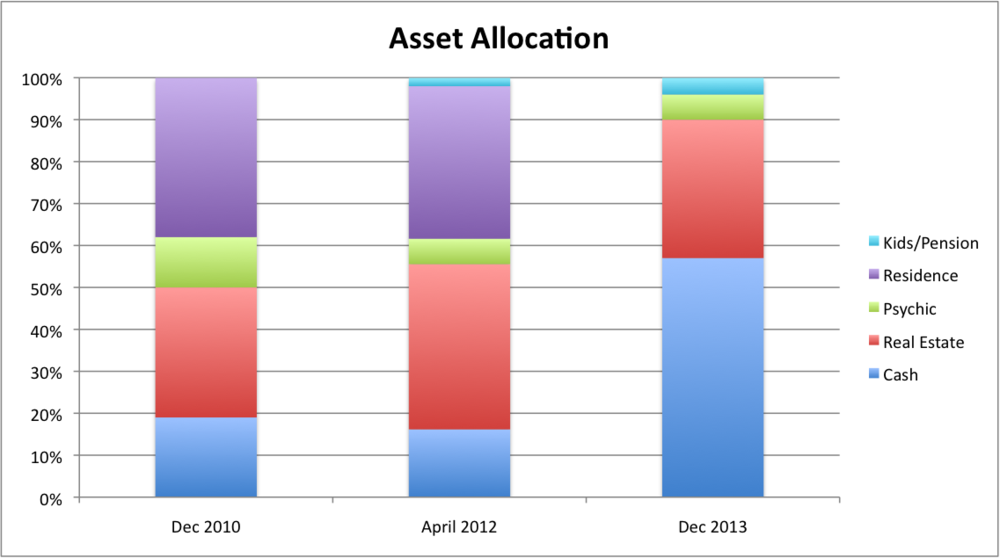
The last time I wrote about asset allocation was December 2010. I shared that my split was 50:50 between assets with postive returns (investments) and assets that had a psychic return. A psychic return is another way of saying the assets depreciate, or cost me money to hold.

Like most people, our house is the largest asset in the family’s balance sheet and the true cost of that asset has been weighing on me. I’ve decided to scratch the itch, sell the house, free the family from being tied to any one location and reallcoate the capital to something productive. It’s been a fascinating study of human psychology as I’ve been living through my biases. 

Right now, we are in the middle column transitioning towards a more liquid position. The pain that we take is leaving our existing house. The benefit, of improved financial health, is invisible to my wife and kids. My daughter’s main concern is bringing the cats to any new residence, so I have her covered.

Byrnfamily

The other major change I have started is allocating capital for my kids’ education, they have 529 accounts, which let gains roll up tax free. I made an error when we started saving for the kids by using a minor custody account, rather than the 529 vehicles. Both the kid’s accounts invest in a low-cost index fund of US equities. I’ve taken a twenty-year view of the markets on their behalf.

Over the last three years, I made a decision to allocate the family’s earned income to a business owned by my wife. This enabled us to start a 401k for her and get her credit rating established. A project for 2012-2013 is setting me up in a similar fashion.

The kids/pension allocation will likely tick up by 2% per annum and be mainly allocated to equities. In a high tax, high rate environment, previous allocations into tax deferred vehicles will be valuable.

Ltr

I lifted the above chart from Barry Ritholtz’s Blog. Ever since I saw that chart, I’ve been asking myself where I want to be when conditions shift back to normal. Conditions are going to shift eventually and we, collectively, give too much weight to the last three years of extremely low rates. 

I’m shifting to cash equivalents to give myself the choice to spend that money (gradually) while I allocate more time to my family and wait for conditions to return to normal. Also, that gives me the flexibility to move quickly if there is another unpleasant shock. My property portfolio was purchased in a four month period when conditions suited me.

I’m willing to foresake a lot of upside, and endure considerable hassle/pain from moving, so that I can be relaxed around the house and have time to love, write and ride.

There’s a leap of faith that I’m going to forget the current pain in a few years time. I enjoy reading old blogs so this is a reminder to myself to check back in.

Contemplative Parenting

My daughter goes to a preschool where most of the parent/teacher community is Buddhist. They share my respect for tolerance and a caution for getting bogged down in dogma. Last night they offered a class on contemplative parenting and I attended.

When I attend a seminar, my goal is to find one thing that I can apply, immediately, in my life. Last night I learned several so have the added bonus of a blog post to share!

+++ 

Each session starts with everyone saying a few words about how things are going.

This marks a change from the typical “who I am” introductions, which focus on the past or the future.

Tell us a little bit about how things are going and how your kids are doing right now…

+++ 

To be effective as employees, negotiators, athletes, spouses or parents… we need to be present. If “present” sounds new-agey to you then what they are talking about is not allowing the normal stresses of life to clutter up our minds. For me, this requires:

  • Sleep
  • Nutrition
  • Exercise
  • Gradual removal of clutter, both in the minds of people with whom I associate, and in my physical surroundings (traffic, urban noise, living space).

To be effective parents we need to get our own lives (and minds) in order. Very similar to performance psychology in business and athletics – the Buddhists were speaking my language!

+++ 

Children have a fundamental need to belong. Effective parenting taps into this need via a mix of boundaries and inspiration.

Young children can gain a sense of belonging via objects – Daddy’s watch; a colorful piece of paper; sharing a meal, getting a clean diaper for brother. This object focus also explains the attraction of dolls, bandaids, blankets… that I see in my daughter.

Parent/child conflict comes when the ability to belong is blocked, or threatened. To be effective in meeting this conflict, we need to be present and free from the influence of our own fears.

As Dad, my capacity to be effective is related directly to the amount of fatigue I am experiencing as well as being free from the perception of time pressure.

The choice, to be less tired and less busy, is difficult to make because it triggers a fear of being less successful. External success is attractive to my ego (winning races, earning money, relative performance).

+++

Practical Tips

To create empathy ask the child what sort of face it creates when…

  • What sort of face does your brother make when you hit him?
  • What sort of face does Mommy make when you hug her?

Scaffolding love onto others…

  • Helping care for a younger sibling – changing a diaper, feeding, cleaning
  • Seeing parents involved in helping others – volunteer work

Adjust behavior in yourself that you want the kids to emulate:

  • Loudness
  • Automatic reactions
  • Neglecting our own needs to the point of exhaustion
  • Kindness in word and action
  • Respect

Create self-confidence by providing a safe environment for independent success.

Pause, start small and follow up.

+++

While the class was directed at parenting, the advice was applicable across all aspects of my life. I enjoy tips I can apply across the board.


Coach Your Own

Following up on last week, I’ve shed enough stuff to feel like I’ve made progress. By the time the dust settles, it will have taken:

  • Seven dumpster loads
  • A pick-up truck full of gear to an eBay store
  • Two van loads of donated clothing
  • Sending one hundred pounds of papers to a shredding service

I’ve yet to tackle our kitchen, our garage or our kid-krap. These areas are emotionally charged so I’ll need to review the ZenHabits tips!

Clearing out highlights the money spent on items that I don’t use any more.

+++

Last week, I alluded to making changes for the benefit of my family. I’m going to call bullsh*t on myself and point out that anything I do for them, I’m really doing for myself. I’ll explain further.

We might view it as more noble to teach our children, rather than knock out training camps in the tropics – but the reality is we’re making choices either way.

In my 30s, I fluked into combining unknown athletic talents with the time to exploit them. I decided to pursue triathlon for a year and it changed my life, quite by accident. There wasn’t any conscious choice to become a great athlete – the decision was to leave a polluted place (Hong Kong) and settle in a pristine place (New Zealand). Once there, I gave myself the luxury of doing what I wanted (traithlon training).

The change that I’m creating this time is more deliberate but similar in that I’m create space to do what I want to do right now (love, write, teach). There will be benefits for my family but the primary driver is being the person that I want to be. My choices are driven by my self-image.

My attraction to coaching flows from a desire to help others and a realization that continual accumulation is empty. The desire to help others and the emptiness of financial accumulation is what drove me to leave private equity. Elite finance is often about helping yourself.

A rarely discussed paradox of coaching is the best coaches spend far more time with other people’s kids than their own. It was a point made at the ASCA conference that I attended in 2001 – my Dick Jochums Notes are worth a read.

In my current line of work (coaching working athletes), many people spend far more time with other people’s spouses than their own. This choice carries material risks to the health of one’s marriage. Choose wisely.

As I’ve aged, my goals have become less inwardly directed. These days, my competitive spirit flashes more often than it burns. My missions:

  • Help people through my writing
  • Teach my kids how I experience the world
  • Experience love with my wife

I know that my kids will be in grade school when I’m 50 and this phase of my life will be done. Having an end date makes it easier to cope when three-year-olds are bouncing around the house when they should be sleeping!

Once again, I’m tempted to choose the road less travelled.


Life Version 4.5

By my 45th birthday, I’m planning to have made a series of changes to benefit my family and create new opportunities for my 50s.

At Epic Camp, we had a motto, “Many Talk, Few Do.” You may have read the talk at the end of last year – since then, I’ve been working on the do.

The first wave of change is to downsize, declutter and create space for my family. I do best with simple targets so I have been halving all the externals in my life: cars, clothing, investments, non-family commitments, house size, as well as anything that takes time or sends me a monthly bill.

A helpful resource was this Zenhabits article on decluttering. A good friend of mine has managed a 5:1 downsize ratio over the last two years. I’ve been chipping away since last December – the project seems daunting, generates periodic pain and requires frequent communication so my wife doesn’t think I’ve gone nuts!

I’m most rational about my material life when I’m separated from my possessions. The biggest example of this is my house – when I’m away, the decision to place it on the market is obvious. Sitting in my home office… less so. To have clarity on the life I want to create, my strategic planning is done away from my current life.

The 50% goal gets me focused on sticking with the items that are useful and let’s me keep some useless stuff that I’m not ready to part with. I figure I can go for another 50% reduction when I’m ready.

When I clear out a room, I feel great. Clutter creates background fatigue that’s hidden from view when you’re living in it. I should have followed the ZenHabits tip to take before and after photos for motivation.

My buddy kicked off his decluttering project by renting out his house. I’m going a step further and placing mine on the market. That puts a fixed date for me to get my act together. Five dumpster loads have been taken away so far and I’m only a fifth of the way through the rooms in my house.

+++

On the technology side, I figured I’d shoot for a 50% reduction. I am powerless with the internet so I took the radical step of deactivating Facebook and cutting my Twitter follows by 80%.

I miss my cyber-pals but I don’t miss all the crap in my head. If you follow me on twitter then you’ll notice that my signal to noise ratio has improved considerably in the last six months.

When I have doubts about the change, I remind myself that the things that give my life meaning – helping others, riding my bike and sharing love with my family – none require constant connectivity.

I’ve been spending time with friends that are far more experienced, smart and productive than me. Seeing how highly productive people run their lives helps me lift my game.

+++

The most difficult part is choosing to say “not now” to my friends. This process reminds me of the parable of the shepherd that’s shared in The Alchemist. With a bit of luck, I’ll find the gold that’s buried right here with my family.

What’s your personal legend?


Internal and External Motivation

Transformation

As an athlete, there are two transformations that have had a powerful influence over me:

  • Slow to fast
  • Fat to fit

Most everyone that I come in contact with has a belief system that faster, and fitter, is always better. We rarely see people making the decision that they are fast enough, or fit enough. More common is a realization that the drive to become fast & fit has become unhealthy and people leave their sport.

Collectively, we give honors to the fast and fit – so they must be good things, right? Like most things, it depends. 

These honors, and the feelings associated with them, lead many of us to make external traits part of our internal identity. Because ethical strength and internal health are hidden from view, there are risks associated with devloping core beliefs surrounding the goodness of winning, low body fat and a year-round tan.

I put the photos up as they speak for themselves. While I am different, I’m also not different. My external appearance, and abilities, have transformed across the years but my internal life has been much more stable.

Triathlon has be a vehicle for physical change but it has also provided an environment for self-discovery. What are our true internal drivers? They might include:

  • Respect from our peers
  • Proving we are worthy of love – the deeper version of “I want people to like me”
  • Self-esteem
  • Full blown exercise addiction – every single aspect of my life improves with frequent moderate exercise

It’s worth considering our deeper motivators because time, and our bodies, will set a limit on how long we can base our identity on winning, beauty and speed.

My peers that age the best have ultimately come to realize, and address, their internal motivators.

For me, that’s the true value of athletics.