Hidden Costs of Investing

My career in finance was built on our collective reluctance to act on what I’m about to explain.

I know that it’s a pain to change who manages your assets. However, you give up a TON of money by not forcing yourself to choose the lowest cost provider.

How much? Let’s see if we can find out!

Active

I’m 45 years old and I want to draw down my retirement assets at 70. For each $100,000 of my portfolio, what does it cost me to use active management vs the lowest cost provider of passive management?

The table above assumes that you’re not getting (legally) ripped off. A fee/expense differential of 1.2% per annum isn’t out of the ordinary. I’ve worked with vehicles that had total fees and expenses of up to 5% per annum.

The number that should catch your eye is $131,853 OF LOST RETURN per $100,000 OF INVESTMENT. The extra 1.2% of fees means you miss out on the equivalent of 131% of your initial investment over the life of this deal.

By the way, when I help people review the true cost of their portfolios, their fees and expenses are usually more than this scenario. I know it hurts to think that you’re being ripped off but please read through to the end!

What about professional investors? They must be smarter, right?

I don’t know about smarter, but I do know that large institutions are treated very well by their managers.

Government pensions, insurance companies and high-net worth families. They have invested with the firms that taught me finance, and we did very well for them. However, we also did very well for ourselves.

We did this by offering terms called “two and twenty” – we received an annual fee of 2% of the assets that we advised and 20% of the gains that we generated. What’s that look like?

Fund

With 10 years at 7%, a passive investor would receive $195,797 for each $100,000 invested. Using the terms of a professional manager, the money back falls to $150,312 per $100,000 invested. The reduction is due to the impact of fees ($32,908) and profit sharing ($12,577).

The pros are giving away 48% of their return. I’ll leave the “why” for Michael Lewis, Taleb and Kahneman to explain.

But it gets better!

If you live in a large American state then, odds are, your state pension invests in something called a “fund-of-funds.” A fund-of-funds is an active manager that invests in “two and twenty” funds. Two sets of fees. The scale of the resulting underperformance is breathtaking.

Why does this matter to you?

Here’s why. A financial adviser that invests your money in a pool of active managers is delivering a fund-of-funds approach to your portfolio (and you’re probably getting screwed by fees).

All of this is legal and has to be disclosed to you (as investor and/or state taxpayer).

If you ask about total, look through cost of investment and your adviser starts stalling, then you have a problem. 

Also be wary when advisers produce a fee example for a “tax-free investor.” You and I pay taxes and most changes in portfolio mix have a cost to us.

TIP: The best investment you can make is knowing the true cost of your investment strategy. Get it done this week!

“Little” percentages cost you big dollars over time.

+++

Make the call and ask… “Fees, expenses, transactions costs, taxes – please tell me everything that I’m paying all the way through to the final investment.”

When you get the information, go compare to what a company like Vanguard can do for you.
Should You Borrow?

Last year, 50% of my cost of living was related to preschool fees and childcare expenses.

This cost can be a source of anxiety, especially when faced with a grumpy toddler. Interestingly, the only cure appears to be: (a) train morning and night; and (b) write an article during the day. If I do that then life seems pretty good.

Another way to counteract the anxiety is to raise enough cash so that I’ve funded my childcare expenses from now until my youngest is in school, five days a week.

I’ve been looking at borrowing against an investment property. Even though it is irrational to borrow (now) to reduce anxiety about a future expense, I’ve been thinking about putting a loan in place.

Here’s my advice to myself. You might find it useful as debt markets improve for borrowers.

+++

Should I borrow?
Generally no.

However, there are some exceptions that have worked for my family.

Housing – A 30-year fixed loan for a well-located home that has a cost of ownership (mortgage, taxes, insurance, repairs) that is materially less than your cost to rent. If you are unlikely to move for a decade then this type of loan can be a great deal.

There’s a lot in the paragraph above: location, buy vs rent analysis, likelihood of staying put and ability to hold long-term. To stack the deck in your favor, each of these characteristics is essential.

Saving – some folks struggle to save. So a mortgage, particularly a shorter duration one (like 15 years), is a form of forced savings that would not otherwise happen. Still, being locked into a location for 15 years is a big commitment, and inappropriate for most young people.

With real estate, on average, I’ve sold within three years. As a result, the investment return is greatly reduced by the large fees and expenses. To encourage myself hesitate, I assume that I’m losing 10% of the purchase price immediately after I buy. This makes it much more attractive to rent, and if that goes well, then buy small.

+++

The freedom that comes from a debt-free life is empowering and, my willingness to do “no deal,” has saved me from many expensive errors.

My hit rate on offers has been less than 35% and I’ve been fortunate to miss out on some deals.

+++

I’ve been thinking about taking out a loan on an investment property that I own. So, I asked my financial adviser his thoughts and he came up with:

Borrow to buy income

Borrow for specific purpose, say, in advance of money coming in later that will repay the loan

Borrow early in one’s career to buy assets that can be used to good affect and which will likely appreciate – eg home mortgages // but remember that being able to move at short notice can be a great way for rapid career advancement

Borrow to avoid selling assets at a bad time market wise – this one is huge and why I like to have a line of credit available to my family (as well as at least one year’s living expenses held in cash)

Borrowing to supplement cash flow is dodgy unless you know how cash flow is going to increase thereby enabling you to repay – this is the classic way the we end up underwater with credit card debt.

In private equity we had a saying – never fund operating losses. In other words, force yourself to cover your cost of living. If you can’t do that then scale back your living. With my childcare costs, I’ve been running an operating loss for five years and it is a source of stress. More debt, to facilitate more spending, is rarely a cure for financial anxiety.

It’s tempting to borrow when the debt markets are good. I’ve found debt to be most useful when:

  • It sits in a company and is non-recourse
  • It is fixed-rate and used to purchase assets that can generate a significant premium to my cost of finance

Where things have gone well, I’ve tended to take a binary approach. I will either invest in a highly leveraged company or, in the case of my personal portfolio, invest in the assets directly, without additional debt.

The key thing to remember is you don’t need to borrow and it’s awful to trade your freedom for something that doesn’t cure your condition.

Aside from professional education, most ‘things’ don’t make a difference – especially when compared to the health benefits of living a lower stress life.

More Than Money – Family Succession Risk

My lawyer leaned across the table, apologized to my wife, and observed…

I don’t get it. Why don’t you just take the money.

I muttered something about Black Swans and protecting my kids. Later, I went home and ran the numbers. There was something I knew but couldn’t articulate.

Here’s what caught my eye

  • 45 year old man
  • Three young kids
  • What’s the probability that I don’t see my youngest graduate college?
  • What’s the probability that I fail to live long enough to train my successor?
  1. Of 100,000 men born in 1968, how many are still living? 94,507
  2. How many are forecast to be around when my youngest exits college? 80,308.
  3. How many are forecast to be around when my oldest is 35 years old? 62,761.

Source: Find The Best.

With a little bit of math, I can calculate my…

  • 20-year mortality => 15%
  • 30-year mortality => 34%

Those numbers are far higher than a Black Swan event. If I was on a board of directors then we’d be working to address the key-person vulnerability for the firm.

Fortunately, courtesy of my young wife, my kids benefit from a 90% expectancy of Mom or Dad making it for another 35 years. You can find a Couple’s Life Expectancy calculator here.

The risk to my family, comes from losing my skill set (financial, legal, strategic, accounting) before we have a succession plan in place. With a big age gap between me and any reasonable successor, the family needs a back up plan. However, my family doesn’t have the financial means to create a Family Office.

Life insurance doesn’t cover the skills and knowledge gap when your family loses an elder. It might give you money to hire outsiders but they nearly always work for their own interest, rather than the interests of your family.

What to do?

My answer has been to start a family council. The council consists of a lawyer, a doctor and a professional fiduciary. All of these individuals:

  • have known my family for 10-30 years
  • share the family’s values
  • have been seen (by our family) to do the right thing, even when inconvenient

I brief the advisers every 3-6 months about what’s happening in the family. I prepare documents for them that explain how we’re structured. I repeat myself a lot. My wife sits in on the meetings.

My annual cost is roughly equal to the Long-Term Care Policy that I carry. Additionally, I get frequent inputs of really good advice from a group of people that I trust to assist my family if I can’t.

When it comes to succession, I suspect that most of us do a better job for our firms than our families.

Moving Into An Equity Position

A friend asked how to gain equity exposure via the stock market.

I recommended John Bogle’s Book and shared what I do for my own family.

Decide what pot of money to invest – in order of priority

  1. Tax deferred retirement accounts for me and my wife
  2. Tax deferred 529 accounts for my kids’ education
  3. Taxable investment accounts for my family

In Colorado certain 529 accounts also have the benefit of a 1-for-1 deduction from state taxable income in the year of investment. However, the 529 accounts have a higher expense ratio than the funds I access for our retirement accounts (0.45% vs 0.05%). The Colorado state income tax rate is 4.63% so the tax savings helps me justify a higher cost.

For #1 and #3 I prefer to use Vanguard’s Admiral Shares for their Total Stock Market Return Fund (VTSAX) – it has an expense ratio of 0.05%.

I always compare expense ratios for products. For active managers, and fund-of-funds, make sure you get the total expense ratio that looks all the way through the final investment products. Many advisers have a financial incentive to layer fee-generating products and you may have additional taxes due if your portfolio has a lot of (largely unnecessary) churn.

It is important to remember that most people lose the majority of their return via investment churn, taxes and expenses.

Let’s use an actual case study with numbers…

If I wanted to invest $100,000 then I’d move into the position gradually with a fixed dollar amount of VTSAX purchased each week. An example would be $10,000 initial investment (to qualify for the Admiral Shares) then $360 automatically purchased every Wednesday for the next 250 weeks. Five years later, you have your position.

The toughest part about the above strategy is leaving it alone. There will be times when you want to invest more, or less, depending on the emotions involved with following the market. Research shows that our emotions are lousy investment guides. So…

My recommendation is to set the automatic investment at a level that you can sustain FOREVER and leave it alone. Let surplus cash build up in another account and use that for opportunistic investing.

Don’t believe the fallacy that you need a portion of your portfolio “for fun.” The purpose of investing is to earn a return on investment, period. When I want to have fun I go for a bike ride with my pals, I don’t speculate with my family’s capital.

When I do a portfolio review, I look at my total exposure by $ amount and asset class. I review the position “right now” as well as how the position is likely to change, based on future investments, earnings and expenses.

If I’ve lost you at this point then you’re not alone. Sitting down with a financial planner can be extremely valuable. Make sure your adviser makes money by advising you, not selling you products. Firms, like Vanguard, offer financial planning services for a very reasonable fee.

Last week, I shared that I felt over-invested in Real Estate so I’ve made a decision to reduce my holdings. Once I’ve reduced my exposure to real estate, I need to figure out what to do with the cash. Today’s blog post is one option (buy equities over five years). Another option is do “do nothing” and wait for the next crisis. It’s really hard to “do nothing” so, perhaps, I’ll do something really slowly and buy equities over 10+ years.

A long range projection of your family finances (5-10 years) is useful to figure out what dollar amount it makes sense to invest. Consider if you want to retain cash for opportunistic investments: examples might be starting a company; buying investments in a crash; or buying real estate in a recession. In my own life, a handful of opportunistic deals have been what made a difference to my portfolio. These deals were made possible by the ability to deploy cash quickly.

Consider a cash reserve to cover unexpected illness or unemployment. Here’s my post on Lifestyle Insurance. Over and above insurance products, I feel better when I have at least one year’s gross expenses held as a cash reserve. In terms of life changing financial security, here’s my post on Taking Money Off The Table.

I’ve yet to regret selling early – I’m easily frightened by bull markets. A recent trip to the Bay Area set off all kinds of warning bells!

What I’ve described is more generally known as “dollar cost averaging.” John Bogle’s book explains how to use this strategy to give yourself financial security. Highly paid professionals (dentists, doctors and lawyers, particularly) are prone to exploitation by my peers in the financial services industry. Read the book.

A bull market is an ideal time to pause, take stock and ponder long term positions. Right now is when it’s most easy to adjust portfolio strategy.

Thinking About Real Estate

  • The chatter about real estate deals has started again
  • My estate agent friends are slow to reply when I send them deal outlines
  • Mortgage rates remain at historically low levels
  • Inventories are down

…so you might be thinking about buying real estate.

It is worth thinking about “why”.

Beware if you are motivated by a fear of missing out. That’s a boom mentality and we’re all susceptible to herd thinking.

Beware if your local market has swung so that the cost of ownership is more than the cost to rent. You are likely being tempted to speculate, rather than invest.

When I’m ruled by my head, rather than my heart, I am able to remember what follows. I’m writing them out to remind myself to be smart!

Other People’s Money – when interest rates were under 4%, it was a “no brainer” to borrow 30-years fixed to buy a house in a great school district that was less than my cost to rent.

What swung the deal for me was access to the mortgage, which made the long-term cost to own significantly less than the cost to rent. My cost to own is 75% of my cost to rent locally. My cost to own is 30% of my cost to rent in the San Francisco Bay Area (an alternative location I consider frequently).

While interest rates have risen, they remain low by historical standards. I’m in the process of borrowing some more money to take advantage of the inflation insurance offered by long-term, fixed rate lending.

While private equity firms, hedge funds and investment bankers get to use other people’s money, we don’t.

If you are using your own money it pays to remember the next two tips.

Real Economic Growth drives wealth creation and liquidity drives pricing.

Put simply, if you are thinking about buying real estate then what’s likely to happen to the local economy over the next 25 years.

Can’t hold for 25 years? Don’t buy.

Why? Because you lose the option to move quickly and easily. Your mobility is a highly valuable asset. Don’t give it up easily.

As you age, and if you choose to have kids, the value of your “move option” will decrease. At 45, with three kids and a low cost base, it would be expensive for me to move.

That’s OK – my cost of living is so low compared to my Tech/Finance peers (HK, London, SF Bay Area, New York) that I suspect many of them will move to me instead (and support our local property market).

+++

Understanding Crowd Psychology

While I’m sure YOUR memory is excellent. How long is the memory of our fellow citizens?

Institutional memory is about three years long – the clean out of 2008-2010 is fading from our collective consciousness. How bad was it? It was awful but we’re unable to remember. I spent this weekend reviewing papers from 2006-2008 and was amazed at what I’d forgotten.

Always remember that our mood is skewed by the recent past. 2013 was a very positive year compared to the five years that preceded it.

Let’s recap… if you…

  • can hold long term
  • have the funds available to buy
  • like the long-term growth prospects of your location

…then my advice is to sit and wait for a crisis.

How often do we get a solid crisis opportunity? It’s more often than you think. Key ones that I’ve lived through…

  • Stock Market Crash of 1987
  • High UK interest rates, and tanking property values, 1990/1991
  • Mid-90s Asian Crisis
  • Tech Bust of 2000/2001
  • Great Recession of 2008/2009

Five great buying opportunities and that only includes one’s that I lived through.

Because it takes three years to forget the boom that preceded the bust… you need to allow 2-3 years to move into your position. You’ll see this pattern repeated over-and-over in real estate.

Be patient, balance your holdings and wait for the next crisis.

Taking Money Off The Table

With markets high and interest rates creeping up, some people might be thinking about selling portions of their holdings.

I’ve had the opportunity to “cash out” on more than one occasion. Looking back, I completely missed how freakishly lucky I was to have the opportunity to choose.

One time I didn’t take the money, the other time I did. Both decisions worked out OK so I’ll share my process.

+++

First, when I make a buy/sell decision I try to value the asset independently as well as consider what the situation is worth to me.

For example, my current business (consulting) is worth far more to me than it would be to a third party. Unique benefits are: gives me a voice, allows me to get paid for what I like to do, allowances for vehicles/home office, gives me an opportunity to help my local community, brings me close to my friends.

Always consider the non-financial benefits of your current situation – these are hidden to third parties, who rarely give you value for them.

+++

The biggest decision financial decision of my life was when I chose to hand back a partnership in a private equity firm. I was 31 years old and, while the opportunity cost was huge, I figured that I could get back to my old situation if I was willing to take a pay cut.

Again, I completely missed my extreme good fortune to be able to choose. Not surprisingly, my peers and family thought I was nuts.

Take Home Point: my downside position was my old life back with less money coming in.

Take Home Point: once you get five years living expenses off the table, it gives you flexibility in an uncertain world. I achieved that goal early in my first career and it gave me freedom to take risks. With this goal, the toughest part is lifestyle humility. I was lucky to start my career working for a very humble man.

Implications of Failure/Black Swans: Getting things wrong at 31 wouldn’t have been that big a deal as my fall back plan was asking for my old job back. Consider your fallback plan.

+++

Roll forward five years:

I was out of the PE business for five years, recently married and co-founder of a company that did property development. In the intervening five years, I co-founded a fund management business that was doing well.

Age – 36 years old, still young but now with a wife and new life that wouldn’t make it easy to return to Private Equity.

Net Worth – illiquid with a personal g’tee into the General Partner of the fund management company. I had placed myself in a position where I could lose more than my total net worth. Not smart!

Implications of failure/black swans – personal bankruptcy, loss of personal freedom, starting from scratch, return to big city living – highly unattractive, especially given my love of inexpensive living (cycling, forests, reading, writing).

I told my business partner that I wanted to sell out and would accept any terms that worked for him. He bought me out over three years at a 50% discount to third party offers we received. He wanted control and the price was good enough.

In this case the intangibles (control) made the deal highly attractive to the buyer. I didn’t get wrapped up in fair value, what I needed was a deal that was “good enough.” When you are selling to the operating management, you are very likely to take a discount on fair value.

+++

From twenty-five years of spending time with the 0.001%, here is what I’ve noticed about money and wealth.

A – having 5 years living expenses, in cash, gives tremendous flexibility. Whatever that # is for you, it represents the highest utility aspect of your financial life. Nobody can make you do something you don’t want to do when you are able to hit the road and know that you’re OK for a long while. This is huge.

B – if you’ve built a successful business then you’ll never be out of work unless you are permanently disabled (insure that risk now). That said, consider if you are comfortable with the worst case scenario. Reading Taleb saved me from personal bankruptcy.

C – depending on your age, there is a magic number where you will be able to survive without working for the rest of your life. Most the wealthy folks that I know (call them the 2%) scale their lifestyle so they never get there. They don’t even get to the enviable position of being able to work at what they love.

Keep it real. Spending time with people that have 5-10% of your net worth is a smart use of your time.

With fitness, and finances, most people aspire to spend time with people that have FAR MORE than them. This screws you up.

If you want to feel good about your life then teach people that have less.

A couple weeks each year I live like I did when I was a student – I look forward to these weeks as they keep me grounded and get me OK with personal downside scenarios.

Small businesses have limited exit windows. Part of what pushed me to sell was a funding environment that seemed crazy to me. Separate from my views on valuation, I knew that the easy money wouldn’t last. I got the timing wrong on the contraction but it came eventually.

What’s Your Gifting Strategy

I love riding my bike with friends. To create more opportunities for that to happen, I give away a lot of cycling gear each year. When my friends wear the gear, I hope they think of me – even if they don’t think of me, it makes me happy to give gear away.

Here’s what I’ve learned about gifting…

It is an essential and effective way to influence behavior.

At some level, most of us feel that we deserve gifts. I need to be cautious about reinforcing entitlement in recipients.

The best gifts are items we can use while doing a favorite activity. An athlete-buddy of mine gave me a set of nordic ski underwear and gloves. I think she wanted me to learn to ski! I use her gift weekly and think about what a considerate person she is. The shirt makes me so happy (it’s my favorite color) that I wear it as casual wear. It’s not surprising that my pal scored a homerun with her gift, she’s a psychiatrist.

Gift frequency is better than size – for example 4 gifts of $250 generates more happiness than one gift of $1000. However, see habituation below.

Random is better than scheduled – I like random gifts. If I see something somebody will like, I get it and send it over to them.

Value is highest at point of award, not receipt – important to remember this for children, employees, heirs and other important people that you gift towards.

Consider my piece last week about Class Dojo, earning the ten points my daughter needs for a treat gives her more pleasure than the treat itself.

An example from the corporate world… At the private equity firm where I worked, the partners would award annual profit sharing points – there were 10,000 points available for each investment fund and we’d earn our share of 1,000 points annually. This system spread the allocation across many years, rather than having it back-end loaded when the investments were sold.

Things that people will use often, and associate with you are excellent – think about my friend’s gift of a shirt and gloves. To give me the same amount of pleasure she would have had to send me $5,000! A well-selected gift is worth far more than its monetary value.

Gifting to people’s children, ie via education, is deeply appreciated – parents have a sense of obligation towards their kids.

People (employees, spouses, kids, yourself) adapt very quickly to changes in standard of living, and forget how they got there. I avoid gifts that eliminate the self-esteem that comes from taking care of one’s self.

Be wary of reinforcing feelings of entitlement – for example, beautiful people and skilled athletes are trained that the world will take care of them. As they age, they experience pain when their gifts of chance (beauty and athletic prowess) fade.

+++

Some people gift publicly for reasons of family, or corporate, strategy. Others prefer to gift anonymously. Considerations:

  • Be wary of the motivation of recognition.
  • If you ask your pals to support your causes then you will feel an overwhelming need to reciprocate (and you might not feel the same desire to support their causes). Of course, remember that it is OK to say “no.”
  • Most of us have small budgets for gifting – pay particular attention to situations where a little time and money can have a big impact.

If you need more of something then have a strategy to gift some of what you need.

Antifragile Thinking – Nothing and Waiting

How can I use volatility to improve my investment decisions?

When I read Taleb, I’m tempted to go for the big bet using options with skewed payoffs. I think the real lesson is more straightforward than using out-of-the-money options, which is good because I’m not trained in derivatives pricing!

I have a favorite game that I play with any purchase. Determine value before I find out price. In the context of real estate (or buying companies), value the asset before you find out the asking price.

In 2009, I saw a “for sale” sign come up in my neighborhood. I played my game and priced the property in my head. Unfortunately, the property was listed at 25% over my valuation. So nothing happened, I waited, watched the property and the sign came down.

In 2010, the sign came back up and I checked the price. It was listed at a 40% reduction. Yay! I immediately put in an offer slightly below listing price. The owner countered my offer and we agreed a deal that everyone was happy with.

In 2009, I followed my investment mantras:

  • I don’t need to do a deal, I need to do a good deal
  • Let volatility do its work and create a situation to buy at an attractive price
  • My work is to build core capital, educate myself and be patient

My family needs one deal like the above per decade. Putting that in context, If the family is changing strategy more than one month in a hundred then we might be taking too much action. An “active” strategy would be anything that requires strategic change more than one month in fifty.

I don’t need advisers that earn fees when I take action. I need systems that prevent me from tinkering for no gain.

So the game is: deciding what I want, educating myself and waiting. Eventually, volatility will bring a great opportunity my way – at that point, I need to be willing to commit in size.

I tell my wife that was my strategy with our marriage – I also admit that I got lucky with her being better than I imagined. Elite swimmers have hidden options (loyalty, persistence, patience, internal motivation) and being OK with long term incremental progress.

To cope with the amount of “no action” inherent in the above strategy, I work on case studies, study history and, especially in relationships, improve myself.

One deal per decade.

Antifragile Thinking – New Old Ancient Nature

How can we use volatility to improve our thinking?

Rank the incoming information according to age – New Old Ancient Nature – if in doubt then choose the older option.

Remember that time will kill most ideas and concepts. Be willing to miss out on the latest/greatest – pay attention to concepts that are proven by time.

I coach a surgeon and his Dad was also a doctor. Now retired, the older doctor noted that “everything I learned in med school turned out to be incorrect.” Now clearly, everything wasn’t wrong! I would love to ask the doc, out of everything you learned, what was right?

We might get a list like:

  • Hygiene – do it
  • Blood pressure as leading indicator of a need for lifestyle change
  • Smoking – avoid it

Thinking back to my own education (economics and finance). What proved to be correct?

  • Track the cash
  • Interest rate trends
  • Mean reversion
  • Compounding

Another field that interests is endurance sport:

  • Consistency
  • Variable Stimuli
  • Strength and Stamina
  • Specific Preparation

Nutrition:

  • Restrict the “new” – refined, processed, modified, engineered
  • Focus on the “old”  – ingredients your great-grandmother could have eaten

In a field that interests you, what are the three concepts that have stood the test of time? Focus on those concepts.

As you discover the power of this concept, you’ll benefit from reducing the fire hose of noise that reaches you daily via the media, advertising and social networks. These sources of info are “new” and. therefore, useless at best. More likely, they are misleading and reduce the quality of our thinking.

To improve my thinking, I need less noise in my head. “Not-thought” is what makes “good thought” clear to me.

Turning this on it’s head… if I can increase the amount of “no-thought” then the depth of my insight will increase and I’ll be able to see the useful info contained in what gets through. Implications:

  • Reduce email – a favorite from Taleb’s AMA is limit to 15 messages per day
  • Restrict media and eliminate the most noisy sources – television, chat forums, Facebook, reality TV, talk radio
  • Schedule breaks to settle mind (exercise, mediation)
  • Replace mental habits that clutter thinking
    • envy replaced by being happy for others
    • over-correction replaced by finding the good
    • Tinkering replaced by letting it ride
    • anger/fear/sorrow replaced by gratitude

I find that I don’t need to be charitable for the above to work. 

“Thank God, I’m free to act differently than that person.” triggers gratitude and let’s me move on.

Towards An Antifragile Life – Living With Volatility

I’d encourage you to read Taleb to experience the hero, and anti-hero, directly. Acting on his books saved me from personal bankruptcy. I owe him much of my personal freedom.

Separate from his tips for financial living, what are the lessons that I can bring into my larger life?

Don’t Tinker, Let My Winners Run, As Much Nothing As Possible – I blow at least $10,000 a year forgetting these points. My sin is neglecting the benefit of “no action.” Every year:

  • I cost myself money by tinkering with my winners
  • I waste emotional energy by getting involved in situations that will work themselves out with my help
  • I spend goodwill via over-correcting the people close to me

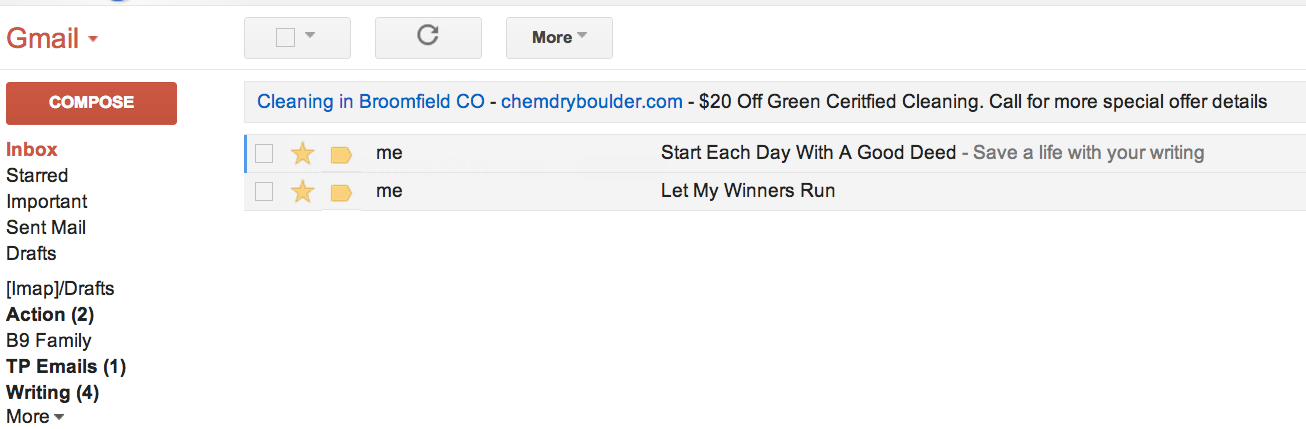
The tip about letting my winners run is so persistent in my investing errors that I’ve sent myself an email that I see every time I log into gmail. The other email is designed to make me a better man.

Inbox Almost Zero

Inbox Almost Zero

Maintain Personal Freedom – Taleb’s style is about freedom. Freedom to do what he wants. Freedom to say what he wants. I get that. I need to be cautious with choices that restrict freedom.

Debt – my family has one loan, a mortgage on a house that I could leave and rent for more than my mortgage/insurance/taxes.

Taleb, and others, challenge conventional wisdom about the use of debt, particularly with regard to College. My wife and I left college debt free and that colors our judgement. Friends of mine, that are doctors, talk about debt-free doctors being able to “do medicine right.” Statements like that, bring home Taleb’s advice to use as little medicine as possible.

Pay For Optionality & Avoid Open Ended Commitments – I’ve made both necessary, and ill-considered, commitments in my life. I pride myself on reliability so feel pain when I’m falling short on a commitment, or need to exit. As a result, I’m willing to pay a premium for flexibility and accept less success to avoid long-term attachment. The pain I feel is an Anglo-Saxon cultural phenomenon, in some Asian cultures, it is expected that relationships will change with circumstances. I smile when I think about Northern Europeans doing business in China and India.

Relationships – Taleb is big on parties, especially ones with lots of different interesting people. My goal at a party, if you can get me to go, is simple. Avoid being the most boring person there! I’m selling myself short. While it would help, the solution isn’t to liven up. The solution is to understand that exposure to many different people is helps create a life with meaning and opportunities to use our skills to help others. Networking is about using volatility to our advantage and the most valuable form of networking is having fun while sharing a mutual interest. I’ll go a far out of my way to share a bike tour with a buddy! I’ve made most of my best friends while exercising!

Insurance & Legal Structuring – insulate yourself from the improbable via insurance and appropriate legal structuring (links to blogs that tell you what I actually do).

Toxic People – have you considered the emotional payoff profile of the people that are close to you? Taleb talks about asymmetric outcomes in the financial sphere but far more common is the downside associated with certain individuals. Some people have a poor payoff profile and others consistently make me feel fantastic.

Think about the people you spend time with – how do they make you feel about yourself? Create space for great people by ditching the toxic folks.

By the way, if you’re truly courageous then think about how you make other people feel about themselves – especially people that have no recourse against you. Too often, I come up short here! When I’m tempted to criticize, I ask myself three questions:

  • What are my goals here?
  • Will criticism serve my goals
  • How am I making this person feel?

Taleb rails against bankers and senior management. Speaking as an insider, he is 100% right about how those sectors operate. The deck is stacked, and will remain stacked, in favor of the insiders.

If you find yourself in senior management, or finance, then think back to what was “enough” when you started.

Too often, the compromises associated with success are the seeds that create Black Swans in our personal lives.