
How I Met Your Mother

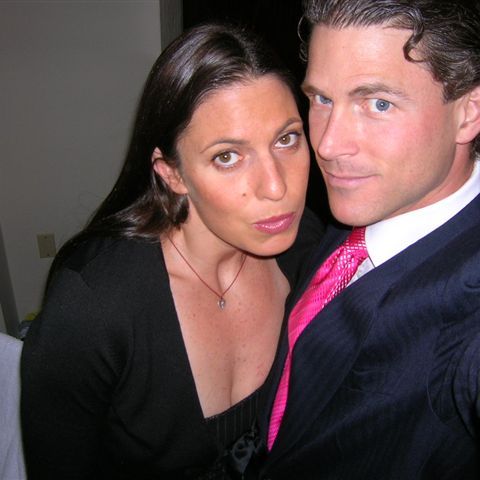
Gordo and MonicaWhen I lived in Asia, I made some money, had my best friend die and blew up my marriage.

A wise friend observed that it was fortunate that the marriage exploded because I was better off waiting until I was able to offer something to a relationship. My buddy, who would spend the next decade dealing with her breast cancer, captured an essential aspect of successful relationships – that they are best avoided until you are prepared to continually offer yourself.

I look back at my writing from that time and smile at how hostile I was to relationships. Ten weeks before I met my wife, I rode across the United States with a Swedish buddy. He gave comfort that, indeed, there were “at least three women in the world” for me. When I asked, “why three and not one?” He smiled and told me, “the world’s a big place, Gordo.”

Squash Court

[This is the squash court where I met your mother]

In the middle of 2004, I conquered my fears and walked into a room of (mostly) female, triathletes. They were training under the instruction of a six-time world champion, Dave Scott. Dave personifies the old coaching adage “challenge your men and love your ladies.” He didn’t cut me any slack!

It was a complicated situation as my wife-to-be was going out with my landlord’s brother and neither of us were aware that we should be together. I played a long game, got her out of the country and we were engaged before she returned to Boulder.

Nelson, NZ in 2005

[Here’s your mother as a young woman in New Zealand. She was working as my extra-special soigneur at a stage race.]

We were lucky. We grew into each other.

+++

The journey that led to a wonderful life partner began years before I met Monica. I started by cultivating independent self-love, which sounds like something you’d hear in yoga class.

In the language of business…

To do a good deal, you have to be willing to do no deal, a fundamental component of success.

Divorce caused me enough pain to make me hostile to any form of intimacy. First a childhood divorce, then my own as an adult. There were deep feelings of failure associated with marriage. I had not learned how to strengthen a marriage and was preoccupied with the illusion of failure.

After my divorce, I made myself a better person. This was not my goal. Becoming a better person happened because I stopped living the values of other people – back then I was misled by money and assets. Later I was misled by victory and vanity. At the end, I hope to end up with kindness, good humor and service!

My introversion, and pride, fed a desire to prove that I could be happy alone. Truth be told, I was never alone – I wrote frequently and had two very close friendships. One of these was with Scott Molina and he joked that I had ’embarked on the longest dry streak known to man.’ Scott’s observation still makes me smile!

To make myself relationship worthy, I needed to create a life where I was happy without an intimate relationship. In order to have something to give, I needed to develop a source of energy outside of the relationship. I found my source in athletics and nature.

The great spiritual traditions write about love being the source. I have a long way to go there. My love for my children is a sign explaining that everything I need is within myself.

As an introvert, the teaching that I’m my own source feels natural because I’m happy when I’m alone. However, I need to be careful that I’m not alone too much. First, because there is a deep human need for intimacy. Second, because a life with meaning requires us to do good work in the world.

After five years of working on myself, I met my wife. In Monica, I discovered that I enjoyed spending time with her more than I enjoyed being alone. I’m not sure if that will make sense to an extroverted reader, who might find solitude draining. However, for the sociopathic hermit in me, it was a revelation.

To create an intention for success, I tell my wife, frequently:

  • There’s no way I am going to improve my situation through any pathway other than our marriage.
  • I’m grateful for all you do – family life is a challenge but I know that family life alone would be far, far more challenging.
  • While I accept that it only takes one person to crater a relationship, I will never speak about failure on my side. If we hit hard times then I’ll stay close and wait for you to come to your senses.
  • I hold the trust between us as sacred.

All thoughts to the contrary, of what I state above, are a sign of temporary insanity!

Ironman New Zealand 2004

[As a couple, Ironman New Zealand 2004 was our best ever. Your mother swam 2.4 miles in 46 minutes and finished 2nd overall. Living in love makes you powerful!]

Today is the 10th anniversary of the day I met your mother and I’m so grateful.

Love you, Babe!

More Than Money – Sharing Time

It’s common to think of volunteering as giving time to a cause.

The most powerful lesson of hospice is the reality that, short of organ donation, I can’t give time to anyone.

What I can do is share time.

+++

In most of our roles, we can be swapped out. Absent someone to love, this can be a lonely reality. Family roles, particularly parenting children, is an area where it’s more difficult to replace us. Interestingly, these are roles where love dominates. Kids can survive just about anything if they are supported by the knowledge that they are loved.

My family is central to my life’s work. It’s the most direct way I can influence the world. Volunteering is most useful when it makes me a better member of my family. By “better” I mean wise.

Given that I’m married to a woman where “the tone is the message,” I want to spend time in situations that improve my soft skills. My family, and my marriage, doesn’t receive much benefit when I improve my technical knowledge.

Gordo and the Easter BunnyVolunteering puts me in situations where I am truly clueless. For at least a few hours a week, it’s good to realize that I’m clueless! Specific to hospice:

  • there’s no ability to fix anything
  • I’m not empowered to do anything other than serve
  • my best course of action is nearly always “quiet presence”
  • I create a habit of doing what needs to be done
  • I do my work without expectation of being thanked, or paid

If you have young kids, or elderly parents/grandparents, then you may find a lot of similarities with my list and your role.

Most of the friction that I observe in families is due to someone seeking to fix a situation that isn’t their domain, or doesn’t have a solution.

In terms of self-improvement:

  • Volunteering rewards me if I act in a manner completely different than my typical persona. Until I started volunteering, I had never received positive feedback for being a quiet, humble helper.
  • Caring for the sick has an unavoidable benefit of increasing tolerance. You can’t help but change your opinion of people when you’re serving them.
  • Making a habit of good deeds gives me ammunition to take on the voice in my head that tells me that I’m falling short.
  • Pushing my fear envelope is exciting and increases my ability to think clearly in situations that are emotionally charged.
  • Work that challenges the heart leaves me feeling grateful and gratitude is an effective antidote for most everything that ails me.

Whatever your field, when you hear the call, I urge you to follow it.

Goodness through action.

The Most Beautiful Man In The World – Talking To Kids About Dying

Orion

Did you know that Orion was the most beautiful man in the world? Here’s a link to his story – a personal favorite of mine.

How can I talk about death without freaking out my kids? First up, I don’t start the conversation. However, I don’t avoid it either.

There is a split between older (4-6 years old) and younger preschoolers (2-3 years old) and my approach differs between the kids, as well as how they are feeling when they bring up mortality.

My first conversation about death with my son (2.75 years old) started when he picked up a line that stuck in his head, “David’s Daddy Died.” At two, death doesn’t have meaning and I don’t want him to get locked onto thinking that mom/dad might disappear on him.

From an early age, we’ve taught him that “we will be coming back” when we leave him. Indeed, a key milestone of childhood development is the ability to self-comfort when separate from our parents for 1, 3, 5 and 7 hours. We started this process, gradually, with all our kids as soon as possible.

Axel’s nature means that he experiences less separation anxiety than our other kids. Still, he looked to me for an explanation about “David’s Daddy Died.” Here’s what I do each time…

  • I go down on one knee
  • I look him in the eyes
  • I open my arms for a hug
  • I say, “YOUR Daddy’s right here”
  • I give him a huge hug

Sometimes it takes a couple repeats of… “Your Daddy’s right here” but it always works to bring him to the present, give him reassurance and shift us back to whatever we were doing.

With a 4-6 year old, the conversation is different. My oldest understands death and can have questions about it. She remembers her great-grandmother (who died on this day one year ago) and has asked me about it.

  • What’s death – your body stops working
  • Is she coming back – no, her body is finished
  • Is it like sleeping – no, it’s different
  • Daddy, are you going to die – Sweetie, everything ends
  • How long until you die – likely more than 40 years

And the biggie… Daddy, where will you be when you die?

  • Once again, I look her in the eyes
  • Put my hand over her heart
  • And say, “I will always be with you. Even when I’m not with you, just close your eyes and you will feel me in your heart.”

I then choose a person – perhaps my grandmother, or her mother – and we both put our hands on our hearts and think about that person. “See you can feel the person, even when they aren’t in the room. That’s where you go.”

When they get a little older, I’ll teach them how to spot Orion in the sky and share that he was the most beautiful man in the world.

When they see Orion, I’ll tell them to always remember that I love them.

See me beautiful.

Five Years A Father

Denver Zoo Spring Break 2014Five and a half years into parenthood, what stands out.

First, you don’t need to make the kids a priority. Babies, toddlers and preschoolers are extremely effective at expressing their needs!

Second, I’d strongly recommend being a binary parent with your core values. If you’re not into physical and verbal abuse – give yourself a blanket no hit and no yell policy. This saves you having to decide if a situation merits abusing your kids or spouse.

It’s surprisingly easy to fall into abusive habits. I’m a lot more aggressive than I realized pre-kids. Part of why I volunteer is to atone for the remorse I feel with regard to my thoughts about my children!

Don’t worry about the difficulties. Everyone deals with the same stuff and our minds do a good job of forgetting about misery. Two practical tips here…

Spend time listening to other parents talking about their situation. It will always make you feel better.

When fellow parents ask how you are doing, answer them “I’m OK now” or “I’m good now” or, perhaps, “I’m great now.”

The second tip is an effective tactic to avoid carrying the past into the future. Only a small minority of moments will be truly miserable. These moments can be high energy and, therefore, easily remembered. I can be bring myself to tears if I focus on my strongest memories of despair. Not a good habit. On the flip side, when things get so bad they become funny, those are the memories that make a marriage.

A Flower For DaddyOne of the most surprising things has been the moments of pure bliss. Sometimes I get so happy that my body tingles. Transcendental experiences.

Christmas 2013Take a lot of pictures. Print out the pictures that trigger joy in you – I can feel my heart as I look at the photos that I share this week.

It’s not possible to have too many positive triggers. There are days, and nights, when you’ll need them!

Screen saverBased on our home life, there are three things that you, and your spouse will be tempted to let slide: sleep, marriage and health.

Further, you’re likely to get so washed out, that you’ll be grateful if your spouse drops sleep or health to make your life easier.

Carving out time to maintain your marriage is inconvenient. However, it’s essential to avoid finding yourself lost. Your kids are going to keep on rolling either way.

Laugh as a family.

Coping With Anger

A recent conversation about parenting:

Husband: I’m not used to being filled with hate and anger

Wife: Any other father would be yelling and hitting by now

Husband: The Dalai Lama wouldn’t be hitting

Wife: Any normal father

Husband: I’m not trying to be normal, I’m trying to be exceptional

+++

Recently, I’ve been finding myself being “really mad” at one of my kids. Worse, I have been carrying my anger around and wrapping it in self-pity. This is a crappy habit to create!

To turn things around, I tried a 14-day cleanse…

Monica laughed as my cleanse was light weight in a Boulder sense… huge salad for dinner and no booze. I didn’t notice any difference physically but the anger has started lifting.

Here’s what I’ve been doing to cope.

Own It – when I’m angry, I notice the anger. I try to create some space by breathing and noticing “wow, I’m angry.” When I can pull this off, I don’t act on my anger.

Not acting on anger is a win, even when angry.

Identity – I remind myself that I’m not always the role that is making me angry:

  • Employee of difficult boss
  • Parent of difficult kid
  • Customer of difficult company

I discovered my painful identity when I was hiking (alone) feeling sorry for myself. I reframed my self pity into “a guy who can go for a hike.”

This helped until I became “guy who’s calf blew out on a hike!” At least my calf trouble got me swimming again and I noticed that problems in my body don’t make me angry.

Communicate – My anger doesn’t like anyone to know about it. So I have been introducing my anger to my wife, my friends and, now, you. Getting the emotion in the open creates space. Space is good.

Share Goodness – when I’m happy or enjoying myself… I send a little bit of that happiness to the object of my anger.

Breathing in – this is a good moment

Breathing out – I send her some goodness

The Rational Mind – I think of myself as being calm and rational. It’s everyone else that runs on autopilot.

Persistent irrational emotions point out that I’m merely OK in “my world” but have trouble with “the World.”

I want to apply evil intent on my kids but, looking deeply, the only possible intent is love and inclusion. Until I can experience that reality:

  • Keep breathing
  • Keep trying
  • Let go of the emotional warfare

+++

Today’s my youngest’s birthday. She’s one. It took me five years to become comfortable with babies and now they are gone!

Hopefully, I can up-skill with preschoolers before 2018.

Family Mantras

In my life, focusing on the faults of others is always a reminder to look inwards. For when I’m struggling with myself, I start to look outwards for easier targets! My article on creeping clutter was triggered by catching myself wishing my wife would clean up the kitchen.

There is a lot of anger in the world outside my home. Even inside, the minds of preschoolers are churning with strong emotions.

I’ve been able to modify my own sources of greed, envy and anger. I do this through awareness of three truths:

  • We’ve already won
  • We have more than we need
  • I don’t need to be right, I want to be at peace

When I see the truth in these mantras, I remove the seeds of greed, anger and envy. If these seeds grow then we can end up disgraced, or in prison. Theft, fraud, infidelity, anger and unhappiness have their root in a desire for more.

As I roll through my day, I am on the lookout for examples of how we’ve won, how we have more than we need and how serenity benefits the family.

A friend observed that having the opportunity to argue shows how lucky we are. Debate is a sign of affluence. When faced with an argument, he sees a person that is lucky to have the time to make themselves unhappy!

From the outside, it can appear that I spend a lot of time focused on the risk of negative outcomes. However, from the inside, I find it helpful to remember that my time is limited. To my family, I say…

Whatever happens, remember this – I had a fantastic life and loved you very much.

What’s your family mantra?

Love and Hate

The first time your kid tells you that she hates you can be traumatic. My wife will never forget when our oldest told her that she hated her. Not reacting is one of my strengths so, when it was my turn, my daughter’s hate flowed through me. As a father, I want to help my daughter accept her emotions and let them go. 

Quite often, people that are good with love (mothers, wives, daughter), close themselves to negative emotions, such as hate. That closure, between mothers and daughters especially, can lead to strange dynamics, especially when an unexpected trigger results in an outpouring of hate.

I have an ability to react slowly. Being slow to react makes me appear cold but has helped me deal with some very abrasive people (and challenging preschoolers).

A couple weeks after my non-reaction to my daughter’s hate, the conversation when like this:

Daddy, I love you

Daddy, I hate you

But, I love you more

There is a tension between the love and hate in our little girl. By acknowledging, and not suppressing, the hate, we helped her avoid making the hate her focus.

The other morning, we were walking into school and she saw a little buddy entering the classroom with his mom. 

Lex beamed and told me, “Daddy, that’s my friend.” 

The little guy immediately screamed, “I am NOT your friend!” Causing his mother to stop cold with a universal look of maternal horror. 

Lex shrugged and said, “it’s OK Dad, he’ll be my friend this afternoon.”

A home environment where we let go of hate is wonderful gift to pass to our children.