Vanity And Victory

Kids have an amazing capacity to reflect and absorb the world around them.

I can see this ability, most clearly, in how they pick up the phobias and idiosyncrasies my spouse. With regard to my own traits, I see my strengths reflecting in the kids. By the way, my wife sees the same thing – just reversed.

There is a great scene in the movie, Parenthood, where Steve Martin exclaims, “I just can’t figure out where he gets this obsessive behavior from!” I think about that quote a lot and smile at myself. I own obsession in our household.

As an elite athlete, I valued physical power, domination and winning. You can see these characteristics expressed in other fields (finance, business, perhaps the military). These values have strengths and weaknesses. For a young person, they help you get a tremendous amount of work done (good) but they can leave you blind to the feelings of others (less good). Lacking empathy isn’t always a bad thing, say if you’re combat infantry. However, when that value flows up the organization, it can lead to harassment and corruption.

Over the last two years, I saw the risk of maintaining my values of vanity and victory. I became aware of corruption and scandal throughout the lives of my peers. We always tell ourselves that we’re different but the evidence was so overwhelming that I had to admit that I was fooling myself. Elite performance is a high risk field for ethical strength.

Most athletes sort the world into fast/slow and fit/fat. This differs from business, expressed as rich/poor and beautiful/ugly.

I get resistance when I point these splits out of people (they are obvious in my own thinking). If you can’t see them then listen to other people talk about individuals with mixed characteristics. For example, fast/fat and slow/fit create confusion in athletic populations.

Back to the start of this piece – my children learn little from what I say but they learn most everything from what I do. Bringing them up in a household that prizes winning, and looking good, above all else might not be the best way to play it. They’re going to get plenty of that in the local Boulder community.

Widening the net, consider an individual that achieved the difficult task of creating a lot of wealth. If your #1 value (expressed in peer admiration) is wealth then you are setting up a conflict with your kids, who crave your admiration. If they reject you then they might be protecting their self-image from realizing that they can never be successful on the terms you prize. Look outside your family for examples, they are easy to see.

Millionaire, Champion, CEO… these are difficult to achieve – you deserve respect for the work required to achieve.

  • Achievement become identity
  • Identity becomes values
  • Values become skewed
  1. Remember that the value lies in the work, not the achievement
  2. Goodness requires neither beauty nor money
  3. Listen to how your friends speak about others
  4. Consider if you may need to adjust your friends

As always, I’m talking to myself, not you.
Getting My Affairs In Order

In March, I shared a family legal structure. Even with that structure in place, there will be significant admin for your family to sort when you pass. This admin will hit your spouse and children when they are least equipped to deal with it.

Given that people are useless at administration when they are grieving, how can you make life easier for your family? 

Simplify possessions, portfolios and personal legal structure. Almost everything we have will be sold, donated or disposed. Streamlining yourself, in advance, is an act of love that will save your kids days and weeks of effort. If you have mementos that are special to you then sit down your kids, and grandkids, for storytime. Use the pictures and personal effects to make your history, their history. Without this effort, your memories will end with your passing. Your kids will treasure their memories when you pass. 

Brief your successor(s) – consider the roles that you play in your family (financial, administrative, emotional), who’s backing you up? Do they know it? Have you explained their role to them? Do your successor(s) have written plans and checklists to work through? It’s far easier to update an existing plan than to create one when you’re under the stress of an unexpected event.

Establish A Joint Operating Account – Start with a joint operating account with your spouse. As you age, consider a joint account with your most reliable adult child. In my family, at least half of us have bodies that outlive our minds. It’s very likely that I’ll need to hand off to one of my kids at some stage.

Consider Medical and Financial Powers of Attorney – These roles require different skill sets – consider splitting. Have an honest conversation with the individual you’re considering to help you out. Are they willing, and able, to fulfil their role.

Consider Probate – If you died today then would your estate require probate? What are the costs, and disclosure requirements, associated with probate in your locale? Are you OK with that? What are the steps necessary to avoid probate?

Clear Instructions – make your Will crystal clear, simple and easily available when you pass. Brief your executor, and personal representative, well in advance.

Proactive Disclosure – Hold meetings with your financial/admin attorney, your medical representative and your spouse. I’m 44 and have a quarterly state-of-the-family meeting with my succession team. Not because I expect to die anytime soon, rather as an insurance policy to lessen the blow on my loved ones if I’m taken out at short notice.

Sorting the above doesn’t make coping with death easy, but it does go a long way towards reducing the chance that your survivors are overwhelmed, or ripped off.

Be very careful with financial powers of attorney and signing rights over your assets. I’ve seen fraud within families and between lifelong friends. Establish structures that limit the ability to one corrupt individual to hurt your family. Remember that even competent people make mistakes.

When you think you’ve got everything sorted – try explaining it to a trusted friend. Once you’ve explained it to your pal, have them explain it back to you. I guarantee you’ll learn something.

Three tips for estate planning:

  1. Say what needs to be said, today.
  2. Be a hero now, not when you pass.
  3. You’ll get the greatest satisfaction from sharing gifts (in person) with the people you love.

+++

Denver Bar Association: what to do when someone dies

Colorado Bar Association: personal representative and trustee under probate

A Death in the Family

I spend my working life with high achievers that are used to being in control. These individuals are used to getting stuff done and sorting things out. They are the doers of our society.

Because death can appear to lack a solution, it is a challenge to a high achiever’s identity. Overlay the reality, that our own time is coming, and it’s not surprising that we feel overwhelmed.

Interestingly, there’s no quicker way to pull the energy out of a room, or conversation, than talking about my experiences with death. It’s one of the strongest, deepest emotional triggers (for avoidance) that we have. Even my pals that are doctors and chaplains, become visibly uncomfortable with these topics – the well-adjusted have subtle tells, but they remain. We share a deep avoidance of the topic of death.

Here’s what I learned over the last few months of watching a family cope with the death of a parent.

Death strips our filters away – the dying person as well as their closest family. This can be terrifying to consider, the world seeing our minds laid bare. We have nothing to fear because our fears are universal.

I found it inspirational – because what lay beneath all the filters was a very accepting person. A life, well lived, brings a sense of peace at the end.

Next I was grateful, because I have the time to continue to sort myself out. I can offer my children a powerful gift by demonstrating how to cope when it’s their turn.

With the curtains pulled back, and facing an ultimate source of power, everyone trended towards their automatic, and deepest, programming.

Death, and dying, are powerful – they aren’t good, bad, angry, scared, fearful, or anything else – the emotional interpretation of their power comes from within us. If we can pause, even briefly, to consider what/how we are feeling, there is a tremendous opportunity for learning.

For example, I learned that my deepest emotional response is “flight.” Faced with the power of dying, pressure would build inside my body and I’d have an overwhelming urge to ride my bike uphill to release that energy.

By the way, I followed my urge to ride over the last two weeks and it was deeply therapeutic. I gave a spontaneous solo eulogy to myself every ride for week.

In my emotional life, breakdown, sadness, fear and anger are signs of resistance, an internal blockage that needs to be opened. Exercise provides me with a physical mantra to open myself and release energy before it solidifies into emotions.

Another member of my family lives cerebrally. She found that pressure would build in her head. To process, and release, her energy – she engaged her mind on a family-related history project.

Every member of the immediate family found their capacity to think, and remember, was impaired. For some this lasted for weeks, others for days. Don’t expect to get anything achieved when you’re grieving. Ask for help.

To become an outstanding athlete, I needed to process my emotional history. Or perhaps it was processing my emotional history that’s enabled me to deepen my capacity for success. I’ll never know for sure, but I’m grateful for the lessons of sport.

Many high achievers use performance to mask, rather than cope with, their emotional histories. If that’s the case then you’ll find a unique opportunity for growth as you move through the process of grieving.

+++

Recommended reading: http://www.trucare.org/education/recommended-reading

Grannie’s Bystander Problem

I played a central role in managing my grandmother’s care over the last two years. Here are some thoughts that might help you and your siblings.

It’s better for everyone to have ‘the conversation’ before it is required. Most families lack plans, or skills, to deal with their elders’ passing.

A – each elderly person needs a champion. By champion, I mean a leader, not an owner, of a situation.

B – the champion’s role is to co-ordinate care by the family, and outsiders. In our family, reflecting different skills, we split the financial/admin support from the emotional/medical support. This split works very well.

C – be careful not to ‘own’ an elder. Use caution with commitments that might impair your ability to meet the needs of your spouse and kids. Don’t become a casualty, emotionally or financially.

The highest achieving, or most emotionally giving, can be tempted to move the elder into their house. This can be great, or a disaster, we’ve seen both outcomes in our family. Often from the same situation, but different perspectives (grand kids vs spouse).

D – be open with what needs to be done and ask everyone to contribute a little bit.

E – geographical spread costs time and money. My family lives all over the world, there is a large, mostly hidden, potential liability due to our spread.

Because the problems of the elderly (health, loneliness, death) are difficult to resolve, many people don’t bother to try. That’s a shame because you’ll never regret a small kindness but you might regret not making any effort at all.

A friend shared with me that, in death, she didn’t have anything to offer her parent. The earlier relationship had been unhealthy and she’d decided to end the cycle of pain in her family. She was getting push back from her family to engage but couldn’t bring herself to do something that lacked authenticity.

It reminded me that sometimes our role might be to take the blame as others deal with their grief. Being a father gives me many opportunities to chose what I think is best, rather than expedient.

As a parent, I hope to teach my kids to improve a little bit on the legacy I pass to them.

With powerful emotions, write down how you’re feeling. Time will reshape your memory and you may want a record of why you made your decisions, especially if you have a habit of regret.

The following were central lessons:

As the end nears, small kindnesses have large impacts.

Everyone contributes based on their own capacity.

Don’t keep score.

Your community likely has resources to help you manage. Ask for help.

Our actions train our families to manage our own decline.

Preserve dignity as long as possible.

When You’ve Made Your Money

By the time I was 32 years old, I had created a life where I had the option of working parttime. For the most part, I got that opportunity “right” and enjoyed my freedom.

My errors came from from the thought (perhaps the lie) that spending yields happiness. That belief, shared by most my peers, pulled me back into fulltime employment twice over the last decade.

The first time I was pulled back, it was to help a friend start a business. There was huge equity upside and I loved the work. It was a good decision but I ended up over-extended financially. Thankfully, I started selling down in 2005 and, in the Great Recession of 2008, “only” lost 2/3rds of my net worth.

The scale of the losses was equal to what wiped out my grandfather’s generation. In the four generations of my family tree (that end with me), we’ve lost enough money for the entire family to never have to work a day in their lives. The bulk of my current job description (father, teacher, administrator, spouse, brother, uncle, trustee) is trying to reduce the frequency, and consequences, of these bad decisions.

When I took my big financial hit, my cost of living (2008) was 5x higher than what I spent in my first year of “freedom” post-college (2001).

Due to the bankruptcy of the business I’d been advising, I was under a tremendous amount of stress. Reflexively, I chose to cut expenses and replace income. My family’s 2009 expenditure was half of 2008, but remained 2.5x higher than what I spent in 2001. I focused on my back-up career of coaching (always have Plan B!) and managed to cover 50% of what I was spending.

At that point, 2010, I didn’t know what to do. Inside my personal business plan, I have a heuristic “if in doubt then wait.” So I repeated the year, with a couple exceptions, Axel (2011) and Bella (2012).

Gradually, across 2011 and 2012, I realized that preserving the status quo (large house, dad working to pay bills that don’t make him happy) was insane. Despite being complete insanity, I was following a path that had universal support in my peer group. As my kids popped up, I noticed that I was getting less and less fun to be around AND I was actively working to create a life outside my house.

The family readings that I shared, and my family history, show that it’s almost certain that we will wipe ourselves out (perhaps more than once) in the next seventy-five years.

What should you know about your money?

  • Most of any financial legacy will be gone a couple decades after my death, or spent by people I never knew
  • The greatest pressure I experience is preserving wealth that I’m unlikely to spend
  • I know I can live in peace on a fraction of my current spending

What do I truly need? Easy to answer day-to-day: exercise, love, service and health.

For the long-term, I like to have a mission. Why not make the people I live with part of my mission? Then I’m surrounded by meaning, and success. If that’s the case then what does my family truly need?

Empathy – it’s easy to find people to do stuff. It’s a lot tougher to find people to listen and care.

Learn To Teach Ourselves – my writing is about sharing how I teach myself. Tools that I want to pass to my kids: write down insights and blindspots, make errors visible, replace habits that hold us back and share stories of what you’d like to become.

Cope With Loss – More by accident than design, I’ve been on a self-guided education of the major faith traditions, neuroscience and behavioral psychology. This has led me to believe that loss is an opportunity to learn by experience. Until life deals us a major setback, we will not understand impermanence and the nature of existence. Create a daily practice that let lets you process, release and recharge from the challenges we all face. Deal with loss by continuing the good that you’ve learned.

My kids weren’t around for for the first 40 years of my life. Common sense means I won’t be here for the last 40 years of their lives.

What’s your legacy?

Good memories and a skill set that let’s the student surpass the teacher.

Difficult Conversations

Over the last year, I have been travelling to learn about my friends’ lives. The trips are short, and we have the opportunity to talk a lot. By keeping the trip short, and going to my pals, the quality of the conversation is high and the inconvenience to my family is small. The trips have a large payoff for me:

  • Gratitude for the life I have
  • Learn what’s good about their lives – try to figure out the payoff from living like them
  • Make sure I see friends that I want to keep in my life
  • Learn about an aspect of their lives where they have different knowledge than me (teenagers, aging, the transition to adulthood, healthcare, performance psychology, grief & loss).
  • Do something random to generate new opportunities.

One of my favorite discussion topics is managing difficult conversations. For example, a challenging situation for doctors is telling the mirror image of themselves about the arrival of their greatest medical fear – cancer or terminal illness.

I ask questions about.. How to cope? How to be effective? What is best practice?

These skills are useful at work and are essential to create an exceptional family web. I’ll share what I’ve learned so far.

Before a difficult conversation, pause and remember:

  • This situation is not about me
  • I am part of the solution
  • Be cautious
  • Understand that I will make incorrect assumptions about everything around me

The points above get me in a relaxed frame of mind, especially when combined with my Big Meeting Protocol. The mental preparation works best when combined with an on-going process of self-reflection (that I like to do while cycling). You’ll be surprised that you can mute your emotional triggers by awareness that they exist.

Understand your hot bottons – examples might be: not caring, not doing enough, letting someone down, past mistakes where I’ve yet to ask for forgiveness, or not addressing areas in my own life where I need to make change.

Know your desired outcome – examples might be: clear communication, exit a relationship, create consensus, make better decisions.

Follow up in writing – if the conversation triggers fear, or anger, in the other person they are unlikely to remember the conversation. Even if you’re hearing each other, everyone hears a different conversation. Certainly, everyone remembers a different conversation.

Focus on helping the other person – I’m more likely to get my desired outcome if I help the other person achieve their own goals. A doctor might ask a terminally ill patient, “is there an up-coming event that we can focus on getting you to attend?” Alternatively, a family member might have concerns about public perception, confidentiality or independence.

Remembering my tendency to make incorrect assumptions – I like to gather information from the other party so I can better serve their needs. Often, a person’s needs are as straightforward as being listened to, respected and valued.

Finally, I remember that my mission isn’t to change others…

  • …because I don’t know best
  • …because I have my hands full with myself
  • …because my life is my source

A Tale of Two Brothers

A story that’s true across cultures and time.

Consider two brothers…

If, under pain of death, you were given a week to get a task done then you’d be wise to call the older brother.

However, if you were told that you only had a week to live, irrespective of what you did, then you’d be wise to call the younger brother.

Two brothers, two different sets of skills.

It’s important to learn from all aspects of our families and respect our differences. There’s much to learn from people that are different from ourselves.

Love you bro.

Family Habits & Traditions

In our family, we have been working on creating habits that benefit the individual, the marriage and the family.

Individual Habits

The greatest change between my first and second marriages was improving my individual habits. To marry the right woman, I had to become a better man.

As you stack on the commitments of career, marriage and children – make time to sustain habits that give your life meaning. Interestingly, I used to think that five hours of exercise per day gave my life meaning – it was a relief to discover that I do just fine on far less. That realization makes me wonder what additional aspects of my current life will fall away over time.

Another observation is my wife gives me total freedom to entertain my fantasies. Specifically, since my teens I have had a recurring desire to escape. My wife is willing to cover the family for 2-8 day stretches. The gift of time alone gives me perspective on what my family brings me (love, companionship, and an opportunity for service).

Marriage Habits

Set these habits up before the kids arrive!

  • Communicate before you have issues – if you’re fighting, or angry, then you have issues – get professional mediation with your issues
  • Weekly date night – two hours per week, every week
  • Time without agenda – in 2013, we’re weightlifting together each week
  • Couples Retreat – some of our favorite memories (an article from early in the marriage, and an article with kids swarming)
  • Cooking healthy food and splitting household chores – efficiency from specialization

Maintain these habits after the kids arrive! It’s easy to lose yourselves.

Family Habits

We’ve stolen best practice whenever, wherever possible!

  • Daddy trips – since my daughter was toilet trained we’ve done trips together
  • Easter egg hunt – we missed this year but want to bring it back – we invite our friends’ kids and friends without kids
  • Matching pajamas at Christmas – these make great family pictures and provide fond memories across the year. I have a “Daddy G” set of PJs that make me smile every time I look at them. Participation is optional, we’ve had a feisty three-year-old opt out!
  • Sunday breakfast – we’ve stopped and started with this one because it’s tough to get a toddler to sit still for long. For summer, we are thinking of trying a picnic so the little ones can run around.
  • Rings – on both sides of our families, there have been family rings used to symbolize coming of age – we’ve thought about maintaining this tradition
  • Parent / Kid Events – with three kids, we’re thinking about doing events with Mom/Dad and just-one-kid – perhaps on their quarter birthdays (5.25, 5.50, 5.75 for example). The goal being some time with both parents when the kid gets to choose what we do.

Deciding on religious education is an area that we’ve been considering and I’ve been educating myself about my wife’s family’s tradition. In terms of making a choice that has the potential to resonate for 100 years, this is one of the more important.

Exploring The Role of Family

Despite a life spent on the road, I see an end of life benefit to having family established in one location. I’d like my family to maintain my dignity for as long as possible. I think this is a key role for family, and tough to subcontract.

What are other areas where family can help?

Supporting family members to take risks that enrich their lives. The investor in me always brings this back to helping somebody start a business. However, my family tree shows that backing family members can be a poor investment. There is a far greater return from the family offering emotional support for the courage to make a change designed for self-improvement.

Considering some bad decisions that have been made by myself, friends and family, I note that they tend to be made by cutting corners in an effort to make a little bit more money, get some more sex or gain additional status. Family plays a dual role here: (a) strengthening moral resolve through clarity in family ethics; and (b) teaching each other how to enjoy life without spending excessive money, overeating or getting loaded. Specifically, the family as a role in teaching attractive alternatives to the false gods we are taught in a consumer society.

I often socialize around food, alcohol or spending. However, when you ask my brother and I about our fondest memories of growing up, they center around exciting challenges, with good friends, while living in nature. For a decade of my early life, I spent 4-12 weeks a year at camp. A question that I’ve been asking myself is how I can create “Camp Dad” in Colorado. Learning to appreciate nature is one of the greatest gifts I can give my kids.

Last week I visited India. When you fall through the cracks in India, you fall a long, long way. The social safety net in Canada gives comfort that you’re never going to be totally screwed. Here in the US, health care costs can wipe out a family. Access to healthcare could be another role for family, particularly if you live where isn’t universally available.

Some members of my family feel that education is an appropriate area for the family to help. As you can read in earlier article, many families waste valuable capital by over-educating their kids. That said, I’ve been thinking about when educational spending makes sense and will write about that in the future. In our family, we have successful case studies that balance where we wasted money.

How does a family, or organization, get to the point where the membership is comfortable enough with each other to contribute?

Within my own family, we’re working towards the above by agreeing how we will interact with each other:

  • No taboo topics (facilitated by sharing our own life lessons)
  • Everyone talks
  • Build trust via respect, honesty and avoiding unnecessary pain
  • Have an open discussion of commitments
  • Have clear mission (we’re still working on this – for now, we have a general statement to strengthen human capital)

What’s your family seeking to achieve and what do your interactions say about your values?

Family Legal Structure

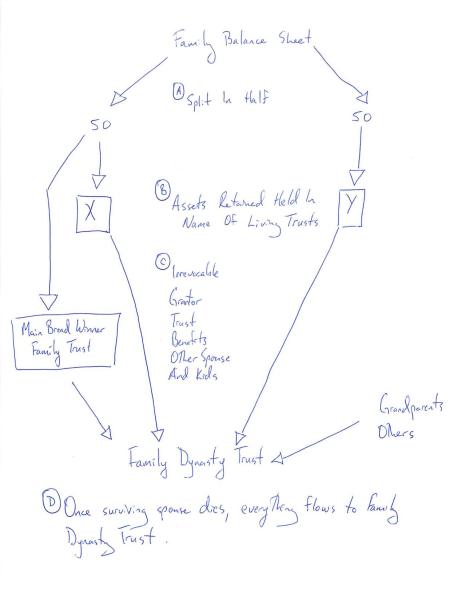
Was chatting with a doctor buddy and ran through a potential legal structure for an American family that contains one, or more, high earners.

It goes like this (picture at the bottom)…

Step One: Once you get married, you split the family balance sheet in half.

Step Two: As you have kids you:

  • set up 529 accounts for each kid 
  • set up minor accounts for each kid

Gift into kids 529 and minor accounts as desired and subject to gifting rules. 

Step Three: Main wage earner, often this is spouse with greatest potential for adverse legal judgements, gifts some, or all, of balance sheet to an irrevocable Grantor Trust that benefits other spouse and kids. Note – irrevocable. You can insert clause that spouses need to be together for a spouse to benefit else kids only. Look into lifetime gift and generation skipping tax exemptions for Settlor of the Grantor Trust. Never gift capital that you might need in your lifetime.

Step Four: Both spouses hold residual assets in name of revocable living trusts. Wills are structured to flow assets to Living Trusts. This makes it easier for your survivors to administer your affairs.

Step Five: Dynasty Trust receives any elder generation inheritance or gifting. This is to avoid taking capital directly that one generation is likely to pass to their kids or grandkids. Consult an expert about generation skipping taxes.

Step Six: All wills and living trusts flow funds to Dynasty Trust eventually.

Capacity to create, and implications of, the above structure vary by jurisdiction so take professional advice. This is a gross simplification but will point you, or your professional adviser, in the right direction.

A picture of the structure follows…

Family Legal Structure

This shows why people call the estate tax a voluntary tax and one way families structure around tax.