Should I Sell My House

Spring has seen a surge in the Boulder property market. As a result of the surge, many locals are considering selling their homes, or investment properties. I am going to share how I try to make better decisions with real estate.

First Step: Gather Information

Start with a family budget that lays out expenses and revenues for the next twelve months. Once created, budgets are easy to maintain.

A technique that I use as a budget reality check is comparing cash that leaves our family bank account (for a month, or a quarter) against our projected expenses. Over the years, I’ve had some surprises by comparing “cash out” to budgeted expenses.

The next step is gathering income and expense details for your key assets. In my family, we make this easy for ourselves by having a separate “house account” which pays out everything that’s house related. In my property business we track everything by property.

To help you out, page 55 of my recent book has a list of expenses as well as detailed case studies for various types of property investments.

If you resist pulling this information together then consider if you are seeking to hide something from yourself. I’ve been known to resist gathering information when it might contain bad news!

Step Two: Pull the information together for the target property.

Here’s an example from where I used to live. I’ve adjusted the figures to reflect expenses per $100,000 of house value.

If I rent the house then I have to pay:

  • Rental Agent Commission – $321
  • Insurance – $180
  • Taxes – $677
  • Maintenance – $136
  • Furniture Removal – $85
  • Mortgage – none for this property
  • Utilities – tenant pays
  • Damage & Hassle – possibly material, property is in excellent condition and ready for sale

Against that I have a rental projection of $5,145 per annum (per $100,000 of house value). Round numbers, the property is forecast to yield 3.7% [(5,145 less 1,399) divided by 100,000].

If you have a mortgage against the property then remember to consider the return on investment with, and without, your mortgage.

  • Yield on valuation – take your net profit before interest and divide by the net value of the property (after sales commission and capital gains tax)
  • Yield on equity – take your net profit after interest (exclude the principal amount of your mortgage payment – only include interest) and divide by the net equity that you have in the property

To illustrate, if there was $40,000 of debt per $100,000 of value then the interest payment would be $1,400 at a mortgage rate of 3.5%. The net profit after interest would be $2,346 on $60,000 of equity (3.9% net yield on equity).

Step Three: Consider Big Picture Questions

What will I do with the equity if I sell? For many of us, housing is a form of forced savings. If we had the equity sitting in a bank account then we might be tempted to spend it. If you are thinking about switching to another property investment, then you’re likely to do best by staying put. Property has very high transaction, and switching, costs (due to real estate commissions).

How often can I sell this asset? Certain assets, such as vacation homes, boats, luxury goods, can only be sold in good market conditions. This creates a paradox because your best window to sell will be when you’re tempted to hang on to the assets. If I want to sell then I remind myself to leave something in the deal for the buyer.

Where will you live? If you are thinking about selling your main residence then be clear about where you will move, and the expenses associated with your new location. Generally speaking, prime markets are the first to respond to an uptick. For example, the Boulder market saw this recent surge a year after Palo Alto ticked up. Secondary Colorado markets might take another year to see improvement. What’s been happening in your next location for the last year, how does that compare to your home market?

As an example, the value of my old house now “buys” 30-35% of the square footage in Palo Alto vs Boulder – it used to buy 50-60% of the square footage. When moving between cities, states and countries, timing plays a key role with purchasing power. When moving “prime” to “secondary” – it is possible to get priced out of a market. I’ve seen examples of this in the San Francisco Bay Area, London and Vancouver. If you sell out of a prime market then values can rise and make it very tough to buy back in.

What does your current mortgage, insurance and taxes “buy” if you were to shift to a rental unit? I like to compare own vs rent. My current house would cost me $1,000 per month more to rent than to own. This is a function of the down payment I put down and covered in my article on Mortgage Debt As Inflation Insurance.

What’s your tax exposure ? Agent’s fees and realized capital gains can make moving from owning to renting less attractive. As a landlord, being able to depreciate the house (but not the land) will reduce the taxable income generated by the property.

Three final questions that I like to ask myself:

  • Can I afford to be wrong?
  • What happens if I do the opposite?
  • Under what scenarios does my preferred choice become a really lousy decision?

For now, my decision has been to continue to market my old house for sale. However, the yield from renting it out, rather than selling, is compelling.
Understanding Memory

In the recommended reading section, you’ll find three authors that have helped me realize the limits, and benefits, of memory (Cialdini, Kahneman, Munger). Understanding how memory works is helpful for:

  • Creating systems to avoid repeating mistakes
  • Creating schedules to refresh one’s self in the memories of key individuals
  • Understanding how the recent past will skew current decision making
  • ‘Tricking’ yourself into satisfaction

My main system for personal planning is my annual review (an extract from my plan). In my extract, you’ll find notes (some dating back to ancient times) that show how I sustain memories.

A handful of individuals have had a disproportionately positive impact on my life. It’s near impossible to know which situations are going to be “big winners” (hopefully, your spouse and kids score well). Focusing on my “winners” is a strategy that’s served me well.

Two weeks ago, I shared how I map my family eco-system. I’ve found that having fun once a quarter is what it takes to have a strong relationship with people (I don’t live with). Between the quarterly “fun,” I like to work on projects with the key people in my life.

Understanding the impact of the recent past is what I want to discuss today. Specifically, how past memories influence current investment decisions. 

I’ve found that my memory is dominated by the last three years and this is very dangerous for my decision making. An example can been found in our perception of public figures – cast your mind back to:

  • Bill Clinton (impeached in December 1998)
  • Yahoo (peak market cap in January 2000)
  • Tiger Woods (infidelity scandal in November 2009)

The value in understanding the flaws of memory, lies not in keeping ourselves vigilant towards others! The value lies in avoiding traps in our own lives.

Since 2009:

  • the yield on low-risk assets has disappeared
  • investment capital has been tough to find
  • most of us have experienced very low inflation
  • long-term interest rates are the lowest for 150 years

Despite the unique nature of all-of-the-above, most of us expect these situations to prevail for the next three years. In my cognitive world, three-years-backwards and three-years-forwards seems very close to the definition of forever. Some big mistakes are going to be made over the next decade!

Whether I’m feeling stressed about the rate of return on my portfolio, or worried that my kids will never mature… I’m going to give too much weight to the last 18 months and expectations for the next 18 months.

My family history tells me that the near-future (measured ten years out) is going to be nothing like we expect. For 20 years out, we’re totally clueless! 

I would encourage you to pause and consider how the recent past may be skewing current judgements. I’ve been finding mistakes in my own thinking (some potentially worth a lot of money to my family).

I’m going to share a couple of mantras that I use when I’m unsure. The present is so different from the last 50 years that I’m returning to basics:

  • If in doubt then wait
  • The most important part of investing is saving
  • Be patient, wait for panics and mean reversion
  • Collect experiences, not possessions

To end, remember that we can favorably skew the memories of others by having fun with them quarterly!

Finally, ask your spouse (or kids) how often they have fun with you. With the holidays coming up, we can get strategic benefit from fun and strategic gifting (small, frequent and unexpected).

Portfolio Theory

One of the challenges with managing investments is filtering opportuites that present themselves. To make decision making easier, I’ve created a series of filters. I’ll share them and explain a little about each.

Thinking through your own filters can help you avoid mistakes. The deals that end up sucking time, for little return, nearly always fall outside these parameters.

Simple – if something is complicated to manage, or understand, then I don’t bother. This means that I “miss out” on emerging industries and don’t look at technology investments. I acknowledge that the only way I would make money via complexity would be luck, so I skip.

Low cost to hold – holding costly investments hurts, and can force you to sell at poor times.

Focused on long term capital gain – a long horizon reduces the urge to try to make a quick buck by buying things that are cheap. I ask myself, “Where is this investment likely to be in 25 years?”

Liquid in event of capital being required – I’m careful with putting capital into a situation where I might not be able to get it out (at any price).

Tax effective – part of the reason I like residential property is the ability to write off the value of the house against current income. There is a segment of my portfolio that I never expect to sell and the capital gain will “reset” on my death.

If it won’t make a difference then wait – I’m often tempted to make small investments and tinker. History tells me that it’s better to wait and invest only when the fundamentals are extremely compelling.

For advisors that recommend that you to deviate from your principals, consider their financial incentives.


Financial Karma

Having been raised in a Judeo-Christian household, I used to define karma with reference to “sin.” For example, karma is my sins coming back to haunt me. 

Over the last year, I’ve learned a wider definition that goes like this… historical and current choices result in the life I have right now. I prefer that definition as it reminds me that I change the future with decisions today. At 43, our family’s balance sheet is an expression of my financial karma. 

I grew up in Canada, a country where there’s a social contract. The system isn’t perfect but it works for many Canadians. Living in the US, most prefer a model with greater self-reliance. Both systems have their strengths and create different incentives.

The book I referenced last week, makes the point that, historically, people relied on family, rather than government. What are the areas where family support can assist, without screwing up incentives?

As a young man, being an aggressive saver made me happy. I have no idea why, likely a habit that was built from a very young age. With three kids in my house, my desire to sacrifice today, to enable security tomorrow, remains strong. At a deep level, it feels like the right thing to do.

Boulder is an environment with a lot of financial wealth. The focus in Colorado isn’t as consumption-centric, as my previous homes in London and Hong Kong, but my reality is a far more expensive life than what I had created in New Zealand. 

Part of my annual review is asking myself the question, “Am I getting value for money within my current life?” Being honest with myself, the answer is “not yet.”

A key part of this year’s review has been completing a five-year plan to get my family to cash flow breakeven. When I became unemployed at the end of 2008, I gave myself a pass for five years to take stock and see what happened. The four year anniversary of that decision is approaching and I have a good idea where I want to take the family.

Long term, I have been considering the life I want to live in front of my kids. A parent’s life choices are powerful lessons on effort, consumption and strategic management.

I see a benefit to the kids of taking my consumption down. Expectations management is something the Kiwis do very well. All my pals in Christchurch understand the relationship between work-results-satisfaction. It is a very grounded society and I enjoyed my time there.

Consider:

  • What are the most useful elements of financial wealth?
  • What does my life say about my attitudes towards wealth?
  • Are my current choices aligned with my family values?
  • How best to give my kids a chance to be successful: in their own terms, relative to their peers and relative to myself?

I’ll end with book recommendation: Wealth in Families by Collier. Another title that is valuable regardless of your net worth – the sections on anchors and family management contain a lot of good questions for parents to consider.

I measure true wealth in freedom.

How I Allocate Money

When I left my private equity career in 2000, I was able reduce my annual expenditure 90% by moving from Hong Kong to New Zealand. I bought a five-bedroom house for US$25 per sq ft (those were the days) and the income from that property covered my housing expenses. Kiwi health care is government funded and I purchased a top-up policy for my travels.

At the time, my Dad advised me to “take the number that you think you need to retire and triple it.” In 2000, I had neither the desire to retire nor a particular number in mind. His advice proved accurate as I gained clarity on what’s required for me to retire, at any given point.

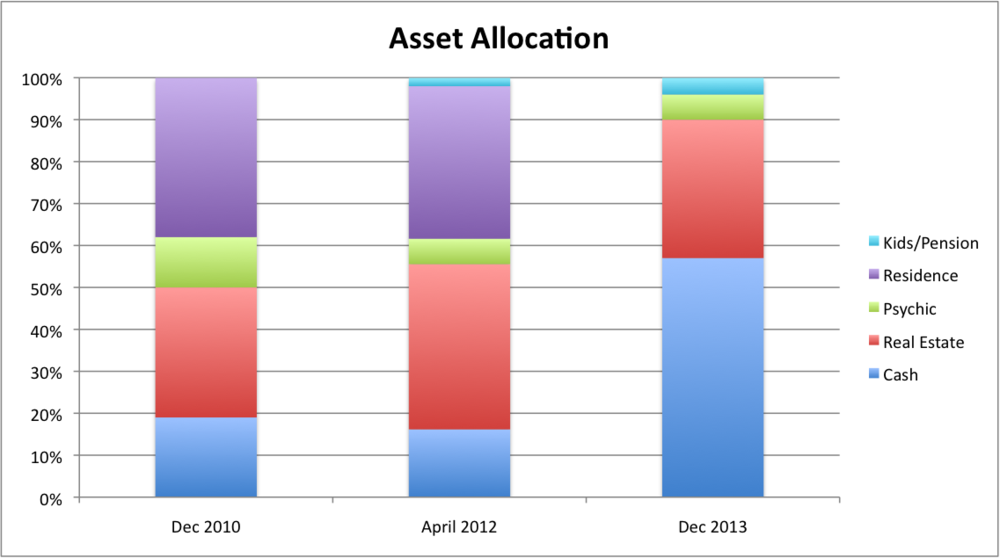
The last time I wrote about asset allocation was December 2010. I shared that my split was 50:50 between assets with postive returns (investments) and assets that had a psychic return. A psychic return is another way of saying the assets depreciate, or cost me money to hold.

Like most people, our house is the largest asset in the family’s balance sheet and the true cost of that asset has been weighing on me. I’ve decided to scratch the itch, sell the house, free the family from being tied to any one location and reallcoate the capital to something productive. It’s been a fascinating study of human psychology as I’ve been living through my biases. 

Right now, we are in the middle column transitioning towards a more liquid position. The pain that we take is leaving our existing house. The benefit, of improved financial health, is invisible to my wife and kids. My daughter’s main concern is bringing the cats to any new residence, so I have her covered.

Byrnfamily

The other major change I have started is allocating capital for my kids’ education, they have 529 accounts, which let gains roll up tax free. I made an error when we started saving for the kids by using a minor custody account, rather than the 529 vehicles. Both the kid’s accounts invest in a low-cost index fund of US equities. I’ve taken a twenty-year view of the markets on their behalf.

Over the last three years, I made a decision to allocate the family’s earned income to a business owned by my wife. This enabled us to start a 401k for her and get her credit rating established. A project for 2012-2013 is setting me up in a similar fashion.

The kids/pension allocation will likely tick up by 2% per annum and be mainly allocated to equities. In a high tax, high rate environment, previous allocations into tax deferred vehicles will be valuable.

Ltr

I lifted the above chart from Barry Ritholtz’s Blog. Ever since I saw that chart, I’ve been asking myself where I want to be when conditions shift back to normal. Conditions are going to shift eventually and we, collectively, give too much weight to the last three years of extremely low rates. 

I’m shifting to cash equivalents to give myself the choice to spend that money (gradually) while I allocate more time to my family and wait for conditions to return to normal. Also, that gives me the flexibility to move quickly if there is another unpleasant shock. My property portfolio was purchased in a four month period when conditions suited me.

I’m willing to foresake a lot of upside, and endure considerable hassle/pain from moving, so that I can be relaxed around the house and have time to love, write and ride.

There’s a leap of faith that I’m going to forget the current pain in a few years time. I enjoy reading old blogs so this is a reminder to myself to check back in.

Rental Property Economics

In May 2008, I wrote up an article about my search for an investment property – makes interesting reading about the state of the market, as I saw it, back then.

My criteria in mid-2008 (just before we hit-the-wall) were:

  • Climate opposite to Boulder, CO
  • Would enjoy using during vacant periods
  • Less than 1% annual holding costs
  • Forecast net yield (after all expenses) 10% over treasuries
  • 50% capital upside over a ten-year view
  • Entry price less than $200 per sq foot
  • Superior location in a prime destination
  • No leverage purchase — don’t reach financially

To a property guy, “prime Arizona” is Scottsdale not Tucson but… “prime” for me means prime cycling and friends!  If that means I trade a little capital appreciation, then I’m OK with that.

Given that I’ve been explaining the Tucson property market to my pals, I thought that I’d run through the case study for you.  When all the smart money says that a market is going to fall 20%, it’s a good time to consider buying.

I’ve been looking at Tucson for three years, mainly to address my goal of winter cycling fitness.  While I’ve had great success with seasonal migration to Australia/New Zealand, it is a very expensive option for my family.  So I’ve been looking to change my winter cycling “cost” into property investment “income”.

Because of my personal, and corporate, position, my downside is a lower cost location to ride with my pals.  This is where my business (Endurance Corner) enables me to protect my downside scenario.  I know other people that do similar things – by locating their company’s office inside a commercial property deal.  You can often create strategic benefits to your investment life, from your working life.

I had considered buying a house in Tucson (still would like to) but the holding costs are too high and they are far tougher to manage for investment income.  I even know the exact house but can’t bring myself to increase my personal overheads.

When adding up your uses of cash be sure to include:

  • Purchase Price
  • Transfer Fees
  • Taxes – I pre-fund the first year in my mind
  • Insurance – if you pay HOA then the external building is probably covered, but you’ll need coverage for the inside and your fixtures/fittings/furniture
  • HOA Terms – most places have restrictions on property use, read these as they can bite you in the bum – similar to taxes, I pre-fund a year’s worth of taxes in my calculations.  Make sure the seller is picking up HOA and tax arrears on the property.
  • Furniture – depending on taste, you’re looking at $5-20 for a reasonable specification.  My advice is “under buy” on furniture for a rental property.  It will get trashed and it’s worth NOTHING if you have to sell it.  If you buy more than one condo (for investment) then consider leaving one unfurnished so you have a fall back in case you need to unload one of your units.
  • Repairs – I’ve been looking at foreclosed properties.  Often these have damages and require extensive repairs.  Estimate the cost to repair, double your estimate and subtract that from your bid price.  Also, double the time that you expect the repairs to take.  Budget your holding costs (HOA, taxes, utilities) for the extended repair period.
  • Closing Costs – about $1,500 for a standard completion, seek to split these with the vendor.

Taking all of the above into account, Tucson is currently selling for ~$70-90 per sq ft (furnished).  That’s cheap.

It’s cheap for a reason, there are relentless foreclosures because mortgages are oustanding at $150 per sq ft.  While the foreclosures work through the market, there will be no capital appreciation and it will be near impossible for a non-bank owner to achieve a decent price.  

When estimating your prospective return remember to include:

  • Water – often covered by your HOA, which surprises me in a desert.
  • Telephone / Cable – if you go for direct TV make sure you can mount the dish with a southern aspect and your HOA allows dishes.  Have the Direct TV guy wire the dish into your cable system (already wired in your condo probably).
  • Electricity – if disconnected allow for getting a city permit to reconnect.
  • Appliances – if missing then make sure your dryer door will open when installed – we had a little snafu with on of our purchases.
  • Vacancy rates – take whatever vacancy rate you think you can achieve and increase it by 25% — still OK with the deal?  Also, how are you going to rent the property off-peak?
  • Own use periods – Southwest has $49 one-way flights to Tucson from Denver.  Sounds cheap, but… $50 bike fee each way and $70 per week parking fee (for my car at the airport).  So it’s a minimum of $270 per trip for me to head down.  Closer to $500 with taxes and a car rental.

Other issues:

  1. Make sure you’re clear with the agent about your intended use – some foreclosed properties are sold on the condition that it is our main residence.
  2. To get the best pricing, you’ll want to offer a cash deal, quick completion and buy on a “as is” basis.  
  3. It is very tough to raise debt finance for investment property but it won’t be that way forever.  While I wouldn’t count on it, I suspect that money to refinance will be available down the road, after you have a three to five year track record of rental income.  Within my own projections, I can see a scenarion 
  4. What can go wrong – consider your exposure to long vacancy periods, fire, theft, furniture damage, and aircon bills.  You will get hit with all of these eventually.
  5. Banks are under pressure to unload foreclosed properties and bankers are handling a huge number of transactions.  Therefore, it makes sense to increase your margin of safety with your bids.  As we move out of peak season, the banks know that they will be looking at HOA, taxes and maintenance for the entire low season.  Mid-summer could be an excellent time to pick up SunBelt real estate at highly attractive prices.

Remember that property is “easy in” but “difficult out.”  Make sure you are able to hold for at least five years.  It could be a rough ride but it looks like a good bet to me.

Tweet me any follow up questions and I’ll try to cover.

Valuing Real Estate

In the property markets that I follow, the second half of 2010 saw a material change in price expectations. Asking prices as well as achieved prices are heading down, significantly.

A number of factors are driving this phenomenon:
Time: our memory of the past is dominated by our experience over the previous three years.  The property market is in its third year of poor performance.  As a result, we are starting to trend the recent past to future expectations.  While things have been awful, I don’t think that awful will continue indefinately.

Cash: refinancing became difficult in mid-2008.  Many owners have been writing mortgage checks for the last 30 months and each of those checks can cause a little bit of pain.  Foreclosures and unemployment remain high – more pain.

Sentiment: deals that are being completed, in all markets, are being done at 25-60% off peak values.  Residential real estate is very much a word off mouth market.  While people used to brag about how much their property was worth, current chattering centers around repossessions, downward price adjustments and low entry prices.

Availability of Debt: I dropped by my bank this week to talk mortgage and business loans.  Suffice to say, it is a very difficult debt market right now. Lack of funding drives prices down.  Remember that money will not always be tight.

Expectations for residential property are as bad as I can remember.  The last time things were this negative was 1990, when base rates were in the teens and I was working in London.  Interestingly, imagine what would happen to the market if long rates return to historical averages?  It would be a short term disaster and a fantastic buying opportunity.  If the big moves in rates (over the last three days) continues then there will be a lot of pain around.

Why buy real estate?
The Great Inflation of asset prices ran from 1992-2008 in most markets.  If you are under 45 then those market conditions are the only ones we have ever known.  It’s worth reading a copy of Irrational Exuberance to understand how assets normally behave.  Pay particular attention to mean reversion of returns and long term rates of real return.

I want to own real estate for a number of reasons:

  • The option value of land;
  • To receive a net yield; and
  • As a store of real purchasing power.

Personally, I benefit through the option to downsize where I live by moving into one of my rental units.  This option is not available with a bond/stock portfolio.

What’s a reasonable net yield?  Ten year US govt bonds are ~3.5% (big moves this week).  Safe but no upside in the value of your capital.

What I do is compare a range of bond benchmarks to the prospective net yield of the target property.

When I calculate yield, I factor in the broken furnace, the roof repair, the tree trimming, the radon mitigation, the gas leak with the stove, insurance, taxes and vacancy period.  Many people forget about these sorts of issues and overestimate their true net CASH yield.

With properties that I bought in 2010, my net cash yield for 2010 will be zero.  That’s ok, as it links to my current year benchmark (check your savings account yield).  My prospective net cash yield is about 3%.  Not massive but considering my alternatives, and goals, sufficient.

Now my yield expectation is 3% but I priced the deals at 4-10% to achieve that net.  That is my margin of safety and reflects that, even with appropriate due diligence, stuff always pops up when you shift from buyer to owner.  By the way, stuff pops up in all types of markets.  Remember to insure your Black Swans.

The target yield that’s appropriate depends on:

  • Your alternative use for the funds;
  • Your view on the prospects for the people that live in that neighborhood and the local economy; and
  • The amount of land with the property, alternative uses for that site and redevelopment/subdivision opportunities.

The better the prospects, and the greater the option values, the lower the current yield I am willing to accept.

There are no fixed rules but with research and common sense you can decide on a fair deal.  That fair deal is your valuation.  The amount under valuation (that you pay) is your margin of safety.  Try to arrive at your valuation independent from asking prices.  What I do to figure my target yield for different types of deals.  Then I head to the market to find those deals.  I am selective with the type and look in a narrow geography (down to specific streets and developments).

Be careful with property investments.  They are easy to get into and can be difficult/expensive to exit.

Understanding Your Financial Funnel

Financial_funnel

A number of readers have reached out to me saying, essentially… “like the blog but have no idea how to apply it.”  Today, I’ll explain how I allocate time.

The two most precious things in my life are time and personal freedom. I wonder how many more times I’ll have the chance to rake leaves and enjoy Thanksgiving dinner with Monica.  I also realize that life could strip away everything I have at short notice.  With these thoughts in my head, it can be tempting to live in the moment.  That’s a good thing right?  I’m not so sure.  The human condition gives too much weight to the present.  My life today is enjoyable because I’ve made a habit of enjoying (today) preparing for tomorrow.

Yesterday I thought about the five things that had the greatest impact on my financial life.

  1. A childhood habit to save a portion of everything I earned
  2. Selling my best investments early – never squeezing the last dollar
  3. Consistent bad luck with gambling – early negative feedback on speculation
  4. Good luck – starting my career with one of the most successful investment teams in history
  5. A 20-year cycle of declining interest rates

Education, peer group, personal network and work ethic had an impact as well.  I guess that’s a list of nine items.  

How do we use daily action to create our life situation?  The #1 thing for me is optimizing where I spend my time.  I have a very low tolerance for things that don’t advance my personal agenda.  Sounds a bit cold but our agenda can be anything (world peace, matrimonial success, helping our kids).  It need not (and probably should not) be optimizing our bank account.  

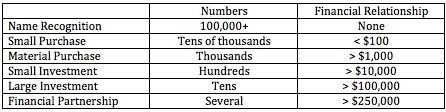
The paradox of financial stability is people that are the most uncomfortable with wealth have the most to gain from improving their relationship with their Financial Funnel.  What’s the funnel?  I drew mine for you above.

The graphic that I produced is an example of comparing reach (people) vs financial relationship (in dollars).  It will change across our lives and well as through the natural ups and downs of our financial situation.

I also think that it would be insightful to add a fourth column that shows where we spend our time on a daily/weekly/annual basis.  Your time is valuable and you increase your return per hour by focusing on the narrow end of your funnel.

Consider where the following fit:

  • Email
  • Facebook, Twitter, YouTube
  • Meetings
  • Social obligations
  • Chat forums
  • Television, video, internet

I often make a list of the key people in my life and make sure that I am responsive to them.  This is very hard to do consistently!  The wide end of the funnel is an easy place to spend low-value reactive time – rather than proactive action at the valuable end.  I could easily spend my entire life on a legacy of chat forum posts and sent mail – while my young family lives downstairs from my home office.

Once in a lifetime…

Lifestyle Hedging

If all you did was watch TV and read the newspaper then it would be easy to conclude that the main benefit of wealth is stuff.  In fact, people that fail to accumulate wealth often have a preoccupation with acquiring stuff.


In my life, “stuff” works against my goal of maintaining freedom of location and occupation.  I construct my personal strategy to:  


— Maximize freedom

— Protect against things that scare, or can unexpectedly hurt, me

— Play on human idiosyncrasies with regards to rewards


For what follows I’m going to use the word “investment” but what I’m really talking about is a proxy for material amounts of personal energy — it could be a child, a job, a business, a thought you can’t shake, a hobby, a race… ultimately, it all boils down to energy and time.

For now, let’s leave aside ego and envy!

+++

Freedom — My investments exist to support the life I want to lead.  Items that require me to invest large amounts of time, stress, or worry need to be carefully considered.  There are many situations where you could be paid quite well but they aren’t worth your time.  

Ask these questions before you do the deal:

 — how can this deal hurt me;

 — how will I manage this situation;

 — who’s going to monitor this situation.


If the answers point to an impairment of my personal freedom then I won’t invest.  

Remember, what really kills you in a bad deal is all the time (and emotional energy) that you waste trying to sort out a losing situation.  You can earn back the money – you never get back the time!

Fear and Black Swans — collectively, we are poor at estimating the likelihood of adverse events.  We also tend to be blind to unlikely events that would be really bad for us.  A great book that you should read is The Black Swan – Taleb says it very well.

Rewards — lots of little rewards make me happier than single big rewards.  My favorite example is checks in the mail.  I love it – a letter and money!  The psychic value of opening the letter, stamping the check, filling out the deposit slip and riding to the bank… it’s real.

So, when I talk about a Lifestyle Hedge, I’m looking for investments that fit into the above structure.  Collectively, I want my portfolio to maintain my freedom, address my fears, insure against Black Swans and be tilted towards my idiosyncratic reward profile.

Let’s get into a current case study.

+++

The media is all over whether Quantitative Easing will spark inflation or the Great Unwinding will result in Japanese-style deflation.  What to do?

Hopefully, you’ve done your homework from last week.  Start by whipping out your personal financial assessment.

Inflation — how will your essential/discretionary personal expenditure change over the next decade?  

The things that are going to impact me are: my kids & dependents and my personal choices.  Cost of living changes will have some impact but the change in my cost of living will be controlled by my personal choices.  I control my personal inflation rate.

Deflation — typically, deflation is bad for governments, corporations and heavy borrowers.  The media says that deflation is bad for me but… I don’t see it.  Doesn’t scare me (but I’d be terrified if I was highly leveraged).

Given that governments, corporations and heavy borrowers have more say on monetary policy than individuals that rarely spend more than they earn… I think a good burst of inflation is likely.  


The most recent inflationary burst was asset-based (housing, shares, bonds) – we’ve been living in a period of rampant inflation with financial intermediaries leveraging our society to mask its effects. If you think that inflation was under control for the last decade then you weren’t paying attention to your personal financial assessment.

I protect against inflation by:


— Owning my office, easier when you work at home;

— Working for an operating business that caters to high performers; and

— Organizing training camps for people that share my passion for exercise.


I protect against deflation by doing the exact same things and avoiding personal leverage. From an inflation/deflation point of view, my lifestyle is hedged.

I have additional strategies for Things That Scare Me but that’s enough for this week.


Self-Centered Investing – Financial Assessment

A key aspect that is often missing from discussions about valuation is the investor.  Before we can get to valuing an investment, we need to consider what type of investment makes sense for us.

Experts talk about diversification, asset classes, currencies, hedging, inflation, deflation, capital structure… but they rarely talk about you — specifically, your fears, your defensive position and your desired lifestyle.

As well, we tend to have a romantic notion, supported via financial marketing, that investing is designed to make us rich so we can retire to a life a leisure.  

For me, reality is far different

+++ 

Here’s the process I go through to optimize my portfolio structure.  Three types of financial information are required:

#1 – An accurate income statement // clearly lay out the money coming in and the money going out – I like to look forward 12 months and review quarterly to check against actual figures.  

#2 – An accurate balance sheet // lay out all your assets and liabilities – for each of the assets/liabilities note all benefits/costs (financial, time and hassle) in a column beside them.

#3 – Create a cash flow statement that links your income statement with your balance sheet — this will let you understand how you are financing your life. If you are living off borrowings (borrowed time) then best to make that highly visible.

You can find tools for the above with a quick google search.  With my expenses, I write them down as detailed as possible then clump them into three categories: essential, discretionary and luxury.

Ultimately, your expenses and savings goals will drive the amount that you have to work.  Therefore, expense visibility, and control, is an essential step of maintaining your personal freedom.

+++

Now that you have a clear picture of your financial position, consider:

Your Desired Lifestyle – how do you want to live, what’s that going to take // work to convert collecting these experiences into sources of income

Black Swans – unexpected, adverse events (I like to structure my assets to protect myself, and my family) // consider how to hedge these

Macro Trends – what happens to your life if economic trends change (employment, interest rates, inflation, deflation) – focus on mitigating the changes that would impair your quality of life.

I’ll cover my take on these topics next week with a piece on Lifestyle Hedging.

The value in a portfolio comes from peace of mind and the life it enables you to lead.