What Do We Need To Retire?

My post showing how a 1.2% fee differential can cost you 131% of your pension contributions inspired Paul Meloan to write an article about The Clear Value of Financial Planning. The article lays out Paul’s case for his work in the field.

To help you understand the cost/benefit relationship, have your advisers write out the dollar amounts that you’re paying in fees, expenses and taxes. Be sure they include all the soft costs that are buried in your mutual funds.

In Paul’s article, he lays out questions for a family to consider. I thought I’d answer these questions, as viewed from a life outside the box.

#1 – How large of a pool of assets do my significant other and I require in order to live in the manner which we desire for the rest of our lives?

The most important thing for you to remember is to declare victory immediately. You have more than you need and are in a position to think about the future. Many, many people are less fortunate than you. Spending time with the less fortunate will temper your needs and get you to financial freedom more quickly.

The financial services industry is built backwards from your true needs. If you listen carefully then you can hear the industry say, “you can be happy tomorrow if you have more.”

Be happy now, with less.

I recommend that you flip question #1. When I look at my family’s net worth, I express it in terms of “years of current expenditure.”

For example, if your net worth is $500,000 (Assets Minus Liabilities) and your current expenditure is $125,000 per annum then you have FOUR years of current expenditure (500,000 / 125,000).

Why is this is a useful way to consider your position? It’s useful because it changes the conversation from

  • What do I need to be happy tomorrow?; towards
  • How can I spend wisely today?

The years-to-burn exercise reminds me that the fastest way to improve my financial position is to reduce my current expenditure, not take more risk.

In terms of years-to-burn, my peak wealth was 13 years ago. I was living out of a Subaru and sleeping on a friend’s floor in LA. My life was extremely simple – eat, sleep, train. It was one of the happiest periods of my life and my net worth was 1/6th of right now.

It’s worth repeating… I increased my net worth by 600% and feel less wealthy.

Historically, most my spending has been wasted.

  • luxury air travel
  • high-end hotels
  • excessive childcare
  • personal assistants
  • office space
  • non-performing assets
  • personal luxury expenditure (clothes, cars, boats, vacations)

I ditched most of these because I discovered that they were bandaids healing myself from a lack of satisfaction with daily living. My spending was driven by our culture rather than my needs.

Choose your hometown and your buddies carefully! I assure you that the exact same family will have needs that vary by geography. Consider:

  • Manhattan vs Boulder
  • Aspen vs Truckee
  • Palo Alto vs Greenville
  • Santa Barbara vs Hood River

I came close to moving to Palo Alto to spend more time with my pals (love you guys and gals). It would have changed my life – not better, not worse – but absolutely different.

The more time that you spend helping people that have less than you, the smaller your retirement fund will “need” to be. There are examples of this all around us.

Finally, the benefit of wealth is not to leave work. The benefit is to feel secure enough to choose meaningful work, regardless of compensation. Hang out with people that are rich in personal satisfaction (artists, priests, teachers, ministers, caregivers, coaches, guides) – you’ll know them when you speak with them.

#2 – What should be the composition of that pool of assets, and how should they relate to each other in terms of risk and expected returns?

You can beat all of your pals by using Bogle’s Little Book of Common Sense Investing.

As a bonus, the strategy is simple to understand and easy to execute.

If you can’t figure the book out then call Vanguard and they will help you in exchange for a fixed price fee when you need help.

If you keep screwing up then get yourself a financial coach and pay a fixed fee to hold you to your plan.

We all do better when someone is watching – that’s why I have a blog.

Restructuring and Rebalancing My Portfolio

At the end of May, I did my first rebalancing exercise. This required a fair amount of preparation:

  1. Setting up an individual 401K under my consulting company
  2. Checking my family cash flow for the next 90 days and making sure I had 120 days worth of reserves
  3. Getting a home equity line of credit to cover financial emergencies
  4. Moving legacy retirement funds to the appropriate (pre- or post-tax) IRA account
  5. Shifting my current IRA assets to Vanguard
  6. Making a table that showed where everything ended up, and what it held
  7. Deciding on my desired portfolio mix
  8. Considering tax implications of the restructuring that was implied by my mix
  9. Executing the strategy

The exercise above required wading through admin, building spreadsheets and carefully mapping things out. It’s worth getting specialist advice from a CPA because if you screw up then you can get hit with penalties and/or trigger capital gains taxes.

It’s a pain, and finance companies do not make it easy to move your business away.

Considering fees saved, I earned $1,000 for each hour of my time. I’ve seen cases where families could save up to $10,000 per hour.

Financial inertia can be extremely costly!

My decisions were the result of this year’s reading. I started with the short, free eBook, If You Can, and worked through the author’s recommended reading.

I used Vanguard funds and the expense ratio for my portfolio is less than 0.1% per annum.

Have you asked your adviser to explain your total cost of ownership? Following my blog on expenses, a friend called his adviser, asked the question and was transferred to a call center! He’s still waiting for an answer, they said it would “take a while to pull things together.”

For what it’s worth, my portfolio criteria are:

  • Simple
  • Low cost to hold
  • Focused on long term capital gain
  • Liquid in event of capital being required
  • Tax effective
  • If it won’t make a difference to my overall situation then wait

Like the behavioral finance books say, it was hard to sell the equity funds with the markets at all-time highs.

Now the tough part, resist tinkering and tracking.

Setting Family Financial Priorities – College and Retirement

wedding_day

What’s next? It’s tempting to think about my kids. College accounts are on my list but they aren’t the next priority.

Why?

Because kids that will be successful don’t need much help and the family (particularly a financially responsible child) gains by not having to pay for Mom and Dad’s Golden Years.

Education has an mixed return on investment. Here’s my article on how families blow more than $1 million per kid. It’s a rare family that looks at education in terms of return on investment.

+++

If you want to give your family a leg up then take care of yourself. Do this by max’ing out your retirement accounts – especially anything with an employer match.

I have a single member 401K under my consulting business. If you’re self-employed then you can find out your options by getting in touch with Vanguard.

I spent Friday afternoon shifting my retirement assets and Vanguard has an online tool that the self-employed might find useful.

+++

What about college?

In current dollars, my pals that have put their kids through college have spent $200,000 per kid.

That’s $600,000 for my family of three – ignoring grad school.

Considering my entire family tree, there is no way the family would earn a reasonable return on that level of investment. Of course, my mind likes to tell me that MY kids will be different!

Thinking about the opportunity cost of $600,000:

  • A lifetime annuity of ~$2,400 per month – starting now
  • We could move into one of the best public school districts in the country
  • We could buy three rental properties and teach our kids about money by having them involved in deciding to borrow against the properties (or not) to fund their educations. The kids could receive a direct financial benefit from minimizing the cost (if any) of their educations
  • We could help send a dozen kids to grad school
  • We could back a family member to buy into an established professional practice
  • We could work less (for the rest of our lives) and make the world a better place
  • We could live abroad long enough for the kids to become bilingual (or to gain residency in a country with free education, national health care and retirement support)
  • We could improve the lives of thousands of people in the developing world (schools, safe drinking water, medical care)

The ideas above ignore the cost of the misery that we give ourselves worrying about funding college!

Given that I’m unsure that the family wants to support three college educations, we are working towards funding one college education spread between three 529 accounts.

Total annual contributions to college funds can be $14,000 per kid, per parent => a potential investment of $84,000 per annum for a two-parent family with three kids.

For all but the top 2% of US earners, paying for everything will be out of reach.

Don’t beat yourself up.

The best thing I can do for my family is love them and work on continually improving myself. I’ve come to see the benefits of my constraints.

Setting Family Financial Priorities – Healthcare

Over the last ten years, my family has incurred well over $300,000 of medical bills – births, broken wrists, malpractice, sick kids, MRIs – it all adds up.

In my family budget, I include my premiums ($7,872) and my entire deductible ($7,500). We fund our deductible via our HSA ($6,550 family contribution limit in 2014) and top up when required. The HSA is funded automatically each month so I’m forced to save that money. Most US Bank’s have a subsidiary that can help you set up an HSA.

$15,000 per annum is a lot of money but most years, we “save” a dollar for each dollar we pay out.

BellaFor example, my daughter spent 4 nights in the hospital:

  • $18,500 retail price became $8,500 after discounts given to my insurer
  • $8,500 bill blew through our deductible so we received a $7,500 invoice
  • We had previously saved $5,000 in our HSA so…

End result… I write an unexpected check for $2,500 instead of $18,500.

Health insurance offers up some benefits:

  • Cap our potential liability
  • Access the discounted rates offered to our insurance company
  • Pay automatically (direct debit insurance payments and HSA contributions)

Sidebar: work with health benefits would be a valuable addition to our family. A decent health plan could save us $15,000 per annum.

+++

My next investment is a long-term care policy – about $5,000 per annum for the two of us. Even though the likelihood of payout on the policy is remote – for now – the policy gives me a lot of comfort in case tragedy strikes my wife, or me.

More on this in a post from 2010.

If I couldn’t afford my retirement investments then I’d skip the long-term care insurance, it has a low expected return on investment.

Getting Crushed Financially

Market Moves

I love this chart.

Blow it up, print it out and study!

Jerry created the chart to show nearly a century of bull markets but what caught my eye was the nature of the eight bear markets.

  • Duration of 3 to 34 months
  • Scale of loss (peak to trough) of 22 to 84%

If you’re an investor then it’s important to realize that it is perfectly normal that you’ll get crushed once a decade. Knowing that it’s normal won’t make it hurt less, but it might make you realize that your pain is temporary.

Personally, my worst bear market was 2008. It was a doozy.

In the space of six months:

  • my family’s net worth fell 65%
  • I lost my job
  • My dependents doubled
  • I discovered that my (joint & several) partner was involved with fraudulent activity
  • I was exposed to the risk of civil prosecution

Absolutely awful.

I share this story to help you remember that THE world isn’t ending when YOUR world collapses.

Setbacks are part of life and my making it 20 years without a major financial setback was abnormal. In fact, I had several setbacks along the way (15% hits) that I’d forgotten.

Save the chart for a rainy day and I’ll retweet at the next recession.

Checking In With Your Real Estate Investments

Today’s article is longer than usual (1,150 words) but it’s worth big money to most families. I’m going to run through how you review a property investment. I use a version of this template for every property deal that I consider.

I make the cost of property ownership visible to my family. This habit keeps me from buying too large a property, or leaving valuable assets empty most of the year.

If you can’t calculate the sums before you buy then wait.

If you remember one thing from this article… act as if you will “lose” 10% of your purchase price the day you buy.

Let’s get started!

First: Calculate Net Realizable Value – What Happens If You Sell?

Start by coming to a view on current market value. To estimate market value, lay out the different options available. Be conservative, I’ve been known to fool myself with a dream value that has no chance of being realized.

In the case of the sample property, I have a wide range of options to value:

  • Dream value – $1,000,000
  • Estimate from Zillow.Com – $949,795
  • Have the owners ask local agents what they think – $925,000
  • Old appraisal – $850,000 (Nov 2012)
  • Assessment value from the city – $830,000 (end 2013)
  • Written down tax basis – $792,772

The tax basis of the property is your allowable cost, plus additions that are capitalized, less depreciation that you’ve taken against your taxes. When you buy a property, you have to allocate the cost between buildings (depreciable) and land (not depreciable). I usually use the appraisal that was done at the time of purchase, or figures from the county assessor’s office.

With this property, I know that the owners checked with local real estate agents and applied a discount to what the agents told them. So, for the purposes of this exercise, I’m going to use the Owner’s Valuation of $925,000.

When you sell, you don’t get the gross value. I account for sales expenses by taking 94% of the gross value. In our example, that leaves $869,500 (94% of $925,000).

The next step is to strip out any capital gains tax that would be payable. In this case, I know the family has an effective capital gains tax rate of 25% (including State). So we take the net price ($869,500) and deduct the taxable basis ($792,772) to get the taxable gain of $76,728. Taking 25% of the gain gives a capital gains tax liability of $19,182.

So the net realizable value for the property is $869,500 less $19,182 => $850,318.

Note that the net realizable value is FAR LESS than the gross value.

Rule of thumb: the market usually needs to rise 10% for you to get your money back.

I assume that I lose 10% of the purchase price on the day I buy. This assumption makes me reluctant to buy, which has saved me from many poor investments!

As an asset class, real estate is costly to own, illiquid and expensive to sell. Do your sums before purchasing.

Next: Figure Out The Cash Flow Before, and After Financing

For the next bit, you probably want to print the article out, grab a pencil and make notes for your own property.

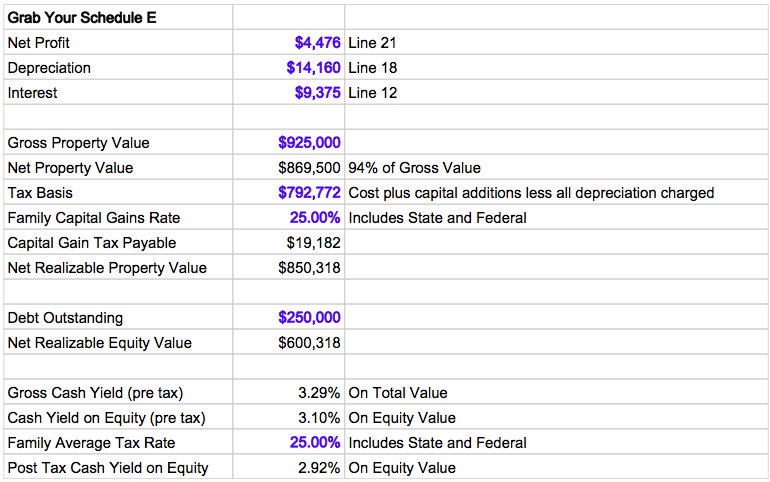
If you can’t handle the pencil/paper method then this is a link to a spreadsheet that will do the calculations for you – make your own copy and fill in the Blue Cells. A picture of the spreadsheet is below.

Property Data SetStart with your net income after all expenses and depreciation. If you live in the US then pull up your Schedule E and look on Line 21 – in this case the net income was $4,476.

I recommend separate bank accounts for your main house expenses and any property investments. This makes it easier to track expenses by property.

To calculate cash flow before interest, we need to add back interest – Line 12 in the US – $9,375.

At this stage, I like to make a note about the total debt outstanding and the interest rate you pay – in our example the debt is $250,000 at a rate of 3.75%. Remember that you only want to count interest paid, not principal repayments.

Revenue Less Expenses ($4,476), Add Back Interest ($9,375) gives you $13,851 of profit before interest expense.

Because depreciation is a non-cash expense, you add depreciation back to calculate cash flow before interest and depreciation. In the US see Line 18 – $14,160 for this case study.

So the total net cash flow (before interest and depreciation) is $13,851 + $14,160 = $28,011.

To check the gross cash yield on the property you divide cash flow before interest and depreciation by the gross net realizable value. $28,011  / $850,318 = 3.3%.

3.3% is the gross yield and ignores the mortgage that is in place. The gross yield tells you the cash that the asset is generating. To figure out how your equity is performing, you need to adjust for the debt that was used to purchase the property.

Let’s adjust for interest and debt.

  • $28,011 less interest of $9,375 gives $18,636 of cash flow after interest
  • Net Realizable Value of $850,318 less debt of $250,000 gives $600,318 net realizable equity value. The equity is the value of “your money” in the deal.

$18,636 / $600,318 = 3.1% return on equity

Consider Taxes

Note that the 3.1% return on equity (above) does not take into account Income Taxes (federal and state) that would be payable on the net income. I know that the owners have an average income tax rate of 25%.

With real estate, your taxable profit is reduced by depreciation charges. So you take the net profit after interest and depreciation ($4,476) and multiply by your tax rate (25%) to get taxes payable of $1,119.

Income taxes reduce the return on equity to 2.9% – calculated as  ($18,636 – $1,117) / $600,318.

If you are able to hold for a long time then property can be a tax effective way for you to invest your money. Note that, in this example, the effective tax rate is 6% ($1,117 / $18,636).

Remember to estimate your taxes on the income after interest and depreciation.

Finally: Step Back and Consider The Big Picture

Now you have the financial information required to consider the deal (buy, hold, sell, refinance).

Questions I consider:

  1. What are the family’s overall financial goals and how does this property fit into these goals?
  2. How large is this asset class as a percentage of the family’s total balance sheet?
  3. What are the alternative uses of the equity in this property?
  4. Are there debts that cost more than this property is yielding?
  5. Are there large capital sums that will be paid in future years (roof, structural, local energy regulations)? If yes, then consider if you need to adjust value or increase future expense budgets.
  6. Consider the sustainable yield. Know that by adding back the depreciation, you have made an assumption that you won’t have to replenish the building any faster than your current year repairs budget. If the current year was a light expense year then are fooling yourself on the true yield that you’ll be receiving.

Ideally, you will have done ALL these calculations BEFORE you bought the property. If you did the calculations then pull them out and compare your budget to actual experience.

Update your numbers each May and track your investment over time.

You can find more about property investing in my free book available for download here.

If you’re curious about my thoughts… I like this deal because it sits beside a downtown core with strong economic growth. It’s yielding nearly 3% after tax and has excellent prospects for continued capital growth. Down the road, owners can retire to this property, rent out one of the units and live in the other at a low net cost.

Hidden Costs of Investing

My career in finance was built on our collective reluctance to act on what I’m about to explain.

I know that it’s a pain to change who manages your assets. However, you give up a TON of money by not forcing yourself to choose the lowest cost provider.

How much? Let’s see if we can find out!

Active

I’m 45 years old and I want to draw down my retirement assets at 70. For each $100,000 of my portfolio, what does it cost me to use active management vs the lowest cost provider of passive management?

The table above assumes that you’re not getting (legally) ripped off. A fee/expense differential of 1.2% per annum isn’t out of the ordinary. I’ve worked with vehicles that had total fees and expenses of up to 5% per annum.

The number that should catch your eye is $131,853 OF LOST RETURN per $100,000 OF INVESTMENT. The extra 1.2% of fees means you miss out on the equivalent of 131% of your initial investment over the life of this deal.

By the way, when I help people review the true cost of their portfolios, their fees and expenses are usually more than this scenario. I know it hurts to think that you’re being ripped off but please read through to the end!

What about professional investors? They must be smarter, right?

I don’t know about smarter, but I do know that large institutions are treated very well by their managers.

Government pensions, insurance companies and high-net worth families. They have invested with the firms that taught me finance, and we did very well for them. However, we also did very well for ourselves.

We did this by offering terms called “two and twenty” – we received an annual fee of 2% of the assets that we advised and 20% of the gains that we generated. What’s that look like?

Fund

With 10 years at 7%, a passive investor would receive $195,797 for each $100,000 invested. Using the terms of a professional manager, the money back falls to $150,312 per $100,000 invested. The reduction is due to the impact of fees ($32,908) and profit sharing ($12,577).

The pros are giving away 48% of their return. I’ll leave the “why” for Michael Lewis, Taleb and Kahneman to explain.

But it gets better!

If you live in a large American state then, odds are, your state pension invests in something called a “fund-of-funds.” A fund-of-funds is an active manager that invests in “two and twenty” funds. Two sets of fees. The scale of the resulting underperformance is breathtaking.

Why does this matter to you?

Here’s why. A financial adviser that invests your money in a pool of active managers is delivering a fund-of-funds approach to your portfolio (and you’re probably getting screwed by fees).

All of this is legal and has to be disclosed to you (as investor and/or state taxpayer).

If you ask about total, look through cost of investment and your adviser starts stalling, then you have a problem. 

Also be wary when advisers produce a fee example for a “tax-free investor.” You and I pay taxes and most changes in portfolio mix have a cost to us.

TIP: The best investment you can make is knowing the true cost of your investment strategy. Get it done this week!

“Little” percentages cost you big dollars over time.

+++

Make the call and ask… “Fees, expenses, transactions costs, taxes – please tell me everything that I’m paying all the way through to the final investment.”

When you get the information, go compare to what a company like Vanguard can do for you.

Should You Borrow?

Last year, 50% of my cost of living was related to preschool fees and childcare expenses.

This cost can be a source of anxiety, especially when faced with a grumpy toddler. Interestingly, the only cure appears to be: (a) train morning and night; and (b) write an article during the day. If I do that then life seems pretty good.

Another way to counteract the anxiety is to raise enough cash so that I’ve funded my childcare expenses from now until my youngest is in school, five days a week.

I’ve been looking at borrowing against an investment property. Even though it is irrational to borrow (now) to reduce anxiety about a future expense, I’ve been thinking about putting a loan in place.

Here’s my advice to myself. You might find it useful as debt markets improve for borrowers.

+++

Should I borrow?
Generally no.

However, there are some exceptions that have worked for my family.

Housing – A 30-year fixed loan for a well-located home that has a cost of ownership (mortgage, taxes, insurance, repairs) that is materially less than your cost to rent. If you are unlikely to move for a decade then this type of loan can be a great deal.

There’s a lot in the paragraph above: location, buy vs rent analysis, likelihood of staying put and ability to hold long-term. To stack the deck in your favor, each of these characteristics is essential.

Saving – some folks struggle to save. So a mortgage, particularly a shorter duration one (like 15 years), is a form of forced savings that would not otherwise happen. Still, being locked into a location for 15 years is a big commitment, and inappropriate for most young people.

With real estate, on average, I’ve sold within three years. As a result, the investment return is greatly reduced by the large fees and expenses. To encourage myself hesitate, I assume that I’m losing 10% of the purchase price immediately after I buy. This makes it much more attractive to rent, and if that goes well, then buy small.

+++

The freedom that comes from a debt-free life is empowering and, my willingness to do “no deal,” has saved me from many expensive errors.

My hit rate on offers has been less than 35% and I’ve been fortunate to miss out on some deals.

+++

I’ve been thinking about taking out a loan on an investment property that I own. So, I asked my financial adviser his thoughts and he came up with:

Borrow to buy income

Borrow for specific purpose, say, in advance of money coming in later that will repay the loan

Borrow early in one’s career to buy assets that can be used to good affect and which will likely appreciate – eg home mortgages // but remember that being able to move at short notice can be a great way for rapid career advancement

Borrow to avoid selling assets at a bad time market wise – this one is huge and why I like to have a line of credit available to my family (as well as at least one year’s living expenses held in cash)

Borrowing to supplement cash flow is dodgy unless you know how cash flow is going to increase thereby enabling you to repay – this is the classic way the we end up underwater with credit card debt.

In private equity we had a saying – never fund operating losses. In other words, force yourself to cover your cost of living. If you can’t do that then scale back your living. With my childcare costs, I’ve been running an operating loss for five years and it is a source of stress. More debt, to facilitate more spending, is rarely a cure for financial anxiety.

It’s tempting to borrow when the debt markets are good. I’ve found debt to be most useful when:

  • It sits in a company and is non-recourse
  • It is fixed-rate and used to purchase assets that can generate a significant premium to my cost of finance

Where things have gone well, I’ve tended to take a binary approach. I will either invest in a highly leveraged company or, in the case of my personal portfolio, invest in the assets directly, without additional debt.

The key thing to remember is you don’t need to borrow and it’s awful to trade your freedom for something that doesn’t cure your condition.

Aside from professional education, most ‘things’ don’t make a difference – especially when compared to the health benefits of living a lower stress life.

More Than Money – Family Succession Risk

My lawyer leaned across the table, apologized to my wife, and observed…

I don’t get it. Why don’t you just take the money.

I muttered something about Black Swans and protecting my kids. Later, I went home and ran the numbers. There was something I knew but couldn’t articulate.

Here’s what caught my eye

  • 45 year old man
  • Three young kids
  • What’s the probability that I don’t see my youngest graduate college?
  • What’s the probability that I fail to live long enough to train my successor?
  1. Of 100,000 men born in 1968, how many are still living? 94,507
  2. How many are forecast to be around when my youngest exits college? 80,308.
  3. How many are forecast to be around when my oldest is 35 years old? 62,761.

Source: Find The Best.

With a little bit of math, I can calculate my…

  • 20-year mortality => 15%
  • 30-year mortality => 34%

Those numbers are far higher than a Black Swan event. If I was on a board of directors then we’d be working to address the key-person vulnerability for the firm.

Fortunately, courtesy of my young wife, my kids benefit from a 90% expectancy of Mom or Dad making it for another 35 years. You can find a Couple’s Life Expectancy calculator here.

The risk to my family, comes from losing my skill set (financial, legal, strategic, accounting) before we have a succession plan in place. With a big age gap between me and any reasonable successor, the family needs a back up plan. However, my family doesn’t have the financial means to create a Family Office.

Life insurance doesn’t cover the skills and knowledge gap when your family loses an elder. It might give you money to hire outsiders but they nearly always work for their own interest, rather than the interests of your family.

What to do?

My answer has been to start a family council. The council consists of a lawyer, a doctor and a professional fiduciary. All of these individuals:

  • have known my family for 10-30 years
  • share the family’s values
  • have been seen (by our family) to do the right thing, even when inconvenient

I brief the advisers every 3-6 months about what’s happening in the family. I prepare documents for them that explain how we’re structured. I repeat myself a lot. My wife sits in on the meetings.

My annual cost is roughly equal to the Long-Term Care Policy that I carry. Additionally, I get frequent inputs of really good advice from a group of people that I trust to assist my family if I can’t.

When it comes to succession, I suspect that most of us do a better job for our firms than our families.

Working For Your Spouse – Family Tax Planning

In finance and sport, we find participants that make a lot more money than their spouses (bankers, executives, athletes, doctors, lawyers). Even when a couple files jointly, there can be benefits to splitting income.

If you are an athlete then you might want to hire a coach or agent.

If you are a professional then you might have a separate consulting business that requires the services of an administrator, executive assistant or bookkeeper. This separate business might need it’s own office premises and these premises could be located in your home.

Providing there are real services exchanged, at fair market values, there can be benefits to your family with having your spouse own, and run, a separate services business.

The benefits come from:

  • Improved financial power dynamics within your relationship.
  • The ability to compensate a member of your family, for services that you’d have to hire independently.
  • The ability for a younger, or lower earning, family member to qualify to make their own retirement account contributions. See single-k for more information.
  • A reduced overall tax burden by bringing business expenses (occurred by outsiders) into the family’s allowable deductions. Examples might be travel or professional fees.
  • Improving the credit rating of a family member, thereby saving the family money on it’s overall cost of borrowing.

What’s reasonable will vary on your situation and an experienced tax accountant can guide you on what’s appropriate.