Moving Into An Equity Position

A friend asked how to gain equity exposure via the stock market.

I recommended John Bogle’s Book and shared what I do for my own family.

Decide what pot of money to invest – in order of priority

  1. Tax deferred retirement accounts for me and my wife
  2. Tax deferred 529 accounts for my kids’ education
  3. Taxable investment accounts for my family

In Colorado certain 529 accounts also have the benefit of a 1-for-1 deduction from state taxable income in the year of investment. However, the 529 accounts have a higher expense ratio than the funds I access for our retirement accounts (0.45% vs 0.05%). The Colorado state income tax rate is 4.63% so the tax savings helps me justify a higher cost.

For #1 and #3 I prefer to use Vanguard’s Admiral Shares for their Total Stock Market Return Fund (VTSAX) – it has an expense ratio of 0.05%.

I always compare expense ratios for products. For active managers, and fund-of-funds, make sure you get the total expense ratio that looks all the way through the final investment products. Many advisers have a financial incentive to layer fee-generating products and you may have additional taxes due if your portfolio has a lot of (largely unnecessary) churn.

It is important to remember that most people lose the majority of their return via investment churn, taxes and expenses.

Let’s use an actual case study with numbers…

If I wanted to invest $100,000 then I’d move into the position gradually with a fixed dollar amount of VTSAX purchased each week. An example would be $10,000 initial investment (to qualify for the Admiral Shares) then $360 automatically purchased every Wednesday for the next 250 weeks. Five years later, you have your position.

The toughest part about the above strategy is leaving it alone. There will be times when you want to invest more, or less, depending on the emotions involved with following the market. Research shows that our emotions are lousy investment guides. So…

My recommendation is to set the automatic investment at a level that you can sustain FOREVER and leave it alone. Let surplus cash build up in another account and use that for opportunistic investing.

Don’t believe the fallacy that you need a portion of your portfolio “for fun.” The purpose of investing is to earn a return on investment, period. When I want to have fun I go for a bike ride with my pals, I don’t speculate with my family’s capital.

When I do a portfolio review, I look at my total exposure by $ amount and asset class. I review the position “right now” as well as how the position is likely to change, based on future investments, earnings and expenses.

If I’ve lost you at this point then you’re not alone. Sitting down with a financial planner can be extremely valuable. Make sure your adviser makes money by advising you, not selling you products. Firms, like Vanguard, offer financial planning services for a very reasonable fee.

Last week, I shared that I felt over-invested in Real Estate so I’ve made a decision to reduce my holdings. Once I’ve reduced my exposure to real estate, I need to figure out what to do with the cash. Today’s blog post is one option (buy equities over five years). Another option is do “do nothing” and wait for the next crisis. It’s really hard to “do nothing” so, perhaps, I’ll do something really slowly and buy equities over 10+ years.

A long range projection of your family finances (5-10 years) is useful to figure out what dollar amount it makes sense to invest. Consider if you want to retain cash for opportunistic investments: examples might be starting a company; buying investments in a crash; or buying real estate in a recession. In my own life, a handful of opportunistic deals have been what made a difference to my portfolio. These deals were made possible by the ability to deploy cash quickly.

Consider a cash reserve to cover unexpected illness or unemployment. Here’s my post on Lifestyle Insurance. Over and above insurance products, I feel better when I have at least one year’s gross expenses held as a cash reserve. In terms of life changing financial security, here’s my post on Taking Money Off The Table.

I’ve yet to regret selling early – I’m easily frightened by bull markets. A recent trip to the Bay Area set off all kinds of warning bells!

What I’ve described is more generally known as “dollar cost averaging.” John Bogle’s book explains how to use this strategy to give yourself financial security. Highly paid professionals (dentists, doctors and lawyers, particularly) are prone to exploitation by my peers in the financial services industry. Read the book.

A bull market is an ideal time to pause, take stock and ponder long term positions. Right now is when it’s most easy to adjust portfolio strategy.

Taking Money Off The Table

With markets high and interest rates creeping up, some people might be thinking about selling portions of their holdings.

I’ve had the opportunity to “cash out” on more than one occasion. Looking back, I completely missed how freakishly lucky I was to have the opportunity to choose.

One time I didn’t take the money, the other time I did. Both decisions worked out OK so I’ll share my process.

+++

First, when I make a buy/sell decision I try to value the asset independently as well as consider what the situation is worth to me.

For example, my current business (consulting) is worth far more to me than it would be to a third party. Unique benefits are: gives me a voice, allows me to get paid for what I like to do, allowances for vehicles/home office, gives me an opportunity to help my local community, brings me close to my friends.

Always consider the non-financial benefits of your current situation – these are hidden to third parties, who rarely give you value for them.

+++

The biggest decision financial decision of my life was when I chose to hand back a partnership in a private equity firm. I was 31 years old and, while the opportunity cost was huge, I figured that I could get back to my old situation if I was willing to take a pay cut.

Again, I completely missed my extreme good fortune to be able to choose. Not surprisingly, my peers and family thought I was nuts.

Take Home Point: my downside position was my old life back with less money coming in.

Take Home Point: once you get five years living expenses off the table, it gives you flexibility in an uncertain world. I achieved that goal early in my first career and it gave me freedom to take risks. With this goal, the toughest part is lifestyle humility. I was lucky to start my career working for a very humble man.

Implications of Failure/Black Swans: Getting things wrong at 31 wouldn’t have been that big a deal as my fall back plan was asking for my old job back. Consider your fallback plan.

+++

Roll forward five years:

I was out of the PE business for five years, recently married and co-founder of a company that did property development. In the intervening five years, I co-founded a fund management business that was doing well.

Age – 36 years old, still young but now with a wife and new life that wouldn’t make it easy to return to Private Equity.

Net Worth – illiquid with a personal g’tee into the General Partner of the fund management company. I had placed myself in a position where I could lose more than my total net worth. Not smart!

Implications of failure/black swans – personal bankruptcy, loss of personal freedom, starting from scratch, return to big city living – highly unattractive, especially given my love of inexpensive living (cycling, forests, reading, writing).

I told my business partner that I wanted to sell out and would accept any terms that worked for him. He bought me out over three years at a 50% discount to third party offers we received. He wanted control and the price was good enough.

In this case the intangibles (control) made the deal highly attractive to the buyer. I didn’t get wrapped up in fair value, what I needed was a deal that was “good enough.” When you are selling to the operating management, you are very likely to take a discount on fair value.

+++

From twenty-five years of spending time with the 0.001%, here is what I’ve noticed about money and wealth.

A – having 5 years living expenses, in cash, gives tremendous flexibility. Whatever that # is for you, it represents the highest utility aspect of your financial life. Nobody can make you do something you don’t want to do when you are able to hit the road and know that you’re OK for a long while. This is huge.

B – if you’ve built a successful business then you’ll never be out of work unless you are permanently disabled (insure that risk now). That said, consider if you are comfortable with the worst case scenario. Reading Taleb saved me from personal bankruptcy.

C – depending on your age, there is a magic number where you will be able to survive without working for the rest of your life. Most the wealthy folks that I know (call them the 2%) scale their lifestyle so they never get there. They don’t even get to the enviable position of being able to work at what they love.

Keep it real. Spending time with people that have 5-10% of your net worth is a smart use of your time.

With fitness, and finances, most people aspire to spend time with people that have FAR MORE than them. This screws you up.

If you want to feel good about your life then teach people that have less.

A couple weeks each year I live like I did when I was a student – I look forward to these weeks as they keep me grounded and get me OK with personal downside scenarios.

Small businesses have limited exit windows. Part of what pushed me to sell was a funding environment that seemed crazy to me. Separate from my views on valuation, I knew that the easy money wouldn’t last. I got the timing wrong on the contraction but it came eventually.

Getting My Affairs In Order

In March, I shared a family legal structure. Even with that structure in place, there will be significant admin for your family to sort when you pass. This admin will hit your spouse and children when they are least equipped to deal with it.

Given that people are useless at administration when they are grieving, how can you make life easier for your family? 

Simplify possessions, portfolios and personal legal structure. Almost everything we have will be sold, donated or disposed. Streamlining yourself, in advance, is an act of love that will save your kids days and weeks of effort. If you have mementos that are special to you then sit down your kids, and grandkids, for storytime. Use the pictures and personal effects to make your history, their history. Without this effort, your memories will end with your passing. Your kids will treasure their memories when you pass. 

Brief your successor(s) – consider the roles that you play in your family (financial, administrative, emotional), who’s backing you up? Do they know it? Have you explained their role to them? Do your successor(s) have written plans and checklists to work through? It’s far easier to update an existing plan than to create one when you’re under the stress of an unexpected event.

Establish A Joint Operating Account – Start with a joint operating account with your spouse. As you age, consider a joint account with your most reliable adult child. In my family, at least half of us have bodies that outlive our minds. It’s very likely that I’ll need to hand off to one of my kids at some stage.

Consider Medical and Financial Powers of Attorney – These roles require different skill sets – consider splitting. Have an honest conversation with the individual you’re considering to help you out. Are they willing, and able, to fulfil their role.

Consider Probate – If you died today then would your estate require probate? What are the costs, and disclosure requirements, associated with probate in your locale? Are you OK with that? What are the steps necessary to avoid probate?

Clear Instructions – make your Will crystal clear, simple and easily available when you pass. Brief your executor, and personal representative, well in advance.

Proactive Disclosure – Hold meetings with your financial/admin attorney, your medical representative and your spouse. I’m 44 and have a quarterly state-of-the-family meeting with my succession team. Not because I expect to die anytime soon, rather as an insurance policy to lessen the blow on my loved ones if I’m taken out at short notice.

Sorting the above doesn’t make coping with death easy, but it does go a long way towards reducing the chance that your survivors are overwhelmed, or ripped off.

Be very careful with financial powers of attorney and signing rights over your assets. I’ve seen fraud within families and between lifelong friends. Establish structures that limit the ability to one corrupt individual to hurt your family. Remember that even competent people make mistakes.

When you think you’ve got everything sorted – try explaining it to a trusted friend. Once you’ve explained it to your pal, have them explain it back to you. I guarantee you’ll learn something.

Three tips for estate planning:

  1. Say what needs to be said, today.
  2. Be a hero now, not when you pass.
  3. You’ll get the greatest satisfaction from sharing gifts (in person) with the people you love.

+++

Denver Bar Association: what to do when someone dies

Colorado Bar Association: personal representative and trustee under probate

What’s Your Gifting Strategy

I love riding my bike with friends. To create more opportunities for that to happen, I give away a lot of cycling gear each year. When my friends wear the gear, I hope they think of me – even if they don’t think of me, it makes me happy to give gear away.

Here’s what I’ve learned about gifting…

It is an essential and effective way to influence behavior.

At some level, most of us feel that we deserve gifts. I need to be cautious about reinforcing entitlement in recipients.

The best gifts are items we can use while doing a favorite activity. An athlete-buddy of mine gave me a set of nordic ski underwear and gloves. I think she wanted me to learn to ski! I use her gift weekly and think about what a considerate person she is. The shirt makes me so happy (it’s my favorite color) that I wear it as casual wear. It’s not surprising that my pal scored a homerun with her gift, she’s a psychiatrist.

Gift frequency is better than size – for example 4 gifts of $250 generates more happiness than one gift of $1000. However, see habituation below.

Random is better than scheduled – I like random gifts. If I see something somebody will like, I get it and send it over to them.

Value is highest at point of award, not receipt – important to remember this for children, employees, heirs and other important people that you gift towards.

Consider my piece last week about Class Dojo, earning the ten points my daughter needs for a treat gives her more pleasure than the treat itself.

An example from the corporate world… At the private equity firm where I worked, the partners would award annual profit sharing points – there were 10,000 points available for each investment fund and we’d earn our share of 1,000 points annually. This system spread the allocation across many years, rather than having it back-end loaded when the investments were sold.

Things that people will use often, and associate with you are excellent – think about my friend’s gift of a shirt and gloves. To give me the same amount of pleasure she would have had to send me $5,000! A well-selected gift is worth far more than its monetary value.

Gifting to people’s children, ie via education, is deeply appreciated – parents have a sense of obligation towards their kids.

People (employees, spouses, kids, yourself) adapt very quickly to changes in standard of living, and forget how they got there. I avoid gifts that eliminate the self-esteem that comes from taking care of one’s self.

Be wary of reinforcing feelings of entitlement – for example, beautiful people and skilled athletes are trained that the world will take care of them. As they age, they experience pain when their gifts of chance (beauty and athletic prowess) fade.

+++

Some people gift publicly for reasons of family, or corporate, strategy. Others prefer to gift anonymously. Considerations:

  • Be wary of the motivation of recognition.
  • If you ask your pals to support your causes then you will feel an overwhelming need to reciprocate (and you might not feel the same desire to support their causes). Of course, remember that it is OK to say “no.”
  • Most of us have small budgets for gifting – pay particular attention to situations where a little time and money can have a big impact.

If you need more of something then have a strategy to gift some of what you need.

Financial Support

As part of planning my kids’ financial education, I’ve been asking myself a series of questions. 

A paradox about family finances is the most financially qualified family members often need the least help. I can take pride in not asking others for help so I fool myself when looking backwards. I have had to think very carefully about the nature of financial support in my life.

At 44, I ask myself, “What level of financial support made a difference at various stages of my life?”

17-20 years old (late 80s) – I had an academic scholarship and worked as a teaching assistant so my core university expenses were covered. Over and above that, $12,500 per annum made a big difference to cover living expenses. That’s about $25,000 in today’s dollars.

21-28 years old – (90s) – I learned how to “live cheap” in university and could survive, quite comfortably, in my early career on $25,000 per annum (2012 equivalent). It was easy for me to hit this minimum once I found a job. So the main support that helped was introductions, rather than financial.

Thinking about my early career, any level of day-to-day financial support would have held me back as there were a number of times that I considered leaving my job. 

By 28 years old, I saved five years worth of core living expenses and considered leaving my first career. Learning to save was a habit from early childhood and reinforced by being standalone in my finances. A key calculation, for me, was knowing that I could live very cheaply and follow my passion for triathlon training.

32-40 years old – this covered my career as an elite athlete and I was able to live comfortably on $50,000 per annum. When I spent more, it was driven by either non-essential (luxury) expenditure or travel related to my work in financial consulting.

Several things that I failed to anticipate in my 20s, and 30s:

  • I wasn’t going to work in a high-paying field forever
  • I was likely to take on dependents in my 40s
  • I would value time with my family
  • End of life care

With three young kids in the house, the ability to work part-time and invest in them is precious. Equally valuable, is the ability to fund preschool and childcare so that I can have time away from the kids. I value these two points at $25,000 per kid. I have friends that are double that number as well as less than half that number. My point, there will be some number that’s appropriate for your family. Working less and childcare are the big numbers with regard to young kids and I never considered them in my pre-fatherhood budgets.


Financial Independence

Fear of failure, or looking stupid, holds us back from learning new skills. Whether you are learning to swim, or figuring out the risks with borrowing a certain amount of money, it pays to develop your beginner’s mind.

If you had trouble following this series then get a copy of The Richest Man in Babylon. The book uses stories, rather than case studies, to teach about money. 

+++

When I ask people to define financial independence, most back into their answer based on current spending. Other people have no idea about their spending so they toss out a huge number that they think would enable them to stop working. Both of these methods fall short because the answers they imply are unrealistic.

I started this series by asking you to consider if a million dollars was as much as you thought. To balance that idea, I showed the power of saving $20 per day.

While it seems attractive to have our financial needs covered via passive income (see Four Hour Work Week), the idle rich are poor role models and the active rich are often held in bondage by their spending.

Constantly saving money to have the ability to spend whatever we want at some future date is a lousy goal. First, we might never achieve our goal. Second, it overlooks a much easier, and more valuable, target. Financial independence is about having the ability to choose your location and occupation.

Additionally, financial reserves give you the ability to say yes to what you want to do and, most importantly, make it easier to define what you are unwilling to do. Many wealthy people end up in prison, or dishonored, because they forget that financial wealth makes it easier to say NO to bad ideas

For example:

  • Do I work in a team that shares my personal values?
  • Should I keep my mouth shut when senior management break the law?
  • Should I lie and cheat the bank, tax man, shareholders or government?
  • Should I invest in companies that sell products that hurt my fellow citizens?
  • Should I sell a product that I know is not in the customer’s best interest?

I’ve had to make decisions on all of the above. These choices cost me (a lot of) money in the short term. However, my choices helped maintain my freedom, and honor, over the long term.

When I think back, a few of my ethical decisions appear irrational based on the economics that I learned in school. Perhaps we undervalue self-respect, or fail to capture the rapidly diminishing returns beyond our basic needs. Perhaps there is a value, of freedom, that we’re not capturing in traditional economic analysis.

A reserve fund, and a mantra of being willing to make less, changed my ability to stand for what I believe in. Optimizing for self-respect is easier with the reserves to sustain unemployment! I’ve chosen unemployment more than once. 

If you haven’t created financial freedom for yourself then set a small daily goal and get started. Make time for the financial education of your kids and spouse. In teaching others, you will remind yourself of the basics:

  • Spend less than you earn
  • Protect core capital
  • Be wary of leverage
  • You only need to achieve financial security once
  • Wealth is about freedom, not money

These topics are poorly understood and largely ignored.

Start small and stick with it.


Mortgage Debt As Inflation Insurance

If you’re under 40 years old, and live in the West, then the only world you’ve ever known is one of declining interest rates and reducing inflation expectations. In this world, inflation happens in textbooks and far away places. Last week, I tried to show that it wasn’t always so.

I want to share a case study about how you can use mortgage debt to provide inflation insurance. While I am very cautious with using leverage, mortgage rates are at a level where it made tremendous financial sense for my family to take advantage of the opportunity I’ll outline.

The numbers that follow are based on a deal that I did last month. You can find my workings in my Financial Education spreadsheet.

Inflation_insurance

What I’ve done for this example is adjust the numbers from a December house purchase to reflect actual values per $100,000. These numbers are for Boulder, Colorado so you’d need to crosscheck for your own geography.

I assume a conservative debt:equity ratio of 50%. You might be able to borrow more but the interest rate that you’ll pay might increase.

Our loan provider gives us a single payment for the mortgage, taxes and insurance. 2/3rds of that amount relates directly to the mortgage and is fixed for 30 years. 1/3rd of that amount, as well as 100% of the other ownership costs, are subject to inflation. You’ll find a checklist for the costs of ownership on Page 55 of my book.

Using the scenario from last week, I imagine a decade of mild inflation (2.5% per annum) followed by five years of historically high inflation (7.5% per annum). This increases prices by 84% over 15 years.

Currently, for the type of property that we bought, the cost to rent is similar to the cost to own – about $300 per month per $100,000 of capital value.

What happens if prices rise by 84%?

  • My cost to rent is likely to increase by inflation and rises to $544 per month.
  • My mortgage payment is fixed so inflation only applies to half of my cost of ownership, which we assume rises by 84%. This means that my future cost to own is $424 per month.

In an inflationary environment, borrowers of low-cost fixed rate debt benefit relative to: (a) people that don’t own assets (the poor); and (b) people that aren’t leveraged (debt-free prudent citizens). What concerns me is the largest borrower of low-cost fixed rate debt is my government.

In an environment where public and private debt levels are high, inflation is a politically painless way to reduce the real value of debt. It is an “easy way out” for elected officials (and overleveraged companies/individuals) to deal with high levels of debt.

I have no idea if we’re going to have high inflation. However, if we experience high inflation, then it is valuable to my family to have a strategy where we can stay put with a payment that is lower than our cost to rent.

Additionally, even with moderate borrowing (50:50), the case study projects that the value of our home equity grows at 7.7% versus inflation at 4.1% per annum.

30 years from now, when I’m 74 years old, we will have a debt-free asset. The family will have the option to use this asset to take care of mom/dad in their senior years. If my wife and I pay down this loan over our working life then we remove end-of-life financial pressure on our family. 

The house we bought was the smallest that met our requirements in the one of the best neighborhoods in our city. You will be tempted to size up in a secondary location – this is a mistake. Choose location first then get the smallest place that meets your needs.

Convenience is my #1 criteria for “best.”

+++

Other Considerations

This house is well located – I suspect that real economic growth in Boulder will be higher than the national average – real economic growth is a key driver for local property values.

Make sure that you get your cost of ownership calculations correct – there are many hidden costs of ownership that I cover in my book.

Inflation might not happen – make sure you are comfortable with low, and no, inflation scenarios (prices could even fall).

Make sure you understand what it would take for you to be unable to service your loan. I’ve been unemployed once per decade in my adult life.

Variable debt, especially loans that reset or are linked to the Prime Rate, can bite you in the butt. The 30-year fixed rate loan, effectively offered by the US Government, is an essential part of this case study. The inflation insurance comes from the fixed-rate loan.

+++

Final Notes

The only thing I know for sure is the future will turn out differently than this projection. It will be fun to revisit this post in 15 years!

Prediction is not the purpose of running scenarios. The purpose of looking at alternative outcomes is to provide information so you can ensure that you are comfortable with any outcome.

One of the best decisions I made in my 20s was focusing on my career and maintaining complete geographical flexibility by renting. This allowed rapid career progression. Even in a rapidly rising market, I “made” much more money by excelling at work, than I would have done with real estate ownership.

Understanding Inflation

I’ll kick off this piece with some charts. The first one is historical inflation in the US, UK, Japan, Germany and France (1950-1994).

Inflationchart

The exact numbers aren’t important – what catches my eye is two periods (early 50s & mid-70s) where inflation was at, or over, 7.5% per annum for a few years. To see why this matters, let’s do a case study.

You have $1,000 stashed in your mattress (or yielding close to 0% in a bank account). Across the year, prices go up by 2.5%. With the gradual increase in prices, how does the effective value of your money change over time?

I view inflation like a negative interest rate. Instead of earning money across the year, you “lose” money because your purchasing power goes down.

In our example, $1,000 on January 1st would buy the equivalent of $975.61 on December 31st.

$1,000 divided by (1 + inflation rate)

You can’t buy as much a year later because prices went up, and you didn’t earn anything on your money.

To be able to buy the same amount of stuff, you would need an after tax return of 2.5%. When your investment return is equal to the inflation rate, you stay neutral. In our example, $1,000 times (1+0.25) = $1,025 is required to stay neutral on December 31st.

Real Return = After Tax Return minus Inflation Rate

Most people will feel happy when $1,000 goes to $1,025 over a year. However, in our example, you haven’t moved forward. Your return has let you stay in the same place.

Right now, the return on low-risk assets is small and the inflation rate is small. So parking your money in low-risk / low-return assets has little cost to your purchasing power. However, doing this for many years can be a poor investment strategy. Inflation hurts consumers slowly and, aside from the price of gas, is largely hidden from our collective consciousness.

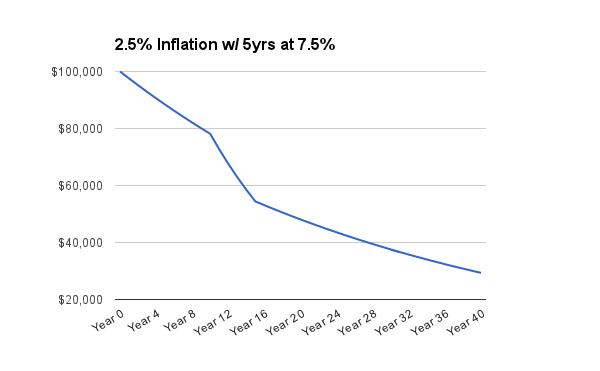
Consider the chart that follows – it assumes a baseline inflation rate of 2.5% per annum and a five-year block where inflation jumps to 7.5%.

Mattressmoney

The chart shows the purchasing power of $100,000 over time. I used $100,000 because that’s the target that I’m going encourage my kids to achieve by the time they’re 30. It’s do-able if they save $20 per day from the time they are 18.

When my balance sheet was largely low-risk, low-return cash equivalent assets, the chart (above) was on my mind. The steep drop in purchasing power due to a five-year period of higher than average inflation would hurt my family’s purchasing power. With extremely low interest rates and rapid Central Bank money creation, I thought (incorrectly) that significant inflation was right around the corner.

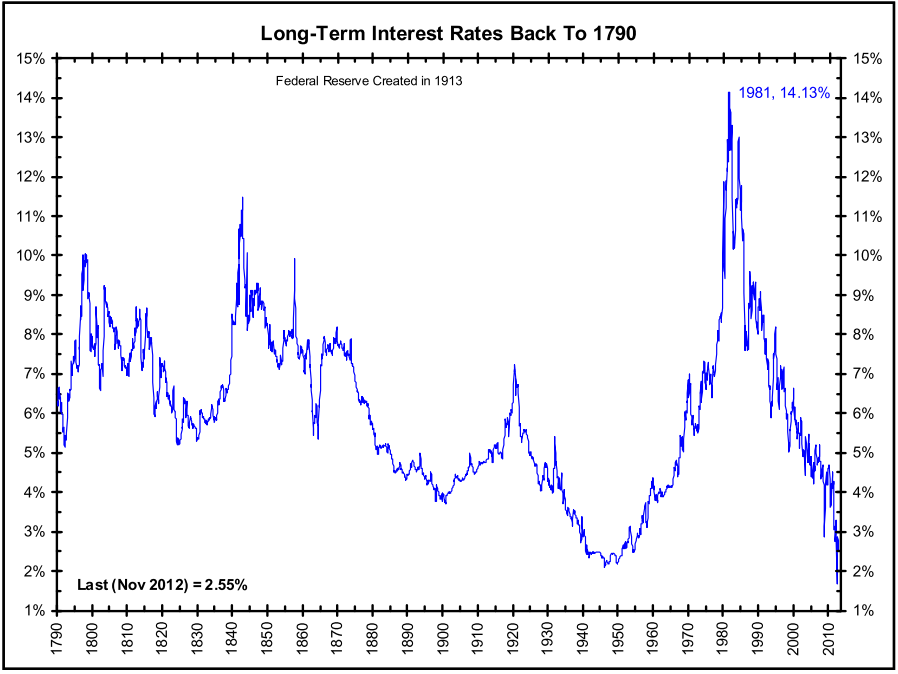
How low are today’s rates? The chart below (posted yesterday by Ritholtz’s blog) gives an idea. Note that the chart goes back to 1790.

Long-term-rates

In 2009/2010, I made a decision to shift into real estate. The market was falling and debt finance wasn’t available. For me, it was the perfect time to buy and I expected Boulder real estate to hold its real purchasing power. In other words, I expected the long-term value of my investment to link closely to the inflation rate. I wasn’t trying to get rich, in a very uncertain time, I wanted an investment that was likely to hold purchasing power. We hear this argument about gold but gold lacks many of the benefits of residential real estate. For an explanation of long-term real estate valuation see Shiller – Irrational Exuberance.

For what it’s worth, an alternative investment that I considered was buying two large-cap stocks (GE/WMT) with attractive dividend yields. I wasn’t able to achieve my target entry price on the stocks so missed that window.

In addition to an expectation that real estate would hold its real purchasing power, the net yield on real estate is attractive if interest rates fall to very low levels. Real estate offers some income protection against prolonged very low inflation and even lower interest rates. I didn’t expect rates to fall as far as they did but considered “what if.”

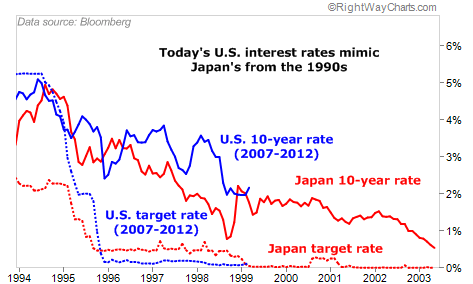
Here’s a chart that plots US rates against the post-bubble history in Japan:

Japan_us_rates

The precise numbers aren’t important. What’s useful is to consider a scenario where low-risk assets have yields under 1% for five, or more, years. What type of investments make sense in that environment? For me, high-quality real estate makes sense. There’s a substantial section in my latest book about real estate.

Other investments that make sense are my kids 529 college accounts and low-cost index funds. The 529 program that we use is has a 0.46% expense ratio and is tax-free, or tax-deferred, depending on use of funds. In 2012, I started small, weekly investments in Vanguard funds for my kids. With Vanguard, the index products (VTSAX/VTIAX) have expense ratios of 0.06% and 0.18% respectively. I’ve only used the US fund so far but am considering adding international.

The index funds have yields that are lower than what I earn on real estate but they are far easier (and less costly) to sell. 

My point: inflation can be a risk, or a benefit, to your family finances. When thinking about portfolio strategy, consider how changes in inflation, and interest rates, will impact your life. Be comfortable with every scenario and remember that we are in a highly unusual situation.

Next week I’ll share a case study of using a mortgage to protect your family from unexpected inflation. I think it’s a much more practical strategy than speculating in commodities, like gold.


Live Long and Prosper

Getting this book out is a form of life insurance for my kids. While I hope I’m around to teach them, ideally by example, there are no guaranties.

The book isn’t perfect but will point them in the right direction. Hopefully, I’ll get a chance to improve over the years to come.

You can download for free here.

All my best for a successful 2013.

gordo


$75,000 Question

A quick post to update with the answer to last Thursday’s question:

How long will it take to achieve a $75,000 portfolio if I can save $1,000 per month and earn 7.5% per annum on my savings. Bonus points – if your marginal tax rate is 27.5% then how much longer do you have to save to achieve your goal?

  • Future Value = $75,000
  • PMT = $1,000 per month
  • rate = 7.5% per annum or 0.625% per month (7.5 / 12)

Answer is 5 years and 2 months – you can find my workings in the google doc that I’ve created for this series.

+++

To calculate the bonus answer a simple solution is to “tax” the investment return using 73.5% (1 – tax rate) to get an annual rate of 5.4375% and a monthly rate of 0.453125%.

This extends the time required to achieve $75,000 by about three months.