What To Do, when you don’t know what to do

familyA couple weeks ago, I was flying Southwest and the passenger beside me was a bit unhinged. He didn’t seem dangerous, but kept inserting delusional rants into a well-informed discussion of current events.

The rest of the plane was avoiding eye-contact but, with him on the aisle and me in the middle, I didn’t have anywhere to go!

I figured that I’d put my hospice training to work and see what happened…

Six words that can profoundly change your interactions with the world, and through that, the reality that you experience with your day-to-day living.

When I think about my first response to stress, it’s the opposite of the tenets: I know you’re wrong, I want to flee you and I resist you.

My kids make my instincts obvious to me. If your kids are angels then you might have to look into other areas of your life:

  • A dying parent, or patient
  • A chatty stranger on the bus
  • A fellow citizen on the opposite side of an emotional issue
  • A kid yelling FART at my daughter’s birthday party
  • An angry family member

I get a physical signal, a tightening in my chest, before my mind kicks into high gear. The physical sensation is my chance to save myself from falling into past patterns.

These situations leave me feeling scared and unsure what to do. On the Southwest flight, I had to remind myself that the passenger had to get through security so probably didn’t have a gun, or knife, on him. Yes, I was worried that he was going to kill me!

In turn, my fear leads me to close off, or engage by digging into my existing beliefs. Classic flight or fight.

However, if I’m aware of my fears then, I can pause and try to help the other person. When I do this, I’m helping myself because I escape my cycle of fear/closing and/or fear/engaging.

Bearing witness – one of our deepest needs is to be seen, to be acknowledged. Watching how the rest of the world treats the aged, a difficult child or the crazy guy on the Southwest flight… I see that I can do the entire world (or at least my fellow passengers) a favor by acknowledging my seat mate for a little while.

Not knowing – listening to other people speak, particularly odd-ball cranks, there is another voice in my head. The inner voice is constantly disagreeing, challenging, explaining why the other person is wrong.

When I’m quiet enough to hear the other voice, I see it’s not rational. It takes the opposite side to whatever it’s hearing. Much like the initial reaction of my three-year old son!

In a situation that doesn’t matter (like talking to a stranger), play a game where you “don’t know.” You’ll find that it is relaxing to give yourself permission to not-know. In turn, a habit of not-knowing prevents needless conflict with kids, at work and in your marriage.

The “not knowing” exercise is a neat one because, when you see the power of change in areas that don’t matter, you’ll unlock an insight into how the only thing that matters is the little things!

Compassionate action – in the case of my eccentric seat mate, it was easy to see the best thing for everyone was for me to listen, with a mind that didn’t know. In fact, I’ve been doing more and more listening.

If you think about it then I’ll bet you can come up with situations where you had NO IDEA about the right course of action:

  • Friend with cancer
  • Friend who had parent die
  • Friend who had child die
  • Divorcing couple
  • Friend with child with developmental difficulties
  • Depressed friend
  • Friend with substance abuse issues
  • Bankrupt friend

When you don’t know what to do, I hope you remember Joan’s advice.

As for my pal on Southwest, he thanked me for my kindness and scurried off the plane.

He left me with a warm feeling of a job well done.

Be brave.
The Middle-Aged Athlete

ec_hatLast weekend, a bunch of my pals were in Hawaii for Ironman. Watching from a distance, Ironman is a reminder that the human body can do some incredible things. While the race is neat, what’s most impressive is the training load that the competitors put themselves through. The physical output, over many years, is impressive – sitting here, I can’t believe I was able to do it!

I’ve had success coaching men between 40 and 75 years old (as well as women from 40 to 55 years old). Interestingly, it’s the guys who are most prone to saying, “I wonder if I’m getting old.” Top amateur women just keep on rolling, about the only thing that slows them down is injury and illness.

On the other hand, guys get really tired. I like to joke with my wife that I get Man-Fatigue – like man flu – it’s a whole different level of fatigue from what she experiences.

What follows isn’t for my pals, who are still crushing it. Keep doing what you love for as long as it makes sense. I miss those days, and you will too! It’s for the rest of you – particularly, if you were a top athlete in your 20s and 30s.

When it comes to aging, I hear this a lot…

  • Age is just a number
  • You’re only old when your age is an excuse
  • 40 is the new 30

These sayings are linked to the first phase of aging – holding on against the natural progression of time. I’m more fond of saying, “this is what 45 looks like and it’s not so bad!”

In my peer group, characterized by exceptional will, a few can extend the “holding on” phase into their 50s and, extremely rarely, their 60s. You can find examples of these special humans (!) on the Big Island each October. I know a few and they are amazing people.

What lies hidden is the psychological, and physical cost, from living an unnatural life. When we put ourselves together in a peer group, that consists of much younger 1%’ers, we’re left wondering… what’s wrong with me? Why can’t I be like XXXX? Am I getting old?

I used to think that I’d be hanging on. Now, I’m not so sure. At first, I thought it was my kids making me tired but there seems to be something deeper at work. Time will tell. Maybe I’ll get a second wind in my 50s! 🙂

When I catch myself thinking that a return to my 20s/30s will improve my life – I say…

  • It’s amazing how much exercise I was able to do
  • I’m grateful to have had the opportunity to compete at a high level

Wonder and gratitude are effective antidotes to mourning the past.

Another thing that I’ve noticed is I get an excellent mood response from small doses of exercise. I have to remind myself of this A LOT so I don’t fry myself.

With exercise, generosity, novelty…happiness links better to frequency than intensity, or dosage.

How do you know if you’re holding on too tight?

  • Ask the people closest to you
  • Pay attention to frequent orthopedic injury
  • Pay attention to frequent depression, or anger

If you aspire to performances that were extreme when you were 10-25 years younger then be sure to spend time with people your own age, as you age.

Trying to be the 1% of the 1% can lead to a rough ride as the years roll on.

Choose wisely.

Money, Marriage, Kids, Family

Back in July, I caught myself fantasizing about my life in the year 2030, when my youngest graduates from high school.

Longing for a better life in the future is a sure sign that I need to make changes in the present!

My dream, of 2030, was an example of the main excuses that I give myself:

  1. Money – If only I had more…
  2. Marriage – I can’t do that, I’ll damage my…
  3. Kids – The trap of giving to the point of self-neglect and external resentment…

To the list above, I’ll add “Family” – I hear others say that they can’t do XYZ because of family considerations.

While it helps our own happiness to serve another, resentment happens when we feel bound to serve.

I know from my own experience that a resentful grandson, son, father or husband isn’t much help at all. I’m awful to live with when filled with resentment.

My antidote with relationships is straightforward.

  1. Empower each other to say “no”
  2. Always be part of the solution – much better than seeking to be THE solution!
  3. Respect other people and let them solve their own situations
  4. Consider every interaction a gift, rather than an obligation – point #1 is essential for this mindset

Now, with money, the antidote is more complicated. My best advice: start by ditching people, situations and things that makes you feel envy.

Envy distracts me from my true needs.

Recently, I spent six years working myself out of financial squeeze and wanted to share the process. When I’m not sure what to do, I start with a clean sheet of paper.

Blank Sheet Living…

Based on where I am today, where would I like to be in five years and what’s it going to take to get there?

Six years ago, I decided that it was important to reduce my family’s net cost of living. I looked at moving to where I could earn more money (Silicon Valley) and where I could live far more cheaply (Boulder County).

In the end, the US Federal Reserve drove mortgage rates to the point where I moved across town, downsized 50% and achieved my goal.

It took a surprisingly large amount of effort to take the path of least resistance!

So now I’m “there” – I achieved my plan and have the ability to reset my life again.

Additionally, I have a wonderful spouse that empowers me to do ANYTHING.

There is deep wisdom in empowering another to choose to love, and serve, us.

I’ve lost all my excuses.

It can be terrifying to lose my excuses!

+++

Goal: Strategy, Tactics

Serenity: Time Alone, Weekly overnights to the high country to explore in solitude

Connection: More Monsy, Share experiences with my spouse and strengthen my marriage, which is my best asset

Long-term Health: Use My Drive For Fitness, Exercise twice a day, watch the booze and carbs

+++

Serenity, Connection and Long-term Health => What’s Your List?

Micro Courage

axel_lionHow do I cultivate deep strength and resiliency?

We might describe resiliency as…

  • The capacity to continue despite life’s setbacks
  • The ability to become stronger due to stress (anti-fragility)
  • The strength to handle anything

They sound great, grand and completely unattainable!

I’m going to guide you through how I break it down into something that I can action in my daily living.

Start by flipping it on it’s head, what are the characteristics of the not-resilient? Think of the biggest head case you know…

  • Angry
  • Anxious
  • Depressed

When I think about anger and anxiety, they strike me as cultural expressions of fear. At some level, we see angry men and anxious women as normal. I feel both emotions all the time and they make me less effective.

What to do?

Over the last two years, I’ve been experimenting with micro-courage.

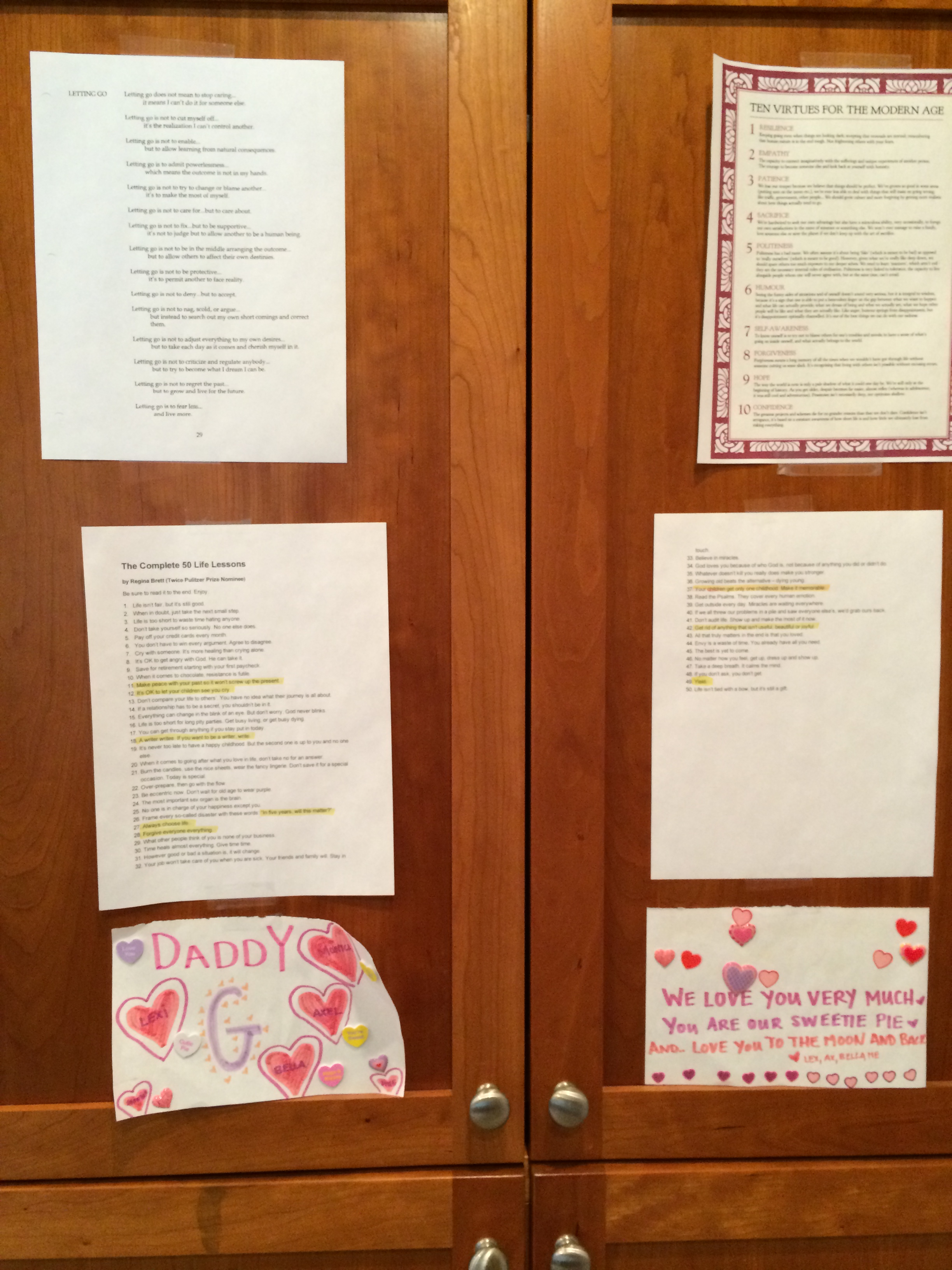
I started by printing up 50 life lessons and highlighting the ones that I wanted to focus on (11, 12, 18, 26, 27, 28, 37, 42, 49). If you come by my office, you’ll see they are taped near my printer…

lifelessonsReflecting on the lessons, I paid particular attention to three:

  • Let your children see you cry
  • Forgive everyone everything
  • Yield

I’d encourage you to find your own (triggers).

The game is to focus your actions on situations at the edge of what you can handle.

Here’s an example:

  • There are lots of homeless folks on the Boulder Creek Bike Path. Some of these folks are violent, others are mentally ill, still others are addicts. As a group, they scare the crap out of me.
  • While I have pals that work with the homeless, I don’t have any clue how to “fix” this problem and often wish the problem would go away (so I don’t have to deal with my inability to deal with it!).
  • Anyhow, there’s one guy that sits by the creek in the 28th St underpass and says good morning to everyone that runs, rides and walks past him. He’s a drinker and can get a little sloppy towards the end of the day.
  • I can’t fix the city’s homeless challenges but I can offer the guy a bit of human connection as I ride by. I look at him, smile and take a breath in. On the face of it, I’m smiling at him but, in reality, I’m staying open to the fear within myself. That’s micro-courage.

The story repeats itself in every part of my life that I want to close off.

I try to “stay open” as many times a day as I can.

The problem can be homelessness, litter, aggression, poor driving, manners, food quality… keep it small, remember to breathe in through your nose with a tiny smile.

Staying open to a small fear, a slight inconvenience, a little bit of sadness… I call it micro-courage.

The habit has been transformative in situations that I used to find overwhelming.

This is what I meant when I wrote that strength comes from staying open to little fears.

Courage is a powerful antidote to fear, anxiety and anger.

Be brave.

True Strength

g_aqua

One of my coaches, Mark Allen, made the observation that to get our race in order, we need to get our lives in order. Racing, like any other form of stress, can strip away our filters.

Mark’s advice is an example of an athletic lesson with a wide application into everyday living.

We share a desire to be strong. This desire is expressed by building up and adding to one’s self.

  • Adding size through muscles, bulk, heels, boots
  • Adding tension from taking on obligations
  • Adding palmares from victories
  • Adding possessions and external signs of power

I’ve done it all: cowboy boots; academic honors; powerlifting; fancy cars; big houses; jewelry for my wife…

Adding, adding, adding.

The list above is about our external life. Building up is a projection of strength, but it isn’t true strength. I think Mark is pointing us towards something that might become resiliency. An integrated life where we are in harmony with our external projection and OK with all aspects of our experience (strong/weak, happy/sad). This harmony lets us cope with the tests of our races (and lives).

Perhaps you’ve had a situation where you tell yourself to be “strong” but a more accurate description is a fear that our inner storm might show through. Having completely fallen apart a few times, isn’t that big of a deal. I don’t want to make a habit of it but I also don’t want to spend my life holding tight and letting the pressure build within me.

When tired, when grieving, when sick, when stressed… life has a way of stripping our filters away.

But how can we process our inner life?

  • Exercise works well for me – moderate effort, repeated movements
  • Others prefer meditation – cultivating stillness and observing one’s mind
  • Many find the combination of breathing and movement in yoga to be effective
  • Thrill seekers tend towards extreme risk and peak experience – works for them but doesn’t work for the larger goals of my family

If we keep peeling away our layers then we might find that the joke is on us.

Why?

Ultimately, every individual unravels.

It can be terrifying when we bump into this reality. You may have experienced this fear through the death of friends, parents and grandparents.

Ultimately, we might find comfort in defining resiliency in terms of something larger than ourselves – family, legacy, lineage, tradition.

Cultivate courage by staying open towards little fears.

Free My Mind

monsyWhat’s the difference between knowledge and wisdom?

Time, perhaps.

My friend, and his father, are both surgeons. The older doctor shared that ‘half of everything I learned, turned out to be wrong.

When I think back to my formal education, a good chunk appears to have been wrong. Of course, studying economics in the 1980s gives one an edge in the search for academic humility.

Why does this matter?

Knowing that most my knowledge will prove meaningless helps me decide where to focus thought. Some questions that I ask myself when I’m wound up…

Could I be having this discussion 10, 100 or 1,000 years ago?

– Nutrition, exercise protocol, the body fat percentage of myself and friends… All are recent phenomena. Not worth devoting much share of mind towards.

– Living well, meaning, time allocation… These questions track back to the ancients.

How long has this problem persisted?

– I love this question with regard to young children. They have been a challenge for parents across thousands of years. My odds of transcendence are long!

Under what conditions is the opposite opinion correct?

– This one is a loaded question because, once you realize that there’s always a situation where the opposite applies, it’s easier to develop tolerance for those who oppose us.

Am I sure?

The benefit of experience is that I’m not sure about much. However, there is a small list of traits where I am quite sure.

It Wasn’t Good For Me

gnomeA number of my pals triathlon’ed from Vancouver to Calgary over the last two weeks. They did the journey as part of something called Epic Camp and I highly recommend Scott Molina’s blog about the trip. I’ve been chuckling along as the crew drill themselves daily across the Canadian Rockies.

In reading Molina’s diary of their adventure, I’ve been feeling three emotions…

Joy that Scott is able to keep on trucking. The guy’s 54 years old and he’s still able to love training at the edge of human endurance. Epic Camp is about the mental component of performance and Scott personifies joy from suffering.

Continuing amazement at what people can accomplish. It’s tempting to put ultra-athletes into a separate category as genetic freaks. The reality is most ultra-athletes are fairly normal physically. The differences arise in their capacity to embrace obsession and the way they experience fatigue & suffering.

Finally, I experience a deep sense of gratitude for my life in Boulder. When I was living my life of extreme athletic performance, I couldn’t see the cost of my status quo.

By the way, lots of people talk about the health risks of extreme exercise. I think that you are right but you’re missing the point. See the camp for what it is… a binge. I’ve always enjoyed a good binge. It’s something I need to watch. Also, so long as you don’t go banana’s with the running, the main short-term risk (to your kidneys) is limited.

Scott knows, and shares, the requirements for athletic success. He’s far more open than any other triathlon writer, myself included.

What’s yet to be published is the total reality of seeking our ultimate triathlon potential. Outside of triathlon, Sam Fussell gave it a shot with bodybuilding. His book, Muscle, is an entertaining account of the life of a full-time amateur (AKA a life similar to most tri-pros). Leaving the extreme drug use to one side, the parallels with my life are many.

I’ve often wanted to write the “whole truth” about my life. I’m most open with the non-racing spouses of my training pals. They know enough about my world to be entertained but aren’t so invested that I challenge their identities with my observations.

I looked deeper into my motivation and saw a desire to protect my children from my near misses. However, my children’s obsession is certainly going to be different than my own and they will resent being told what to do by their, ultimately, sixty-something father.

Here’s where Sam’s book comes into it’s own. The hero in Sam’s book is his mom. She keeps the lines of communication open, accepts Sam for who he his and frees him to change his mind on his own timetable.

As we ascend to the top, we can lose the goodness of our youth. It’s no accident that the highest-achievers had very difficult childhoods. It’s a rare person that becomes more kind under extreme stress – at Epic Camp, Bevan James Eyles is the best example that comes to mind. He was always part of the solution. The rest of us acted like wolves, or hyenas.

What helps everyone is encouragement to hold onto a piece of goodness and stay open when the little voice says, “this isn’t good for you.”

…and while I have no idea who is doing the talking… I know that following that voice has led me to a wonderful life.

Lex

Managing My Inner Game

2014-08-11 18.51.31

As a coach, I have come to realize that a number of my athletes rely on exercise to manage their mental health. I have asked the question…

If daily exercise is a requirement for your mental wellbeing then should we consider if extreme exercise is appropriate for your long-term health?

It’s worth noting that I’ve yet to have a top athlete answer my question with a “yes, we should!” While my pals haven’t answered this question, it’s something that I’ve addressed with choices in my own life.

High-profile athletes, and coaches, can feel the urge to fly-the-flag for extreme exercise. Because of the prestige given to “winning,” it takes courage to walk away from fame, winning or vanity => even when these things are unhealthy for our inner lives.

What calms my inner life and leaves me feeling satisfied?

My list:

  • An outdoor workout with 10-20 minutes of elevated HR
  • Time with my spouse
  • Picking up litter
  • Doing something that other people find too difficult
  • Helping other people
  • High-quality coffee or tea

My list reminds me that much of my spending is wasted.

In my life, the only thing that trumps exercise is sleep. I need to get my sleep AND I need to protect my sleep. I protect my sleep by:

  • Waking up each morning
  • No late naps, late nights, late coffees, late work sessions
  • Removing people and situations that cause me to lose sleep

I’m fortunate with the ups and downs of my moods – I don’t have the extremes that follow some of my pals. My swings are moderated by a lifestyle that gives me frequent top-ups and helps me avoid spiraling downhill. I wrote about downhill triggers here,

It usually takes multiple injuries for an athlete to be open to considering their role in creating their life situation. More normal, is gratitude for a return to training. Be aware when you are in a rush to get back to the pattern, and mental habits, that hurt you.

It takes courage to change our approach.

Be brave.

Five True Friends

mooseThe Philosopher’s Mail is one of my favorite sites on the web. Happiness is a recurring theme in their writing, as is social connection. As your doctor can confirm, there is a link between social connection and health.

The good people at Philosopher’s Mail shared Epicurus’ recipe for a good life. The link is to a lovely article with snazzy pics of Paris Hilton. The article is worth your time – it describes an antidote if you find that external success fails to lead to lasting satisfaction.

The philosopher’s antidote

  • Five true friends, that reinforce inner values (not the external values of city living)
  • Self-determination by escaping the tyranny of corporate serfdom, regardless of financial cost
  • Daily time for quiet reflection, ideally with low-intensity exercise in nature

It’s an interesting list because most of us will lack one aspect of the troika. In my case, it takes effort to say “yes” to social interaction.

As well, we are usually attracted to people that have external traits that we wish to emulate. This can be a good thing…

  • A politically-connected friend making us feel gratitude that we don’t have the duties that come with being a very important person.
  • A healthy friend inspiring us to start a streak of daily activity.
  • A champion friend inspiring us to persist a little longer at a difficult task.

I have different pals with all of the above and, when I’m at my best, they reinforce good traits in me.

However… I’ve also noticed that my most human, and occasionally screwed up pals, can leave me feeling grateful, useful and valued – three traits that have a strong link to personal happiness.

So while the need for pals is well known, I can lead myself astray. So it’s worth using my daily time to quietly consider…

  • Do I have five people to whom I can speak plainly?
  • Separately, who are the five people with whom I spend the most time?
  • How do those people make me feel?

Once I have insight, it’s up to me to have the courage to change.

Be brave.

Too Painful To Care

Monday I wrote about driving energy inwards to improve myself, my marriage, my family.

Related to this lesson, I’ve noticed a habit of avoiding knowledge that conflicts with my core beliefs. This isn’t anything new – human misjudgment is an ever present topic. However, spotting my own misjudgments can make me far more effective.

Being effective, and making better choices, is a more important to me than avoiding change.

A story.

The Tour de France just finished and I didn’t watch any of it. My lack of motivation was unusual and I wondered why.

The legacy of cheating has been to make it too painful to care. In my case, that manifests in a lack of interest in elite sport. In the case of the wider public, there is an element of truth-fatigue. It’s too painful to discover the reality that underlies an obsession with winning.

I’m using sport as an analogy – it’s an easy one for us to feel, and see in others. Choose your favorite sport and you’ll find a tendency to overlook it’s short-comings. If you can’t see it then ask a foreign friend their thoughts (or simply a pal that likes a rival franchise).

The lesson for daily living is deeper.

  • A friend with Alzheimer’s
  • An elder with dementia
  • A sexually abused child
  • A partner that defrauds the community

In these cases, we will feel a strong urge to “give the benefit of the doubt” to whatever causes the least pain. We will default towards inaction and strongly avoid information that compels us to face pain. I feel avoidance strongly in myself – it’s taken many setbacks for me to overcome.

One of the best lessons of hospice is that freedom lies on the other side of fear. Hospice lets me “be with” my fear of death/disease and feel grateful for today. Gratitude is powerful medicine to carry around inside.

Hospice is “easy” – it’s quiet and I’m not expected to solve anything. My home on the other hand… is often loud and I’m in charge. Maintaining serenity in my own house would be transformative for me, my wife and my kids.

So I look for small, daily, opportunities to practice equanimity:

  • Reading a conflicting viewpoint
  • Avoiding “justified” disappointment in a friend
  • Letting a commute unfold without battling my fellow drivers
  • Not playing into a negative emotional pattern with a spouse, child or myself (!)

Overcoming the smallest things, closest to us, can be powerful.

It takes courage to face pain.

Be brave.