Too Painful To Care

Monday I wrote about driving energy inwards to improve myself, my marriage, my family.

Related to this lesson, I’ve noticed a habit of avoiding knowledge that conflicts with my core beliefs. This isn’t anything new – human misjudgment is an ever present topic. However, spotting my own misjudgments can make me far more effective.

Being effective, and making better choices, is a more important to me than avoiding change.

A story.

The Tour de France just finished and I didn’t watch any of it. My lack of motivation was unusual and I wondered why.

The legacy of cheating has been to make it too painful to care. In my case, that manifests in a lack of interest in elite sport. In the case of the wider public, there is an element of truth-fatigue. It’s too painful to discover the reality that underlies an obsession with winning.

I’m using sport as an analogy – it’s an easy one for us to feel, and see in others. Choose your favorite sport and you’ll find a tendency to overlook it’s short-comings. If you can’t see it then ask a foreign friend their thoughts (or simply a pal that likes a rival franchise).

The lesson for daily living is deeper.

  • A friend with Alzheimer’s
  • An elder with dementia
  • A sexually abused child
  • A partner that defrauds the community

In these cases, we will feel a strong urge to “give the benefit of the doubt” to whatever causes the least pain. We will default towards inaction and strongly avoid information that compels us to face pain. I feel avoidance strongly in myself – it’s taken many setbacks for me to overcome.

One of the best lessons of hospice is that freedom lies on the other side of fear. Hospice lets me “be with” my fear of death/disease and feel grateful for today. Gratitude is powerful medicine to carry around inside.

Hospice is “easy” – it’s quiet and I’m not expected to solve anything. My home on the other hand… is often loud and I’m in charge. Maintaining serenity in my own house would be transformative for me, my wife and my kids.

So I look for small, daily, opportunities to practice equanimity:

  • Reading a conflicting viewpoint
  • Avoiding “justified” disappointment in a friend
  • Letting a commute unfold without battling my fellow drivers
  • Not playing into a negative emotional pattern with a spouse, child or myself (!)

Overcoming the smallest things, closest to us, can be powerful.

It takes courage to face pain.

Be brave.
Scope Lock

It’s easy to let short-term news dominate our thinking.

  • Children killed in war
  • Lost airplanes
  • Destroyed airplanes
  • Crashed airplanes

With death, in particular, I was curious.

I asked Google, “How many people die, per day, in the world?”

Google replied, “about 150,000.”

Per DAY.

That helped me put my obsession into context.

++

Realizing that my thoughts are largely wasted can create cognitive dissonance.

…but it’s awful

…I need to care (to show I’m a kind person)

I ask myself, ‘is linking worry to goodness effective?’ In my life, worry makes me anxious, not compassionate.

++

Here’s what I’ve noticed in myself. There’s a hidden cost to obsession with others.

The more I focus on seeking to change others, the less energy I have to change myself.

What one thing, if it happened, would change everything?

In my case, kindness through daily action in my own house.

Beware of feeding what you want to leave behind. In my case, fear – anger – anxiety.

Summertime Template For Young Kids

Here’s a template to help you maintain your sanity, and productivity, with school out of session.

Goals:

  • Exercise before facing the kids
  • Personal time for mom & dad
  • Tire the kids early
  • Nap through the hottest part of the day

Here’s how we roll:

  1. I’m up by 5:30a and back from exercising by 7:30a
  2. My wife does her exercise 7:30a to 9:30a and I get the kids sorted
  3. Kids out the door by 10am and I now have a 3.5 hour slot of total quiet at my house. As, I work at home, this is valuable
  4. Wife and kids head to the club with packed lunch – family swim until 11:30a
  5. Kids eat lunch in the childcare at the club – my wife is free for up to two hours for errands and personal time. Three days a week she coaches masters
  6. Kids arrive home, suitably whipped, 30-60 minutes of madness then everyone naps.
  7. I get another 90-120 minute slot of total quiet – my wife gets a personal slot
  8. Before the kids wake up, I exit for my second exercise session of the day
  9. Evening trip with the kids (swim, friends, park or errands) OR movie night
  10. Dinner (out or home) then bed

This gives me two training sessions, five hours of quality work time and interaction with each of my three kids.

Date night fits with a sitter coming in when the youngest kids are napping.

Alternatively, consider using “day rate” with sitters. We agree a fixed-price deal (8:30am to 8:30pm) and have the sitter take long breaks over lunch and nap. With my working at home this can be a win-win-win between husband-wife-sitter.

For this strategy to be effective, caregivers must resist the urge to interact with the kids on a day off, and during their daily breaks!

Repeat every day June to August.

For weekly productivity, I can get a lot done with 35 hours of totally quiet time split between 14 slots.

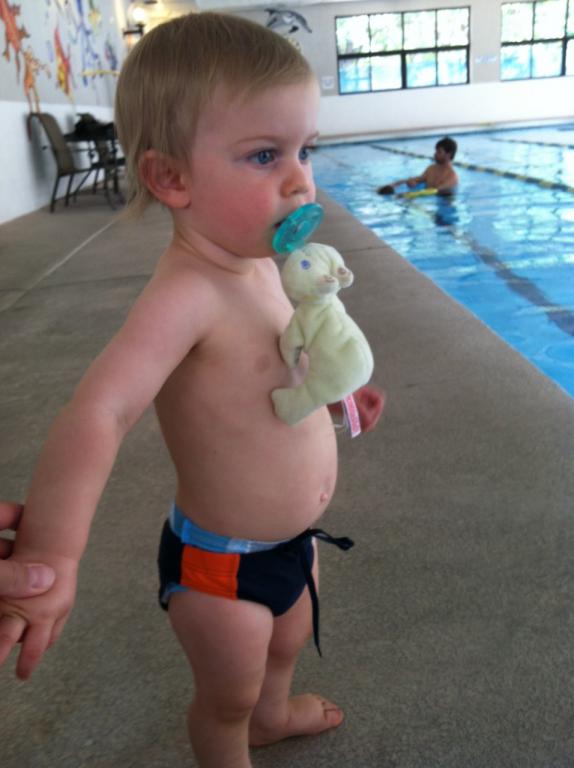
Because swimming is cost effective and accessible to club-provided childcare, we make getting our kids water-safe a high priority (links to my Endurance Corner article). So far, each of our kids has been water-safe by their third birthday.

Axel Swim 18 mths

Getting Kids To Draw

Here’s a tip that buys me an hour when I switch the electronics off.

We visit Google Images and I let the kids pick out their own picture to color – make sure you include “coloring pages” at the end of whatever you want to draw. The picture below is “hippo coloring pages”

Hippo

I’ll let my son stand on my desk and touch the photo that he wants. He can’t believe that he gets to stand on my desk and touch the screen. Happy and excited is good.

Then he grabs the picture from the printer and I set him up at his coloring station.

Kids that are really clingy will do best with a coloring station in your office, or kitchen (depending on what you need to get done).

The coloring stations are set up apart but the kids can color together if they choose. Some days they want to be alone, other days they are OK together.

With older kids, they seem to like a mix of their own drawing and coloring. My daughter loves to make other people cards with words that we spell together.

All kids love pictures that I draw for them. I take full advantage of being able to impress my two-year old…

Gordo Hippo

A little bit of effort on my part keeps me from melting our minds by having Disney’s Frozen on endless loop.

Do you want to build a snowman?

Child’s Play

Pirate ShipAt my kids’ preschool there are only a few rules for safety – mainly around the zip line.

One of the rules they have for kids (and parents) is to NEVER help another kid up a tree or piece of equipment. Their view is the kids have a better idea of their limits than their friends, or parents.

Since they taught this to me, I’ve been a lot more hands off with my children and careful not to encourage them get in over their heads. It’s stressful when they are little but they figure out how things work quite quickly.

Wanted to pass that along as it’s been a useful technique to help my kids self-regulate.

One of my “fondest” toddler memories was my oldest daughter hanging upside down on a cargo net, screaming, at Pirate Ship Park in Vail. By the time I put my phone down and got over there, a mom had bailed me out.

Yes, I was the Dad looking at his phone while his three-year-old hung upside down.

Still working on getting the balance right.

The Luckiest People In The History of People

Last month, after three years, we had the final community night for my daughter’s preschool. I looked around the room and smiled at what a varied bunch we were. Big, small, young, old, crunchy and corporate… each of us with a kid attending preschool.

At these gatherings, we do a check in (link is to my 2013 article). We get a chance to share one joy and one challenge of being with our kids. The group is a powerful experience and, because it was the last gathering of this group of parents, many of us were emotional.

I’ve come to realize that these circles are valuable because I’m given the opportunity to not-solve the problems of everyone there. As you’ll see in the 2013 article, I don’t always take that opportunity.

I did better with listening at my 8th gathering. Some parents were saddened by the thought that their time in the community was coming to an end. They shared that their kids were also feeling sad about leaving the community and moving on to kindergarden. Here’s what I took away with me from the meeting.

Sadness about the end is an opportunity to teach our kids, and ourselves, about the realities of life. The reality being that everything ends and that it is ok to feel whatever we want about endings, including sadness.

It’s OK to show emotion.

My children think I’m the strongest man in the world. They’ve also seen me cry. They know I’m real.

When you feel the sadness of the ending, remember the craziness of living with your children. Hold the sadness of the ending against every parent’s fear that “this will never end!”

Hold the two qualities in your heart and look for a chance to teach it to your kids.

This lesson is everywhere – traffic, winter, rainy days, Monday, smog…

It’s seems strange but, when I’m calm, the sadness leads me to joy when I’m back with the kids. There will come a time when my children are not going to be cradled in my arms yelling at me.

The trick is to focus on the cradling, rather than the yelling.

+++

I was also struck by what a fluke it was that we ended up together – sitting on little chairs, at preschool, in Colorado, on a pleasant spring night.

I know enough about the private lives of the other parents to realize that we’ve all experienced a variation of death, illness, divorce or hardship over the last three years.

In addition to shared hardship, it struck me that we happen to be lucky to have healthy kids and the ability to send them to a place where they are loved.

Lexi's Pillow

Tens of billions of people have lived on our planet and I ended up on my little chair, sewing a pillow for my daughter, smiling to myself.

I’ve been chuckling about that for a month.

Very few people, in the history of people, have the opportunity to live the life that’s available to us.

What are you grateful for?

The Most Beautiful Man In The World – Talking To Kids About Dying

Orion

Did you know that Orion was the most beautiful man in the world? Here’s a link to his story – a personal favorite of mine.

How can I talk about death without freaking out my kids? First up, I don’t start the conversation. However, I don’t avoid it either.

There is a split between older (4-6 years old) and younger preschoolers (2-3 years old) and my approach differs between the kids, as well as how they are feeling when they bring up mortality.

My first conversation about death with my son (2.75 years old) started when he picked up a line that stuck in his head, “David’s Daddy Died.” At two, death doesn’t have meaning and I don’t want him to get locked onto thinking that mom/dad might disappear on him.

From an early age, we’ve taught him that “we will be coming back” when we leave him. Indeed, a key milestone of childhood development is the ability to self-comfort when separate from our parents for 1, 3, 5 and 7 hours. We started this process, gradually, with all our kids as soon as possible.

Axel’s nature means that he experiences less separation anxiety than our other kids. Still, he looked to me for an explanation about “David’s Daddy Died.” Here’s what I do each time…

  • I go down on one knee
  • I look him in the eyes
  • I open my arms for a hug
  • I say, “YOUR Daddy’s right here”
  • I give him a huge hug

Sometimes it takes a couple repeats of… “Your Daddy’s right here” but it always works to bring him to the present, give him reassurance and shift us back to whatever we were doing.

With a 4-6 year old, the conversation is different. My oldest understands death and can have questions about it. She remembers her great-grandmother (who died on this day one year ago) and has asked me about it.

  • What’s death – your body stops working
  • Is she coming back – no, her body is finished
  • Is it like sleeping – no, it’s different
  • Daddy, are you going to die – Sweetie, everything ends
  • How long until you die – likely more than 40 years

And the biggie… Daddy, where will you be when you die?

  • Once again, I look her in the eyes
  • Put my hand over her heart
  • And say, “I will always be with you. Even when I’m not with you, just close your eyes and you will feel me in your heart.”

I then choose a person – perhaps my grandmother, or her mother – and we both put our hands on our hearts and think about that person. “See you can feel the person, even when they aren’t in the room. That’s where you go.”

When they get a little older, I’ll teach them how to spot Orion in the sky and share that he was the most beautiful man in the world.

When they see Orion, I’ll tell them to always remember that I love them.

See me beautiful.

What’s Your Source – A Game

In my early 30s, I gave up climbing as a favor to my family. It was a choice that left me starved of my core need to exercise alone in nature. The “gift” I gave my family had the unintended consequence of starting me down a path that lead to triathlon, as well as my divorce.

Do you know what provides deep personal satisfaction?

Anger, drug and alcohol abuse, fear, depression, gluttony… in my life, these are a sign that I’ve fallen away from a life with meaning.

As a husband, and father of three young kids, I can feel good about putting marriage and family first in the short term. However, if I lose track of my own needs then I end up depressed, angry and full of resentment for the people I was trying to help!

Here’s a game that you can play to stay on track.

Think of yourself and fill in this blank 2 or 3 times…

I am most myself when__________

In my case, I came up with when… I’m riding, uphill, at altitude, in a forest, on a cool day.

Another visualization was when… I’m standing on a ridge line, far above the valley, in the sun.

Another… I’m standing in a forest, it’s snowing and very quiet.

When I see my essential self, I tend to be alone and up high. Mountaineering was a good fit for me.

Then shift your focus to your spouse. In my case…

Monica is most herself when__________

You are likely to find that you skew your view of your spouse based on how you see yourself. I saw my wife swimming (alone) in a pool.

After you’ve had a chance to think through each other, compare notes. I found out that I got my spouse-vision completely wrong!

Monica’s self-image surprised me (at first) because the visions were about helping people. She’s in a good spot as a mom and swim coach – those roles are how she sees her true nature and consistent with some profiling that we’ve done (Myers Briggs).

I hadn’t realized that swim coaching was feeding a core aspect of her personality. It turns out that coaching is a source of energy, satisfaction and meaning for her. It was an important realization for our marriage – we’d be smart to keep that work!

With a young family, you’ll be tempted to lose yourself for the benefit of the kids, or your spouse. You will need your spouse’s support to keep your essential nature in the marriage. The visualization game is one way to start the conversation, and far better than the trouble we cause ourselves when lost in a relationship.

If you keep a daily dose of your essential nature then you’re likely to be a better, and happier, parent and partner.

And now, I’m off for my walk in the forest (uphill, alone, at dawn) after writing my article (quiet, alone, sharing).

It’s important for me to remember that the value of time alone isn’t in the leaving. The value lies in my ability to continue to do work in the world.

+++

Further Reading: How To Make Love All The Time by De Angelis (yes, I read it)

Moving Through A Depression

Tropic Coffee

50 is coming and I can feel that I’m spending my ‘middle’ worrying about money and getting yelled at by my kids.

The challenging thing about depression, or any of my other irrational feelings, is my inability to shake them via conscious thought.

Sharing my fears and concerns helps put them into a more rational context but my cure is always based around actions, rather than more thinking.

I smile when I re-read the paragraph above because (of course) thinking about “thinking too much” doesn’t work!

What does work?

Most helpful was the realization that I needed to make my life more difficult, while not adding stress.

I did this by purchasing a light alarm clock and changing my life so I get up two hours before my kids, who are thankfully good sleepers. By pulling the two hours from the end, to the beginning, of my day – I was able to write, exercise and sit without disruption. Writing, silence and exercise are the best antidote to the despair that I feel around kid noise.

In the heart of winter I reached out for help and attended a parenting workshop. The workshop gave me insight on how fantastic my kids are – nothing like listening to other parents to make me grateful for my own kids! However, despite my kids being normal (and desirable), I find their noise debilitating and draining.

What about the noise?

Some families cope by having constant background noise (TV and radio). For instance, the best parent that I know wears a radio walkman while she works in her house.

Other families ‘cope’ by yelling at the kids and emotionally beating them down. Effective, but not me.

I’ve been wearing earplugs to take the edge of the most intense moments, which rarely add up to more than 90 minutes a day.

People that cope well with noise will tend to find my choice of earplugs rude. Their reality is incapable of understanding what kid noise does to my internal life. I ask them for forgiveness and share the story of the great parent with the walkman.

+++

My son goes to school with the child of a social worker, who shared that her professional training hits a wall when she meets the reality of her own children. Her advice: stay two-steps back from the breaking point.

In applying this advice, I dropped lunch time workouts and replaced them with working in an absolutely quiet environment. This change took a lot of fatigue out of the back-end of my day. On Monday, Wednesday and Friday – I was swimming so intensely that I’d be mentally flat in the afternoons and exhausted by the evenings. Swapping my swim training into an early morning forest jog does nothing for my athletic fitness but it makes a huge impact on my overall mood.

Not swimming is complicated (in my head) because my swim coach is my wife and not spending time with her triggers my fear that my marriage will end and it will be my fault!

So…

The other bit of stress release is to tell my spouse the whole truth with how I am feeling, especially my fears (spending concerns, that I’ll act when I feel despair, that she will leave me, that I’m not a good man).

I have persistent themes that build internal stress – these all get shared with her (and pretty much everyone through my blog).

Most of this is article is to remind myself what to do – I had a tough 48 hours and started writing at 5am in a quiet house!

+++

What makes a difference?

Do something physical and spend a bit of quiet time in advance of the most stressful times of your day. For me that means short, solo, moderate workouts in nature done early morning and late afternoon. Each workout is short enough that the endurance coach in me wants to repeat the entire thing. Physical release and balancing the noise of my home life with quiet periods in my work life.

For the parents that deal with commutes and live in crowded cities – I don’t know how you do it. I’d be at risk for heavy self-medication and persistent deep sadness.

If you’re in that position then wait it out and don’t act on despair.

If I take responsibility for doing what I know works then I always move through a depression. When I’m really beat down it means that I’m very close to things improving.

See the beauty in the good moments.

+++

Serious athletes might find value in an article I wrote about athletic depression and training mania.

How Far We’ve Come

CryI love this picture. Mom’s rushing out of the house, baby Lexi is scarlet and everyone has a sense of panic.

Back then, my daughter’s crying could reduce me to tears. With her younger sister, I’d calmly put her down, let her chill out (or not) and keep moving forward.

My two favorite baby mantras to remind myself that nothing is wrong…

  • Babies cry
  • When they are crying, they are alive

Barf

Here’s another good scene. My first solo overnight trip with my daughter. She’s wearing my hoodie because she just barfed her Mac & Cheese all over herself, her car seat and our van. Good times!

This was a key moment for me. I knew that I could quit and no one would blame me. Instead, Lex and I decided to stick with our plan to overnight and visit the zoo. She still talks about the bad Mac & Cheese – it was orange and man (!) did it stink!

When you’re in the craziness of the day to day, be sure to look around and see the progress that you will make.

Give your kids what your parents need.