A Fiduciary’s Reading List

I’ve completed William Bernstein’s recommended reading from his eBook, If You Can.

The reading humbled me. With a 1st Class degree in Econ / Finance, and 20 years experience in international investing, I was left feeling intellectually arrogant and ignorant. Each of these books challenged my beliefs while explaining financial history.

I’d recommend making these books compulsory reading for your advisers and key family members.

Good people can be found in the field of finance. I appreciate the significant time that each of the authors spent to educate willing readers.

The Millionaire Next Door – introduces the key concepts of wealth, saving, investment and taxes

Your Money & Your Brain – a solid summary of the latest on behavioral psychology as it relates to finance and investment – why I will always fool myself

The Great Depression: A Diary – an inside look at what it is like for a conservative, professional family to live through a depression – 2008-2010 was easy compared to the 1930s – could your family survive on minimal income for multiple years?

All About Asset Allocation – the early chapters were the most useful – simple explanations of the role that volatility plays within a portfolio – reading this book, you’ll be tempted to seek the perfect portfolio mix – my decision has been to keep it simple

Common Sense About Mutual Funds – a wealth of information – Bogle picks apart the industry by making his case for simple and low-cost investing – the book makes one wonder how brokers and financial advisers can sleep at night – readers will learn about the industry structure that silently fleeces its customers

Side Note: if you worked in finance from 1980 to 2000 be sure to adjust your brilliance for volatility and leverage using Bogle’s updated charts. We had one heck of a tailwind. Humbling!

How A Second Grader Beats Wall Street – don’t be fooled by the child-like title – this book will save your family tens of thousands of dollars in fees and taxes

Devil Take the Hindmost – a history of financial speculation – hedge funds in the 1860s & derivatives in the 1600s (!) – as Taleb says, we’re never going to get rid of greed, the challenge is to build the system so the greedy don’t inflict suffering on the good

+++

To Bernstein’s list, I’ll add Estate & Trust Administration for Dummies – a good primer to get you thinking outside of your own self interest.

+++

If you are in an advisory, or trustee, relationship then tick off one book per meeting with your professional team.

Read a book, take notes and discuss how the book impacts your family (or your firm).

Challenge yourself with exposure to the best ideas available.

Studying new approaches can be painful but we all benefit from a bit of cognitive dissonance.

What Do We Need To Retire?

My post showing how a 1.2% fee differential can cost you 131% of your pension contributions inspired Paul Meloan to write an article about The Clear Value of Financial Planning. The article lays out Paul’s case for his work in the field.

To help you understand the cost/benefit relationship, have your advisers write out the dollar amounts that you’re paying in fees, expenses and taxes. Be sure they include all the soft costs that are buried in your mutual funds.

In Paul’s article, he lays out questions for a family to consider. I thought I’d answer these questions, as viewed from a life outside the box.

#1 – How large of a pool of assets do my significant other and I require in order to live in the manner which we desire for the rest of our lives?

The most important thing for you to remember is to declare victory immediately. You have more than you need and are in a position to think about the future. Many, many people are less fortunate than you. Spending time with the less fortunate will temper your needs and get you to financial freedom more quickly.

The financial services industry is built backwards from your true needs. If you listen carefully then you can hear the industry say, “you can be happy tomorrow if you have more.”

Be happy now, with less.

I recommend that you flip question #1. When I look at my family’s net worth, I express it in terms of “years of current expenditure.”

For example, if your net worth is $500,000 (Assets Minus Liabilities) and your current expenditure is $125,000 per annum then you have FOUR years of current expenditure (500,000 / 125,000).

Why is this is a useful way to consider your position? It’s useful because it changes the conversation from

  • What do I need to be happy tomorrow?; towards
  • How can I spend wisely today?

The years-to-burn exercise reminds me that the fastest way to improve my financial position is to reduce my current expenditure, not take more risk.

In terms of years-to-burn, my peak wealth was 13 years ago. I was living out of a Subaru and sleeping on a friend’s floor in LA. My life was extremely simple – eat, sleep, train. It was one of the happiest periods of my life and my net worth was 1/6th of right now.

It’s worth repeating… I increased my net worth by 600% and feel less wealthy.

Historically, most my spending has been wasted.

  • luxury air travel
  • high-end hotels
  • excessive childcare
  • personal assistants
  • office space
  • non-performing assets
  • personal luxury expenditure (clothes, cars, boats, vacations)

I ditched most of these because I discovered that they were bandaids healing myself from a lack of satisfaction with daily living. My spending was driven by our culture rather than my needs.

Choose your hometown and your buddies carefully! I assure you that the exact same family will have needs that vary by geography. Consider:

  • Manhattan vs Boulder
  • Aspen vs Truckee
  • Palo Alto vs Greenville
  • Santa Barbara vs Hood River

I came close to moving to Palo Alto to spend more time with my pals (love you guys and gals). It would have changed my life – not better, not worse – but absolutely different.

The more time that you spend helping people that have less than you, the smaller your retirement fund will “need” to be. There are examples of this all around us.

Finally, the benefit of wealth is not to leave work. The benefit is to feel secure enough to choose meaningful work, regardless of compensation. Hang out with people that are rich in personal satisfaction (artists, priests, teachers, ministers, caregivers, coaches, guides) – you’ll know them when you speak with them.

#2 – What should be the composition of that pool of assets, and how should they relate to each other in terms of risk and expected returns?

You can beat all of your pals by using Bogle’s Little Book of Common Sense Investing.

As a bonus, the strategy is simple to understand and easy to execute.

If you can’t figure the book out then call Vanguard and they will help you in exchange for a fixed price fee when you need help.

If you keep screwing up then get yourself a financial coach and pay a fixed fee to hold you to your plan.

We all do better when someone is watching – that’s why I have a blog.

Checking In With Your Real Estate Investments

Today’s article is longer than usual (1,150 words) but it’s worth big money to most families. I’m going to run through how you review a property investment. I use a version of this template for every property deal that I consider.

I make the cost of property ownership visible to my family. This habit keeps me from buying too large a property, or leaving valuable assets empty most of the year.

If you can’t calculate the sums before you buy then wait.

If you remember one thing from this article… act as if you will “lose” 10% of your purchase price the day you buy.

Let’s get started!

First: Calculate Net Realizable Value – What Happens If You Sell?

Start by coming to a view on current market value. To estimate market value, lay out the different options available. Be conservative, I’ve been known to fool myself with a dream value that has no chance of being realized.

In the case of the sample property, I have a wide range of options to value:

  • Dream value – $1,000,000
  • Estimate from Zillow.Com – $949,795
  • Have the owners ask local agents what they think – $925,000
  • Old appraisal – $850,000 (Nov 2012)
  • Assessment value from the city – $830,000 (end 2013)
  • Written down tax basis – $792,772

The tax basis of the property is your allowable cost, plus additions that are capitalized, less depreciation that you’ve taken against your taxes. When you buy a property, you have to allocate the cost between buildings (depreciable) and land (not depreciable). I usually use the appraisal that was done at the time of purchase, or figures from the county assessor’s office.

With this property, I know that the owners checked with local real estate agents and applied a discount to what the agents told them. So, for the purposes of this exercise, I’m going to use the Owner’s Valuation of $925,000.

When you sell, you don’t get the gross value. I account for sales expenses by taking 94% of the gross value. In our example, that leaves $869,500 (94% of $925,000).

The next step is to strip out any capital gains tax that would be payable. In this case, I know the family has an effective capital gains tax rate of 25% (including State). So we take the net price ($869,500) and deduct the taxable basis ($792,772) to get the taxable gain of $76,728. Taking 25% of the gain gives a capital gains tax liability of $19,182.

So the net realizable value for the property is $869,500 less $19,182 => $850,318.

Note that the net realizable value is FAR LESS than the gross value.

Rule of thumb: the market usually needs to rise 10% for you to get your money back.

I assume that I lose 10% of the purchase price on the day I buy. This assumption makes me reluctant to buy, which has saved me from many poor investments!

As an asset class, real estate is costly to own, illiquid and expensive to sell. Do your sums before purchasing.

Next: Figure Out The Cash Flow Before, and After Financing

For the next bit, you probably want to print the article out, grab a pencil and make notes for your own property.

If you can’t handle the pencil/paper method then this is a link to a spreadsheet that will do the calculations for you – make your own copy and fill in the Blue Cells. A picture of the spreadsheet is below.
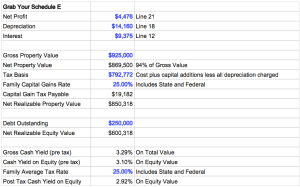
Property Data SetStart with your net income after all expenses and depreciation. If you live in the US then pull up your Schedule E and look on Line 21 – in this case the net income was $4,476.

I recommend separate bank accounts for your main house expenses and any property investments. This makes it easier to track expenses by property.

To calculate cash flow before interest, we need to add back interest – Line 12 in the US – $9,375.

At this stage, I like to make a note about the total debt outstanding and the interest rate you pay – in our example the debt is $250,000 at a rate of 3.75%. Remember that you only want to count interest paid, not principal repayments.

Revenue Less Expenses ($4,476), Add Back Interest ($9,375) gives you $13,851 of profit before interest expense.

Because depreciation is a non-cash expense, you add depreciation back to calculate cash flow before interest and depreciation. In the US see Line 18 – $14,160 for this case study.

So the total net cash flow (before interest and depreciation) is $13,851 + $14,160 = $28,011.

To check the gross cash yield on the property you divide cash flow before interest and depreciation by the gross net realizable value. $28,011  / $850,318 = 3.3%.

3.3% is the gross yield and ignores the mortgage that is in place. The gross yield tells you the cash that the asset is generating. To figure out how your equity is performing, you need to adjust for the debt that was used to purchase the property.

Let’s adjust for interest and debt.

  • $28,011 less interest of $9,375 gives $18,636 of cash flow after interest
  • Net Realizable Value of $850,318 less debt of $250,000 gives $600,318 net realizable equity value. The equity is the value of “your money” in the deal.

$18,636 / $600,318 = 3.1% return on equity

Consider Taxes

Note that the 3.1% return on equity (above) does not take into account Income Taxes (federal and state) that would be payable on the net income. I know that the owners have an average income tax rate of 25%.

With real estate, your taxable profit is reduced by depreciation charges. So you take the net profit after interest and depreciation ($4,476) and multiply by your tax rate (25%) to get taxes payable of $1,119.

Income taxes reduce the return on equity to 2.9% – calculated as  ($18,636 – $1,117) / $600,318.

If you are able to hold for a long time then property can be a tax effective way for you to invest your money. Note that, in this example, the effective tax rate is 6% ($1,117 / $18,636).

Remember to estimate your taxes on the income after interest and depreciation.

Finally: Step Back and Consider The Big Picture

Now you have the financial information required to consider the deal (buy, hold, sell, refinance).

Questions I consider:

  1. What are the family’s overall financial goals and how does this property fit into these goals?
  2. How large is this asset class as a percentage of the family’s total balance sheet?
  3. What are the alternative uses of the equity in this property?
  4. Are there debts that cost more than this property is yielding?
  5. Are there large capital sums that will be paid in future years (roof, structural, local energy regulations)? If yes, then consider if you need to adjust value or increase future expense budgets.
  6. Consider the sustainable yield. Know that by adding back the depreciation, you have made an assumption that you won’t have to replenish the building any faster than your current year repairs budget. If the current year was a light expense year then are fooling yourself on the true yield that you’ll be receiving.

Ideally, you will have done ALL these calculations BEFORE you bought the property. If you did the calculations then pull them out and compare your budget to actual experience.

Update your numbers each May and track your investment over time.

You can find more about property investing in my free book available for download here.

If you’re curious about my thoughts… I like this deal because it sits beside a downtown core with strong economic growth. It’s yielding nearly 3% after tax and has excellent prospects for continued capital growth. Down the road, owners can retire to this property, rent out one of the units and live in the other at a low net cost.

Should You Borrow?

Last year, 50% of my cost of living was related to preschool fees and childcare expenses.

This cost can be a source of anxiety, especially when faced with a grumpy toddler. Interestingly, the only cure appears to be: (a) train morning and night; and (b) write an article during the day. If I do that then life seems pretty good.

Another way to counteract the anxiety is to raise enough cash so that I’ve funded my childcare expenses from now until my youngest is in school, five days a week.

I’ve been looking at borrowing against an investment property. Even though it is irrational to borrow (now) to reduce anxiety about a future expense, I’ve been thinking about putting a loan in place.

Here’s my advice to myself. You might find it useful as debt markets improve for borrowers.

+++

Should I borrow?
Generally no.

However, there are some exceptions that have worked for my family.

Housing – A 30-year fixed loan for a well-located home that has a cost of ownership (mortgage, taxes, insurance, repairs) that is materially less than your cost to rent. If you are unlikely to move for a decade then this type of loan can be a great deal.

There’s a lot in the paragraph above: location, buy vs rent analysis, likelihood of staying put and ability to hold long-term. To stack the deck in your favor, each of these characteristics is essential.

Saving – some folks struggle to save. So a mortgage, particularly a shorter duration one (like 15 years), is a form of forced savings that would not otherwise happen. Still, being locked into a location for 15 years is a big commitment, and inappropriate for most young people.

With real estate, on average, I’ve sold within three years. As a result, the investment return is greatly reduced by the large fees and expenses. To encourage myself hesitate, I assume that I’m losing 10% of the purchase price immediately after I buy. This makes it much more attractive to rent, and if that goes well, then buy small.

+++

The freedom that comes from a debt-free life is empowering and, my willingness to do “no deal,” has saved me from many expensive errors.

My hit rate on offers has been less than 35% and I’ve been fortunate to miss out on some deals.

+++

I’ve been thinking about taking out a loan on an investment property that I own. So, I asked my financial adviser his thoughts and he came up with:

Borrow to buy income

Borrow for specific purpose, say, in advance of money coming in later that will repay the loan

Borrow early in one’s career to buy assets that can be used to good affect and which will likely appreciate – eg home mortgages // but remember that being able to move at short notice can be a great way for rapid career advancement

Borrow to avoid selling assets at a bad time market wise – this one is huge and why I like to have a line of credit available to my family (as well as at least one year’s living expenses held in cash)

Borrowing to supplement cash flow is dodgy unless you know how cash flow is going to increase thereby enabling you to repay – this is the classic way the we end up underwater with credit card debt.

In private equity we had a saying – never fund operating losses. In other words, force yourself to cover your cost of living. If you can’t do that then scale back your living. With my childcare costs, I’ve been running an operating loss for five years and it is a source of stress. More debt, to facilitate more spending, is rarely a cure for financial anxiety.

It’s tempting to borrow when the debt markets are good. I’ve found debt to be most useful when:

  • It sits in a company and is non-recourse
  • It is fixed-rate and used to purchase assets that can generate a significant premium to my cost of finance

Where things have gone well, I’ve tended to take a binary approach. I will either invest in a highly leveraged company or, in the case of my personal portfolio, invest in the assets directly, without additional debt.

The key thing to remember is you don’t need to borrow and it’s awful to trade your freedom for something that doesn’t cure your condition.

Aside from professional education, most ‘things’ don’t make a difference – especially when compared to the health benefits of living a lower stress life.

Thinking About Real Estate

  • The chatter about real estate deals has started again
  • My estate agent friends are slow to reply when I send them deal outlines
  • Mortgage rates remain at historically low levels
  • Inventories are down

…so you might be thinking about buying real estate.

It is worth thinking about “why”.

Beware if you are motivated by a fear of missing out. That’s a boom mentality and we’re all susceptible to herd thinking.

Beware if your local market has swung so that the cost of ownership is more than the cost to rent. You are likely being tempted to speculate, rather than invest.

When I’m ruled by my head, rather than my heart, I am able to remember what follows. I’m writing them out to remind myself to be smart!

Other People’s Money – when interest rates were under 4%, it was a “no brainer” to borrow 30-years fixed to buy a house in a great school district that was less than my cost to rent.

What swung the deal for me was access to the mortgage, which made the long-term cost to own significantly less than the cost to rent. My cost to own is 75% of my cost to rent locally. My cost to own is 30% of my cost to rent in the San Francisco Bay Area (an alternative location I consider frequently).

While interest rates have risen, they remain low by historical standards. I’m in the process of borrowing some more money to take advantage of the inflation insurance offered by long-term, fixed rate lending.

While private equity firms, hedge funds and investment bankers get to use other people’s money, we don’t.

If you are using your own money it pays to remember the next two tips.

Real Economic Growth drives wealth creation and liquidity drives pricing.

Put simply, if you are thinking about buying real estate then what’s likely to happen to the local economy over the next 25 years.

Can’t hold for 25 years? Don’t buy.

Why? Because you lose the option to move quickly and easily. Your mobility is a highly valuable asset. Don’t give it up easily.

As you age, and if you choose to have kids, the value of your “move option” will decrease. At 45, with three kids and a low cost base, it would be expensive for me to move.

That’s OK – my cost of living is so low compared to my Tech/Finance peers (HK, London, SF Bay Area, New York) that I suspect many of them will move to me instead (and support our local property market).

+++

Understanding Crowd Psychology

While I’m sure YOUR memory is excellent. How long is the memory of our fellow citizens?

Institutional memory is about three years long – the clean out of 2008-2010 is fading from our collective consciousness. How bad was it? It was awful but we’re unable to remember. I spent this weekend reviewing papers from 2006-2008 and was amazed at what I’d forgotten.

Always remember that our mood is skewed by the recent past. 2013 was a very positive year compared to the five years that preceded it.

Let’s recap… if you…

  • can hold long term
  • have the funds available to buy
  • like the long-term growth prospects of your location

…then my advice is to sit and wait for a crisis.

How often do we get a solid crisis opportunity? It’s more often than you think. Key ones that I’ve lived through…

  • Stock Market Crash of 1987
  • High UK interest rates, and tanking property values, 1990/1991
  • Mid-90s Asian Crisis
  • Tech Bust of 2000/2001
  • Great Recession of 2008/2009

Five great buying opportunities and that only includes one’s that I lived through.

Because it takes three years to forget the boom that preceded the bust… you need to allow 2-3 years to move into your position. You’ll see this pattern repeated over-and-over in real estate.

Be patient, balance your holdings and wait for the next crisis.

Antifragile Thinking – Nothing and Waiting

How can I use volatility to improve my investment decisions?

When I read Taleb, I’m tempted to go for the big bet using options with skewed payoffs. I think the real lesson is more straightforward than using out-of-the-money options, which is good because I’m not trained in derivatives pricing!

I have a favorite game that I play with any purchase. Determine value before I find out price. In the context of real estate (or buying companies), value the asset before you find out the asking price.

In 2009, I saw a “for sale” sign come up in my neighborhood. I played my game and priced the property in my head. Unfortunately, the property was listed at 25% over my valuation. So nothing happened, I waited, watched the property and the sign came down.

In 2010, the sign came back up and I checked the price. It was listed at a 40% reduction. Yay! I immediately put in an offer slightly below listing price. The owner countered my offer and we agreed a deal that everyone was happy with.

In 2009, I followed my investment mantras:

  • I don’t need to do a deal, I need to do a good deal
  • Let volatility do its work and create a situation to buy at an attractive price
  • My work is to build core capital, educate myself and be patient

My family needs one deal like the above per decade. Putting that in context, If the family is changing strategy more than one month in a hundred then we might be taking too much action. An “active” strategy would be anything that requires strategic change more than one month in fifty.

I don’t need advisers that earn fees when I take action. I need systems that prevent me from tinkering for no gain.

So the game is: deciding what I want, educating myself and waiting. Eventually, volatility will bring a great opportunity my way – at that point, I need to be willing to commit in size.

I tell my wife that was my strategy with our marriage – I also admit that I got lucky with her being better than I imagined. Elite swimmers have hidden options (loyalty, persistence, patience, internal motivation) and being OK with long term incremental progress.

To cope with the amount of “no action” inherent in the above strategy, I work on case studies, study history and, especially in relationships, improve myself.

One deal per decade.

Should I Sell My House

Spring has seen a surge in the Boulder property market. As a result of the surge, many locals are considering selling their homes, or investment properties. I am going to share how I try to make better decisions with real estate.

First Step: Gather Information

Start with a family budget that lays out expenses and revenues for the next twelve months. Once created, budgets are easy to maintain.

A technique that I use as a budget reality check is comparing cash that leaves our family bank account (for a month, or a quarter) against our projected expenses. Over the years, I’ve had some surprises by comparing “cash out” to budgeted expenses.

The next step is gathering income and expense details for your key assets. In my family, we make this easy for ourselves by having a separate “house account” which pays out everything that’s house related. In my property business we track everything by property.

To help you out, page 55 of my recent book has a list of expenses as well as detailed case studies for various types of property investments.

If you resist pulling this information together then consider if you are seeking to hide something from yourself. I’ve been known to resist gathering information when it might contain bad news!

Step Two: Pull the information together for the target property.

Here’s an example from where I used to live. I’ve adjusted the figures to reflect expenses per $100,000 of house value.

If I rent the house then I have to pay:

  • Rental Agent Commission – $321
  • Insurance – $180
  • Taxes – $677
  • Maintenance – $136
  • Furniture Removal – $85
  • Mortgage – none for this property
  • Utilities – tenant pays
  • Damage & Hassle – possibly material, property is in excellent condition and ready for sale

Against that I have a rental projection of $5,145 per annum (per $100,000 of house value). Round numbers, the property is forecast to yield 3.7% [(5,145 less 1,399) divided by 100,000].

If you have a mortgage against the property then remember to consider the return on investment with, and without, your mortgage.

  • Yield on valuation – take your net profit before interest and divide by the net value of the property (after sales commission and capital gains tax)
  • Yield on equity – take your net profit after interest (exclude the principal amount of your mortgage payment – only include interest) and divide by the net equity that you have in the property

To illustrate, if there was $40,000 of debt per $100,000 of value then the interest payment would be $1,400 at a mortgage rate of 3.5%. The net profit after interest would be $2,346 on $60,000 of equity (3.9% net yield on equity).

Step Three: Consider Big Picture Questions

What will I do with the equity if I sell? For many of us, housing is a form of forced savings. If we had the equity sitting in a bank account then we might be tempted to spend it. If you are thinking about switching to another property investment, then you’re likely to do best by staying put. Property has very high transaction, and switching, costs (due to real estate commissions).

How often can I sell this asset? Certain assets, such as vacation homes, boats, luxury goods, can only be sold in good market conditions. This creates a paradox because your best window to sell will be when you’re tempted to hang on to the assets. If I want to sell then I remind myself to leave something in the deal for the buyer.

Where will you live? If you are thinking about selling your main residence then be clear about where you will move, and the expenses associated with your new location. Generally speaking, prime markets are the first to respond to an uptick. For example, the Boulder market saw this recent surge a year after Palo Alto ticked up. Secondary Colorado markets might take another year to see improvement. What’s been happening in your next location for the last year, how does that compare to your home market?

As an example, the value of my old house now “buys” 30-35% of the square footage in Palo Alto vs Boulder – it used to buy 50-60% of the square footage. When moving between cities, states and countries, timing plays a key role with purchasing power. When moving “prime” to “secondary” – it is possible to get priced out of a market. I’ve seen examples of this in the San Francisco Bay Area, London and Vancouver. If you sell out of a prime market then values can rise and make it very tough to buy back in.

What does your current mortgage, insurance and taxes “buy” if you were to shift to a rental unit? I like to compare own vs rent. My current house would cost me $1,000 per month more to rent than to own. This is a function of the down payment I put down and covered in my article on Mortgage Debt As Inflation Insurance.

What’s your tax exposure ? Agent’s fees and realized capital gains can make moving from owning to renting less attractive. As a landlord, being able to depreciate the house (but not the land) will reduce the taxable income generated by the property.

Three final questions that I like to ask myself:

  • Can I afford to be wrong?
  • What happens if I do the opposite?
  • Under what scenarios does my preferred choice become a really lousy decision?

For now, my decision has been to continue to market my old house for sale. However, the yield from renting it out, rather than selling, is compelling.