Towards An Antifragile Life – Living With Volatility

I’d encourage you to read Taleb to experience the hero, and anti-hero, directly. Acting on his books saved me from personal bankruptcy. I owe him much of my personal freedom.

Separate from his tips for financial living, what are the lessons that I can bring into my larger life?

Don’t Tinker, Let My Winners Run, As Much Nothing As Possible – I blow at least $10,000 a year forgetting these points. My sin is neglecting the benefit of “no action.” Every year:

  • I cost myself money by tinkering with my winners
  • I waste emotional energy by getting involved in situations that will work themselves out with my help
  • I spend goodwill via over-correcting the people close to me

The tip about letting my winners run is so persistent in my investing errors that I’ve sent myself an email that I see every time I log into gmail. The other email is designed to make me a better man.
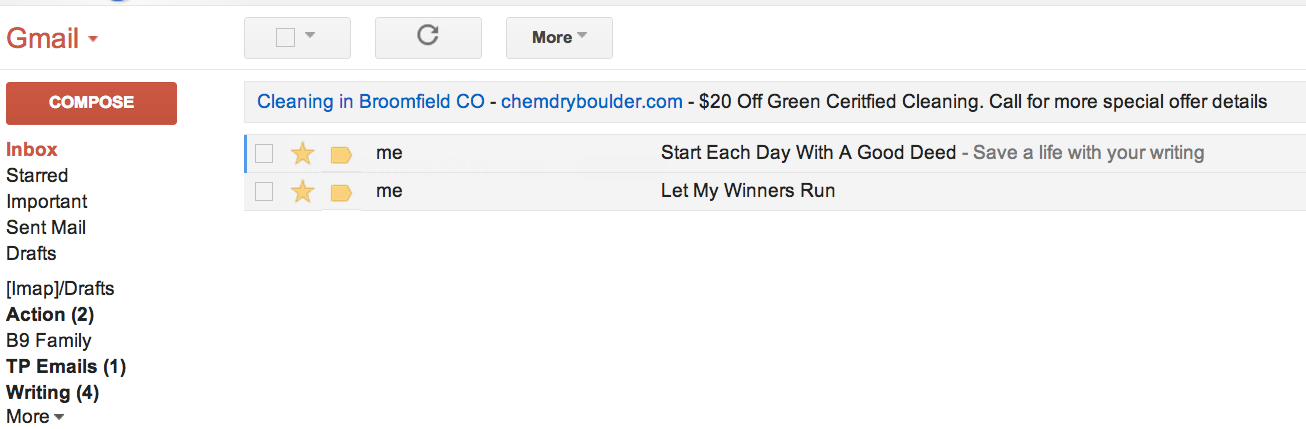
Inbox Almost Zero

Inbox Almost Zero

Maintain Personal Freedom – Taleb’s style is about freedom. Freedom to do what he wants. Freedom to say what he wants. I get that. I need to be cautious with choices that restrict freedom.

Debt – my family has one loan, a mortgage on a house that I could leave and rent for more than my mortgage/insurance/taxes.

Taleb, and others, challenge conventional wisdom about the use of debt, particularly with regard to College. My wife and I left college debt free and that colors our judgement. Friends of mine, that are doctors, talk about debt-free doctors being able to “do medicine right.” Statements like that, bring home Taleb’s advice to use as little medicine as possible.

Pay For Optionality & Avoid Open Ended Commitments – I’ve made both necessary, and ill-considered, commitments in my life. I pride myself on reliability so feel pain when I’m falling short on a commitment, or need to exit. As a result, I’m willing to pay a premium for flexibility and accept less success to avoid long-term attachment. The pain I feel is an Anglo-Saxon cultural phenomenon, in some Asian cultures, it is expected that relationships will change with circumstances. I smile when I think about Northern Europeans doing business in China and India.

Relationships – Taleb is big on parties, especially ones with lots of different interesting people. My goal at a party, if you can get me to go, is simple. Avoid being the most boring person there! I’m selling myself short. While it would help, the solution isn’t to liven up. The solution is to understand that exposure to many different people is helps create a life with meaning and opportunities to use our skills to help others. Networking is about using volatility to our advantage and the most valuable form of networking is having fun while sharing a mutual interest. I’ll go a far out of my way to share a bike tour with a buddy! I’ve made most of my best friends while exercising!

Insurance & Legal Structuring – insulate yourself from the improbable via insurance and appropriate legal structuring (links to blogs that tell you what I actually do).

Toxic People – have you considered the emotional payoff profile of the people that are close to you? Taleb talks about asymmetric outcomes in the financial sphere but far more common is the downside associated with certain individuals. Some people have a poor payoff profile and others consistently make me feel fantastic.

Think about the people you spend time with – how do they make you feel about yourself? Create space for great people by ditching the toxic folks.

By the way, if you’re truly courageous then think about how you make other people feel about themselves – especially people that have no recourse against you. Too often, I come up short here! When I’m tempted to criticize, I ask myself three questions:

  • What are my goals here?
  • Will criticism serve my goals
  • How am I making this person feel?

Taleb rails against bankers and senior management. Speaking as an insider, he is 100% right about how those sectors operate. The deck is stacked, and will remain stacked, in favor of the insiders.

If you find yourself in senior management, or finance, then think back to what was “enough” when you started.

Too often, the compromises associated with success are the seeds that create Black Swans in our personal lives.

Should I Sell My House

Spring has seen a surge in the Boulder property market. As a result of the surge, many locals are considering selling their homes, or investment properties. I am going to share how I try to make better decisions with real estate.

First Step: Gather Information

Start with a family budget that lays out expenses and revenues for the next twelve months. Once created, budgets are easy to maintain.

A technique that I use as a budget reality check is comparing cash that leaves our family bank account (for a month, or a quarter) against our projected expenses. Over the years, I’ve had some surprises by comparing “cash out” to budgeted expenses.

The next step is gathering income and expense details for your key assets. In my family, we make this easy for ourselves by having a separate “house account” which pays out everything that’s house related. In my property business we track everything by property.

To help you out, page 55 of my recent book has a list of expenses as well as detailed case studies for various types of property investments.

If you resist pulling this information together then consider if you are seeking to hide something from yourself. I’ve been known to resist gathering information when it might contain bad news!

Step Two: Pull the information together for the target property.

Here’s an example from where I used to live. I’ve adjusted the figures to reflect expenses per $100,000 of house value.

If I rent the house then I have to pay:

  • Rental Agent Commission – $321
  • Insurance – $180
  • Taxes – $677
  • Maintenance – $136
  • Furniture Removal – $85
  • Mortgage – none for this property
  • Utilities – tenant pays
  • Damage & Hassle – possibly material, property is in excellent condition and ready for sale

Against that I have a rental projection of $5,145 per annum (per $100,000 of house value). Round numbers, the property is forecast to yield 3.7% [(5,145 less 1,399) divided by 100,000].

If you have a mortgage against the property then remember to consider the return on investment with, and without, your mortgage.

  • Yield on valuation – take your net profit before interest and divide by the net value of the property (after sales commission and capital gains tax)
  • Yield on equity – take your net profit after interest (exclude the principal amount of your mortgage payment – only include interest) and divide by the net equity that you have in the property

To illustrate, if there was $40,000 of debt per $100,000 of value then the interest payment would be $1,400 at a mortgage rate of 3.5%. The net profit after interest would be $2,346 on $60,000 of equity (3.9% net yield on equity).

Step Three: Consider Big Picture Questions

What will I do with the equity if I sell? For many of us, housing is a form of forced savings. If we had the equity sitting in a bank account then we might be tempted to spend it. If you are thinking about switching to another property investment, then you’re likely to do best by staying put. Property has very high transaction, and switching, costs (due to real estate commissions).

How often can I sell this asset? Certain assets, such as vacation homes, boats, luxury goods, can only be sold in good market conditions. This creates a paradox because your best window to sell will be when you’re tempted to hang on to the assets. If I want to sell then I remind myself to leave something in the deal for the buyer.

Where will you live? If you are thinking about selling your main residence then be clear about where you will move, and the expenses associated with your new location. Generally speaking, prime markets are the first to respond to an uptick. For example, the Boulder market saw this recent surge a year after Palo Alto ticked up. Secondary Colorado markets might take another year to see improvement. What’s been happening in your next location for the last year, how does that compare to your home market?

As an example, the value of my old house now “buys” 30-35% of the square footage in Palo Alto vs Boulder – it used to buy 50-60% of the square footage. When moving between cities, states and countries, timing plays a key role with purchasing power. When moving “prime” to “secondary” – it is possible to get priced out of a market. I’ve seen examples of this in the San Francisco Bay Area, London and Vancouver. If you sell out of a prime market then values can rise and make it very tough to buy back in.

What does your current mortgage, insurance and taxes “buy” if you were to shift to a rental unit? I like to compare own vs rent. My current house would cost me $1,000 per month more to rent than to own. This is a function of the down payment I put down and covered in my article on Mortgage Debt As Inflation Insurance.

What’s your tax exposure ? Agent’s fees and realized capital gains can make moving from owning to renting less attractive. As a landlord, being able to depreciate the house (but not the land) will reduce the taxable income generated by the property.

Three final questions that I like to ask myself:

  • Can I afford to be wrong?
  • What happens if I do the opposite?
  • Under what scenarios does my preferred choice become a really lousy decision?

For now, my decision has been to continue to market my old house for sale. However, the yield from renting it out, rather than selling, is compelling.

Family Habits & Traditions

In our family, we have been working on creating habits that benefit the individual, the marriage and the family.

Individual Habits

The greatest change between my first and second marriages was improving my individual habits. To marry the right woman, I had to become a better man.

As you stack on the commitments of career, marriage and children – make time to sustain habits that give your life meaning. Interestingly, I used to think that five hours of exercise per day gave my life meaning – it was a relief to discover that I do just fine on far less. That realization makes me wonder what additional aspects of my current life will fall away over time.

Another observation is my wife gives me total freedom to entertain my fantasies. Specifically, since my teens I have had a recurring desire to escape. My wife is willing to cover the family for 2-8 day stretches. The gift of time alone gives me perspective on what my family brings me (love, companionship, and an opportunity for service).

Marriage Habits

Set these habits up before the kids arrive!

  • Communicate before you have issues – if you’re fighting, or angry, then you have issues – get professional mediation with your issues
  • Weekly date night – two hours per week, every week
  • Time without agenda – in 2013, we’re weightlifting together each week
  • Couples Retreat – some of our favorite memories (an article from early in the marriage, and an article with kids swarming)
  • Cooking healthy food and splitting household chores – efficiency from specialization

Maintain these habits after the kids arrive! It’s easy to lose yourselves.

Family Habits

We’ve stolen best practice whenever, wherever possible!

  • Daddy trips – since my daughter was toilet trained we’ve done trips together
  • Easter egg hunt – we missed this year but want to bring it back – we invite our friends’ kids and friends without kids
  • Matching pajamas at Christmas – these make great family pictures and provide fond memories across the year. I have a “Daddy G” set of PJs that make me smile every time I look at them. Participation is optional, we’ve had a feisty three-year-old opt out!
  • Sunday breakfast – we’ve stopped and started with this one because it’s tough to get a toddler to sit still for long. For summer, we are thinking of trying a picnic so the little ones can run around.
  • Rings – on both sides of our families, there have been family rings used to symbolize coming of age – we’ve thought about maintaining this tradition
  • Parent / Kid Events – with three kids, we’re thinking about doing events with Mom/Dad and just-one-kid – perhaps on their quarter birthdays (5.25, 5.50, 5.75 for example). The goal being some time with both parents when the kid gets to choose what we do.

Deciding on religious education is an area that we’ve been considering and I’ve been educating myself about my wife’s family’s tradition. In terms of making a choice that has the potential to resonate for 100 years, this is one of the more important.

Exploring The Role of Family

Despite a life spent on the road, I see an end of life benefit to having family established in one location. I’d like my family to maintain my dignity for as long as possible. I think this is a key role for family, and tough to subcontract.

What are other areas where family can help?

Supporting family members to take risks that enrich their lives. The investor in me always brings this back to helping somebody start a business. However, my family tree shows that backing family members can be a poor investment. There is a far greater return from the family offering emotional support for the courage to make a change designed for self-improvement.

Considering some bad decisions that have been made by myself, friends and family, I note that they tend to be made by cutting corners in an effort to make a little bit more money, get some more sex or gain additional status. Family plays a dual role here: (a) strengthening moral resolve through clarity in family ethics; and (b) teaching each other how to enjoy life without spending excessive money, overeating or getting loaded. Specifically, the family as a role in teaching attractive alternatives to the false gods we are taught in a consumer society.

I often socialize around food, alcohol or spending. However, when you ask my brother and I about our fondest memories of growing up, they center around exciting challenges, with good friends, while living in nature. For a decade of my early life, I spent 4-12 weeks a year at camp. A question that I’ve been asking myself is how I can create “Camp Dad” in Colorado. Learning to appreciate nature is one of the greatest gifts I can give my kids.

Last week I visited India. When you fall through the cracks in India, you fall a long, long way. The social safety net in Canada gives comfort that you’re never going to be totally screwed. Here in the US, health care costs can wipe out a family. Access to healthcare could be another role for family, particularly if you live where isn’t universally available.

Some members of my family feel that education is an appropriate area for the family to help. As you can read in earlier article, many families waste valuable capital by over-educating their kids. That said, I’ve been thinking about when educational spending makes sense and will write about that in the future. In our family, we have successful case studies that balance where we wasted money.

How does a family, or organization, get to the point where the membership is comfortable enough with each other to contribute?

Within my own family, we’re working towards the above by agreeing how we will interact with each other:

  • No taboo topics (facilitated by sharing our own life lessons)
  • Everyone talks
  • Build trust via respect, honesty and avoiding unnecessary pain
  • Have an open discussion of commitments
  • Have clear mission (we’re still working on this – for now, we have a general statement to strengthen human capital)

What’s your family seeking to achieve and what do your interactions say about your values?

Seventh Generation Thinking

This week’s theme is decisions that benefit our children’s children. Put another way, what are the most important choices I make as a parent, uncle, son, cousin, nephew and grandson.

The books of Hughes, mentioned in Readings To Strengthen Your Family discuss the concept of Seventh Generation Thinking. The idea being to make decisions that benefit citizens (or family members) 140 years down the road. Given that my life takes unexpected turns every decade, thinking 50/100/150 years in the future isn’t meaningful to me. I needed to reframe the question.

Taleb, author of The Black Swan and Antifragile, recommends thinking backwards to gain clarity. So, to learn what might really matter, I ask myself “What choices of my great-grandfather continue to echo in my life?”

The themes that I came up with:

  1. Location, citizenship & community
  2. Agreeing the role of family and renewing that covenant each generation
  3. Creating, and sustaining, traditions
  4. Teaching and facilitating good daily habits
  5. Teaching and facilitating financial wellness
  6. Teaching and facilitating effective interpersonal skills
  7. Initiating family strategic reviews and following up

While I left Canada in 1990, way way back, members of my family made a decision to emigrate and that was a key choice. Likewise, my wife’s parent’s decided to move to Colorado when she was a newborn.

Despite my respect for Canada, and occasional desires to move to Palo Alto, being American and living in Colorado provides my kids with the stability and opportunity for a successful life.

Are we in the right place for my children’s children to have a chance to live the life I wish for myself? Here in Colorado, the answer is yes.

Interestingly, up in Vancouver, my great-grandfather would have answered yes in the 1940s. However, Vancouver grew so fast that the city is a little crowded for me.

Over the last 20 years, the place that most felt like home to me was New Zealand. However, putting 12,000 kilometers between my wife and her family doesn’t make sense. Given that I searched the globe (!), to find the right woman, I should respect her roots.

So the first question to consider is, “Are we where we need to be?”

Living in Asia in my late-20s, I began to suspect that I wasn’t where I needed to be. Eventually, in my early-30s, I left Asia and moved to New Zealand. There I found a home, and people, that suited my values. As fate would have it, I met a wonderful American lady and ended up in Boulder. In my life, it’s been easier to see where I shouldn’t be, than where I should.

Giving Men Feedback

A correction from parent, or spouse, always has the potential to be emotionally tough for the recipient. In my own life, I need to be aware that I will want to push back or withdraw. So I need to be conscious of my tendencies.

Being aware of my automatic responses gets my head straight for feedback. Next, I acknowledge that I want feedback, particularly ‘bad’ news. Why? Because my goal in life is gradual improvement. I will never be perfect but I can strive for the best version of myself. The most useful feedback will always be slightly painful.

I also know that the people to whom I am emotionally vulnerable accept me and think I’m terrific. So feedback is never designed to pull me down, feedback is meant to make me even more fantastic!

NOTE: many people get caught in a habit of making “jokes” that are based on undermining the target of the humor. This is poison to a relationship and a sign of our own insecurities manifesting in a desire to pull people down.

While I want to improve, feedback needs to be limited. For example, in our home we got into a pattern of constant correction with our daughter and that spilled into everything else. We saw the problem and attacked it by removing gossip from our house and carefully picking where we want to offer correction.

I also think that time spent with other couples is useful. We had dinner this week with a man that had an arranged marriage in the 1950s. He talked generally about the tragedy of marriage without love, but he was talking about himself. Then we chatted with a couple that had a son my age and the husband was bragging about his wife, after 45 years of marriage! Heart warming. The combo made me grateful, then inspired.

My tactics to influence change…

  1. First and foremost, I need to be willing to offer my time to a situation. If I don’t want to spend time, then I forget about having any ability to influence.
  2. Next, I need a long period of building trust via serving the other person’s needs. By helping people achieve their own goals, I learn about their values and their approach.
  3. Gradually, I might offer one or two tips that might help the individual achieve their own goals.
  4. All the while, I acknowledge our individual right to live our lives the way we want and the fact that my ‘way’ isn’t best. There is a wide range of successful lifestyles in the world and my choices are no better than other people’s.

Some final bullet points about coaching your husband in life…

  • When I’m truly beyond reproach then criticism falls away. Therefore, when it triggers a reaction, I pause and search for the information embedded in the info.
  • Most men crave acceptance – constant low-level correction sends a message that your man is fundamentally not OK.
  • I get more of a kick from honor but that’s probably because I’m deeply accepted by my family. Maybe there’s an insight there – to free your man to become honorable, accept what’s best in him.

Remember to aim for nine positive interactions for each correction you offer. You’ll find this discipline improves your effectiveness and how much people like you! It also gets you focused on creating a habit of enjoying your man, rather than spotting his imperfections.

Finally, if you really want to change the world then focus on improving yourself. When I overstep the boundaries of trust, I’m reminded of this truth.

Acceptance and self-improvement are powerful forces in a marriage. In many ways, my wife and I create the person to whom we’re married!

Look inward with your own desires and your actions in your marriage. If you are driven by acceptance then correcting your spouse can set up a pattern that works against your emotional needs.

Creating A Peaceful Home

To change a habit with my wife and kids, I need to change that habit with everyone.

For example, to break a habit of snapping at other people, I need to remove that response from every single aspect of my life. That’s quite challenging!

If you’re a “yeller” then you won’t stop yelling at your kids until you manage to stop yelling at everyone. Also, many of us are yelling at people that can’t, or don’t, defend themselves. To break the cycle of yelling, it helps to drill down to the true source of our anger (often the past or ourselves).

Sometimes I can’t find the source of the yelling, and have to live with it. Here’s an example from last month. I don’t yell at anyone but, for much of March, there was a voice yelling in my head, mainly at my spirited daughter. I’ve managed to train myself not to express what’s going on in my head so there were times when a silent scream would be triggered each time I saw my little girl. Some of the things I “said” in my head were not very nice!

Having one of my kids act as a stress trigger is a tough situation, as I can’t use my typical strategy of avoidance! I’ve been trying to relax my mind by focusing on the temporary nature of the noise I experience with her. Knowing that there is an ending to every interaction helped calm me down.

I looked deeply and realized that being upset with my daughter had become a habit that was independent of her behavior – even when she was great, the internal battle raged in my mind. There were situations where I wanted her to misbehave to give me an opening to vent. It’s a very good thing that the habits of non-violence and harmony pre-date fatherhood! In the end, I removed myself for a few days, to travel to India for a wedding, and that emptied my mind of the noise.

Coming back to my original goal to speak kindly to my spouse and kids – we need to cultivate kindness with all our interactions. “Kindness to all” being the requirement to deliver “thoughtful speech” to our wives and kids. As I mentioned above, I can train myself to appear calm when there is a storm raging in my mind! It’s not a requirement to be peaceful inside to have a peaceful home (but I’m sure it helps).

I’ll share an idea from Gordon Livingston. Focus on treating people that can’t defend themselves better, for example service people. From that habit, extend towards treating everyone better. Under stress, nobody is good at remembering to treat one category of people better than another.

These habits are also a great way to lower blood pressure without the use of medication. I can see how internalized rage would be bad for one’s health.

When I find myself falling short, I remember that I can’t correct the person I was, but I can correct the person I am. My short comings become inspiration to keep trying for incremental progress.

Why I Declared Victory In My Relationships

I have a men’s group that tries to meet once a quarter. Recently, we were discussing ways to strengthen our marriages by improving ourselves.

The discussion centered around:

  • being better men for our wives
  • more effective communication with our kids
  • ditching our most damaging habits (anger, overeating, excessive drinking, smoking)

I shared that, while I’m far from perfect, it was effective for me to declare victory on all fronts. For the guys, I interpreted my family mantras in light of my closest relationships:

  • I’ve already won – so I never need to “win” with my wife
  • I have more than I need therefore I don’t expect my wife (or kids) to serve me – at an emotional level, I am my own source of happiness
  • My ultimate goal is to live in a peaceful house that’s full of love

Combing all of the above, I find that there’s nothing left to fight about. If I get irritated then it’s because I’m (blindly) projecting an inability to change myself onto my spouse.

There may be areas of disagreement but, when the family has a goal of harmony, I find that the resolution to any conflict becomes apparent. Sometimes the resolution is simply – we’ll have to deal with this for a while.

Within my marriage, my goal isn’t perfection. My goal is continuous gradual improvement and being part of the overall solution.

Related to my earlier piece on guilt, if I deeply believe that I’m “part of the solution” then I’m able to bring a calm perspective to bear. I don’t need to fix anything, I simply need to help make myself, and our home, a little bit better each day.

Gratitude and Inspiration

I’m writing from a hotel room in India. My last trip to India was September 2000 and I went back to read about that trip, a whacky board meeting in Mumbai.

To appreciate my good fortune, there is nothing as effective as a trip through Asia. My life in Boulder compares very favorably to the best that Asia has to offer. Time spent in China and India put the ‘hardships’ of the West into perspective. I am very fortunate.

On the flight over, I read Towards a Meaningful Life. Although I was raised Catholic, my kids are Jewish by birth and we’ve been discussing their spiritual and religious education. The book, written generally, covers the spiritual aspects of Judaism and was recommended as an introductory text. The book contains chapters about a father’s role and provided inspiration to improve my game!

Another source of recent inspiration has been James Altucher’s Blog. Somewhere in his archives was a mood management tip to create a gratitude list. On many levels, feelings of gratitude are good for me.

As a novice coach (2000), I used gratitude to help athletes improve their self-image. We’d get a small notebook and, each night, write three good things about the day. The idea was to start a habit of positive thinking. In addition to the nighttime technique, the athlete would add items across the day when she noticed that she was in a good mental state.

Of late, certain aspects of being a father were getting to me. Even when my daughter was behaving great, I wasn’t enjoying her. I realized that it was time to heal myself. So I created a Gordo Gratitude List in google.

Here’s what I’ve noticed:

Gratitude has a physical sensation – I experience a release around my heart when I feel grateful. It feels very similar to love.

Writing in my list leaves a mental marker for the experience of gratitude.

Returning to my list, lets me return to the physical sensation. Reading the words triggers a physical memory in my body.

The more I trigger the sensation, the more natural it becomes. Seems that gratitude is a free, pleasurable habit.

As you’ll see from my list, most of my triggers are simple items. One of my favorites is “almonds and cashews.” Since starting my list, I get a little hit from each nut. This gives me an incentive to eat more slowly – always a good thing!

If you tend towards pessimism (which you’ll tell yourself is merely realism) then a gratitude list can improve your life experience.

Cultivating gratitude at home is a lot easier to achieve than scheduling a trip through the Third World, which I also recommend.