How Leverage Kills

Ax_snow2In 2008, I was invited to give a strategic overview to a board meeting. One observation that I worked into my presentation was, “the assets aren’t generating any net cash flow before interest expenses.”

One of the directors asked me to clarify, “Do you mean after interest expenses?”

“No, there isn’t any cash generation before interest.”

The CEO talked about timing issues with the refurbishment of existing properties and the conversation moved onwards.

A little over a year later, the entire group was insolvent. The CEO filed for personal bankruptcy and left the country.

+++

How is the above relevant today?

Once again, debt is readily available to finance assets with low, no or negative yields.

This is a good mantra to repeat out loud.

I will never borrow money to buy an asset with a cash yield lower than my cost of borrowing

Why?

You will never, ever, ever, ever… have the same discipline with borrowed money as you do with a cash investment.

  • Land speculation
  • Gold & silver
  • Residential buy-to-rent
  • Vacation homes
  • Fancy cars, boats and RVs

By forcing ourselves to pay cash, we buy far less of these assets.

++

Why do we like to borrow?

  • We can consume more, earlier
  • We can buy more, quicker
  • We can increase the rate of equity appreciation

When greed and ego are involved… pay cash!

++

For whom does leverage work best?

  • Managers that receive a share of gains but have no responsibility for losses
  • Brokers that receive commissions when you borrow or buy
  • The owners of firms that are valued based on assets under management

Look for the above when advisers tell you to borrow more.

++

Many asset classes have had three, or more, years of gains. Our brains are hardwired to assume the last 1,000 days are going to continue indefinitely.

When low yields combine with momentum and easy finance… things can get ugly suddenly.

We’re all going to live through bear markets. They will happen.

Bear markets crush people with debt service greater than operating cash flow.

My friend, the CEO, had personal debt service of $50,000 per week, then his bank went bust, then his employer went bust, then he went bust.

Some risks aren’t worth taking.

+++

This article was triggered by hearing an Australian lawyer rave about a (negative cash flow) buy-to-rent deal. I thought it was going to be decades before I saw that asset class overheat again. Same story, different hemisphere!

The Do-Something Investment

Ax_snow1I saw that Clinton’s son-in-law took some big losses at his hedge fund by making bets on Greece. People are speculating that the Clinton family lost a lot of money in the deal.

While the scale might be different, I see this error in every family that I get to know.

We err by making an investment to help someone “do something.”

Some examples from my own investment history:

  • I’m self-employed and have often been tempted to buy myself an office so I can have a place to do something
  • I’ve offered to back friends in start-ups so they can have the funds to create a business and do something
  • I backed myself in a low-return business, where I didn’t understand the market, so I could have something to do
  • I guaranteed the debt of a friend’s business so he could borrow additional money for his start-up
  • I purchased a property so a friend could have a job acting as my property manager

To limit the damage, I have two questions that I ask.

First: What is the purpose of my family balance sheet?

  • Maintain independence and dignity of elders
  • Educate the kids
  • Share experiences with each other
  • Produce a growing stream of cash flow to fund my future living expenses
  • Support a feeling of security and freedom of occupation

You might have a different list. I’d encourage you to write your list down because the checklist might help prevent expensive errors.

Second: How well have I done with predicting my life on a ten-year prospective basis?

While my life has been rewarding, it’s path has been unpredictable on a ten-year rolling basis.

The unpredictability of life means there is value in maintaining a straight-forward balance sheet that isn’t concentrated in any individual, geography or company.

Put plainly, I’m nearly certain to continue to get the future wrong – especially when I try to predict my family’s needs, desires, location…

+++

Let’s say an investment can get past those two questions.

It is time to keep it real.

#1 – Are we backing the best members of our team?

The best people don’t need the help of connected parties.

Because…

There is plenty of money available for good people with good ideas.

Therefore, by definition, most family investments are focused on the weakest members of the team.

Don’t do it.

#2 – Can we afford to lose our maximum exposure immediately?

Concentration kills.

If you can’t afford to lose your full exposure, immediately, then don’t do it.

+++

If you’re struggling to say “no” then

  1. say “yes” to spending time to help raise funding from a third party
  2. lease instead of buy
  3. focus on enjoying each other’s company, rather than investing together
  4. make an introduction to an expert in the industry to facilitate a working apprenticeship
  5. pay for expert instruction

These options have had a great rate of return in my life.

Wealth Habits – Discretionary Spending

AX_BellaRecently, I met with a financial adviser and she said two things about her practice:

  • I never talk about spending.
  • Most my clients make so much money they don’t need to budget.

I had a physical reaction to those statements.

I felt sick.

Why?

Probably because not-spending in my 20s had a pay-off far greater than every investment I will make in my 40s.

Eventually, I settled myself down by writing this article.

++

#1 – Mean reversion is tendency for natural systems to trend back to the average over time.

Our minds will forecast based on the last 1,000 days, rather than long-term averages.

Therefore, we must force ourselves to consider, what’s the long-term average of this natural system?

Why does this matter in families?

Because the highest-earning family member often lifts everyone’s spending aspirations above the family’s average earning potential. This sets up wealth destruction, as well as unnecessary emotional tension within the family.

The affluent often train their children to destroy wealth.

++

#2 – Consider the transient nature of peak earnings and their relationship with time

A great quote from Mr. Money Mustache – “far wiser to earn your freedom while you are still fired up about working.”

I started out in finance, a field which gets you spending!

I managed to earn my freedom at 31 years old – most my peers hung in until their late-50s/early-60s. Their 15-30 years of additional commitment enables them to spend my current net worth on an annual basis for the rest of their lives.

We often make the mistake of spending with reference to current income, rather than current wealth.

As a guy that bought his freedom “too early” – it was worth it. I’m part of a small sample set – most people stick it out.

++

#3 – Am I getting value for money?

Is your spending having it’s desired outcome?

The value-for-money discussion requires uncommon personal honesty about what motivates you.

Our motivations are not always noble!

Own your motivations and tailor spending to optimize these aspects of your life.

+++

There’s no greater impact on financial wealth than current spending.

How many years would your net assets endure based on what you spent last year?

Be most aware of how you spend your time.

How’d you spend your time last year?

There are valuable lessons available from every stage of your family’s life cycle.

2015-01-21 17.50.57

Wealth Habits – Saving Early

firefighterWhat’s the difference between $1 saved in our 20s and $10 earned in our 50s?

The answer blew my mind. Turns out it’s likely the same thing.

As a young person, it is tempting to tell yourself that you’ll save more when you’re in your “Peak Earning Years.”

The trouble with “save more later” is you might be living with 4 dependents (plus cats) and have a mortgage once you arrive at “tomorrow.”

++

What is the single greatest wealth behavior that you can teach your family?

Early savings and patience

  • I’m 46 and it has been 25 years since I graduated from university
  • In the first five years of my career, assume that I saved $17,500 per annum
  • How much would another graduate have to save from 46 to 60 years old to catch up?
  • Assume a rate of return of 7.5% per annum across all periods

The formula in Excel is called “FV” for future value. You need to know the rate of return on investment, the number of periods and the payment.

7.5% rate of return, across five years, with an investment of $17,500 per annum => gives $101,647 at my 26th birthday

The next step in our case study is to roll the $101,647 from my 26th birthday to my 60th birthday.

7.5% rate of return across thirty-five years with NO ADDITIONAL INVESTMENTS.

What do you think?

BOOM => $1,277,586 from $87,500 invested in the first five years out of university

Consider this example against the $1.2 trillion of US Student Loan debt.

I urge you to revisit these numbers when considering significant spending on private education as well as taking out loans. You are making wealth decisions with massive long term implications.

What it would take to catch up if another graduate waited until her peak earning years?

  • Future Value to achieve is $1,277,586
  • 15 years (46 to 60)
  • Rate of return is 7.5%

The function to calculate the answer is called PMT (payment) and the answer is $48,915 per annum. Across 15 years she must make a total investment of $733,725, versus $87,500 for the early saver.

In this example, $1.00 invested in the 1990s bought the equivalent of $8.38 invested 25-40 years later. This is despite terrorism, wars, civil unrest, recessions, frauds, unemployment, bankruptcies, disease, and all the other bad news that we’re constantly fed.

My wife and I have a joint life expectancy of 47 years.

My daughters have a joint life expectancy of 90 years.

Time is always on your family’s side.

What I Learned Last Year

biscottiTwo themes have dominated my goals for the last couple of years: my relationship with my eldest daughter and my finances.

++

Kids – my daughter worked herself out, no input from me. I didn’t change her nature, I accepted it, and we enjoyed the inevitable progression from preschooler to school-age girl.

For my pals with kids – avoid abandonment and retaliation – everything else is details.

++

Optimism is the only worldview borne out by the facts.

At the end of 2008, I wrote-off 65% of my family balance sheet, was unemployed, owned a loss-making business and was facing civil liability relating to large-scale fraud.

You may have forgotten but everything we were reading was doom and gloom. In reality, that was one of the most useful periods of my life because I was forced to face the gross inefficiency of my spending choices.

The changes that result from earlier setbacks lead to an appreciation of a more simple life and I’ve continued to strip away non-core activities.

My wife is stumped when asked, “What does Gordo do?”

I enjoy my life and serve my family

Act in the spirit of service to the people that love you.

Act as if things will work out.

Keep simplifying.

Free yourself to spend time on what matters.

For the pessimist in your head that likes to point out that we’re all dead in the long run… be wary of overstating your importance in the world.

My death will be a setback for a few people but it won’t change the positive trajectory of history. I will play my role then hand off to the younger generation.

There will be tears and that’s OK.

++

Human Capital & Family Finances

What can each of us bring to our families, and communities?

Strong relationships built on mutual respect and strengthened via self-improvement.

Six years ago, I was left with a home and cash assets. With interest rates moving towards 200-year lows, I realized that I had to be invested. I made an error by going all-in with real estate. Why an error?

  • I was geographically concentrated – the bulk of the portfolio was within two miles of each other.
  • I invested too much – I failed to understand the short-term cash needs of my young family, which arrived in 2008/2011/2012.
  • Each asset represented many years of living expenses – lumpy assets are inefficient when you’re moving towards retirement.
  • Real estate takes a long time to sell. With a traditional portfolio, a gradual sell down is easier to achieve.

My purchases had a margin of safety and I was able to trade my way out of the situation – 4 out of 8 addresses have been sold. Start to finish, it will take 8-10 years for me to change my asset allocation. Our family financial structure gave me time to make the change, we earned income, and we had exposure to asset appreciation.

Time worked things out – we did well but so did all others that were invested from 2009 to 2014.

++

The final lesson – I am greedy in irrational ways. I can soothe my ego by noting that my flaws are widely shared.

I am susceptible to the Endowment Effect. I overvalue what I have – my wife had to force me to sell our old house, I wanted to hold out.

I overvalue future desires. I’m constantly fooling myself that MORE will make a difference.

My antidote:

  • Write down my desires (steam shower, truck, boat, kitchen appliances, vacations, clothes, car, office, ski chalet) then wait and let desire pass
  • Make the wealth cost of “more” both painful and visible
  • Note the choices that create my best days (train AM/PM, help someone, learn, write, teach, spend time with my wife, under scheduled)
  • Spend money to create true luxuries (childcare, time to think, time to learn)
  • Schedule my happiness essentials (time in nature, time with my wife, quiet time to think)

Keep it simple:

  1. Notice the good in life
  2. Write good things down
  3. Do more good things

Early Retirement – The ratio of spending to security

thanksJustin put me onto Mr Money Mustache’s blog (“MMM”). MMM makes a point that if you have a balance sheet that equals 25x your annual spending then you should be set for life.

What prevents us from getting to the magic ratio?

At my best, I see debt and spending as where to focus.

When I’m feeling sorry for myself, I might blame taxes, lack of income or the cruelty of fate.

Like Mr. MM, I retired early. In fact, I’ve had three retirements – two voluntary and one via the insolvency of my de facto employer.

When I was living first class in my late 20s, I realized that I could slash my spending by 90% and take a year long vacation. This change didn’t get me to the magical 25x ratio but it got me close. I worked part-time (as a coach) and knew that I could tighten my spending and get myself to 40x covered.

Somewhere around 2002, I got caught up in the bull market that ran through to 2008. My spending rose, and rose, and rose, and rose. I didn’t mind as I was making good money. If you’re in a high-paying profession then you’re prone to this risk. I’m not unique. Docs, dentists, lawyers and finance professions often extend their careers by 10-25 years by cranking expenditure and borrowing.

My life came to a head in 2008 when the economy went off a cliff, my income dropped 95% and I had grown accustomed to my spending.

Boy did it hurt to stop spending money.

It hurt because I didn’t see the link between spending and the anxiety that filled my life.

Inside my head, the battle raged…

  • I DESERVE…
  • I HAVE NEEDS…
  • IT”S NOT FAIR…

What I was really saying is, “it hurts so much to change. I just want to be happy, please leave me alone.”

I see plenty of conflict in relationships over money. Historically, much of my irritation over clutter stems from an underlying financial anxiety that I’m not addressing via my own habits.

Quite often the main breadwinner delegates the financial planning function, putting their spouse on an allowance and creating a external target for internal angst.

A couple years ago, I realized that I’d done this to my wife. I had to own my fears, change my spending and redirect our family.

+++

I had the courage to take my first retirement at 31 because I remembered the freedom that came from living like a student.

I forgot that lesson, increased my net worth by 500%, and felt completely insecure at 40.

Every $10,000 of expenditure requires $250,000 of assets to buy me financial peace of mind.

What’s the true cost of your spending?

What could you achieve if you removed unnecessary anxiety from your life?

+++

I have buddies that are planning to work an extra decade – to build assets sufficient to support a spending rate that doesn’t bring happiness and strains their home life. They tell me stories of their children begging them to work less.

The pain is real.

So are the benefits from incremental change.

Behavior Not Protocol

winterIn any given field, the bulk of our performance comes from choosing appropriate behaviors rather than optimizing protocol.

Take wealth, I’ve been reading a second book by Nick Murray and he makes the point that behavior is the single greatest source of wealth creation. He goes further to make the point that it has a greater impact than all other factors combined.

In reading the book, it struck me that he could easily have been describing athletic performance.

  • Balanced program
  • Frequent small contributions towards the goal
  • Most people beat themselves
  • Train yourself to overcome human bias and misjudgment

For every wealth behavior, I can find a similar fitness behavior. Works the same with common errors (selling in fear, chasing performance, not resting, fear of fatigue).

Looking forward to 2015, what behavior is required to achieve your goals? Don’t focus on more than three.

What are the most common mistakes that “everyone else” makes in seeking similar goals? Individual experience is a mirage. What are the most common errors made in my field? How best to create a system so I avoid repeating the mistakes?

Regardless of your field…

  • One small daily step – keep chipping away
  • Drive experience inwardstake all external irritations and change them in MYSELF
  • Let go of non-core – our best work requires a clear mind, a clear mind comes from letting go
  • Refuse to make predictions – pundits do worse than random – stay focused on behavior
  • Spend no more than 10% of your time on tweaking protocol – the greatest returns flow from consistent core behaviors

What are the behaviors required for a life with meaning?

Health, kindness, shared experience, close to nature.

Quarterly Financial Review

2014-11-19 13.36.43-1The way you feel right now is how a bull market impacts consumer sentiment.

  • Gas prices are down – a big psychological boost for me
  • Asset prices are at all-time highs – makes me feel safe
  • Your business is performing well – makes me feel safe

In these conditions, it’s tempting to change investment strategy and chase recent high performing assets (or managers).

We’ve decided to stay-the-course. There’s hasn’t been any major change in our life situation so there need not be any change in our investment strategy.

We’re on track to achieve our goals:

  • The freedom to chose rewarding part-time work
  • A source of income that we don’t outlive
  • Educating our kids
  • Passing capital to our adult kids when it’s time for us to say good-bye

Do you know your goals?

Do you know the behaviors that can screw up achieving your goals?

++

We sold our old house in September and I implemented our strategy of gradually buying equities. We’re 34% equities so there’s been “lost profits” from having money outside of the equity market – especially when the US market hits all-time-high after all-time-high…

Surprisingly… lost profits don’t bother me, or screw up our goals, and I was relieved in October when the portfolio held up well.

Dollar-based equities have continued to outperform our international investments so I’ll rebalance by tilting new purchases towards international. Yes, I’m going to buy more of what everyone is saying will tank in 2015 (VTIAX). I have a strategy of reinvesting dividends and keeping International equity at 50% of my US equity exposure.

It’s likely that I’ll need cash flow to cover year end expenses. I will sell bond funds to raise the cash. That will bump up our equity allocation as a percentage of assets.

The underperformance of our international equities creates the possibility of tax-loss harvesting in December. Next week, I am preparing draft accounts for the different parts of my family and reviewing the cost basis of our investments. Later this month, we will decide if it makes sense to realize losses.

++

We spend $12,000 per annum at Whole Foods and they are offering a 10% rebate on gift card purchases through Jan 1. They let us pay with a credit card which gives another 1% via cash back. That is an 11% return on investment, on money we are certain to spend.

We eat at Native Cafe and they have an even better offer of a 20% rebate on gift card purchases. There’s only one location in Boulder and the company financials aren’t are strong as Whole Foods. I’ll limit myself to five months worth of meals.

Even better than shopping at Whole Foods, or eating out, is staying at home and using goods purchased at CostCo. We spend $10,000 a year at CostCo and it saves us thousands of dollars.

If you don’t know what, where and when you spend then Mint.com is an easy way to track your family finances.


Simple Wealth, Inevitable Wealth

Happy_EverythingI came across this week’s title via a book recommended in The Reformed Broker’s twitter feed. The author is Nick Murray, who’s been a financial adviser for longer than I’ve been on the planet!

Here’s a link to the book on Nick’s website.

The book is an easy read and the first pass through won’t take you long. It’s a good one to share with your family and discuss. My key take aways…

Volatility isn’t loss – while emotionally painful, adverse movements in asset prices only hurt me if I sell. So long as I can hold through the bottom, price movements have limited bearing on my life.

Dividends are indexed income that comes from appreciating tax-deferred assets. This point really hit home. Sample yields from my portfolio:

  • US Equity – VTSAX => 1.82%
  • US Bond – VBTLX => 2.00%
  • Boulder Real Estate => 3.30%

Both the equity and the real estate have an option embedded via the potential for capital appreciation. The value of the asset can increase (or decrease), thereby increasing my total return on investment.

Nick would say the true risk on my portfolio lies at the far end because a long-term holding of bond-type assets has zero capacity for capital appreciation – I receive return of capital, taxable income and exposure to default risk.

Dollar Cost Averaging with a lump sum is only superior when there’s a crash within 2 to 3 years of receipt of funds. Very similar to the advice Vanguard gave a friend of mine and something I hadn’t fully considered. My lump sum article was written at 5.5 years into a bull market and my holdback capital has an investment rate of 2 to 3 years.

If your goal is long-term wealth creation then you should be close to 100% equity – this is similar to Warren Buffett’s advice for his daughter’s portfolio (90% US Equity index and 10% short-term government bonds). Nick makes the point that dividend income is indexed and we can afford to ride the volatility.

Protect your family by holding enough short-term securities so you don’t have to sell into the inevitable crashes and let long-term compounding do its work.

He also has a great example of the change in total dividends and total profitability across long periods when the market “doesn’t move.” Even when share prices are stagnant, the world makes forward progress.

The book contains very little advice on investment selection because Nick’s take home point is Behavior Drives 90% of Investor Return.

This mirrors my advice to athletes – until you can do, what you do doesn’t matter. Nick’s point is we focus too much on the type of Investment and not enough on making ourselves better Investors.

The final chapter was the best – Optimism is the only Realism. The pessimists in our lives will claim that their views are based in reality. While fear, anger and pessimism are supported by our media, Nick makes the point that long-term optimism is the only position supported by the facts.

Lots to discuss with my family and I recommend it to your own.

Panic Early – stress testing my family finances in October 2014

2014-10-25 11.24.20-1I was on a business trip in Asia when the call came through from my wife…

Are we OK?

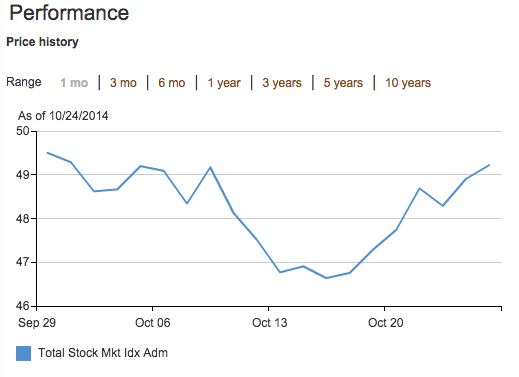
The markets had come off 5% and the news media had cranked their fear machines to full throttle. You can see the dip below. I got the call at the bottom of the “U.”

Screenshot 2014-10-27 08.36.45

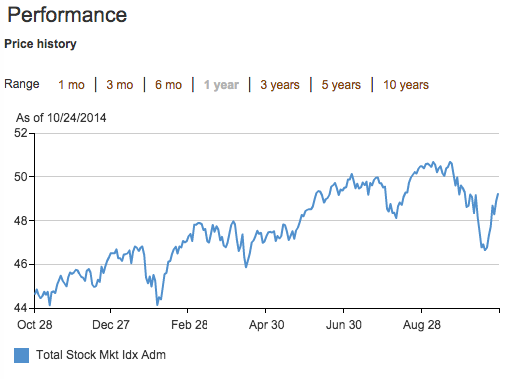
The next chart shows why everyone freaked… memories are short. Here’s the one-year view of my US Equity Fund…

Screenshot 2014-10-27 08.37.02Looking at the chart above, I got the call at the bottom of the right-hand “V.”

So I opened up my tracking app to see how we were doing.

Despite the 24/7 coverage of the impending financial apocalypse, our family net worth hadn’t moved.

Strange.

I opened up my Vanguard app to see how our financial investments were performing. Down about 1% in total – not bad considering the financial pundits were acting like we’d plunged off a cliff.

Why so little movement in my life?

1 – I focus on the total portfolio position, not the elements inside the portfolio, which are constantly changing. I check in on the portfolio monthly and rebalance the asset mix quarterly.

2 – Aside from a modest 30-year fixed rate mortgage, there is ZERO debt in my financial life. Leverage magnifies the impact of changes in asset prices.

NOTE – If you have a financial advisor in a Big Bank then I bet they’ve been trying to sell you margin loans on your portfolio. The cost of your margin loan is greater that my expected rate of return for my portfolio – therefore, I view your margin loan as a direct wealth transfer from your family to your adviser’s firm and bonus. I have pals that make a living selling these products – my choice is to send my kids to public school and make less money.

Know that you can get better advice from Vanguard for far less money – plus Vanguard products cost you less than a tenth of what the Big Banks charge.

3 – I’m exposed to more than US Equities. The key components of my family’s balance sheet are:

  • US Equities (VTSAX)
  • Int’t Equities (VTIAX)
  • US Intermediate Bond (VBTLX)
  • US Short-Term Government Bond (VSBSX)
  • Boulder Real Estate

When the equity markets freak out, sometimes my bonds appreciate due to people swapping into US government securities. This is nice but I don’t really care because…

I hold the bonds to reduce the volatility of my total portfolio and to provide capacity to buy more equities when the market tanks.

+++

After checking things out I told my wife that we were OK and she said…

So, I guess the lesson is not to panic?

My reply, “Actually, I panicked when the market was down 2%.”

The difference is my capacity to act on my plan, rather than my emotions.

The lessons are:

If you can’t do the plan then it’s the wrong plan!

I’ll end with the five-year chart for an index of 500 large stocks that are traded in the US.

Screenshot 2014-10-27 08.38.34

If you thought October was a rough ride, you ain’t see nothing yet, it wasn’t even a blip.