Getting My Affairs In Order

In March, I shared a family legal structure. Even with that structure in place, there will be significant admin for your family to sort when you pass. This admin will hit your spouse and children when they are least equipped to deal with it.

Given that people are useless at administration when they are grieving, how can you make life easier for your family? 

Simplify possessions, portfolios and personal legal structure. Almost everything we have will be sold, donated or disposed. Streamlining yourself, in advance, is an act of love that will save your kids days and weeks of effort. If you have mementos that are special to you then sit down your kids, and grandkids, for storytime. Use the pictures and personal effects to make your history, their history. Without this effort, your memories will end with your passing. Your kids will treasure their memories when you pass. 

Brief your successor(s) – consider the roles that you play in your family (financial, administrative, emotional), who’s backing you up? Do they know it? Have you explained their role to them? Do your successor(s) have written plans and checklists to work through? It’s far easier to update an existing plan than to create one when you’re under the stress of an unexpected event.

Establish A Joint Operating Account – Start with a joint operating account with your spouse. As you age, consider a joint account with your most reliable adult child. In my family, at least half of us have bodies that outlive our minds. It’s very likely that I’ll need to hand off to one of my kids at some stage.

Consider Medical and Financial Powers of Attorney – These roles require different skill sets – consider splitting. Have an honest conversation with the individual you’re considering to help you out. Are they willing, and able, to fulfil their role.

Consider Probate – If you died today then would your estate require probate? What are the costs, and disclosure requirements, associated with probate in your locale? Are you OK with that? What are the steps necessary to avoid probate?

Clear Instructions – make your Will crystal clear, simple and easily available when you pass. Brief your executor, and personal representative, well in advance.

Proactive Disclosure – Hold meetings with your financial/admin attorney, your medical representative and your spouse. I’m 44 and have a quarterly state-of-the-family meeting with my succession team. Not because I expect to die anytime soon, rather as an insurance policy to lessen the blow on my loved ones if I’m taken out at short notice.

Sorting the above doesn’t make coping with death easy, but it does go a long way towards reducing the chance that your survivors are overwhelmed, or ripped off.

Be very careful with financial powers of attorney and signing rights over your assets. I’ve seen fraud within families and between lifelong friends. Establish structures that limit the ability to one corrupt individual to hurt your family. Remember that even competent people make mistakes.

When you think you’ve got everything sorted – try explaining it to a trusted friend. Once you’ve explained it to your pal, have them explain it back to you. I guarantee you’ll learn something.

Three tips for estate planning:

  1. Say what needs to be said, today.
  2. Be a hero now, not when you pass.
  3. You’ll get the greatest satisfaction from sharing gifts (in person) with the people you love.

+++

Denver Bar Association: what to do when someone dies

Colorado Bar Association: personal representative and trustee under probate

When You’ve Made Your Money

By the time I was 32 years old, I had created a life where I had the option of working parttime. For the most part, I got that opportunity “right” and enjoyed my freedom.

My errors came from from the thought (perhaps the lie) that spending yields happiness. That belief, shared by most my peers, pulled me back into fulltime employment twice over the last decade.

The first time I was pulled back, it was to help a friend start a business. There was huge equity upside and I loved the work. It was a good decision but I ended up over-extended financially. Thankfully, I started selling down in 2005 and, in the Great Recession of 2008, “only” lost 2/3rds of my net worth.

The scale of the losses was equal to what wiped out my grandfather’s generation. In the four generations of my family tree (that end with me), we’ve lost enough money for the entire family to never have to work a day in their lives. The bulk of my current job description (father, teacher, administrator, spouse, brother, uncle, trustee) is trying to reduce the frequency, and consequences, of these bad decisions.

When I took my big financial hit, my cost of living (2008) was 5x higher than what I spent in my first year of “freedom” post-college (2001).

Due to the bankruptcy of the business I’d been advising, I was under a tremendous amount of stress. Reflexively, I chose to cut expenses and replace income. My family’s 2009 expenditure was half of 2008, but remained 2.5x higher than what I spent in 2001. I focused on my back-up career of coaching (always have Plan B!) and managed to cover 50% of what I was spending.

At that point, 2010, I didn’t know what to do. Inside my personal business plan, I have a heuristic “if in doubt then wait.” So I repeated the year, with a couple exceptions, Axel (2011) and Bella (2012).

Gradually, across 2011 and 2012, I realized that preserving the status quo (large house, dad working to pay bills that don’t make him happy) was insane. Despite being complete insanity, I was following a path that had universal support in my peer group. As my kids popped up, I noticed that I was getting less and less fun to be around AND I was actively working to create a life outside my house.

The family readings that I shared, and my family history, show that it’s almost certain that we will wipe ourselves out (perhaps more than once) in the next seventy-five years.

What should you know about your money?

  • Most of any financial legacy will be gone a couple decades after my death, or spent by people I never knew
  • The greatest pressure I experience is preserving wealth that I’m unlikely to spend
  • I know I can live in peace on a fraction of my current spending

What do I truly need? Easy to answer day-to-day: exercise, love, service and health.

For the long-term, I like to have a mission. Why not make the people I live with part of my mission? Then I’m surrounded by meaning, and success. If that’s the case then what does my family truly need?

Empathy – it’s easy to find people to do stuff. It’s a lot tougher to find people to listen and care.

Learn To Teach Ourselves – my writing is about sharing how I teach myself. Tools that I want to pass to my kids: write down insights and blindspots, make errors visible, replace habits that hold us back and share stories of what you’d like to become.

Cope With Loss – More by accident than design, I’ve been on a self-guided education of the major faith traditions, neuroscience and behavioral psychology. This has led me to believe that loss is an opportunity to learn by experience. Until life deals us a major setback, we will not understand impermanence and the nature of existence. Create a daily practice that let lets you process, release and recharge from the challenges we all face. Deal with loss by continuing the good that you’ve learned.

My kids weren’t around for for the first 40 years of my life. Common sense means I won’t be here for the last 40 years of their lives.

What’s your legacy?

Good memories and a skill set that let’s the student surpass the teacher.

28-days away from elite sport

Today is the four-week anniversary of my pause from focusing on elite sport.

For moral support, my wife’s been taking a 28-day break from Facebook . I think her break has been tougher because Facebook started an email campaign against her. I had a similar thing happen to me in 2010 and forewarned her that the spam-bots were crafty!

I’ve been Facebook free since the start of 2012 – it can be done.

My break has been 100% positive – I can’t find a single drawback to my life from pausing from professional sport.

Training – with less web usage (particularly twitter), I suddenly had time to train in the morning before my kids get up. While it was “only” one extra run per week, I felt great that entire day from the early session. It’s worth noting that 1 extra session per week, boosted 14% of my waking hours. Early training is high-return exercise.

Reading – I’ve been talking about reading at home for more than a year. I do most of my reading on airplanes and, subtly “blame” my kids for not being able to read at home. In the last month, I’ve managed to read three books at home, which is more than the previous twelve months! The books were: The Gift of Therapy; Living a Jewish Life; and Life’s Greatest Lessons. Turns out I was the issue, not my kids (who remain full of energy and a source of self-knowledge).

Patience – It could be the normal ebb and flow of parenting relationships but, as I reduce my time online, I’ve had more tolerance with my kids. Less in-bound noise seems to result in better relationships around me.

As for the outside world, Life Goes On…

My media filter isn’t complete and I heard all the major stories (and a few that haven’t hit the press yet). The difference is they filtered through gradually, rather than having to ferret them out. While I might be less informed on athletic gossip, I know enough to meet the needs of my friends, family and team. “Fresh news” is nearly always incorrect – I’m better off without it (links to my blog on improved thinking).

Turns out I was fooling myself about my need for constant input on, and criticism of, the choices of others. Not the first time.

Another debt of gratitude to my wife (links to my gratitude list).

The cost of the status quo is always hidden. I’m glad I was willing to try a change.

Towards An Antifragile Life – Living With Volatility

I’d encourage you to read Taleb to experience the hero, and anti-hero, directly. Acting on his books saved me from personal bankruptcy. I owe him much of my personal freedom.

Separate from his tips for financial living, what are the lessons that I can bring into my larger life?

Don’t Tinker, Let My Winners Run, As Much Nothing As Possible – I blow at least $10,000 a year forgetting these points. My sin is neglecting the benefit of “no action.” Every year:

  • I cost myself money by tinkering with my winners
  • I waste emotional energy by getting involved in situations that will work themselves out with my help
  • I spend goodwill via over-correcting the people close to me

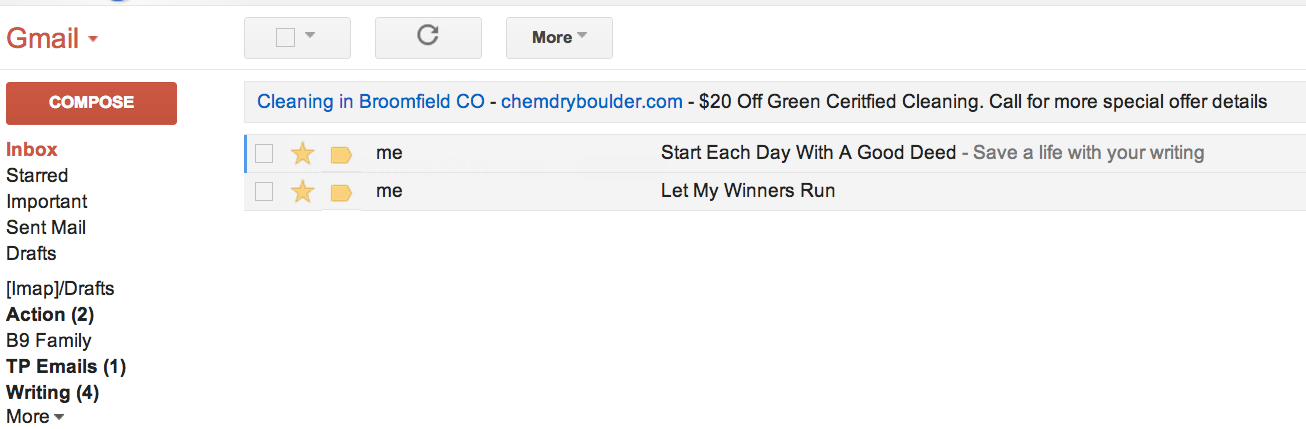
The tip about letting my winners run is so persistent in my investing errors that I’ve sent myself an email that I see every time I log into gmail. The other email is designed to make me a better man.

Inbox Almost Zero

Inbox Almost Zero

Maintain Personal Freedom – Taleb’s style is about freedom. Freedom to do what he wants. Freedom to say what he wants. I get that. I need to be cautious with choices that restrict freedom.

Debt – my family has one loan, a mortgage on a house that I could leave and rent for more than my mortgage/insurance/taxes.

Taleb, and others, challenge conventional wisdom about the use of debt, particularly with regard to College. My wife and I left college debt free and that colors our judgement. Friends of mine, that are doctors, talk about debt-free doctors being able to “do medicine right.” Statements like that, bring home Taleb’s advice to use as little medicine as possible.

Pay For Optionality & Avoid Open Ended Commitments – I’ve made both necessary, and ill-considered, commitments in my life. I pride myself on reliability so feel pain when I’m falling short on a commitment, or need to exit. As a result, I’m willing to pay a premium for flexibility and accept less success to avoid long-term attachment. The pain I feel is an Anglo-Saxon cultural phenomenon, in some Asian cultures, it is expected that relationships will change with circumstances. I smile when I think about Northern Europeans doing business in China and India.

Relationships – Taleb is big on parties, especially ones with lots of different interesting people. My goal at a party, if you can get me to go, is simple. Avoid being the most boring person there! I’m selling myself short. While it would help, the solution isn’t to liven up. The solution is to understand that exposure to many different people is helps create a life with meaning and opportunities to use our skills to help others. Networking is about using volatility to our advantage and the most valuable form of networking is having fun while sharing a mutual interest. I’ll go a far out of my way to share a bike tour with a buddy! I’ve made most of my best friends while exercising!

Insurance & Legal Structuring – insulate yourself from the improbable via insurance and appropriate legal structuring (links to blogs that tell you what I actually do).

Toxic People – have you considered the emotional payoff profile of the people that are close to you? Taleb talks about asymmetric outcomes in the financial sphere but far more common is the downside associated with certain individuals. Some people have a poor payoff profile and others consistently make me feel fantastic.

Think about the people you spend time with – how do they make you feel about yourself? Create space for great people by ditching the toxic folks.

By the way, if you’re truly courageous then think about how you make other people feel about themselves – especially people that have no recourse against you. Too often, I come up short here! When I’m tempted to criticize, I ask myself three questions:

  • What are my goals here?
  • Will criticism serve my goals
  • How am I making this person feel?

Taleb rails against bankers and senior management. Speaking as an insider, he is 100% right about how those sectors operate. The deck is stacked, and will remain stacked, in favor of the insiders.

If you find yourself in senior management, or finance, then think back to what was “enough” when you started.

Too often, the compromises associated with success are the seeds that create Black Swans in our personal lives.

Family Habits & Traditions

In our family, we have been working on creating habits that benefit the individual, the marriage and the family.

Individual Habits

The greatest change between my first and second marriages was improving my individual habits. To marry the right woman, I had to become a better man.

As you stack on the commitments of career, marriage and children – make time to sustain habits that give your life meaning. Interestingly, I used to think that five hours of exercise per day gave my life meaning – it was a relief to discover that I do just fine on far less. That realization makes me wonder what additional aspects of my current life will fall away over time.

Another observation is my wife gives me total freedom to entertain my fantasies. Specifically, since my teens I have had a recurring desire to escape. My wife is willing to cover the family for 2-8 day stretches. The gift of time alone gives me perspective on what my family brings me (love, companionship, and an opportunity for service).

Marriage Habits

Set these habits up before the kids arrive!

  • Communicate before you have issues – if you’re fighting, or angry, then you have issues – get professional mediation with your issues
  • Weekly date night – two hours per week, every week
  • Time without agenda – in 2013, we’re weightlifting together each week
  • Couples Retreat – some of our favorite memories (an article from early in the marriage, and an article with kids swarming)
  • Cooking healthy food and splitting household chores – efficiency from specialization

Maintain these habits after the kids arrive! It’s easy to lose yourselves.

Family Habits

We’ve stolen best practice whenever, wherever possible!

  • Daddy trips – since my daughter was toilet trained we’ve done trips together
  • Easter egg hunt – we missed this year but want to bring it back – we invite our friends’ kids and friends without kids
  • Matching pajamas at Christmas – these make great family pictures and provide fond memories across the year. I have a “Daddy G” set of PJs that make me smile every time I look at them. Participation is optional, we’ve had a feisty three-year-old opt out!
  • Sunday breakfast – we’ve stopped and started with this one because it’s tough to get a toddler to sit still for long. For summer, we are thinking of trying a picnic so the little ones can run around.
  • Rings – on both sides of our families, there have been family rings used to symbolize coming of age – we’ve thought about maintaining this tradition
  • Parent / Kid Events – with three kids, we’re thinking about doing events with Mom/Dad and just-one-kid – perhaps on their quarter birthdays (5.25, 5.50, 5.75 for example). The goal being some time with both parents when the kid gets to choose what we do.

Deciding on religious education is an area that we’ve been considering and I’ve been educating myself about my wife’s family’s tradition. In terms of making a choice that has the potential to resonate for 100 years, this is one of the more important.

Seventh Generation Thinking

This week’s theme is decisions that benefit our children’s children. Put another way, what are the most important choices I make as a parent, uncle, son, cousin, nephew and grandson.

The books of Hughes, mentioned in Readings To Strengthen Your Family discuss the concept of Seventh Generation Thinking. The idea being to make decisions that benefit citizens (or family members) 140 years down the road. Given that my life takes unexpected turns every decade, thinking 50/100/150 years in the future isn’t meaningful to me. I needed to reframe the question.

Taleb, author of The Black Swan and Antifragile, recommends thinking backwards to gain clarity. So, to learn what might really matter, I ask myself “What choices of my great-grandfather continue to echo in my life?”

The themes that I came up with:

  1. Location, citizenship & community
  2. Agreeing the role of family and renewing that covenant each generation
  3. Creating, and sustaining, traditions
  4. Teaching and facilitating good daily habits
  5. Teaching and facilitating financial wellness
  6. Teaching and facilitating effective interpersonal skills
  7. Initiating family strategic reviews and following up

While I left Canada in 1990, way way back, members of my family made a decision to emigrate and that was a key choice. Likewise, my wife’s parent’s decided to move to Colorado when she was a newborn.

Despite my respect for Canada, and occasional desires to move to Palo Alto, being American and living in Colorado provides my kids with the stability and opportunity for a successful life.

Are we in the right place for my children’s children to have a chance to live the life I wish for myself? Here in Colorado, the answer is yes.

Interestingly, up in Vancouver, my great-grandfather would have answered yes in the 1940s. However, Vancouver grew so fast that the city is a little crowded for me.

Over the last 20 years, the place that most felt like home to me was New Zealand. However, putting 12,000 kilometers between my wife and her family doesn’t make sense. Given that I searched the globe (!), to find the right woman, I should respect her roots.

So the first question to consider is, “Are we where we need to be?”

Living in Asia in my late-20s, I began to suspect that I wasn’t where I needed to be. Eventually, in my early-30s, I left Asia and moved to New Zealand. There I found a home, and people, that suited my values. As fate would have it, I met a wonderful American lady and ended up in Boulder. In my life, it’s been easier to see where I shouldn’t be, than where I should.

How I Cope With Change, Setbacks and Success

One of the things I’ve found with transitions, whether they are ‘good’ or ‘bad’ they can trigger depression. I’ve built a routine to cope and I’ll share that routine.

Thinking through the changes in my life, I can group them into categories

Moving transitions – I’ve lived all around the world and each move can seem like a big deal. However, because my daily life stays the same, these are easy to navigate. As well, I feel like I’m in control because these transitions happen due to a new opportunity that I want to pursue. The key to enjoying moving is maintaining the ability to move without hassle. Until I was 25, I could move with a single taxi ride – after that wasn’t feasible, I subcontracted the packing, moving and unpacking. If you strip out the “move” the moving transition (when you’re single) is fun. Perhaps that’s why I still harbor romantic notions of easily moving between residences with nothing but an iPhone and a toothbrush. While moves are fun, owning geographically dispersed assets is a hassle.

With kids and a spouse, moving can become stressful because you’re creating an involuntary transition for others. This reality is why I’ve been hesitant to ask my family to move from Colorado. Besides, Boulder is a great place to live and it’s easier to change my attitude than my family’s situation.

New life transitions – This type of transition might involve moving, but it might not. These shifts means your daily routine is going to be completely different. Examples are:

  • Going Pro – recreational athletes deciding to become fulltime athletes. This is called living-the-dream in my peer group.
  • Athletic Retirement – making a decision to let go of elite athletics
  • Joining The Workforce – after University, living the dream, a sabbatical or maternity leave. Big shock to the system because you’re not in control of your work schedule any more
  • Boyfriend/Husband – having to consider the needs of another in decision making (I failed spectacularly for years at this)
  • Wife/Motherhood – the transition from single woman, to wife, to mother, to mother of adult children, to grandmother. Each phase potentially resulting in a new routine, and often, a new self-image.

These transition, even for “good” reasons can act as depression triggers. The trigger being the need to let go of an existing identity.

In 2000, during a year long leave of absence, I can remember sitting in an Aussie hotel room wondering, “why the hell do I feel so depressed? I have an opportunity to vacation for a year.” The trigger likely being my loss of identity as “finance guy.” I navigated through that transition and, from 2000 to 2002, changed my identity to an athlete.

In 2002/2005/2008/2011, same crisis but different trigger! I had dark patches when I wasn’t able to train at the level of an elite athlete. At first the trigger was fatigue from extreme training. However, when I turned 40, the inevitable decline of physical capacity made itself felt.

Having learned to separate my self from my emotions, the transition seemed bizarre. I remember riding up St Vrain Canyon on a beautiful day and wanting to cry the entire time. I turned around early on the ride and suspected that my elite career was over. Strange, or extreme, emotional events cause me to pause and look inwards.

I consulted with a athlete-doctor, now our team doc at Endurance Corner. He observed that extreme exercise, and variable training load, can have outsize effects on an athlete’s neurochemistry. Seeing the link between my physical choices and my inner mental state was an “a-ha moment” in my life.

The way I experience stress, exercise, alcohol, sex and many other experiences is different than most. I can make myself drunk with exercise – a strong sustained effort will get me “high.” I joke about fatigue intoxication but it’s real (and a lot of fun to get completely blasted in a socially acceptable manner). In my case, the same effect that makes me high, can also make me depressed.

Below, I share how to keep the buzz a good one. Whether you are an athlete, or not, the key to managing life transitions is have a core daily routine that you repeat. This core daily practice is universal – if you look for it then you’ll find it everywhere (religion, spiritual practice, bloggers, self-help gurus, success literature). Everybody has their secret recipe and, often, something they want to sell you.

Unexpected change – With a move, or a new life, I can see it coming and I feel like I have a choice. A sense of control, even via illusion, is comforting. There are some transitions that arrive on their own. They might be negative: unemployment, divorce, infidelity, fraud, injury or illness. They might be positive: financial windfall, promotion, fame or unexpected victories.

The negative surprises can get us stuck in a cycle of blame and anger. The positive surprises can trigger feelings of guilt and lack of self-worth.

Both types of surprise can fool us into thinking that we’ve earned the right to cover up our pain by following false gods. You can take your pick of the seven deadly sins – in my family we “soothe” ourselves with with anger, alcohol, sex, food, and my favorite, fatigue.

+++

I have dealt with all these transitions, good and bad, around the world, on multiple occasions. There are four techniques that bring me out of the depression that results from a serious setback.

Give yourself time to mourn – I give myself 48 hours to feel awful. I let myself feel really sorry for myself. Then it is time to get back on track.

Getting Back On Track – keep it simple. One hour of exercise, low sugar diet, no booze, bright light and one positive step per day. This works every single time.

When I’m depressed, I’m fearful that my game plan won’t work and I’m tempted not to start. The dialogue goes… it probably won’t work this time, this time I’m really depressed. However, the simple steps have never failed me and is similar to what others report working.

The hour-per-day of exercise is flexible. I give myself a “win” if I start the hour. For example, I broke a few ribs at the end of 2011 so had to walk slowly around my neighborhood. In a particularly tough month in 2004, my wife staged an intervention to get me going by walking me around the block. We joked that she was walking-her-gordo; it worked and I got going again. The big thing for me is getting out of the house and into natural light. Having restarted myself a zillion times, I don’t mind the dark weeks. They make me appreciate the majority of my life, when I’m rolling along just fine.

Create Space – when I have no idea what I’m going to do. I give myself time to figure it out. I used to find an open schedule terrifying until I noticed that I enjoyed those days tremendously. Remember that we don’t need to quit our jobs and move to the Himalayas to find space. Simply block out time where you unplug from technology and chill out. To chill, I like being near water, or walking in a forest. Here in Boulder, I’ve been known to stare at the mountains – sometimes I need to drive there, but I prefer to ride.

Gain perspective – the best part of these setbacks is the realization that they aren’t fatal. Eventually something will prove fatal. However, it’s not going to be a broken marriage, a bankruptcy, an act of white-collar crime or some guy cutting corners to race fast.

Two books that helped me feel my Family Mantras: The Last Lecture and Tuesdays with Morrie. Those situations were fatal and I aspire to show the protagonists level of courage.

Learning to cope with serious transitions makes us useful to our friends, families and employers. An ability to continue to move forward under duress is a valuable life skill.

Start by overcoming the small setbacks that appear in daily life.

I can get through highly charged situations so long as I remember to breathe!

Let’s Agree That It Is OK To Say No

I was chatting with a buddy and asked if I could borrow a book.

“No, you can’t. Go buy it for yourself.”

“But, I promise to return it.”

“I know you’ll return it, Dave (mutual friend) wouldn’t return it but you would.”

“But, if I buy it for myself then the author (a writer that cashed in on exploiting my pals) will get my money, and that bothers me.”

“Sorry, can’t help you, that’s your issue.”

My friend says “no,” without reservation, many times per day. He’s a grandmaster of “no.”

++

The ability to say “no” frees us from the emotional drain of doing what we don’t want to do AND frees those around us to be open about their needs & desires.

Everyone is better off.

Running a major corporation, dealing with a demanding friend or guiding an energetic preschooler, puts us in a position where we will never be able to meet every request. We will never meet the demands of the world, or our inbox.

To protect our ability to do what needs to be done, we need to create a habit of shedding what we can’t do.

It’s OK to say “no.”

++

Another example. Over at Endurance Corner, we host training camps for triathletes. At the start of camp, I often say:

We’re here to support your camp. Feel free to ask us for anything you need. If we can get it done for you then we will make it happen. If we can’t get it done then we will tell you why.

Ask me anything.

If I can serve you then I will do it.

If I can’t serve you then I will tell you why.

++

Much of the stress we experience in our lives comes from a reluctance to say “no.”

Toxic people and sociopaths use this reluctance against us. It’s a form of abuse and they feed off the abuse. We’re not doing anyone any good by complying with their wishes.

Within your Family Web, see if you can get everyone to agree that it is OK to say “no.”

It’s better for everyone.

A Perfect Day

In January, I was given a gift that most parents (with three kids under five) never receive, a week alone in Hawaii.

I knew this might be my only week alone this year.

I had to make it count!

It took me a few days to create the Perfect Day. Here’s what it contains:

  • Train twice
  • Ride bike uphill
  • Espresso
  • Cold room for sleeping
  • Reading and writing
  • Quiet time

To create this day, I had to say “no” quite a bit, mostly to my training buddy but also to myself.

This day would lose it’s lustre over time because it is missing love, service and connection to others. However, I can bring this day back to the real world and include my family.

It is nearly impossible for me to recall serenity. Stress is much more salient. I have to trust my past self when he sends advice to my future self!

Social media, cable and group think are not about serenity – they are about triggering envy, fear and anger.

I explained my list to my wife and she asked me, “what about me?”

She didn’t remember that 72 hours earlier I asked her to write out her perfect week.

I forget too.

When you have moments of clarity, write them down.

Working In Corrupt Societies

Two weeks ago I shared a list of questions that I’ve used consciously, and unconsciously, to make decisions when my surroundings didn’t make sense anymore.

Until I turned 30, corruption was something that happened to other people. Looking back, either I was the problem, or I was far too self-absorbed to take a look around. Probably a mix of both.

+++

Cycling (today) is providing a case study of what happens when multi-generational corruption comes into the public domain.

We are reading frequent insider references to cycling being a corrupt society (Hamilton, Millar, Vaughters). Against this background, it is useful to remember that most elite athletes are good people. Within my own circle, I don’t know any evil cheaters – they are simply cheaters. 

How do good people create, sustain and cope with life in a corrupt society? Deciding that there isn’t a problem (triathlon) is one way. Another way to cope is to become part of a “solution.” Activists working to change a corrupt society are given a pass because we balance their good deeds against their continued participation in corruption. I’d point out that anyone cashing a check at the top of cycling is part of that society. Best to be honest with one’s self.

With truly good people, their goodness will drive them from corruption. Reading the cycling autobiographies, I was struck by how the lying drains the joy from cyclists’ hearts.

I don’t blame others for taking the money. As a young man, I had my price.

When I have set my price (via wins, money or recognition), I knew it was time to leave.