
Micro Courage

axel_lionHow do I cultivate deep strength and resiliency?

We might describe resiliency as…

  • The capacity to continue despite life’s setbacks
  • The ability to become stronger due to stress (anti-fragility)
  • The strength to handle anything

They sound great, grand and completely unattainable!

I’m going to guide you through how I break it down into something that I can action in my daily living.

Start by flipping it on it’s head, what are the characteristics of the not-resilient? Think of the biggest head case you know…

  • Angry
  • Anxious
  • Depressed

When I think about anger and anxiety, they strike me as cultural expressions of fear. At some level, we see angry men and anxious women as normal. I feel both emotions all the time and they make me less effective.

What to do?

Over the last two years, I’ve been experimenting with micro-courage.

I started by printing up 50 life lessons and highlighting the ones that I wanted to focus on (11, 12, 18, 26, 27, 28, 37, 42, 49). If you come by my office, you’ll see they are taped near my printer…
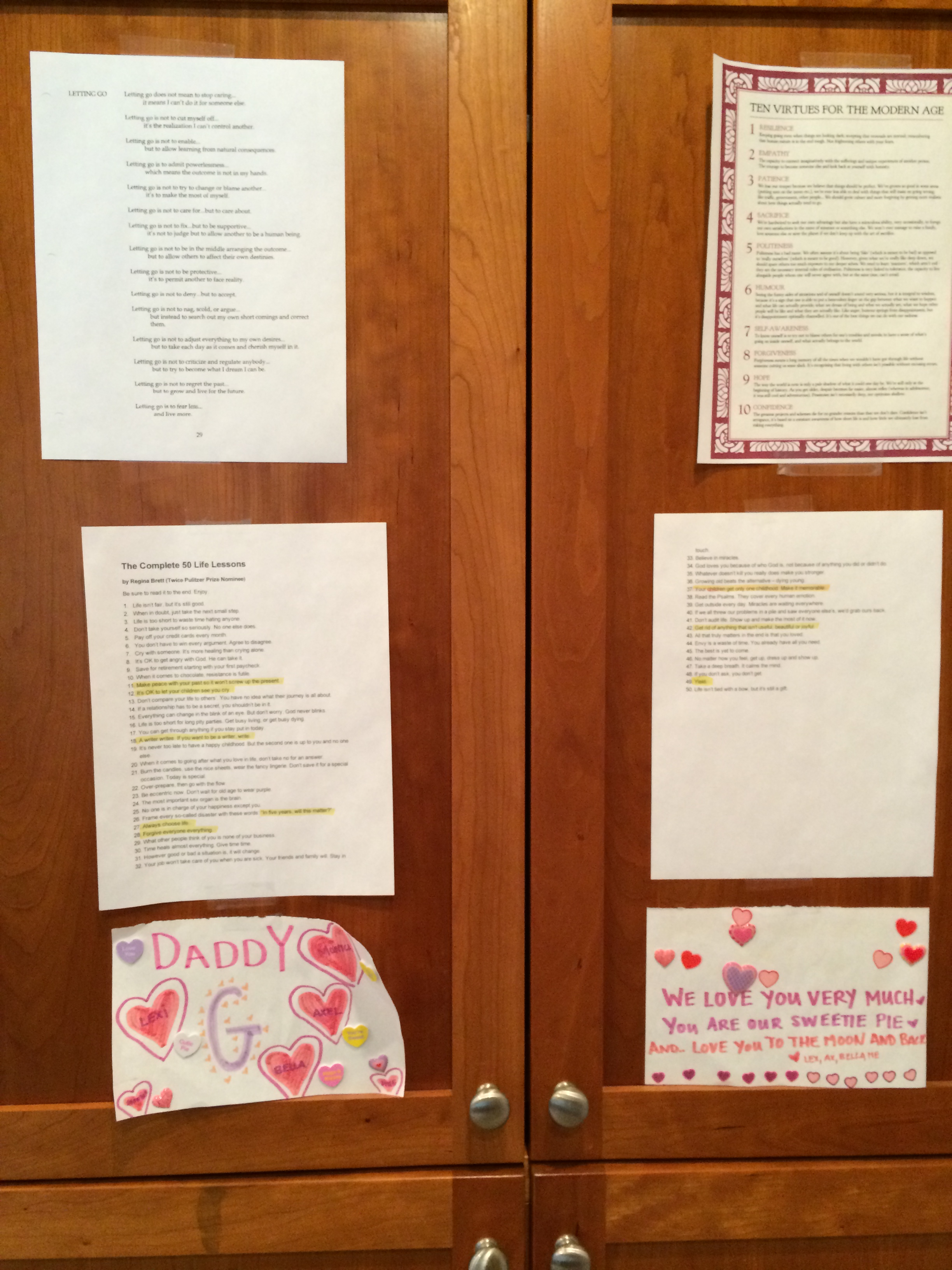
lifelessonsReflecting on the lessons, I paid particular attention to three:

  • Let your children see you cry
  • Forgive everyone everything
  • Yield

I’d encourage you to find your own (triggers).

The game is to focus your actions on situations at the edge of what you can handle.

Here’s an example:

  • There are lots of homeless folks on the Boulder Creek Bike Path. Some of these folks are violent, others are mentally ill, still others are addicts. As a group, they scare the crap out of me.
  • While I have pals that work with the homeless, I don’t have any clue how to “fix” this problem and often wish the problem would go away (so I don’t have to deal with my inability to deal with it!).
  • Anyhow, there’s one guy that sits by the creek in the 28th St underpass and says good morning to everyone that runs, rides and walks past him. He’s a drinker and can get a little sloppy towards the end of the day.
  • I can’t fix the city’s homeless challenges but I can offer the guy a bit of human connection as I ride by. I look at him, smile and take a breath in. On the face of it, I’m smiling at him but, in reality, I’m staying open to the fear within myself. That’s micro-courage.

The story repeats itself in every part of my life that I want to close off.

I try to “stay open” as many times a day as I can.

The problem can be homelessness, litter, aggression, poor driving, manners, food quality… keep it small, remember to breathe in through your nose with a tiny smile.

Staying open to a small fear, a slight inconvenience, a little bit of sadness… I call it micro-courage.

The habit has been transformative in situations that I used to find overwhelming.

This is what I meant when I wrote that strength comes from staying open to little fears.

Courage is a powerful antidote to fear, anxiety and anger.

Be brave.

True Strength

g_aqua

One of my coaches, Mark Allen, made the observation that to get our race in order, we need to get our lives in order. Racing, like any other form of stress, can strip away our filters.

Mark’s advice is an example of an athletic lesson with a wide application into everyday living.

We share a desire to be strong. This desire is expressed by building up and adding to one’s self.

  • Adding size through muscles, bulk, heels, boots
  • Adding tension from taking on obligations
  • Adding palmares from victories
  • Adding possessions and external signs of power

I’ve done it all: cowboy boots; academic honors; powerlifting; fancy cars; big houses; jewelry for my wife…

Adding, adding, adding.

The list above is about our external life. Building up is a projection of strength, but it isn’t true strength. I think Mark is pointing us towards something that might become resiliency. An integrated life where we are in harmony with our external projection and OK with all aspects of our experience (strong/weak, happy/sad). This harmony lets us cope with the tests of our races (and lives).

Perhaps you’ve had a situation where you tell yourself to be “strong” but a more accurate description is a fear that our inner storm might show through. Having completely fallen apart a few times, isn’t that big of a deal. I don’t want to make a habit of it but I also don’t want to spend my life holding tight and letting the pressure build within me.

When tired, when grieving, when sick, when stressed… life has a way of stripping our filters away.

But how can we process our inner life?

  • Exercise works well for me – moderate effort, repeated movements
  • Others prefer meditation – cultivating stillness and observing one’s mind
  • Many find the combination of breathing and movement in yoga to be effective
  • Thrill seekers tend towards extreme risk and peak experience – works for them but doesn’t work for the larger goals of my family

If we keep peeling away our layers then we might find that the joke is on us.

Why?

Ultimately, every individual unravels.

It can be terrifying when we bump into this reality. You may have experienced this fear through the death of friends, parents and grandparents.

Ultimately, we might find comfort in defining resiliency in terms of something larger than ourselves – family, legacy, lineage, tradition.

Cultivate courage by staying open towards little fears.

Managing My Baseline

As I’ve gained a better understanding of my mind, I’ve made micro changes to improve my daily satisfaction. Most of these changes involve reseting my baseline for expectations.

Two simple examples can be found in my approach to coffee and wine.

COFFEE

I was thrilled when Peet’s Coffee & Tea opened in Boulder. However, I noticed that my baseline quickly reset and drinking coffee elsewhere resulted in disappointment.

My ability to easily access “the best” increased my total dissatisfaction across a month.

What to do?

I switched my morning routine to start with a cup of CostCo brew. It’s a solid brew and gets me rolling.

However, a few months ago, I won coffee-for-a-year from Peet’s and get a pound of beans each month. So I started drinking Peet’s in the morning and everything reset again.

More disappointment resulted when, mid-month, we’d run out.

However, now I see my disappointment as a chance to reset and I anticipate each new month’s shipment.

Anticipation is a key part of pleasure – worth remembering that tip in relationships as well!

WINE

My senses of hearing, taste and smell are all below average. It’s an area, like my driving, where my self-assessment is more accurate than most.

When buying wine, I combine my known sensory deficit with a simple heuristic – never pay more than $15 for a bottle of wine.

This makes it easy for my pals to blow me away with their moderate vintages, has me drinking less and reduces my total annual spend on alcohol. All good results.

Like my three-year old son, I try to make myself easy to impress!

LAIRD HAMILTON

That’s Laird, Gabby and family above. My wife follows them on Facebook and mentioned that she thought they were a well-grounded couple.

All I could do was laugh and say, “Laird’s your baseline for a husband?!”

Apparently, Laird’s “a little soft” but that’s OK because he has three kids.

For some reason, Laird appearing soft didn’t make me feel a whole lot better.

Anyhow, exercising makes me happy and, perhaps, my wife was giving me a nudge to train more.

+++

Remember what I said about the coffee and the wine, it applies in every aspect of our lives.

Too much luxury can ruin our appreciation for the beauty of everyday life.

Take time to reset your expectations.

Five True Friends

mooseThe Philosopher’s Mail is one of my favorite sites on the web. Happiness is a recurring theme in their writing, as is social connection. As your doctor can confirm, there is a link between social connection and health.

The good people at Philosopher’s Mail shared Epicurus’ recipe for a good life. The link is to a lovely article with snazzy pics of Paris Hilton. The article is worth your time – it describes an antidote if you find that external success fails to lead to lasting satisfaction.

The philosopher’s antidote

  • Five true friends, that reinforce inner values (not the external values of city living)
  • Self-determination by escaping the tyranny of corporate serfdom, regardless of financial cost
  • Daily time for quiet reflection, ideally with low-intensity exercise in nature

It’s an interesting list because most of us will lack one aspect of the troika. In my case, it takes effort to say “yes” to social interaction.

As well, we are usually attracted to people that have external traits that we wish to emulate. This can be a good thing…

  • A politically-connected friend making us feel gratitude that we don’t have the duties that come with being a very important person.
  • A healthy friend inspiring us to start a streak of daily activity.
  • A champion friend inspiring us to persist a little longer at a difficult task.

I have different pals with all of the above and, when I’m at my best, they reinforce good traits in me.

However… I’ve also noticed that my most human, and occasionally screwed up pals, can leave me feeling grateful, useful and valued – three traits that have a strong link to personal happiness.

So while the need for pals is well known, I can lead myself astray. So it’s worth using my daily time to quietly consider…

  • Do I have five people to whom I can speak plainly?
  • Separately, who are the five people with whom I spend the most time?
  • How do those people make me feel?

Once I have insight, it’s up to me to have the courage to change.

Be brave.

Too Painful To Care

Monday I wrote about driving energy inwards to improve myself, my marriage, my family.

Related to this lesson, I’ve noticed a habit of avoiding knowledge that conflicts with my core beliefs. This isn’t anything new – human misjudgment is an ever present topic. However, spotting my own misjudgments can make me far more effective.

Being effective, and making better choices, is a more important to me than avoiding change.

A story.

The Tour de France just finished and I didn’t watch any of it. My lack of motivation was unusual and I wondered why.

The legacy of cheating has been to make it too painful to care. In my case, that manifests in a lack of interest in elite sport. In the case of the wider public, there is an element of truth-fatigue. It’s too painful to discover the reality that underlies an obsession with winning.

I’m using sport as an analogy – it’s an easy one for us to feel, and see in others. Choose your favorite sport and you’ll find a tendency to overlook it’s short-comings. If you can’t see it then ask a foreign friend their thoughts (or simply a pal that likes a rival franchise).

The lesson for daily living is deeper.

  • A friend with Alzheimer’s
  • An elder with dementia
  • A sexually abused child
  • A partner that defrauds the community

In these cases, we will feel a strong urge to “give the benefit of the doubt” to whatever causes the least pain. We will default towards inaction and strongly avoid information that compels us to face pain. I feel avoidance strongly in myself – it’s taken many setbacks for me to overcome.

One of the best lessons of hospice is that freedom lies on the other side of fear. Hospice lets me “be with” my fear of death/disease and feel grateful for today. Gratitude is powerful medicine to carry around inside.

Hospice is “easy” – it’s quiet and I’m not expected to solve anything. My home on the other hand… is often loud and I’m in charge. Maintaining serenity in my own house would be transformative for me, my wife and my kids.

So I look for small, daily, opportunities to practice equanimity:

  • Reading a conflicting viewpoint
  • Avoiding “justified” disappointment in a friend
  • Letting a commute unfold without battling my fellow drivers
  • Not playing into a negative emotional pattern with a spouse, child or myself (!)

Overcoming the smallest things, closest to us, can be powerful.

It takes courage to face pain.

Be brave.

Scope Lock

It’s easy to let short-term news dominate our thinking.

  • Children killed in war
  • Lost airplanes
  • Destroyed airplanes
  • Crashed airplanes

With death, in particular, I was curious.

I asked Google, “How many people die, per day, in the world?”

Google replied, “about 150,000.”

Per DAY.

That helped me put my obsession into context.

++

Realizing that my thoughts are largely wasted can create cognitive dissonance.

…but it’s awful

…I need to care (to show I’m a kind person)

I ask myself, ‘is linking worry to goodness effective?’ In my life, worry makes me anxious, not compassionate.

++

Here’s what I’ve noticed in myself. There’s a hidden cost to obsession with others.

The more I focus on seeking to change others, the less energy I have to change myself.

What one thing, if it happened, would change everything?

In my case, kindness through daily action in my own house.

Beware of feeding what you want to leave behind. In my case, fear – anger – anxiety.

The Trap Of Fixing

Camping With My SweetieSome say hate is a sign that you’re having an impact.

I’m not sure.

I think it’s more accurate to say that hate is a reaction to what I’m sending out. It’s an opportunity to pause, consider and learn.

When I’m focused on helping people, my ratio of positive to negative interactions is 500:1.

I find being told to change extremely painful. It’s like I let the World down, which is a major trigger for me.

The best antidote that I’ve found for dealing with my own negative feelings is to pause, not react, and ask myself, I’ll be happy when…

  • all dopers are caught
  • all frauds are punished
  • you change, rather than me
  • you. stop. that. right. now.
  • you close your sport, business, site, magazine because it bothers me
  • everyone, like me, has equal justice, from bigots like you
  • you break those friendships off

Are you sure that you’ll be happy if they change?

I won’t be happy when you change. I’ll pat myself on the back and move on to the next target. It is a path that’s guaranteed to make ME miserable and strengthen whomever is happens to be “wrong.”

My reality is that I will either be happy now, or not at all.

I share this because the 500:1 ratio is a compelling case that we can have a much greater impact by helping, rather than correcting, each other.

The positive interactions are what make us happy.

Break the chain.

Moving Through A Depression

Tropic Coffee

50 is coming and I can feel that I’m spending my ‘middle’ worrying about money and getting yelled at by my kids.

The challenging thing about depression, or any of my other irrational feelings, is my inability to shake them via conscious thought.

Sharing my fears and concerns helps put them into a more rational context but my cure is always based around actions, rather than more thinking.

I smile when I re-read the paragraph above because (of course) thinking about “thinking too much” doesn’t work!

What does work?

Most helpful was the realization that I needed to make my life more difficult, while not adding stress.

I did this by purchasing a light alarm clock and changing my life so I get up two hours before my kids, who are thankfully good sleepers. By pulling the two hours from the end, to the beginning, of my day – I was able to write, exercise and sit without disruption. Writing, silence and exercise are the best antidote to the despair that I feel around kid noise.

In the heart of winter I reached out for help and attended a parenting workshop. The workshop gave me insight on how fantastic my kids are – nothing like listening to other parents to make me grateful for my own kids! However, despite my kids being normal (and desirable), I find their noise debilitating and draining.

What about the noise?

Some families cope by having constant background noise (TV and radio). For instance, the best parent that I know wears a radio walkman while she works in her house.

Other families ‘cope’ by yelling at the kids and emotionally beating them down. Effective, but not me.

I’ve been wearing earplugs to take the edge of the most intense moments, which rarely add up to more than 90 minutes a day.

People that cope well with noise will tend to find my choice of earplugs rude. Their reality is incapable of understanding what kid noise does to my internal life. I ask them for forgiveness and share the story of the great parent with the walkman.

+++

My son goes to school with the child of a social worker, who shared that her professional training hits a wall when she meets the reality of her own children. Her advice: stay two-steps back from the breaking point.

In applying this advice, I dropped lunch time workouts and replaced them with working in an absolutely quiet environment. This change took a lot of fatigue out of the back-end of my day. On Monday, Wednesday and Friday – I was swimming so intensely that I’d be mentally flat in the afternoons and exhausted by the evenings. Swapping my swim training into an early morning forest jog does nothing for my athletic fitness but it makes a huge impact on my overall mood.

Not swimming is complicated (in my head) because my swim coach is my wife and not spending time with her triggers my fear that my marriage will end and it will be my fault!

So…

The other bit of stress release is to tell my spouse the whole truth with how I am feeling, especially my fears (spending concerns, that I’ll act when I feel despair, that she will leave me, that I’m not a good man).

I have persistent themes that build internal stress – these all get shared with her (and pretty much everyone through my blog).

Most of this is article is to remind myself what to do – I had a tough 48 hours and started writing at 5am in a quiet house!

+++

What makes a difference?

Do something physical and spend a bit of quiet time in advance of the most stressful times of your day. For me that means short, solo, moderate workouts in nature done early morning and late afternoon. Each workout is short enough that the endurance coach in me wants to repeat the entire thing. Physical release and balancing the noise of my home life with quiet periods in my work life.

For the parents that deal with commutes and live in crowded cities – I don’t know how you do it. I’d be at risk for heavy self-medication and persistent deep sadness.

If you’re in that position then wait it out and don’t act on despair.

If I take responsibility for doing what I know works then I always move through a depression. When I’m really beat down it means that I’m very close to things improving.

See the beauty in the good moments.

+++

Serious athletes might find value in an article I wrote about athletic depression and training mania.

Coping With Anger

A recent conversation about parenting:

Husband: I’m not used to being filled with hate and anger

Wife: Any other father would be yelling and hitting by now

Husband: The Dalai Lama wouldn’t be hitting

Wife: Any normal father

Husband: I’m not trying to be normal, I’m trying to be exceptional

+++

Recently, I’ve been finding myself being “really mad” at one of my kids. Worse, I have been carrying my anger around and wrapping it in self-pity. This is a crappy habit to create!

To turn things around, I tried a 14-day cleanse…

Monica laughed as my cleanse was light weight in a Boulder sense… huge salad for dinner and no booze. I didn’t notice any difference physically but the anger has started lifting.

Here’s what I’ve been doing to cope.

Own It – when I’m angry, I notice the anger. I try to create some space by breathing and noticing “wow, I’m angry.” When I can pull this off, I don’t act on my anger.

Not acting on anger is a win, even when angry.

Identity – I remind myself that I’m not always the role that is making me angry:

  • Employee of difficult boss
  • Parent of difficult kid
  • Customer of difficult company

I discovered my painful identity when I was hiking (alone) feeling sorry for myself. I reframed my self pity into “a guy who can go for a hike.”

This helped until I became “guy who’s calf blew out on a hike!” At least my calf trouble got me swimming again and I noticed that problems in my body don’t make me angry.

Communicate – My anger doesn’t like anyone to know about it. So I have been introducing my anger to my wife, my friends and, now, you. Getting the emotion in the open creates space. Space is good.

Share Goodness – when I’m happy or enjoying myself… I send a little bit of that happiness to the object of my anger.

Breathing in – this is a good moment

Breathing out – I send her some goodness

The Rational Mind – I think of myself as being calm and rational. It’s everyone else that runs on autopilot.

Persistent irrational emotions point out that I’m merely OK in “my world” but have trouble with “the World.”

I want to apply evil intent on my kids but, looking deeply, the only possible intent is love and inclusion. Until I can experience that reality:

  • Keep breathing
  • Keep trying
  • Let go of the emotional warfare

+++

Today’s my youngest’s birthday. She’s one. It took me five years to become comfortable with babies and now they are gone!

Hopefully, I can up-skill with preschoolers before 2018.

When You’ve Made Your Money

By the time I was 32 years old, I had created a life where I had the option of working parttime. For the most part, I got that opportunity “right” and enjoyed my freedom.

My errors came from from the thought (perhaps the lie) that spending yields happiness. That belief, shared by most my peers, pulled me back into fulltime employment twice over the last decade.

The first time I was pulled back, it was to help a friend start a business. There was huge equity upside and I loved the work. It was a good decision but I ended up over-extended financially. Thankfully, I started selling down in 2005 and, in the Great Recession of 2008, “only” lost 2/3rds of my net worth.

The scale of the losses was equal to what wiped out my grandfather’s generation. In the four generations of my family tree (that end with me), we’ve lost enough money for the entire family to never have to work a day in their lives. The bulk of my current job description (father, teacher, administrator, spouse, brother, uncle, trustee) is trying to reduce the frequency, and consequences, of these bad decisions.

When I took my big financial hit, my cost of living (2008) was 5x higher than what I spent in my first year of “freedom” post-college (2001).

Due to the bankruptcy of the business I’d been advising, I was under a tremendous amount of stress. Reflexively, I chose to cut expenses and replace income. My family’s 2009 expenditure was half of 2008, but remained 2.5x higher than what I spent in 2001. I focused on my back-up career of coaching (always have Plan B!) and managed to cover 50% of what I was spending.

At that point, 2010, I didn’t know what to do. Inside my personal business plan, I have a heuristic “if in doubt then wait.” So I repeated the year, with a couple exceptions, Axel (2011) and Bella (2012).

Gradually, across 2011 and 2012, I realized that preserving the status quo (large house, dad working to pay bills that don’t make him happy) was insane. Despite being complete insanity, I was following a path that had universal support in my peer group. As my kids popped up, I noticed that I was getting less and less fun to be around AND I was actively working to create a life outside my house.

The family readings that I shared, and my family history, show that it’s almost certain that we will wipe ourselves out (perhaps more than once) in the next seventy-five years.

What should you know about your money?

  • Most of any financial legacy will be gone a couple decades after my death, or spent by people I never knew
  • The greatest pressure I experience is preserving wealth that I’m unlikely to spend
  • I know I can live in peace on a fraction of my current spending

What do I truly need? Easy to answer day-to-day: exercise, love, service and health.

For the long-term, I like to have a mission. Why not make the people I live with part of my mission? Then I’m surrounded by meaning, and success. If that’s the case then what does my family truly need?

Empathy – it’s easy to find people to do stuff. It’s a lot tougher to find people to listen and care.

Learn To Teach Ourselves – my writing is about sharing how I teach myself. Tools that I want to pass to my kids: write down insights and blindspots, make errors visible, replace habits that hold us back and share stories of what you’d like to become.

Cope With Loss – More by accident than design, I’ve been on a self-guided education of the major faith traditions, neuroscience and behavioral psychology. This has led me to believe that loss is an opportunity to learn by experience. Until life deals us a major setback, we will not understand impermanence and the nature of existence. Create a daily practice that let lets you process, release and recharge from the challenges we all face. Deal with loss by continuing the good that you’ve learned.

My kids weren’t around for for the first 40 years of my life. Common sense means I won’t be here for the last 40 years of their lives.

What’s your legacy?

Good memories and a skill set that let’s the student surpass the teacher.