A Collection of Moments

2015-08-23 09.08.27This week marks the start of the school year and that should enable me to get back to blogging.

Last weekend, I had the opportunity to knock out 13 hours of cycling and 13,000 vertical feet.

Even better, I got to visit with an old friend from New Zealand, Scott Molina.

2015-08-22 11.58.47Above are a couple of local characters out for Rollyfest – happening halfway between my house and the Continental Divide. I stopped in, both days, for a large pourover. Yes, those are pipes (below).
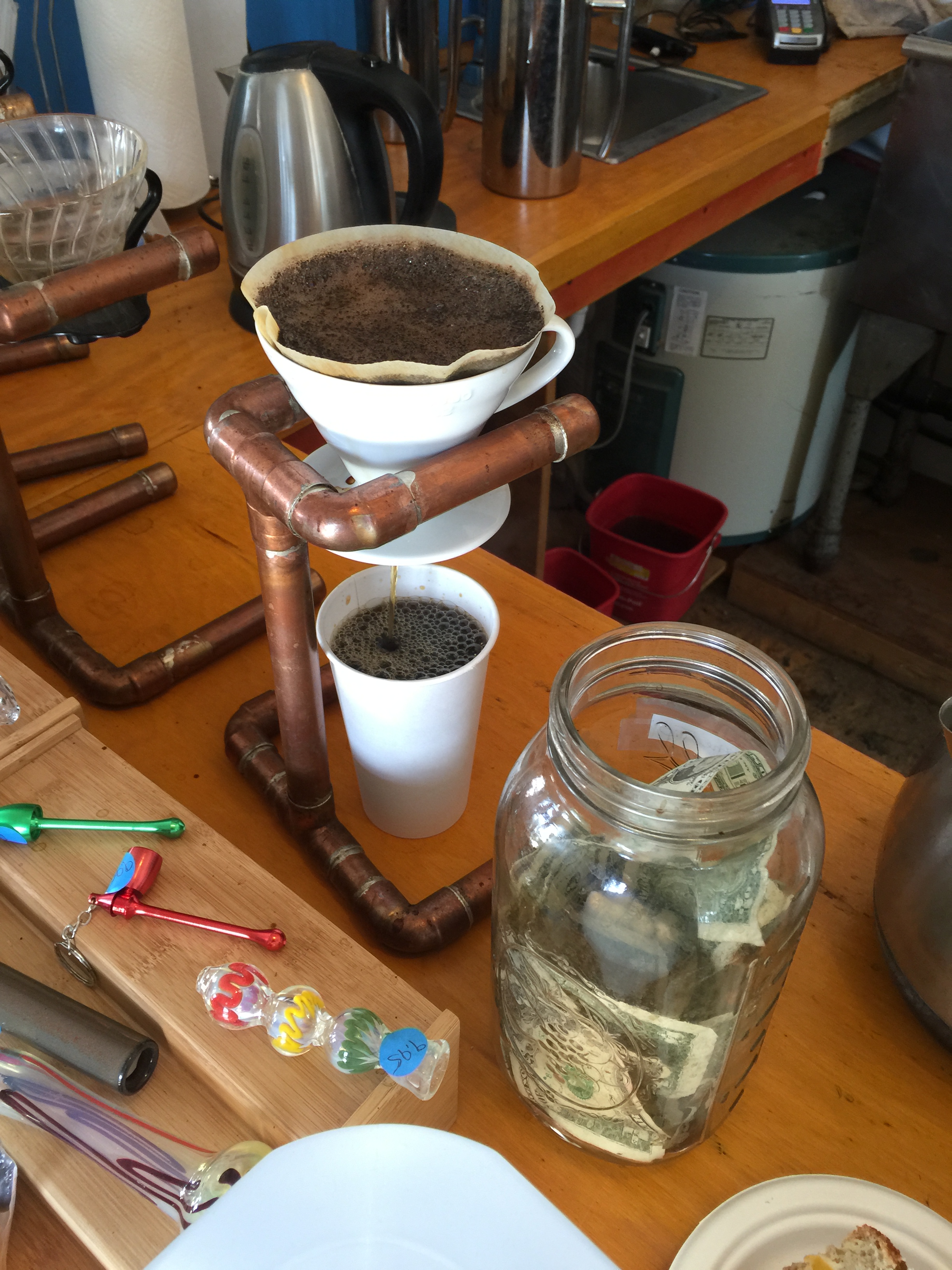
2015-08-22 11.27.10

I was thoroughly blasted when I arrived in Winter Park (elevation 9,100 ft) and got a kick out of the Kiwi recovery set-up…

2015-08-22 17.53.24

I opted for the toast.

You learn a lot about a guy when you train together. Scott’s one the nicest people I’ve ever met.

One of Molina’s quirks is that he likes to get dressed for the first session of the day, the night before. When we shared a room, he’d sleep in his run gear (and have his morning coffee pre-brewed).

True to form… here is with his mountain bike shoes on the night before…

2015-08-22 21.38.02

It was made clear, by Erin (Scott’s wife), that this wasn’t an “epic” camp, which suited me fine.

However, I was the only one that had done their final route in the last twenty years (!) and knew they had some surprises heading their way.

Kiwis don’t complain…

They don’t complain when the planned route is detoured up a 100-year old wagon track above the pass…

They don’t complain when they double-end-o down the rough descent…

2015-08-23 12.43.18

And they certainly don’t complain when they have to hike-a-bike over a collapsed tunnel at 11,600 feet (red jersey over my shoulder)…

2015-08-23 11.25.00

I was soooo grateful that the route wasn’t my idea!

In addition to the temporary hardships, we had remarkable views…

2015-08-23 11.44.29

Such a pleasant change to focus on helping others, rather than my next session.

2015-08-23 09.59.45

Life is what you focus on.

2015-08-22 14.33.56

What are you doing when you’re thinking about love?

A Young 46

boatingSomewhere beyond your 30th birthday the world might begin to tell you that you look young for your age.

If you say this to me, I might smile and reply, “This is what 46 looks like.”

Likewise, many people say… “but I don’t feel my age.” To them I note, that’s what your age feels like.

They might follow that up with… “I wonder what 50, or even 75, is going to feel like?”

It’s going to feel like right now.

+++

The practice of accepting my age helps me accept all phases of life…

  • The overtired toddler
  • The anxious teen
  • The sociopathic 20-something
  • The fearful cancer patient
  • The crabby elder
  • The grieving spouse

If we are fortunate to live a long life then we will move through most these phases of experience. At midlife, they surround me.

If we happen to be “young for our age” then it might take a few more years for us to arrive at the phase where we “look old.” But it’s coming.

So I will try to enjoy this day and I will try to accept whatever day you are going through.

And when I am scared, or angry, or tired…

I’ll pause, try not to pass it on and remember to live as best I can.


Wealth Habits: Are we there yet?

2015-07-09 11.30.50A question I ask athletes is, “Why did you start?

When sitting down with a family, I change the question slightly, “What is living well?

Write down detailed answers.

Answering these questions honestly will surface your values and help you make better choices.

The answers will also help you understand when you’ve achieved victory, and you might discover something rather strange about winning.

You feel just the same.

Because you feel the same, you’ll be tempted to change your strategy. You will forget why you started and lose sight of what it takes to live well. You’ll strive for more.

The exact nature of your “more” will be influenced by your peers. Unsure? They will be happy to tell you. Just ask a room full of buddies… “What’s your proudest accomplishment?”

Look inside and see if you’re tempted to strive towards their goals.

With my academic, financial and athletic friends – I can feel the temptation to strive.

Striving towards another person’s answers might not fulfill you, especially as only a minority bother to consider the “why” behind their daily choices.

You may find that it takes a surprising amount of faith to stay the course. My list is exercise, write, read, love, help others and sleep.

It’s important to remember your answers. They are an effective antidote against the temptation to strive. In my case, striving is a result of desire: to buy assets, to make money, to compete against others, to go shopping and other variations of more more more.

  • In a family
  • In a marriage
  • In a company
  • In your life

How will you recognize success?

It might feel different than you expect.


Unmet Needs

number_oneI have many traits that can lead to poor outcomes:

  • I’m prone to hurry
  • I overestimate my capacity to impact external situations
  • I have a bias towards action
  • I’m stressed by noise and crowds

All of the above, work against my ability to help people and can lead to misery.

To get along better with others, I’ve started asking myself:

What’s the unmet need that’s driving this behavior?

Here’s a link to my article about how to help others: quiet presence, listen without knowing and compassionate action.

With my kids, I’ve noticed that most anti-social behavior stems from six sources:

  • Hunger – lack of food
  • Thirst – lack of drink
  • Sleep – lack of recovery
  • Boredom – lack of engagement
  • Need For Compassion – lack of connection
  • Habit / Temperament

The above are easy to spot in babies, toddlers and preschoolers.

Once you can see them in your kids, try to feel them in yourself. Through self-awareness, you may start to see what drives the behavior of people around you.

The antisocial effects of hunger, thirst, sleep and boredom are why I resist changes to the underlying routine of my life: train AM/PM, eat/drink real food, sleep in a cool room, read and write.

I have a desire to be effective in all my relationships.

Do you?

If you don’t that’s OK. I certainly didn’t care about anyone other than myself for long periods of my adult life. If you don’t care then own it.

My difficulties with people make sense when viewed from the lens that I didn’t care and had significant unmet needs (health, exercise, solitude, nature).

Own my needs.

Address my needs.

Slowly, I have the capacity to focus outside myself.

How to meet that need for connection?

  • Put my phone down
  • Relax my inner experience with a two slow breaths
  • Listen, without knowing, until the person has spoken fully
  • Smile, nod and comment about an area of agreement

This works magic. The entire cycle takes less than a minute.

Connection is the solution.

On The Occasion of My 10th Wedding Anniversary

car_shotSome reflections on relationships.

Love will make your spouse more beautiful but remember that kindness is more valuable than beauty.

Working on myself has proven more effective than working on my marriage, my family or any other person/project in my life.

A valuable step in making myself suitable for marriage was getting myself to the point where I was comfortable being alone.

I couldn’t offer myself to others until I was comfortable with myself.

Gradual self-improvement is the journey.

ACT as if you remember why you wanted someone in your life in the first place — to share common experiences.


Thank you for helping me achieve everything I need in life. I reviewed my notes from the last three years and, together, we’ve achieved everything I wanted. So nice to be able to share my journey with you.

Love you, babe.

Less Little Lies

bear2A friend asked what it has been like to step back from athletic competition. Much of what follows applied when I left jobs, peers or habits – any of which might not have fit my life anymore.

The immediate impact is usually relief and a realization of the unnecessary cost my choices where imposing. Quite often, the relief is followed by sadness at leaving old habits, even negative ones.

In terms of “what’s it like” to compete less – it’s exactly the same, just less fatigue and soreness. All my “issues” follow me wherever I go!

What is available is an opportunity to look at the impact of a competitive, or corporate, lifestyle.

I often cloak a selfish reality with talk of benefits outside myself. Shareholder value, national prestige, competing on an international stage, earning money for my children… these little lies are repeated until they become my reality.

Fooling myself isn’t necessarily a problem. I spent my teens and twenties solely focused on my personal outcome. It worked at the time.

In my 30s, I broadened my circle to help other people assist with achieving my personal outcome. It still worked for me.

That lifestyle was a form of greed – more more more.

With a spouse and kids, the lies have to increase to justify continuing the choices of my youth.

Long-term competition isn’t a problem. The problem is the thinking that results from turning away from my spouse, my kids, my family and my community.

We tell ourselves that we will change when we have X, or achieve Y, or become Z.

What I’ve done is tell myself…

I’m going to look directly at my flaws, a diseased friend, a homeless beggar, a hysterical child or a demented hospice patient.

Whatever it is that scares me. I’ll look at it.

I’m going to acknowledge that I can’t fix the situation but I’ll try to do something small to make life better.

Working towards overcoming the difficulties of my inner life is similar to the pleasure of overcoming others through competition.

The reward is just as sweet and others do not pay a price for my success.


Fatherhood: Giving Myself A Break

disneyDuring the school year, my son and I have a routine. When I come back from my afternoon workout, he takes a bath while I have a shower. It’s a win-win-win as the two of us end up clean and my wife likes a fresh family.

Last week, as I was heading out the door for date night, my son asked me to help him get clean.

One of my reactions was fear.

  • Fear that if I gave into this request then I’d never get out of the house.
  • Fear that if I gave into the request then the requests would never stop.

Fortunately, I was able to pause before I acted on my fear.

While pausing, the thought arrived that I MUST break this pattern of behavior in my boy.

What pattern was that?

Loving me, or wanting to spend time with me? 😉

Pausing a little more, I thought about everyone in the situation.

  • The Sitter – being left with a dirty, unhappy four-year old
  • My Wife – sitting outside, content with her apps
  • My Boy – wanting his dad to spend time with him
  • Myself – feeling a wall rising inside me as I’m tempted to close out my son

I sent my wife a text that I’d be a bit late, enjoyed giving my son a bath and everything worked out fine.

+++

I share this story because it highlights a dangerous habit that is easy to create.

Closing my inner life because I’m scared of future demands.

If you look for this pattern then you will see it everywhere.

  • Gifting – refusing to help now, to avoid being asked later
  • Parents – giving into the desire to break the child now, to “help” them later

Inside me, the habit feels like a form of revenge.

I’ll turn away from you now, because that’s “easier” than having to say no later.

Looking deeply, I’m the one that is hurt by this habit (and I’m robbing myself of the feel-good benefit of being a nice guy).

Harsh people think their hardness is a long-term favor to the people in their lives. They probably learned this habit in a difficult childhood.

My heart tells me that I’ll be OK with the risks of staying open to the people in my life.

Be brave.

Can’t Be Bought

bearLooking forward to 50, I will find myself with 10, 7 and 6 year olds living under my roof. Those are great ages to accompany a 50-something man as he explores the world.

There remains a lot to look forward to.

The key advice that I give myself, and offer you, is to approach life with the understanding that you can’t be bought.

The reality is, often, we can be bought. If that describes your current position then keep your mind open to the possibility of increasing your price until you remove it all together. That’s what I’ve been working towards for the last 20 years, or so.

What’s your price?

I must remember the dissatisfactions have come from letting money influence my life choices. I’ve taken on assignments because I thought I should, rather than because they fit my principles. I’ve sustained a double-whammy when those assignments took me away from the people closest to me.

What are better principles to guide my thinking?

  • Lean towards marriage, family, friends, local community – let’s call these Core People
  • Share experiences with Core People
  • Pay attention to spending that has an immediate beneficial impact – my highest utility spending is childcare that enables me to share experiences or spend time alone
  • Aim to help all people – keep broadening my circle of altruism
  • Set aside time for continuous simplification – automatic bill pay, empty time in my schedule, reduced admin, streamline possessions
  • Don’t pay for luxury – adversity makes fond memories

Every day offers a chance to turn toward my principles.

Looking At 50

unitedIf I followed the path of the majority of my mentors then 50 would see me gearing up for a Big Push. The push might be towards athletics, or business, or a career path that I neglected earlier in my life.

Instead, I find myself asking, “How can I make a lasting difference for my family?”

That’s surprising, based on my younger self, but not surprising if I take the time to learn about the natural progression of men in my situation. So that’s been a clear lesson, the illusion of individual experience. If you can’t see this illusion in yourself then spend some time with a teenager.

Late last year, I had lunch with a young man that works in finance. He lives in Hong Kong. He drives a wonderful Italian sports car. He makes plenty of money. He’s one of the fittest employees in his firm. He’s engaged to a fantastic Chinese-Canadian woman.

It got me thinking.

You see… I was having lunch with a man who was living my former life in Asia.

It was humbling. Humbling because it drove home how I’m prone to fooling myself about success being due to the special nature of myself.

Don’t take the good, or the bad, too seriously. Take time to learn from the many who have walked before us.

Ultimately, all that we will be left with are memories of what we’ve done:

  • taking action that serves the collective
  • being open to those that love us
  • focused time on marriage, family, friends, community

Choose wisely.

When To Review Strategy

dad_axI’ll start with my answer… now is not the time to change strategy because I know…

  • The more often I change, the greater my opportunity for error and increased costs
  • The more changes I make, the worse I’ll do

+++

Q2-2015 marked the completion of the five-year plan that I put together at the end of 2008.

When to consider change?

A major life event is a good time to consider change.

  • In 2008, I was faced with unemployment.
  • In 2000, it was a divorce.
  • I’ve seen friends face criminal charges, bankruptcies, health emergencies and deaths.

A crisis can be a sign that, absent change, things are likely to deteriorate. It can also provide a nudge to endure the discomfort of change.

In my case, a high-spending rate combined with unemployment to tip me off that I was heading towards a major problem.

The plan required us to move (twice), establish new careers, achieve a dramatic reduction in spending and change the allocation of 95% of our balance sheet.

I expected the changes to be costly and forecast our balance sheet to decline by 20%. I was wrong. In reality, the balance sheet increased by 2% per annum.

Why?

  • I’m good at cost control – we made changes early, and severely.
  • We maintained exposure to favorable events – things like promotions, bonuses, babies, cheap mortgages, new friends, equity options.
  • Despite my fears, the world tends to improve.

I was also wrong about the price that we would achieve for the assets we sold. On average, we sold 10% under my estimate of “fair value.”

The Endowment Effect shows that we overvalue what we own. It’s valuable knowledge to be reminded that I’m prone to the standard forms of human misjudgment.

These two lessons are important to remember:

  • Things are likely to turn out better than I expect
  • I overvalue what I possess (jobs, assets, habits, the status quo)

I paid close attention to my “good days” since 2008. They were nothing like I expected and have influenced my thinking in how best to spend the next 1,000 days.