Wins, Pain, Anticipation and Endings

grumpy_catLast Sunday, I was puttering around the house waiting for my daughter to wake up from her nap and caught myself in a thought-trap. I was thinking:

Well, here’s another ride that I’ll be missing

Note the connection I was making between a small loss (missed ride) and my daughter.

Not Good.

A habit of creating frequent mental losses is guaranteed to make us miserable.

+++

There are four areas I tweak to manage my mood.

Wins

Because bigger isn’t (much) better, spread ’em out.

  1. Each morning I wake up (win)
  2. Cup of coffee (win)
  3. Second cup of coffee, heck ya! (win)

Three wins before anyone is awake.

This morning, I tacked on a run. Four wins by 7AM.

Coffee, meals, workouts, articles, work assignments, chore completion => all of these make me happy, so I’ve made them smaller, and more frequent.

++

Pain

The opposite of winning isn’t losing. It’s pain.

  • A whining three-year old => pain
  • The cacophony of three overtired kids in my car => pain

painI have four tactics that I use with pain. I’ll give examples as a father but I use them everywhere (work, athletics, family).

Temporary – everything ends, maintain perspective

Meaning – my behavior is an example I set to prepare my children to care for my demented future self

Schedule Myself – every day has at least two slots for me – a slot might be as small as a 15-minute walk around the neighborhood – I free myself to serve others by acknowledging that I served myself already.

Wins – see my pain as another person’s win // I prefer to deal with kid insanity on my own, rather than with my spouse => makes me feel like a hero because I am enduring to spare another

++

Anticipation

  • Vacations
  • Bonuses
  • Performance reviews
  • Exams
  • Pitch meetings
  • Prospecting

The corporate world is filled with events where we can anticipate a win.

Anticipating a win feels good.

You can use this effectively within a marriage.

  • Step up to take a bunch of pain (send your spouse on vacation without the kids)
  • Sex dates
  • Date night
  • Couples retreats
  • Large purchases (works great even if you NEVER buy)

Remember that the win need not be large.

Anticipate small wins.

This is what makes Facebook such a powerful medium.

++

Endings

If you pay attention to your pain memories then you might find that the most painful are ones where peak pain happened at the end.

  • Sports (Packers, anyone?)
  • Divorces
  • Bankruptcies
  • Life, then Death

With parenting, I need to allow time to unwind after things go crazy.

Previously, I would be in a rush to get the kids to sleep so I could get to bed. When things didn’t go easily, which was often with my oldest, I would be ending every single day with peak pain. It was exhausting. My oldest grew up and that worked itself out.

However, our middle kid started having difficulty with his bedtime routine. Applying a little behavioral psychology, we shortened his nap, napped ourselves (when required), and made sure we had 90 minutes awake after putting him to sleep. It made the same situation, seem a lot less painful.

Move the pain away from the ending.

Ideally, take it early.

pancake


These tactics work well and you can find more info in Kahneman’s Thinking Fast & Slow

Navigating the Jockstrap Dilemma

khumbu_yakA buddy has a magic jockstrap that he likes to wear ALL the time.

He claims it helps his performance and recovery.

Normally, his jockstrap would not be an issue for me. However, I’m one of his advisers and he asked me what I thought.

What to do?


We often find ourselves faced with a friend, client or family member that has beliefs we find ridiculous.

Here is what I do.

Pause

I know my first response with jockstraps is likely to offend my friend or, at least, create cognitive dissonance. So it’s better to wait and consider things carefully.

Give me a bit of time, I’ll need to do a bit of research on that… 

++

Context

Is the jockstrap on the critical path? Is it the difference between success and failure?

Magical clothing, and other superstitions, are rarely the difference between success and failure.

++

Action

What is the jockstrap’s impact on behavior?

My pal is motivated, thinks he’s performing better and not focused on something that might screw up his performance.

There can be adverse consequences from the effective treatment of superstitions!

++

Can I Prove The Opposite?

I happen to think that jockstraps don’t impact performance.

Can I prove my point of view? Am I sure?

The placebo effect is real, and proven.

++

One Thing

What’s the one thing, if addressed, will have a material positive impact on performance?

Focus on the “one thing” together.

Don’t spend time tweaking items that have no impact.

Use influence sparingly, then strongly.

The greatest influence on the world is via my own behavior.

My buddy can easily see that I don’t wear a jockstrap.

+++

Most importantly, after I didn’t call him out, I went for a walk and asked myself…

What’s MY jockstrap!!!

😉

What Can Go Right

NYE_2014Above is a picture of my beautiful wife at a New Year’s Eve party in the French West Indies. Strangely, quite a bit had to go wrong for us to enjoy this evening.

Last year at this time I had ZERO idea that event was possible.

If you struggle to shake your fears about what can go wrong then here’s an exercise to help you remain open to what can go right.

++

Before your next date night, couple’s retreat or family gathering. Spend a little time asking yourself:

What can go right in my life? 

What I did was take some paper, turned it sideways and wrote two headings…

What Can Go Right // Related Questions

The topics I considered:

  • Asset Appreciation
  • Asset Sales
  • Time Allocation
  • Continuous Education
  • Expense/Income Balance
  • Family Health
  • New Friends and Family
  • Improved Traits

Considering the details opened up some interesting questions:

  • Should we trade out of luxury and low-return assets?
  • Reallocate capital and time towards opportunities for shared experiences?
  • What projects provide the opportunity for family members to work together?
  • What do we want to study?
  • Who is the best person to teach us?
  • Where is a fun venue for instruction?
  • What role does family play in health?
  • What traits are desirable to attract into the family?
  • How can we promote these traits in ourselves?

To hold myself accountable, I highlighted three traits that would make me more effective: be more fun; handle kid noise better; and react more slowly.

In my case, being fun is characterized by being open to new experiences and handling change.

Last year, we did the opposite exercise => What can go wrong => I might be “a little too good” at that kind of brainstorming!

Interestingly, the “wrong list” is full of external events and the “right list” is filled with items that are within our control.

This brought up an essential question…

Am I worried about the right things?

Maintaining Function and Independence

Here’s an effective way to use a few of the hours I saved you with my email tips. It takes less than half an hour a week.

The session takes 12 minutes and will help you maintain your ability to:

  • get out of a chair
  • recover from a fall
  • pull yourself up from the floor
  • cope with your carry on luggage

The above are HIGH on my priority list for maintaining independence and dignity as I age.

Alternate between a lower body exercises and an upper body exercise. Aim for 12 sets total – 6-15 reps per set – I take a minute per set including rest.

  • Lower
    • Squat
    • Leg Press
  • Upper
    • Pull up
    • Dip

Back and forth (upper/lower), rest as you need but if you need more than a minute then reduce weight.

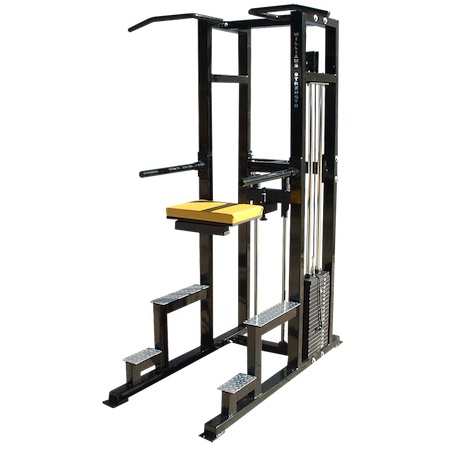
You’ll probably need an assist on the pull-ups and the dips – there’s a machine (below) in most gyms that will help you get going.

Use a wide range of motion – better to go lighter, and slower, with a full range.

dip

Goblet squat is great way to learn how to do the squat exercise. It’s a lot like sitting into, and getting up from, a chair.

The routine is simple but takes effort to do twice a week, every week, forever.

This routine is an effective way to reduce the speed that I will become frail. I’ve been doing some version of it since high school, over 30 years and counting!

When I travel, it can seem silly to pay drop-in fees for 12-20 minutes of exercise.

What gets the wallet out is understanding what I might lose if I take a bad fall late in life.

I also get really sore if I go more than a week without strength training.

So start light and have an expert teach you proper form.

+++

As an alternative, here is the NY Times’ seven-minute workout.

The Big Boys Can’t Do It

We didn’t have the purest of reasons for starting our daughter climbing:

  • Living with her was “rather unpleasant” when she didn’t exercise
  • The classes lasted 90 minutes
  • We didn’t have to stay in the building

There have been some favorable unintended consequences and all our kids will climb.

Upper body strength – Girls that do an upper body sport early get a lifelong athletic advantage in most areas. Climbing fits nicely into our swim family.

Clarity of thought – one of the few healthy ways I could clear my mind prior to my 40s was via exercise. The clarity that arrived through my climbing was addicting. I was fortunate to change sport before serious injury. An old guide introduced me to the progression of a world-class mountaineer (Good, Great, Dead).

But the best part was my daughter’s reaction after the climb in the video.

We were watching the video together. The boy that you can see in the foreground tried to follow the route. He came off on the overhang. Two of his buddies gave it a shot and they both came off.

She smiled, gave me a hug and said, “Look Daddy, the big boy’s can’t do it.”

A useful lesson for daughters, and sons.

Wealth Habits – Saving Early

firefighterWhat’s the difference between $1 saved in our 20s and $10 earned in our 50s?

The answer blew my mind. Turns out it’s likely the same thing.

As a young person, it is tempting to tell yourself that you’ll save more when you’re in your “Peak Earning Years.”

The trouble with “save more later” is you might be living with 4 dependents (plus cats) and have a mortgage once you arrive at “tomorrow.”

++

What is the single greatest wealth behavior that you can teach your family?

Early savings and patience

  • I’m 46 and it has been 25 years since I graduated from university
  • In the first five years of my career, assume that I saved $17,500 per annum
  • How much would another graduate have to save from 46 to 60 years old to catch up?
  • Assume a rate of return of 7.5% per annum across all periods

The formula in Excel is called “FV” for future value. You need to know the rate of return on investment, the number of periods and the payment.

7.5% rate of return, across five years, with an investment of $17,500 per annum => gives $101,647 at my 26th birthday

The next step in our case study is to roll the $101,647 from my 26th birthday to my 60th birthday.

7.5% rate of return across thirty-five years with NO ADDITIONAL INVESTMENTS.

What do you think?

BOOM => $1,277,586 from $87,500 invested in the first five years out of university

Consider this example against the $1.2 trillion of US Student Loan debt.

I urge you to revisit these numbers when considering significant spending on private education as well as taking out loans. You are making wealth decisions with massive long term implications.

What it would take to catch up if another graduate waited until her peak earning years?

  • Future Value to achieve is $1,277,586
  • 15 years (46 to 60)
  • Rate of return is 7.5%

The function to calculate the answer is called PMT (payment) and the answer is $48,915 per annum. Across 15 years she must make a total investment of $733,725, versus $87,500 for the early saver.

In this example, $1.00 invested in the 1990s bought the equivalent of $8.38 invested 25-40 years later. This is despite terrorism, wars, civil unrest, recessions, frauds, unemployment, bankruptcies, disease, and all the other bad news that we’re constantly fed.

My wife and I have a joint life expectancy of 47 years.

My daughters have a joint life expectancy of 90 years.

Time is always on your family’s side.

Seeking Truth, Enduring Pain

SXMMy favorite quote on pain comes from a champion athlete, Dave Scott.

Dave was giving a talk the day before an Ironman triathlon and was asked, “How do you deal with the pain of racing?”

His reply…

First of all, it’s not pain, it’s managed discomfort

Along the same vein, I heard Dave’s rival (Mark Allen) share the advice that…

To achieve a result, you need to be willing to accept whatever is required to get to the result

Many people confuse pain, with the process.

Others, incorrectly, believe that they can achieve a meaningful life without having to endure discomfort.

Plan => Do Work => Recover & Evaluate

Plan => Do Work => Recover & Evaluate

Plan => Do Work => Recover & Evaluate

The discomfort comes within the process. Specifically, with identifying, and addressing, our shortcomings and beliefs that prevent success.

++

What’s the opposite of “seeking truth, enduring pain?”

Lies and pleasure?

I don’t think so.

Think about a situation where someone “can’t handle the truth.”

What do you receive from them when you probe the truth?

Fear and anger

These are “negative” emotions but useful to point the way towards truth.

++

The ability to see the world clearly requires a commitment towards radical honesty within our own lives.

If I can’t see the truth within myself, I’ll constantly be fooling myself with others.

So…

When I feel fear and anger, I know that I am on to something.

I might be close to an area that’s holding back clear thinking.

Seek the truth beyond the triggers.


Book Recommendation along these lines is Ray Dalio’s Principles – available as a free PDF.

How I Do Email

gmailFive years ago I took a two-week vacation and came home to 1,500 email messages. I spent 20 hours clearing the backlog and realized that something had to change.

My system will give me an extra 250 hours per annum – for the rest of my life.

If you’ve ever wondered where you could find-the-time then email is likely your greatest source of increased productivity.

+++

#1 – I started by switching to gmail

#2 – When an email arrives I have four choices:

  • Delete
  • Deal with it
  • Unsubscribe
  • Action

Delete – end the thread and do the world a favor

Deal with it – anything in your life that takes two minutes, or less, to complete… Do It Now – remember you’ve already interrupted yourself by checking email

Unsubscribe – this is a pain in the ass when you start – there’s so much coming… however, after five years I average less than one unsubscription per day.

Action – for items that require clear thought, or take more than two minutes, move to your “action” folder

#3 – Once a week, go top to bottom in your action folder

  • Give people what they need – no more
  • If It takes more than four lines then be sure to save your work – FAQs, blogs, article ideas
  • You have a limited number of keystrokes in your life, don’t waste them, or someone else’s
  • Any message that was in the action folder the last time you went through, make an appointment in your calendar to deal with it and delete. If you blow off the appointment then it wasn’t important

Learn to use filters so high volume senders can be automatically sorted to a directory and dealt with as a batch.

Teach your high volume senders to reduce their emails to a single message that you can deal with efficiently.

One-on-one email interaction should be priced at your highest rate per hour. Remember that it is your lowest reach method of communication – you’re only reaching one person, max.

#4 – Learn gMail HOT KEYS – worth another 10-25 hours a year

  • J – forward to next message
  • K – back to previous message
  • Y – remove current label
  • R – reply to sender
  • A – reply all
  • O – open
  • [tab] return – send

It’s worth the pain to change.

What I Learned Last Year

biscottiTwo themes have dominated my goals for the last couple of years: my relationship with my eldest daughter and my finances.

++

Kids – my daughter worked herself out, no input from me. I didn’t change her nature, I accepted it, and we enjoyed the inevitable progression from preschooler to school-age girl.

For my pals with kids – avoid abandonment and retaliation – everything else is details.

++

Optimism is the only worldview borne out by the facts.

At the end of 2008, I wrote-off 65% of my family balance sheet, was unemployed, owned a loss-making business and was facing civil liability relating to large-scale fraud.

You may have forgotten but everything we were reading was doom and gloom. In reality, that was one of the most useful periods of my life because I was forced to face the gross inefficiency of my spending choices.

The changes that result from earlier setbacks lead to an appreciation of a more simple life and I’ve continued to strip away non-core activities.

My wife is stumped when asked, “What does Gordo do?”

I enjoy my life and serve my family

Act in the spirit of service to the people that love you.

Act as if things will work out.

Keep simplifying.

Free yourself to spend time on what matters.

For the pessimist in your head that likes to point out that we’re all dead in the long run… be wary of overstating your importance in the world.

My death will be a setback for a few people but it won’t change the positive trajectory of history. I will play my role then hand off to the younger generation.

There will be tears and that’s OK.

++

Human Capital & Family Finances

What can each of us bring to our families, and communities?

Strong relationships built on mutual respect and strengthened via self-improvement.

Six years ago, I was left with a home and cash assets. With interest rates moving towards 200-year lows, I realized that I had to be invested. I made an error by going all-in with real estate. Why an error?

  • I was geographically concentrated – the bulk of the portfolio was within two miles of each other.
  • I invested too much – I failed to understand the short-term cash needs of my young family, which arrived in 2008/2011/2012.
  • Each asset represented many years of living expenses – lumpy assets are inefficient when you’re moving towards retirement.
  • Real estate takes a long time to sell. With a traditional portfolio, a gradual sell down is easier to achieve.

My purchases had a margin of safety and I was able to trade my way out of the situation – 4 out of 8 addresses have been sold. Start to finish, it will take 8-10 years for me to change my asset allocation. Our family financial structure gave me time to make the change, we earned income, and we had exposure to asset appreciation.

Time worked things out – we did well but so did all others that were invested from 2009 to 2014.

++

The final lesson – I am greedy in irrational ways. I can soothe my ego by noting that my flaws are widely shared.

I am susceptible to the Endowment Effect. I overvalue what I have – my wife had to force me to sell our old house, I wanted to hold out.

I overvalue future desires. I’m constantly fooling myself that MORE will make a difference.

My antidote:

  • Write down my desires (steam shower, truck, boat, kitchen appliances, vacations, clothes, car, office, ski chalet) then wait and let desire pass
  • Make the wealth cost of “more” both painful and visible
  • Note the choices that create my best days (train AM/PM, help someone, learn, write, teach, spend time with my wife, under scheduled)
  • Spend money to create true luxuries (childcare, time to think, time to learn)
  • Schedule my happiness essentials (time in nature, time with my wife, quiet time to think)

Keep it simple:

  1. Notice the good in life
  2. Write good things down
  3. Do more good things

Problem Child

2014-12-21 17.38.03There are three phrases that I pay attention to when they enter my mind..

  • If only…
  • I wish…
  • …not like me

All three are used when I’m trying to get the world to fit into a preconceived notion of what I deserve.

That notion is “more like me.”

🙂

++

A story!

I was watching my daughter’s Christmas recital and thinking 40 years (!) back to my preschool recital.

I was remembering sitting in my grandmother’s car after I had RUINED the recital by singing out of tune.

Smiling inwards at the child I was… a parent leans over to my wife and says, “I can’t figure him out, he’s nothing like me.”

++

Later, I say to my wife,

There’s nothing wrong with that kid. 

Imagine living in a house where everyone thinks that there is something wrong with you and you can’t understand what you’re doing, or why you’re doing it.

Thankfully, that wasn’t my childhood. However, it is the living situation of many kids that are seen as “problems.”

It’s also how I’ve spent most my adult life – clueless on the sources of my effect on other people.

Whether we are talking about kids, or other people, we do everyone a favor if we remember that nothing is being done to us. Most the time, we’re observing a temporary situation that will work itself out.

Christmas vacation can be tough – remember that they will be back at school, grown up and in charge of us (!) soon enough.