Structuring A Family Pension

Ax_iglooThree questions for your next family meeting, or your financial adviser:

  1. How long of a retirement should we plan to fund?
  2. As a couple, what is our joint life expectancy?
  3. As a family, how do we invest considering our collective life expectancy?

Today, I’m going to take you into the future of your retirement, your children’s retirement and your grandchildren’s retirement.

++

Retirement

If I make it to 63 then my wife will be 55. At that point, there is a 50% chance that at least once of us will last another 31 years. Here’s a calculator that you can use.

It’s worth repeating – as a couple we have a joint life expectancy of 31 years when I reach 63 years old (17 years from now). Today, my wife and I have a joint life expectancy of 47 years.

That’s a heck of a long time for inflation to act on our cost of living.

Inflation of 2.5% for 47 years brings each $10,000 of current expenditure up to $31,917.

In other words, despite being middle aged, our core cost of living is likely to triple across our lifetime.

++

Children

The joint life expectancy of my daughters (6 and 2) is 90 years. Their cost of living is going up 8-10x over their lives.

Can I insure against the risk that my surviving children run out of money late in life?

Let’s look at a case study.

At the end of last year, I was considering an expensive vacation. I couldn’t justify spending the money on myself and the calculation that follows is part of the reason.

As a family, we can make the decision to invest $10,000 per annum. There would be no impact on my quality of life.

What could it do for my children?

  • $10,000 per annum, invested for 47 years, 5% rate of return is $1,781,194
  • $1,781,194 invested for an additional 13 years at 5% is $3,358,707
  • Over $3 million in 60 years from redirecting my vacation budget

Let’s talk in 2015 dollars. I have no idea about future inflation, let’s assume 2.5%.

  • The $3.4 million will be worth a lot less in 2075 than today
  • $3,358,707 discounted back to 2015 at 2.5% is $763,379

In case I’ve lost you.

  • The cost is foregoing $10,000 of annual expenditure for the rest of my marriage.
  • The benefit is my survivors share a 30-year retirement income with a current purchasing power of $49,658 per annum.

The payment is calculated with 5% rate of return, over 30 years, with $763,379 starting value.

It’s never “too late” for compounding to work for your family. I’m closing in on 50 and can leave a valuable form of insurance to my children by changing my current habits.

++

Grandkids

Run the exact same scenario except I have 85 years to grow the capital.

  • Invest $10,000 per annum for 47 years
  • Roll up for another 38 years (85 years total)
  • Discount back 85 years at 2.5%
  • How much income for the surviving grandkids (in retirement)?

30 years of $90,705 per annum in 2015 dollars ($1.4 million of present value, 5% rate of return).

It’s worth the effort to learn finance and tweak your wealth behaviors.

++

This post inspired by Nick Murray’s book, Behavioral Investment Counseling

Link to a google doc that let’s you tinker with my assumptions. Make a copy before editing.

How Leverage Kills

Ax_snow2In 2008, I was invited to give a strategic overview to a board meeting. One observation that I worked into my presentation was, “the assets aren’t generating any net cash flow before interest expenses.”

One of the directors asked me to clarify, “Do you mean after interest expenses?”

“No, there isn’t any cash generation before interest.”

The CEO talked about timing issues with the refurbishment of existing properties and the conversation moved onwards.

A little over a year later, the entire group was insolvent. The CEO filed for personal bankruptcy and left the country.

+++

How is the above relevant today?

Once again, debt is readily available to finance assets with low, no or negative yields.

This is a good mantra to repeat out loud.

I will never borrow money to buy an asset with a cash yield lower than my cost of borrowing

Why?

You will never, ever, ever, ever… have the same discipline with borrowed money as you do with a cash investment.

  • Land speculation
  • Gold & silver
  • Residential buy-to-rent
  • Vacation homes
  • Fancy cars, boats and RVs

By forcing ourselves to pay cash, we buy far less of these assets.

++

Why do we like to borrow?

  • We can consume more, earlier
  • We can buy more, quicker
  • We can increase the rate of equity appreciation

When greed and ego are involved… pay cash!

++

For whom does leverage work best?

  • Managers that receive a share of gains but have no responsibility for losses
  • Brokers that receive commissions when you borrow or buy
  • The owners of firms that are valued based on assets under management

Look for the above when advisers tell you to borrow more.

++

Many asset classes have had three, or more, years of gains. Our brains are hardwired to assume the last 1,000 days are going to continue indefinitely.

When low yields combine with momentum and easy finance… things can get ugly suddenly.

We’re all going to live through bear markets. They will happen.

Bear markets crush people with debt service greater than operating cash flow.

My friend, the CEO, had personal debt service of $50,000 per week, then his bank went bust, then his employer went bust, then he went bust.

Some risks aren’t worth taking.

+++

This article was triggered by hearing an Australian lawyer rave about a (negative cash flow) buy-to-rent deal. I thought it was going to be decades before I saw that asset class overheat again. Same story, different hemisphere!

The Do-Something Investment

Ax_snow1I saw that Clinton’s son-in-law took some big losses at his hedge fund by making bets on Greece. People are speculating that the Clinton family lost a lot of money in the deal.

While the scale might be different, I see this error in every family that I get to know.

We err by making an investment to help someone “do something.”

Some examples from my own investment history:

  • I’m self-employed and have often been tempted to buy myself an office so I can have a place to do something
  • I’ve offered to back friends in start-ups so they can have the funds to create a business and do something
  • I backed myself in a low-return business, where I didn’t understand the market, so I could have something to do
  • I guaranteed the debt of a friend’s business so he could borrow additional money for his start-up
  • I purchased a property so a friend could have a job acting as my property manager

To limit the damage, I have two questions that I ask.

First: What is the purpose of my family balance sheet?

  • Maintain independence and dignity of elders
  • Educate the kids
  • Share experiences with each other
  • Produce a growing stream of cash flow to fund my future living expenses
  • Support a feeling of security and freedom of occupation

You might have a different list. I’d encourage you to write your list down because the checklist might help prevent expensive errors.

Second: How well have I done with predicting my life on a ten-year prospective basis?

While my life has been rewarding, it’s path has been unpredictable on a ten-year rolling basis.

The unpredictability of life means there is value in maintaining a straight-forward balance sheet that isn’t concentrated in any individual, geography or company.

Put plainly, I’m nearly certain to continue to get the future wrong – especially when I try to predict my family’s needs, desires, location…

+++

Let’s say an investment can get past those two questions.

It is time to keep it real.

#1 – Are we backing the best members of our team?

The best people don’t need the help of connected parties.

Because…

There is plenty of money available for good people with good ideas.

Therefore, by definition, most family investments are focused on the weakest members of the team.

Don’t do it.

#2 – Can we afford to lose our maximum exposure immediately?

Concentration kills.

If you can’t afford to lose your full exposure, immediately, then don’t do it.

+++

If you’re struggling to say “no” then

  1. say “yes” to spending time to help raise funding from a third party
  2. lease instead of buy
  3. focus on enjoying each other’s company, rather than investing together
  4. make an introduction to an expert in the industry to facilitate a working apprenticeship
  5. pay for expert instruction

These options have had a great rate of return in my life.

Simple Wealth, Inevitable Wealth

Happy_EverythingI came across this week’s title via a book recommended in The Reformed Broker’s twitter feed. The author is Nick Murray, who’s been a financial adviser for longer than I’ve been on the planet!

Here’s a link to the book on Nick’s website.

The book is an easy read and the first pass through won’t take you long. It’s a good one to share with your family and discuss. My key take aways…

Volatility isn’t loss – while emotionally painful, adverse movements in asset prices only hurt me if I sell. So long as I can hold through the bottom, price movements have limited bearing on my life.

Dividends are indexed income that comes from appreciating tax-deferred assets. This point really hit home. Sample yields from my portfolio:

  • US Equity – VTSAX => 1.82%
  • US Bond – VBTLX => 2.00%
  • Boulder Real Estate => 3.30%

Both the equity and the real estate have an option embedded via the potential for capital appreciation. The value of the asset can increase (or decrease), thereby increasing my total return on investment.

Nick would say the true risk on my portfolio lies at the far end because a long-term holding of bond-type assets has zero capacity for capital appreciation – I receive return of capital, taxable income and exposure to default risk.

Dollar Cost Averaging with a lump sum is only superior when there’s a crash within 2 to 3 years of receipt of funds. Very similar to the advice Vanguard gave a friend of mine and something I hadn’t fully considered. My lump sum article was written at 5.5 years into a bull market and my holdback capital has an investment rate of 2 to 3 years.

If your goal is long-term wealth creation then you should be close to 100% equity – this is similar to Warren Buffett’s advice for his daughter’s portfolio (90% US Equity index and 10% short-term government bonds). Nick makes the point that dividend income is indexed and we can afford to ride the volatility.

Protect your family by holding enough short-term securities so you don’t have to sell into the inevitable crashes and let long-term compounding do its work.

He also has a great example of the change in total dividends and total profitability across long periods when the market “doesn’t move.” Even when share prices are stagnant, the world makes forward progress.

The book contains very little advice on investment selection because Nick’s take home point is Behavior Drives 90% of Investor Return.

This mirrors my advice to athletes – until you can do, what you do doesn’t matter. Nick’s point is we focus too much on the type of Investment and not enough on making ourselves better Investors.

The final chapter was the best – Optimism is the only Realism. The pessimists in our lives will claim that their views are based in reality. While fear, anger and pessimism are supported by our media, Nick makes the point that long-term optimism is the only position supported by the facts.

Lots to discuss with my family and I recommend it to your own.

Panic Early – stress testing my family finances in October 2014

2014-10-25 11.24.20-1I was on a business trip in Asia when the call came through from my wife…

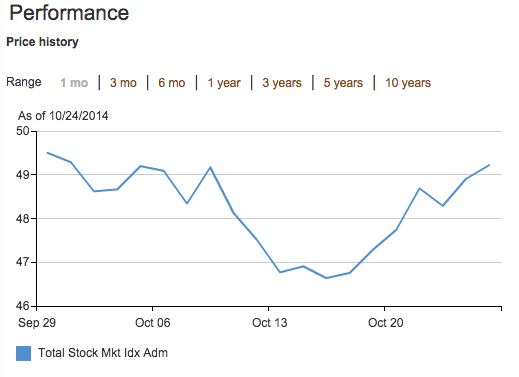
Are we OK?

The markets had come off 5% and the news media had cranked their fear machines to full throttle. You can see the dip below. I got the call at the bottom of the “U.”

Screenshot 2014-10-27 08.36.45

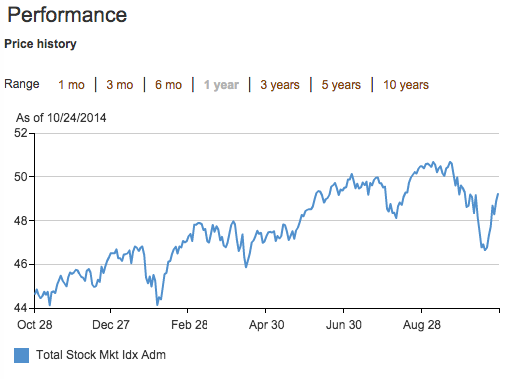
The next chart shows why everyone freaked… memories are short. Here’s the one-year view of my US Equity Fund…

Screenshot 2014-10-27 08.37.02Looking at the chart above, I got the call at the bottom of the right-hand “V.”

So I opened up my tracking app to see how we were doing.

Despite the 24/7 coverage of the impending financial apocalypse, our family net worth hadn’t moved.

Strange.

I opened up my Vanguard app to see how our financial investments were performing. Down about 1% in total – not bad considering the financial pundits were acting like we’d plunged off a cliff.

Why so little movement in my life?

1 – I focus on the total portfolio position, not the elements inside the portfolio, which are constantly changing. I check in on the portfolio monthly and rebalance the asset mix quarterly.

2 – Aside from a modest 30-year fixed rate mortgage, there is ZERO debt in my financial life. Leverage magnifies the impact of changes in asset prices.

NOTE – If you have a financial advisor in a Big Bank then I bet they’ve been trying to sell you margin loans on your portfolio. The cost of your margin loan is greater that my expected rate of return for my portfolio – therefore, I view your margin loan as a direct wealth transfer from your family to your adviser’s firm and bonus. I have pals that make a living selling these products – my choice is to send my kids to public school and make less money.

Know that you can get better advice from Vanguard for far less money – plus Vanguard products cost you less than a tenth of what the Big Banks charge.

3 – I’m exposed to more than US Equities. The key components of my family’s balance sheet are:

  • US Equities (VTSAX)
  • Int’t Equities (VTIAX)
  • US Intermediate Bond (VBTLX)
  • US Short-Term Government Bond (VSBSX)
  • Boulder Real Estate

When the equity markets freak out, sometimes my bonds appreciate due to people swapping into US government securities. This is nice but I don’t really care because…

I hold the bonds to reduce the volatility of my total portfolio and to provide capacity to buy more equities when the market tanks.

+++

After checking things out I told my wife that we were OK and she said…

So, I guess the lesson is not to panic?

My reply, “Actually, I panicked when the market was down 2%.”

The difference is my capacity to act on my plan, rather than my emotions.

The lessons are:

If you can’t do the plan then it’s the wrong plan!

I’ll end with the five-year chart for an index of 500 large stocks that are traded in the US.

Screenshot 2014-10-27 08.38.34

If you thought October was a rough ride, you ain’t see nothing yet, it wasn’t even a blip.

Being Good Enough – work finance family

The concept of “good-enough” is essential if you are prone to worry, or if your inability to be perfect prevents you from trying to improve!

Because anxious people get an emotional charge from worry. It’s a tough habit to break!

  • A good-enough mother, father or caregiver
  • A healthy-enough approach to diet and exercise
  • A focused-enough approach to your main vocation (parenting, teaching, coaching, business, sport)

As a Dad, my kids are overwhelming. I was forced to let go (of the unreasonable expectations I set for myself). What enabled me to shift was considering my family’s needs… Do my children say they love me? What does my wife say about my marriage? What happens when I’m not around?

In my work and financial life, it’s easy to endlessly tinker – seeking to optimize a situation where constant change is proven to make things worse, rather than better. My best outcome is to crease a simple solution, that’s good-enough, and limit my ability to screw things up.

What to do? I recommend that you don’t take specific advice from me. Find what works for you. However, I share the specifics of what I do because the simplicity of my approach is a useful counterbalance to the complexity that’s sold to us.

Act as if the goal of the financial services industry is to separate you from your money and run from from any advisor that’s not bound by a fiduciary duty to act in your best interest. Be aware that even the fiduciaries are prone to making money at your expense.

Next, focus on the four things that truly matter

  • Save – live on less than you earn
  • Fees & Expenses – low-cost passive indexing gives you a big edge
  • Dollar-cost averaging – create a strategy that runs on autopilot and get on with living
  • Be Able To Hold Through Dips – never extend yourself, live debt free, be able to hold through unexpected unemployment

At times, you may need expert advice for:

  • Wills, Estates & Trusts
  • Tax & Accounting
  • Pensions & Retirement

The rules on the above vary by country and state. Get advice on a fixed fee basis and expect to review every five years.

What about portfolio? I aim for something that’s “good enough” and spend my energy staying focused on the tips above (save, low cost, buy a little bit frequently, be able to hold). The more decisions I have to make, the greater the scope for human misjudgment.

I do best when I focus on what I directly control:

  • family annual cost of living
  • new investment rate
  • cost to hold my portfolio

However, what to do about my house? That’s a key asset for most families. Here’s what I’ve told my family council. If I’m gone then help my wife get to…

  • Personal residence (10%)
  • US Equity Index Fund (30%)
  • Int’l Equity Index Fund (30%)
  • US Bond Index Fund (30%)

For the young people reading, the 10% constraint means that it will be a long time before you have enough equity for a down payment. That’s a good thing! I waited until I had 20 years living expenses saved, and had watched two recessions from the sidelines.

One of the neat things about triathlon is the ability to be very good at something by combining good-enough performances in each of its components. With three kids and a young wife, something had to give – from the self-centered approach of my years as an elite athlete.

+++

The financial stuff above is based on a short eBook called, If You Can. The book took me an hour to read – you should read it.

How A Kid Saves $100 Per Week

Bogus BasinThe fact that $100 per week from age 12 to 30 equals $150,000 (at 5% compounding) caught my wife’s eye. She asked me to explain how one of our kids could save $100 per week.

My assumptions:

  • Colorado minimum wage is $8 per hour
  • The habit I want to support is investing 50% of net earnings
  • 15 hours a week gets us to $120 gross

Now, 15 hours a week is a lot. Most kids would learn that they need to start a much lower, say 3-7 hours. That’s OK with me – it’s the habit, not the quantum that matters.

What would they do?

Right now we spend significant money/time on childcare, cleaning and yard work. All of these are up for grabs, if there’s interest.

In my wife’s case, she spent her childhood swimming – there wasn’t surplus time, or energy, for much work. Her payoff was an out-of-state athletic scholarship, a biology degree and a life-long habit of healthy choices.

Up in Canada, I started working early and continued through university. I paid local tuition, had an academic scholarship and graduated in four years. My family’s payoff was reduced financial support and a financially secure adult (with an advanced finance degree). My healthy habits came a lot later!

The offer I’d make to my kids is dollar-for-dollar matching with their saved earnings. I’d start them with the second-grader portfolio (90% equity). Here’s the Second Grader Book link – highly recommend it to adults!

Creating an early habit of working, and investing, will have a far greater return than ANY alternative uses of funds.

In effect, I’m setting up a program by which my children earn financial support and learn the skills to manage money when I’m gone.

As the kids gain experience, I can teach them about investing, personal taxation, compound interest, financial accounting and asset allocation – with their own assets.

By allowing my family (and my family council), to follow along, everyone learns the skills required when I’m gone.

Ten Lessons From The Great Recession

pawneeFor my family, September 2014 marked the the end of the Great Recession, which (for us) had started in October 2008. Navigating the recession took a year longer than my worst case assumption of five years.

I wanted to share my lessons as I can feel the temptation to ignore them returning!

#1 – You can’t know your partners – I’ve lived with friends for up to six months at a time and had no idea about their personal situation – my favorite quote here is one about knowing your marriage… “if you’re lucky then you might know 50% of your marriage, YOUR half.”

#2 – Burn rate kills – Between October 2008 and March 2009, I lost 100% of my net income. Without significant changes, I knew the loss of income would screw up our family finances. I would have really freaked if I knew that interest rates were going to zero! Staying variable enabled us to cut 90% of business expenses and 50% of household expenses – these were gone by April 2009. The lesson here is to be very careful of building up long-term financial commitments.

#3 – Real Estate, even prime, is only liquid in a bull market – there is an urban myth that real estate is a low volatility asset class. Until 2009, there were many national markets that had NEVER gone down! I will not be able to time the market – I should always be willing to sell early – future purchases should only be made for assets that the family is willing to hold for more than 25 years.

#4 – For my core capital, my benchmark return is zero – there is a portion of my family balance sheet that would be very painful to lose. Don’t risk capital for tiny yield – examples here are constantly pedaled by brokers (foreign currency deposits, derivative-linked investments, highly-leveraged investment schemes, alternative assets, growth stocks).

#5 – I’m a better man when I’m constrained – This applies in all areas of my life. At the peak of the boom there was tremendous ego and waste in my life. I’m very fortunate that life gave me a kick in the butt and I had to make choices. I don’t have the emotional maturity to be unconstrained in action, maybe someday!

#6 – Create plans B, C and D – ring fence different aspects of your life, and finances – NEVER guarantee another person’s obligations (see #1 above). In 2014, my life has a series of fallback plans to deal with potential setbacks – I spent the recession taking steps to protect myself, my wife, my kids, and my family.

#7 – Investment properties should avoid furnished rentals, anything with a material housing association payment, and anything with a cost to hold (vacant) that’s greater than long term interest rates – I made good money by investing in real estate through the bottom but would have done better by focusing on properties with a lower cost to hold.

#8low-cost passive index investing gives me what I need. The best gamblers I know take a profit-share on other people’s money and use non-recourse leverage.

#9 – stop trying to win – I misallocate energy, money and time when I forget that a simple life is a good life. Reaching for external success and excessive financial wealth leads to poor decisions and choices. I make my best choices when I measure wealth in terms of health, controlling my schedule and sharing time with people I love.

#10 – don’t capitalize luxury expenditure – particularly, second homes and depreciable assets – stay variable!

My errors and misjudgments persist across cultures and generations!

Choose Wisely


Moving Into An Equity Position – Lump Sum

We sold our house in September, the market is at an all-time high, interest rates remain near an all-time low…

What-to-do?

My existing portfolio mix is 60/40 equity/debt. I’m happy with that position so will ring fence those assets and continue to rebalance quarterly.

With the new money…

  • 40% Intermediate Bond Fund
  • 30% Short-term US Government Bond Fund
  • 30% Equity (20 US / 10 Int’l)

I came at the equity number because I could live with the impact of a 20-50% equity market decline (6-15% of total portfolio) if a big drop happened the day after I invested. Considering greater exposure to a drop was too painful.

To move my allocation from 30% equity to 60% equity:

  • Take 130 weeks to do the move
  • Move equal amounts each week by exchanging short-term bond fund for the two equity funds that I use (VTSAX/VTIAX) – set up an automatic exchange on Vanguard
  • Track the individual purchases (automatically via Vanguard) to create options for tax efficiency – if you track your cost based on specific purchase IDs then you can specify the exact shares that you want to sell/exchange at a later date
  • Review quarterly
    • 20% drop in the market will trigger a 10% increase in equity weighting
    • 30% drop in the market will trigger another 10% increase in equity weighting
    • 40% drop in the market will have me shift to my goal weighting of 60% equity

My strategy (30% equity to start) is more usual for an investor older than me. It is particular to my own situation and not advice for you.

For expert advice, check out All About Asset Allocation by Richard Ferri.

Here’s my original article, about buying equities, from March 2014.

Budgets For Beginners

flyingA reader asked for simple tips for starting out with financial management.

+++

#1 – track everything you spend in a month

You may be surprised at the comfort that “knowing” gives you. The anxiety of “not knowing” is usually huge.

#2 – make a list of everything you owe, the minimum payments, and the rate of interest on each account

#3 – after you pay your monthly essentials, surplus cash goes to eliminate your credit card accounts (highest rate to lowest rate). Pay them off and close the accounts. Make a minimum extra repayment of $100 per week on the account with the highest rate.

#4 – saving (or debt repayment) is best done weekly, and automatically – for Americans, an IRA is a good option to consider. If you’re unsure what to do then have each adult in your house stick $100 per week into a target date retirement fund with a low-cost provider, like Vanguard.

+++

The habit of weekly savings is powerful.

I helped a friend repay $10,000 in two years by using 100 weekly checks – her net worth when we started was negative $10,000. All she had was her clothes, her computer and a debt she owed. If she’d continued the savings habit then she’d have a portfolio of $75,000 now.

$100 per week from 18 to 62 years old will grow to $720,304 (5% compounding).

+++

Financially secure parents/grandparents – consider matching earned retirement savings, this will help you to avoid supplementing consumption.

$100 per week from 12 to 30 years old will grow to $150,000 (5% compounding).

+++

How much should you save?

If you want more info on saving for retirement then Bernstein’s ebook is a good one – it’s $0.99 on Amazon right now and a quick read.