What I Learned Last Year

biscottiTwo themes have dominated my goals for the last couple of years: my relationship with my eldest daughter and my finances.

++

Kids – my daughter worked herself out, no input from me. I didn’t change her nature, I accepted it, and we enjoyed the inevitable progression from preschooler to school-age girl.

For my pals with kids – avoid abandonment and retaliation – everything else is details.

++

Optimism is the only worldview borne out by the facts.

At the end of 2008, I wrote-off 65% of my family balance sheet, was unemployed, owned a loss-making business and was facing civil liability relating to large-scale fraud.

You may have forgotten but everything we were reading was doom and gloom. In reality, that was one of the most useful periods of my life because I was forced to face the gross inefficiency of my spending choices.

The changes that result from earlier setbacks lead to an appreciation of a more simple life and I’ve continued to strip away non-core activities.

My wife is stumped when asked, “What does Gordo do?”

I enjoy my life and serve my family

Act in the spirit of service to the people that love you.

Act as if things will work out.

Keep simplifying.

Free yourself to spend time on what matters.

For the pessimist in your head that likes to point out that we’re all dead in the long run… be wary of overstating your importance in the world.

My death will be a setback for a few people but it won’t change the positive trajectory of history. I will play my role then hand off to the younger generation.

There will be tears and that’s OK.

++

Human Capital & Family Finances

What can each of us bring to our families, and communities?

Strong relationships built on mutual respect and strengthened via self-improvement.

Six years ago, I was left with a home and cash assets. With interest rates moving towards 200-year lows, I realized that I had to be invested. I made an error by going all-in with real estate. Why an error?

  • I was geographically concentrated – the bulk of the portfolio was within two miles of each other.
  • I invested too much – I failed to understand the short-term cash needs of my young family, which arrived in 2008/2011/2012.
  • Each asset represented many years of living expenses – lumpy assets are inefficient when you’re moving towards retirement.
  • Real estate takes a long time to sell. With a traditional portfolio, a gradual sell down is easier to achieve.

My purchases had a margin of safety and I was able to trade my way out of the situation – 4 out of 8 addresses have been sold. Start to finish, it will take 8-10 years for me to change my asset allocation. Our family financial structure gave me time to make the change, we earned income, and we had exposure to asset appreciation.

Time worked things out – we did well but so did all others that were invested from 2009 to 2014.

++

The final lesson – I am greedy in irrational ways. I can soothe my ego by noting that my flaws are widely shared.

I am susceptible to the Endowment Effect. I overvalue what I have – my wife had to force me to sell our old house, I wanted to hold out.

I overvalue future desires. I’m constantly fooling myself that MORE will make a difference.

My antidote:

  • Write down my desires (steam shower, truck, boat, kitchen appliances, vacations, clothes, car, office, ski chalet) then wait and let desire pass
  • Make the wealth cost of “more” both painful and visible
  • Note the choices that create my best days (train AM/PM, help someone, learn, write, teach, spend time with my wife, under scheduled)
  • Spend money to create true luxuries (childcare, time to think, time to learn)
  • Schedule my happiness essentials (time in nature, time with my wife, quiet time to think)

Keep it simple:

  1. Notice the good in life
  2. Write good things down
  3. Do more good things

Early Retirement – The ratio of spending to security

thanksJustin put me onto Mr Money Mustache’s blog (“MMM”). MMM makes a point that if you have a balance sheet that equals 25x your annual spending then you should be set for life.

What prevents us from getting to the magic ratio?

At my best, I see debt and spending as where to focus.

When I’m feeling sorry for myself, I might blame taxes, lack of income or the cruelty of fate.

Like Mr. MM, I retired early. In fact, I’ve had three retirements – two voluntary and one via the insolvency of my de facto employer.

When I was living first class in my late 20s, I realized that I could slash my spending by 90% and take a year long vacation. This change didn’t get me to the magical 25x ratio but it got me close. I worked part-time (as a coach) and knew that I could tighten my spending and get myself to 40x covered.

Somewhere around 2002, I got caught up in the bull market that ran through to 2008. My spending rose, and rose, and rose, and rose. I didn’t mind as I was making good money. If you’re in a high-paying profession then you’re prone to this risk. I’m not unique. Docs, dentists, lawyers and finance professions often extend their careers by 10-25 years by cranking expenditure and borrowing.

My life came to a head in 2008 when the economy went off a cliff, my income dropped 95% and I had grown accustomed to my spending.

Boy did it hurt to stop spending money.

It hurt because I didn’t see the link between spending and the anxiety that filled my life.

Inside my head, the battle raged…

  • I DESERVE…
  • I HAVE NEEDS…
  • IT”S NOT FAIR…

What I was really saying is, “it hurts so much to change. I just want to be happy, please leave me alone.”

I see plenty of conflict in relationships over money. Historically, much of my irritation over clutter stems from an underlying financial anxiety that I’m not addressing via my own habits.

Quite often the main breadwinner delegates the financial planning function, putting their spouse on an allowance and creating a external target for internal angst.

A couple years ago, I realized that I’d done this to my wife. I had to own my fears, change my spending and redirect our family.

+++

I had the courage to take my first retirement at 31 because I remembered the freedom that came from living like a student.

I forgot that lesson, increased my net worth by 500%, and felt completely insecure at 40.

Every $10,000 of expenditure requires $250,000 of assets to buy me financial peace of mind.

What’s the true cost of your spending?

What could you achieve if you removed unnecessary anxiety from your life?

+++

I have buddies that are planning to work an extra decade – to build assets sufficient to support a spending rate that doesn’t bring happiness and strains their home life. They tell me stories of their children begging them to work less.

The pain is real.

So are the benefits from incremental change.

Behavior Not Protocol

winterIn any given field, the bulk of our performance comes from choosing appropriate behaviors rather than optimizing protocol.

Take wealth, I’ve been reading a second book by Nick Murray and he makes the point that behavior is the single greatest source of wealth creation. He goes further to make the point that it has a greater impact than all other factors combined.

In reading the book, it struck me that he could easily have been describing athletic performance.

  • Balanced program
  • Frequent small contributions towards the goal
  • Most people beat themselves
  • Train yourself to overcome human bias and misjudgment

For every wealth behavior, I can find a similar fitness behavior. Works the same with common errors (selling in fear, chasing performance, not resting, fear of fatigue).

Looking forward to 2015, what behavior is required to achieve your goals? Don’t focus on more than three.

What are the most common mistakes that “everyone else” makes in seeking similar goals? Individual experience is a mirage. What are the most common errors made in my field? How best to create a system so I avoid repeating the mistakes?

Regardless of your field…

  • One small daily step – keep chipping away
  • Drive experience inwardstake all external irritations and change them in MYSELF
  • Let go of non-core – our best work requires a clear mind, a clear mind comes from letting go
  • Refuse to make predictions – pundits do worse than random – stay focused on behavior
  • Spend no more than 10% of your time on tweaking protocol – the greatest returns flow from consistent core behaviors

What are the behaviors required for a life with meaning?

Health, kindness, shared experience, close to nature.

Quarterly Financial Review

2014-11-19 13.36.43-1The way you feel right now is how a bull market impacts consumer sentiment.

  • Gas prices are down – a big psychological boost for me
  • Asset prices are at all-time highs – makes me feel safe
  • Your business is performing well – makes me feel safe

In these conditions, it’s tempting to change investment strategy and chase recent high performing assets (or managers).

We’ve decided to stay-the-course. There’s hasn’t been any major change in our life situation so there need not be any change in our investment strategy.

We’re on track to achieve our goals:

  • The freedom to chose rewarding part-time work
  • A source of income that we don’t outlive
  • Educating our kids
  • Passing capital to our adult kids when it’s time for us to say good-bye

Do you know your goals?

Do you know the behaviors that can screw up achieving your goals?

++

We sold our old house in September and I implemented our strategy of gradually buying equities. We’re 34% equities so there’s been “lost profits” from having money outside of the equity market – especially when the US market hits all-time-high after all-time-high…

Surprisingly… lost profits don’t bother me, or screw up our goals, and I was relieved in October when the portfolio held up well.

Dollar-based equities have continued to outperform our international investments so I’ll rebalance by tilting new purchases towards international. Yes, I’m going to buy more of what everyone is saying will tank in 2015 (VTIAX). I have a strategy of reinvesting dividends and keeping International equity at 50% of my US equity exposure.

It’s likely that I’ll need cash flow to cover year end expenses. I will sell bond funds to raise the cash. That will bump up our equity allocation as a percentage of assets.

The underperformance of our international equities creates the possibility of tax-loss harvesting in December. Next week, I am preparing draft accounts for the different parts of my family and reviewing the cost basis of our investments. Later this month, we will decide if it makes sense to realize losses.

++

We spend $12,000 per annum at Whole Foods and they are offering a 10% rebate on gift card purchases through Jan 1. They let us pay with a credit card which gives another 1% via cash back. That is an 11% return on investment, on money we are certain to spend.

We eat at Native Cafe and they have an even better offer of a 20% rebate on gift card purchases. There’s only one location in Boulder and the company financials aren’t are strong as Whole Foods. I’ll limit myself to five months worth of meals.

Even better than shopping at Whole Foods, or eating out, is staying at home and using goods purchased at CostCo. We spend $10,000 a year at CostCo and it saves us thousands of dollars.

If you don’t know what, where and when you spend then Mint.com is an easy way to track your family finances.


Simple Wealth, Inevitable Wealth

Happy_EverythingI came across this week’s title via a book recommended in The Reformed Broker’s twitter feed. The author is Nick Murray, who’s been a financial adviser for longer than I’ve been on the planet!

Here’s a link to the book on Nick’s website.

The book is an easy read and the first pass through won’t take you long. It’s a good one to share with your family and discuss. My key take aways…

Volatility isn’t loss – while emotionally painful, adverse movements in asset prices only hurt me if I sell. So long as I can hold through the bottom, price movements have limited bearing on my life.

Dividends are indexed income that comes from appreciating tax-deferred assets. This point really hit home. Sample yields from my portfolio:

  • US Equity – VTSAX => 1.82%
  • US Bond – VBTLX => 2.00%
  • Boulder Real Estate => 3.30%

Both the equity and the real estate have an option embedded via the potential for capital appreciation. The value of the asset can increase (or decrease), thereby increasing my total return on investment.

Nick would say the true risk on my portfolio lies at the far end because a long-term holding of bond-type assets has zero capacity for capital appreciation – I receive return of capital, taxable income and exposure to default risk.

Dollar Cost Averaging with a lump sum is only superior when there’s a crash within 2 to 3 years of receipt of funds. Very similar to the advice Vanguard gave a friend of mine and something I hadn’t fully considered. My lump sum article was written at 5.5 years into a bull market and my holdback capital has an investment rate of 2 to 3 years.

If your goal is long-term wealth creation then you should be close to 100% equity – this is similar to Warren Buffett’s advice for his daughter’s portfolio (90% US Equity index and 10% short-term government bonds). Nick makes the point that dividend income is indexed and we can afford to ride the volatility.

Protect your family by holding enough short-term securities so you don’t have to sell into the inevitable crashes and let long-term compounding do its work.

He also has a great example of the change in total dividends and total profitability across long periods when the market “doesn’t move.” Even when share prices are stagnant, the world makes forward progress.

The book contains very little advice on investment selection because Nick’s take home point is Behavior Drives 90% of Investor Return.

This mirrors my advice to athletes – until you can do, what you do doesn’t matter. Nick’s point is we focus too much on the type of Investment and not enough on making ourselves better Investors.

The final chapter was the best – Optimism is the only Realism. The pessimists in our lives will claim that their views are based in reality. While fear, anger and pessimism are supported by our media, Nick makes the point that long-term optimism is the only position supported by the facts.

Lots to discuss with my family and I recommend it to your own.

Panic Early – stress testing my family finances in October 2014

2014-10-25 11.24.20-1I was on a business trip in Asia when the call came through from my wife…

Are we OK?

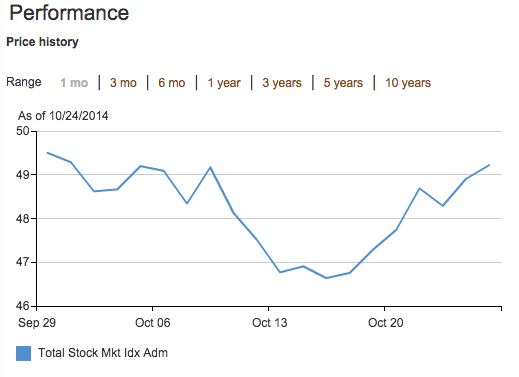
The markets had come off 5% and the news media had cranked their fear machines to full throttle. You can see the dip below. I got the call at the bottom of the “U.”

Screenshot 2014-10-27 08.36.45

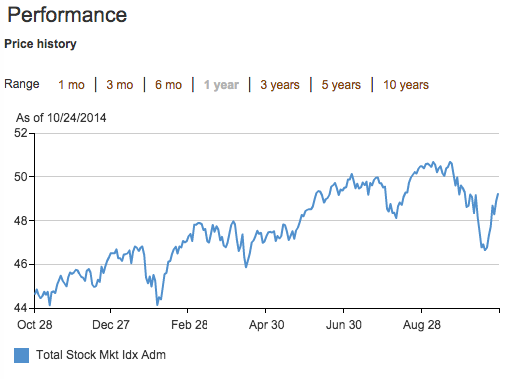
The next chart shows why everyone freaked… memories are short. Here’s the one-year view of my US Equity Fund…

Screenshot 2014-10-27 08.37.02Looking at the chart above, I got the call at the bottom of the right-hand “V.”

So I opened up my tracking app to see how we were doing.

Despite the 24/7 coverage of the impending financial apocalypse, our family net worth hadn’t moved.

Strange.

I opened up my Vanguard app to see how our financial investments were performing. Down about 1% in total – not bad considering the financial pundits were acting like we’d plunged off a cliff.

Why so little movement in my life?

1 – I focus on the total portfolio position, not the elements inside the portfolio, which are constantly changing. I check in on the portfolio monthly and rebalance the asset mix quarterly.

2 – Aside from a modest 30-year fixed rate mortgage, there is ZERO debt in my financial life. Leverage magnifies the impact of changes in asset prices.

NOTE – If you have a financial advisor in a Big Bank then I bet they’ve been trying to sell you margin loans on your portfolio. The cost of your margin loan is greater that my expected rate of return for my portfolio – therefore, I view your margin loan as a direct wealth transfer from your family to your adviser’s firm and bonus. I have pals that make a living selling these products – my choice is to send my kids to public school and make less money.

Know that you can get better advice from Vanguard for far less money – plus Vanguard products cost you less than a tenth of what the Big Banks charge.

3 – I’m exposed to more than US Equities. The key components of my family’s balance sheet are:

  • US Equities (VTSAX)
  • Int’t Equities (VTIAX)
  • US Intermediate Bond (VBTLX)
  • US Short-Term Government Bond (VSBSX)
  • Boulder Real Estate

When the equity markets freak out, sometimes my bonds appreciate due to people swapping into US government securities. This is nice but I don’t really care because…

I hold the bonds to reduce the volatility of my total portfolio and to provide capacity to buy more equities when the market tanks.

+++

After checking things out I told my wife that we were OK and she said…

So, I guess the lesson is not to panic?

My reply, “Actually, I panicked when the market was down 2%.”

The difference is my capacity to act on my plan, rather than my emotions.

The lessons are:

If you can’t do the plan then it’s the wrong plan!

I’ll end with the five-year chart for an index of 500 large stocks that are traded in the US.

Screenshot 2014-10-27 08.38.34

If you thought October was a rough ride, you ain’t see nothing yet, it wasn’t even a blip.

Being Good Enough – work finance family

The concept of “good-enough” is essential if you are prone to worry, or if your inability to be perfect prevents you from trying to improve!

Because anxious people get an emotional charge from worry. It’s a tough habit to break!

  • A good-enough mother, father or caregiver
  • A healthy-enough approach to diet and exercise
  • A focused-enough approach to your main vocation (parenting, teaching, coaching, business, sport)

As a Dad, my kids are overwhelming. I was forced to let go (of the unreasonable expectations I set for myself). What enabled me to shift was considering my family’s needs… Do my children say they love me? What does my wife say about my marriage? What happens when I’m not around?

In my work and financial life, it’s easy to endlessly tinker – seeking to optimize a situation where constant change is proven to make things worse, rather than better. My best outcome is to crease a simple solution, that’s good-enough, and limit my ability to screw things up.

What to do? I recommend that you don’t take specific advice from me. Find what works for you. However, I share the specifics of what I do because the simplicity of my approach is a useful counterbalance to the complexity that’s sold to us.

Act as if the goal of the financial services industry is to separate you from your money and run from from any advisor that’s not bound by a fiduciary duty to act in your best interest. Be aware that even the fiduciaries are prone to making money at your expense.

Next, focus on the four things that truly matter

  • Save – live on less than you earn
  • Fees & Expenses – low-cost passive indexing gives you a big edge
  • Dollar-cost averaging – create a strategy that runs on autopilot and get on with living
  • Be Able To Hold Through Dips – never extend yourself, live debt free, be able to hold through unexpected unemployment

At times, you may need expert advice for:

  • Wills, Estates & Trusts
  • Tax & Accounting
  • Pensions & Retirement

The rules on the above vary by country and state. Get advice on a fixed fee basis and expect to review every five years.

What about portfolio? I aim for something that’s “good enough” and spend my energy staying focused on the tips above (save, low cost, buy a little bit frequently, be able to hold). The more decisions I have to make, the greater the scope for human misjudgment.

I do best when I focus on what I directly control:

  • family annual cost of living
  • new investment rate
  • cost to hold my portfolio

However, what to do about my house? That’s a key asset for most families. Here’s what I’ve told my family council. If I’m gone then help my wife get to…

  • Personal residence (10%)
  • US Equity Index Fund (30%)
  • Int’l Equity Index Fund (30%)
  • US Bond Index Fund (30%)

For the young people reading, the 10% constraint means that it will be a long time before you have enough equity for a down payment. That’s a good thing! I waited until I had 20 years living expenses saved, and had watched two recessions from the sidelines.

One of the neat things about triathlon is the ability to be very good at something by combining good-enough performances in each of its components. With three kids and a young wife, something had to give – from the self-centered approach of my years as an elite athlete.

+++

The financial stuff above is based on a short eBook called, If You Can. The book took me an hour to read – you should read it.

Ten Lessons From The Great Recession

pawneeFor my family, September 2014 marked the the end of the Great Recession, which (for us) had started in October 2008. Navigating the recession took a year longer than my worst case assumption of five years.

I wanted to share my lessons as I can feel the temptation to ignore them returning!

#1 – You can’t know your partners – I’ve lived with friends for up to six months at a time and had no idea about their personal situation – my favorite quote here is one about knowing your marriage… “if you’re lucky then you might know 50% of your marriage, YOUR half.”

#2 – Burn rate kills – Between October 2008 and March 2009, I lost 100% of my net income. Without significant changes, I knew the loss of income would screw up our family finances. I would have really freaked if I knew that interest rates were going to zero! Staying variable enabled us to cut 90% of business expenses and 50% of household expenses – these were gone by April 2009. The lesson here is to be very careful of building up long-term financial commitments.

#3 – Real Estate, even prime, is only liquid in a bull market – there is an urban myth that real estate is a low volatility asset class. Until 2009, there were many national markets that had NEVER gone down! I will not be able to time the market – I should always be willing to sell early – future purchases should only be made for assets that the family is willing to hold for more than 25 years.

#4 – For my core capital, my benchmark return is zero – there is a portion of my family balance sheet that would be very painful to lose. Don’t risk capital for tiny yield – examples here are constantly pedaled by brokers (foreign currency deposits, derivative-linked investments, highly-leveraged investment schemes, alternative assets, growth stocks).

#5 – I’m a better man when I’m constrained – This applies in all areas of my life. At the peak of the boom there was tremendous ego and waste in my life. I’m very fortunate that life gave me a kick in the butt and I had to make choices. I don’t have the emotional maturity to be unconstrained in action, maybe someday!

#6 – Create plans B, C and D – ring fence different aspects of your life, and finances – NEVER guarantee another person’s obligations (see #1 above). In 2014, my life has a series of fallback plans to deal with potential setbacks – I spent the recession taking steps to protect myself, my wife, my kids, and my family.

#7 – Investment properties should avoid furnished rentals, anything with a material housing association payment, and anything with a cost to hold (vacant) that’s greater than long term interest rates – I made good money by investing in real estate through the bottom but would have done better by focusing on properties with a lower cost to hold.

#8low-cost passive index investing gives me what I need. The best gamblers I know take a profit-share on other people’s money and use non-recourse leverage.

#9 – stop trying to win – I misallocate energy, money and time when I forget that a simple life is a good life. Reaching for external success and excessive financial wealth leads to poor decisions and choices. I make my best choices when I measure wealth in terms of health, controlling my schedule and sharing time with people I love.

#10 – don’t capitalize luxury expenditure – particularly, second homes and depreciable assets – stay variable!

My errors and misjudgments persist across cultures and generations!

Choose Wisely


Moving Into An Equity Position – Lump Sum

We sold our house in September, the market is at an all-time high, interest rates remain near an all-time low…

What-to-do?

My existing portfolio mix is 60/40 equity/debt. I’m happy with that position so will ring fence those assets and continue to rebalance quarterly.

With the new money…

  • 40% Intermediate Bond Fund
  • 30% Short-term US Government Bond Fund
  • 30% Equity (20 US / 10 Int’l)

I came at the equity number because I could live with the impact of a 20-50% equity market decline (6-15% of total portfolio) if a big drop happened the day after I invested. Considering greater exposure to a drop was too painful.

To move my allocation from 30% equity to 60% equity:

  • Take 130 weeks to do the move
  • Move equal amounts each week by exchanging short-term bond fund for the two equity funds that I use (VTSAX/VTIAX) – set up an automatic exchange on Vanguard
  • Track the individual purchases (automatically via Vanguard) to create options for tax efficiency – if you track your cost based on specific purchase IDs then you can specify the exact shares that you want to sell/exchange at a later date
  • Review quarterly
    • 20% drop in the market will trigger a 10% increase in equity weighting
    • 30% drop in the market will trigger another 10% increase in equity weighting
    • 40% drop in the market will have me shift to my goal weighting of 60% equity

My strategy (30% equity to start) is more usual for an investor older than me. It is particular to my own situation and not advice for you.

For expert advice, check out All About Asset Allocation by Richard Ferri.

Here’s my original article, about buying equities, from March 2014.

Budgets For Beginners

flyingA reader asked for simple tips for starting out with financial management.

+++

#1 – track everything you spend in a month

You may be surprised at the comfort that “knowing” gives you. The anxiety of “not knowing” is usually huge.

#2 – make a list of everything you owe, the minimum payments, and the rate of interest on each account

#3 – after you pay your monthly essentials, surplus cash goes to eliminate your credit card accounts (highest rate to lowest rate). Pay them off and close the accounts. Make a minimum extra repayment of $100 per week on the account with the highest rate.

#4 – saving (or debt repayment) is best done weekly, and automatically – for Americans, an IRA is a good option to consider. If you’re unsure what to do then have each adult in your house stick $100 per week into a target date retirement fund with a low-cost provider, like Vanguard.

+++

The habit of weekly savings is powerful.

I helped a friend repay $10,000 in two years by using 100 weekly checks – her net worth when we started was negative $10,000. All she had was her clothes, her computer and a debt she owed. If she’d continued the savings habit then she’d have a portfolio of $75,000 now.

$100 per week from 18 to 62 years old will grow to $720,304 (5% compounding).

+++

Financially secure parents/grandparents – consider matching earned retirement savings, this will help you to avoid supplementing consumption.

$100 per week from 12 to 30 years old will grow to $150,000 (5% compounding).

+++

How much should you save?

If you want more info on saving for retirement then Bernstein’s ebook is a good one – it’s $0.99 on Amazon right now and a quick read.