Simple Wealth, Inevitable Wealth

Happy_EverythingI came across this week’s title via a book recommended in The Reformed Broker’s twitter feed. The author is Nick Murray, who’s been a financial adviser for longer than I’ve been on the planet!

Here’s a link to the book on Nick’s website.

The book is an easy read and the first pass through won’t take you long. It’s a good one to share with your family and discuss. My key take aways…

Volatility isn’t loss – while emotionally painful, adverse movements in asset prices only hurt me if I sell. So long as I can hold through the bottom, price movements have limited bearing on my life.

Dividends are indexed income that comes from appreciating tax-deferred assets. This point really hit home. Sample yields from my portfolio:

  • US Equity – VTSAX => 1.82%
  • US Bond – VBTLX => 2.00%
  • Boulder Real Estate => 3.30%

Both the equity and the real estate have an option embedded via the potential for capital appreciation. The value of the asset can increase (or decrease), thereby increasing my total return on investment.

Nick would say the true risk on my portfolio lies at the far end because a long-term holding of bond-type assets has zero capacity for capital appreciation – I receive return of capital, taxable income and exposure to default risk.

Dollar Cost Averaging with a lump sum is only superior when there’s a crash within 2 to 3 years of receipt of funds. Very similar to the advice Vanguard gave a friend of mine and something I hadn’t fully considered. My lump sum article was written at 5.5 years into a bull market and my holdback capital has an investment rate of 2 to 3 years.

If your goal is long-term wealth creation then you should be close to 100% equity – this is similar to Warren Buffett’s advice for his daughter’s portfolio (90% US Equity index and 10% short-term government bonds). Nick makes the point that dividend income is indexed and we can afford to ride the volatility.

Protect your family by holding enough short-term securities so you don’t have to sell into the inevitable crashes and let long-term compounding do its work.

He also has a great example of the change in total dividends and total profitability across long periods when the market “doesn’t move.” Even when share prices are stagnant, the world makes forward progress.

The book contains very little advice on investment selection because Nick’s take home point is Behavior Drives 90% of Investor Return.

This mirrors my advice to athletes – until you can do, what you do doesn’t matter. Nick’s point is we focus too much on the type of Investment and not enough on making ourselves better Investors.

The final chapter was the best – Optimism is the only Realism. The pessimists in our lives will claim that their views are based in reality. While fear, anger and pessimism are supported by our media, Nick makes the point that long-term optimism is the only position supported by the facts.

Lots to discuss with my family and I recommend it to your own.

Retiring To Paradise

ParadiseA friend sent me an article about “stress-free living on a tropical island paradise.” The article was a teaser for a subscription-based newsletter about retiring well, on modest means.

The article got me thinking…

  • Why do I find foreign utopias so appealing?
  • What are the components of living well, particularly as I age?
  • What limits my ability to shift towards rewarding, part-time work as soon as possible?

The first thing that I remind myself is satisfaction is never achieved “out-there” in the future. My job is to make a note about the structure of my satisfying days, right here, right now.

Noticing the satisfying parts of my current life lets me define paradise on my own terms.

I guarantee that you’ll find your truth is far different than the marketing brochure!

In my own case, I don’t like to tan, I like to ride my bike uphill and I sleep best in a cold, dry room. Worth reminding myself of these points!

The allure of the tropical paradise…

  • Simplicity
  • Stress-free
  • Natural beauty

What price will I pay for my ticket to paradise? I’ve found two habits that move me away from my definition of paradise – their antidote…

Radical simplification of my life and possessions – all the crap I have in my life provides an endless stream of admin, depreciation and cost of ownership.

Aside from a Sienna Van and high-quality bicycles, none of it is useful. I’ve been chipping away for years. I get a lot of resistance from my family, and I respect their views.

Beach cruiser, surf board, and board shorts…

…I get the allure – yet know that it is simplification, not the tropics, that appeals to me.

Constantly reduce my personal needs – if you are in a high-paying field then you’ll be tempted to delay freeing yourself from full-time work until you “have enough” (to live at a standard that fits your perceived station in society).

My heroes don’t have a lot of possessions but are rich with satisfaction. Choose wisely.

If you’re delaying following your heart so that you can maintain a high spending rate then be sure spending fits your definition of paradise.

Many of the wealthy don’t enjoy spending. It’s how they became wealthy.

If the points above aren’t clear then invert and be honest with yourself.

  • Having so much stuff that I need a team of people to manage my gear, or spend a significant percentage of my life on admin…
  • Constantly increasing my personal needs via the hedonistic treadmill…

This combination, anywhere on the socio-economic scale, is a recipe for misery.

Finally, humans are similar in how we define natural beauty… high view, overlooking park land, ideally with some water.

Think about the most valuable real estate in your local market. It’s likely to have those characteristics.

Most of us will never afford that real estate, which is just another asset to take care of, anyway.

A better solution is to live beside a mountain park and get to a high view as often as possible.

What’s your definition of paradise?

bear

The Price of Admission

elsaI was reading The Meaning of Human Existence by Wilson and came across an excellent question:

What’s the price of admission to your tribe?

The question got me thinking about the ways that groups enforce conformity and create cohesion.

Here are two areas where my groups have led me astray…

Groups that push me to perform external actions that are different than my internal values — examples here would be the executive that complains that she has to lie as part of her job; or selling a product that hurts people; or working alongside people we don’t respect.

These situations lack integrity because we are choosing to ignore our internal reality in an effort to fit in externally. It’s a stressful situation and most of us adjust by changing our internal reality.

A gradual loss of integrity is how my criminal pals became crooks.

The second thing to watch is the temptation to trade health for money.

Despite having a long-term habit of good choices, I feel this temptation daily! It takes effort for me to protect my healthy living routine (sleep, exercise, stress, nutrition, positive connection to others). The sensation of hanging-on-by-a-thread is something that’s been with me for many years.

Parents, mentors, coaches, bosses, organizations, religions… when our leaders offer us money, fame or recognition for going against what feels right… start working on an exit strategy!

Two of my favorite questions for my kids…

  • What do you feel?
  • What do you think?

A life of integrity is built on harmony between our external actions and internal lives.

It takes effort to look inwards, rather than default to the external dogma of our tribe.

What are the values of the people closest to you?

Panic Early – stress testing my family finances in October 2014

2014-10-25 11.24.20-1I was on a business trip in Asia when the call came through from my wife…

Are we OK?

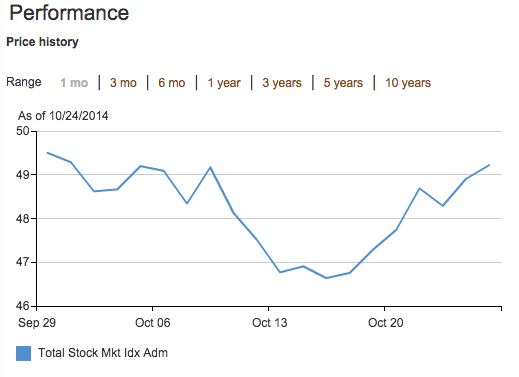
The markets had come off 5% and the news media had cranked their fear machines to full throttle. You can see the dip below. I got the call at the bottom of the “U.”

Screenshot 2014-10-27 08.36.45

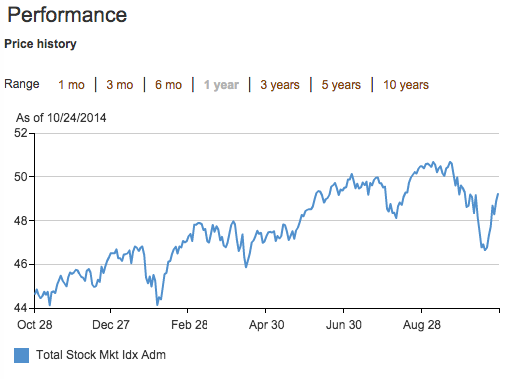
The next chart shows why everyone freaked… memories are short. Here’s the one-year view of my US Equity Fund…

Screenshot 2014-10-27 08.37.02Looking at the chart above, I got the call at the bottom of the right-hand “V.”

So I opened up my tracking app to see how we were doing.

Despite the 24/7 coverage of the impending financial apocalypse, our family net worth hadn’t moved.

Strange.

I opened up my Vanguard app to see how our financial investments were performing. Down about 1% in total – not bad considering the financial pundits were acting like we’d plunged off a cliff.

Why so little movement in my life?

1 – I focus on the total portfolio position, not the elements inside the portfolio, which are constantly changing. I check in on the portfolio monthly and rebalance the asset mix quarterly.

2 – Aside from a modest 30-year fixed rate mortgage, there is ZERO debt in my financial life. Leverage magnifies the impact of changes in asset prices.

NOTE – If you have a financial advisor in a Big Bank then I bet they’ve been trying to sell you margin loans on your portfolio. The cost of your margin loan is greater that my expected rate of return for my portfolio – therefore, I view your margin loan as a direct wealth transfer from your family to your adviser’s firm and bonus. I have pals that make a living selling these products – my choice is to send my kids to public school and make less money.

Know that you can get better advice from Vanguard for far less money – plus Vanguard products cost you less than a tenth of what the Big Banks charge.

3 – I’m exposed to more than US Equities. The key components of my family’s balance sheet are:

  • US Equities (VTSAX)
  • Int’t Equities (VTIAX)
  • US Intermediate Bond (VBTLX)
  • US Short-Term Government Bond (VSBSX)
  • Boulder Real Estate

When the equity markets freak out, sometimes my bonds appreciate due to people swapping into US government securities. This is nice but I don’t really care because…

I hold the bonds to reduce the volatility of my total portfolio and to provide capacity to buy more equities when the market tanks.

+++

After checking things out I told my wife that we were OK and she said…

So, I guess the lesson is not to panic?

My reply, “Actually, I panicked when the market was down 2%.”

The difference is my capacity to act on my plan, rather than my emotions.

The lessons are:

If you can’t do the plan then it’s the wrong plan!

I’ll end with the five-year chart for an index of 500 large stocks that are traded in the US.

Screenshot 2014-10-27 08.38.34

If you thought October was a rough ride, you ain’t see nothing yet, it wasn’t even a blip.

Renewing My Vows

ax_leavesHopefully, I’ll be around so my actions teach my children this post before their first kiss.

If not, then I leave it to point them in the right direction. Read it to them annually, at graduations and at their weddings.

++

Have you ever heard couples discussing their wedding vows? Perhaps wondering if they should include “honor and obey” in the words they exchange? That seems silly to me because it overlooks the essential components of EVERY long-term relationship.

What follows is how I try to live my marriage, and through my marriage interact with everybody. It wasn’t always this way – as a young man, my greatest weakness was a lack of compassion and an inability to see the second order consequences of my habit of hurting other people.

What are the most important ways that we honor each other?

First, and most importantly, is a commitment not to hurt other people.

Relationships fail when we get caught in a cycle of keeping score, tit-for-tat and not breaking the chain.

We don’t even need to be in the same room with each other to perpetuate this cycle. When I hear about marriages through third parties, I can feel the pain that the couple is creating for each other.

So I offer: I’ll do my best not to hurt you and ask that you forgive me for the many times that I’ll fall short.

Small children understand forgiveness instinctively. Each morning, I get a fresh start and, hopefully, I see each morning as a chance to get a little better than yesterday.

Now, my children will be like me in many ways. This means that they will arrive at adulthood with habits that will torpedo their relationships if not addressed. The most toxic of these habits is enjoying subtle retribution and justified anger.

So I offer: When I feel pain, I know it will be because I you have touched one of my many limitations. I vow to turn that knowledge inwards and try to make incremental progress.

I’ve been married for close to a decade. By chipping away a little bit each day, I make progress and, together, we strengthen our marriage.

It is my improvement, not my position, that makes me fit for leadership, and shows that I’m worthy of being honored.

Being honored for experience is great but being forgiven is much more valuable than being honored.

In a successful relationship, my errors are forgiven, rather than acting as triggers on top of 5, 10 or 15 years of repressed, mutually reinforced pain.

My dearest, I promise that I can handle the truth.

In life, we are tempted to protect others from the truth. This is a mistake and you will find that your strongest relationships are built on being open. In sharing our individual truths, we can work towards understanding what rings true as a couple.

The wisdom of these lessons becomes clear when you invert them.

Relationship failure is characterized by retribution, blame outside of myself and suppression of truth.

I failed many times before I learned a better way.

In order to shape my reality, I started by accepting it.

Chose wisely.

Sweet Emotion

A while back, I greatly expanded my twitter feed. I did this with an expectation that I’d be triggered. The world didn’t disappoint me and I was triggered by God ripping into someone…

Screenshot 2014-09-27 13.43.27

It’s been a while since I was triggered to the point of replying to a stranger so I looked inward at the nature, and source, of my reaction.

Here’s what I noticed:

The essence of powerful emotion is energy. Whether the emotion is anger, envy, grief, fear, love or joy… they are all just energy. It’s up to me to “tag” the energy and classify the emotion – my tagging is a function of culture, context and habit.

The energy has a clear physical signature in my body. I have an opportunity to “feel” an emotion before it overtakes my decision making.

When I experience these emotions they are triggered by something touching the raw nerve of personal weakness.

All strong emotion is an opportunity to discover something about myself, as creator of my emotional experience.

Once I understand the above, I can work at the margin of my emotional life to shape my understanding and experience.

Situations that prompt me to automatically respond are extremely valuable – those are my raw nerves. However, because I was emotionally out-of-control, I need time to process.

My response (to God) was how I settle myself down when I’m out of control. Each One A Holy Soul – is a reminder to myself that people that trigger me are about me, not them.

Those five words distract my mind long enough so I slow my reaction time. My internal life might be unpleasant but, hopefully, I react far less often. Not-reaction avoids the human tendency to pass along discomfort.

Later, I can think about my reaction and try to break-the-chain in my own emotional life, which improves my capacity to achieve serenity.

++

Some principles that I’ve found helpful:

  • Channel the energy of strong emotions into positive action – as a middle-aged man, I’m grateful for the extra energy. I need it!
  • Remember it is all about me, my mind is classifying my experiences into emotional states
  • Remember it is all about me, pain is triggered by my mind touching my own weaknesses. Own my weaknesses.
  • Change at the margin
  • Don’t act on anger

Be brave.

What To Do, when you don’t know what to do

familyA couple weeks ago, I was flying Southwest and the passenger beside me was a bit unhinged. He didn’t seem dangerous, but kept inserting delusional rants into a well-informed discussion of current events.

The rest of the plane was avoiding eye-contact but, with him on the aisle and me in the middle, I didn’t have anywhere to go!

I figured that I’d put my hospice training to work and see what happened…

Six words that can profoundly change your interactions with the world, and through that, the reality that you experience with your day-to-day living.

When I think about my first response to stress, it’s the opposite of the tenets: I know you’re wrong, I want to flee you and I resist you.

My kids make my instincts obvious to me. If your kids are angels then you might have to look into other areas of your life:

  • A dying parent, or patient
  • A chatty stranger on the bus
  • A fellow citizen on the opposite side of an emotional issue
  • A kid yelling FART at my daughter’s birthday party
  • An angry family member

I get a physical signal, a tightening in my chest, before my mind kicks into high gear. The physical sensation is my chance to save myself from falling into past patterns.

These situations leave me feeling scared and unsure what to do. On the Southwest flight, I had to remind myself that the passenger had to get through security so probably didn’t have a gun, or knife, on him. Yes, I was worried that he was going to kill me!

In turn, my fear leads me to close off, or engage by digging into my existing beliefs. Classic flight or fight.

However, if I’m aware of my fears then, I can pause and try to help the other person. When I do this, I’m helping myself because I escape my cycle of fear/closing and/or fear/engaging.

Bearing witness – one of our deepest needs is to be seen, to be acknowledged. Watching how the rest of the world treats the aged, a difficult child or the crazy guy on the Southwest flight… I see that I can do the entire world (or at least my fellow passengers) a favor by acknowledging my seat mate for a little while.

Not knowing – listening to other people speak, particularly odd-ball cranks, there is another voice in my head. The inner voice is constantly disagreeing, challenging, explaining why the other person is wrong.

When I’m quiet enough to hear the other voice, I see it’s not rational. It takes the opposite side to whatever it’s hearing. Much like the initial reaction of my three-year old son!

In a situation that doesn’t matter (like talking to a stranger), play a game where you “don’t know.” You’ll find that it is relaxing to give yourself permission to not-know. In turn, a habit of not-knowing prevents needless conflict with kids, at work and in your marriage.

The “not knowing” exercise is a neat one because, when you see the power of change in areas that don’t matter, you’ll unlock an insight into how the only thing that matters is the little things!

Compassionate action – in the case of my eccentric seat mate, it was easy to see the best thing for everyone was for me to listen, with a mind that didn’t know. In fact, I’ve been doing more and more listening.

If you think about it then I’ll bet you can come up with situations where you had NO IDEA about the right course of action:

  • Friend with cancer
  • Friend who had parent die
  • Friend who had child die
  • Divorcing couple
  • Friend with child with developmental difficulties
  • Depressed friend
  • Friend with substance abuse issues
  • Bankrupt friend

When you don’t know what to do, I hope you remember Joan’s advice.

As for my pal on Southwest, he thanked me for my kindness and scurried off the plane.

He left me with a warm feeling of a job well done.

Be brave.

Being Good Enough – work finance family

The concept of “good-enough” is essential if you are prone to worry, or if your inability to be perfect prevents you from trying to improve!

Because anxious people get an emotional charge from worry. It’s a tough habit to break!

  • A good-enough mother, father or caregiver
  • A healthy-enough approach to diet and exercise
  • A focused-enough approach to your main vocation (parenting, teaching, coaching, business, sport)

As a Dad, my kids are overwhelming. I was forced to let go (of the unreasonable expectations I set for myself). What enabled me to shift was considering my family’s needs… Do my children say they love me? What does my wife say about my marriage? What happens when I’m not around?

In my work and financial life, it’s easy to endlessly tinker – seeking to optimize a situation where constant change is proven to make things worse, rather than better. My best outcome is to crease a simple solution, that’s good-enough, and limit my ability to screw things up.

What to do? I recommend that you don’t take specific advice from me. Find what works for you. However, I share the specifics of what I do because the simplicity of my approach is a useful counterbalance to the complexity that’s sold to us.

Act as if the goal of the financial services industry is to separate you from your money and run from from any advisor that’s not bound by a fiduciary duty to act in your best interest. Be aware that even the fiduciaries are prone to making money at your expense.

Next, focus on the four things that truly matter

  • Save – live on less than you earn
  • Fees & Expenses – low-cost passive indexing gives you a big edge
  • Dollar-cost averaging – create a strategy that runs on autopilot and get on with living
  • Be Able To Hold Through Dips – never extend yourself, live debt free, be able to hold through unexpected unemployment

At times, you may need expert advice for:

  • Wills, Estates & Trusts
  • Tax & Accounting
  • Pensions & Retirement

The rules on the above vary by country and state. Get advice on a fixed fee basis and expect to review every five years.

What about portfolio? I aim for something that’s “good enough” and spend my energy staying focused on the tips above (save, low cost, buy a little bit frequently, be able to hold). The more decisions I have to make, the greater the scope for human misjudgment.

I do best when I focus on what I directly control:

  • family annual cost of living
  • new investment rate
  • cost to hold my portfolio

However, what to do about my house? That’s a key asset for most families. Here’s what I’ve told my family council. If I’m gone then help my wife get to…

  • Personal residence (10%)
  • US Equity Index Fund (30%)
  • Int’l Equity Index Fund (30%)
  • US Bond Index Fund (30%)

For the young people reading, the 10% constraint means that it will be a long time before you have enough equity for a down payment. That’s a good thing! I waited until I had 20 years living expenses saved, and had watched two recessions from the sidelines.

One of the neat things about triathlon is the ability to be very good at something by combining good-enough performances in each of its components. With three kids and a young wife, something had to give – from the self-centered approach of my years as an elite athlete.

+++

The financial stuff above is based on a short eBook called, If You Can. The book took me an hour to read – you should read it.

The Yellow Brick Road, not taken

the_roadOne of the best lessons of my life is:

The cost of the status quo is hidden

We never get to see what we miss by NOT changing.

In my early 30s, I made a decision to leave my life in finance and it turned out well. However, I will never see the life that I missed by leaving early.

Recently, I came across a glowing account of Blackstone’s acquisition of Hilton Hotels. The story is written in the style of the hero’s journey.

As I read the article, I realized that the hero was my best-case scenario from an old life in private equity. In the article there is a photo of the hero, sitting in a chair, he has set a personal best performance that’s going to be tough to replicate. In business, and in sport, I’ve had a few of those moments.

Flying back from a Couples Retreat, I asked my wife to read the article. She found it to be an amazing story.

I said, “You just read my best-case scenario from the life I had before I met you. I’m so grateful I got out.”

Similar to what I see when I watch elite sport, my view of elite finance is different than most.

I saw…

  • Buy at the top with other people’s money
  • Pay off bank employees to pass my losses through to their shareholders/taxpayers
  • Provide massive financial incentives for management to work their tails off
  • Let time bail you out
  • Bask in the glow of my peers’ envy

When you look at the life you’re living, what do you see?

How A Kid Saves $100 Per Week

Bogus BasinThe fact that $100 per week from age 12 to 30 equals $150,000 (at 5% compounding) caught my wife’s eye. She asked me to explain how one of our kids could save $100 per week.

My assumptions:

  • Colorado minimum wage is $8 per hour
  • The habit I want to support is investing 50% of net earnings
  • 15 hours a week gets us to $120 gross

Now, 15 hours a week is a lot. Most kids would learn that they need to start a much lower, say 3-7 hours. That’s OK with me – it’s the habit, not the quantum that matters.

What would they do?

Right now we spend significant money/time on childcare, cleaning and yard work. All of these are up for grabs, if there’s interest.

In my wife’s case, she spent her childhood swimming – there wasn’t surplus time, or energy, for much work. Her payoff was an out-of-state athletic scholarship, a biology degree and a life-long habit of healthy choices.

Up in Canada, I started working early and continued through university. I paid local tuition, had an academic scholarship and graduated in four years. My family’s payoff was reduced financial support and a financially secure adult (with an advanced finance degree). My healthy habits came a lot later!

The offer I’d make to my kids is dollar-for-dollar matching with their saved earnings. I’d start them with the second-grader portfolio (90% equity). Here’s the Second Grader Book link – highly recommend it to adults!

Creating an early habit of working, and investing, will have a far greater return than ANY alternative uses of funds.

In effect, I’m setting up a program by which my children earn financial support and learn the skills to manage money when I’m gone.

As the kids gain experience, I can teach them about investing, personal taxation, compound interest, financial accounting and asset allocation – with their own assets.

By allowing my family (and my family council), to follow along, everyone learns the skills required when I’m gone.