Talking About Dementia

The medical director of the hospice where I volunteer gave a lunchtime presentation on dementia.

An interesting stat she shared was 45% of people 85 or older will show symptoms of dementia. With longer life spans, we’re going to be dealing with more dementia.

The mechanisms for the various types of dementia are not well understood but she cited the following risk factors:

  • Heart disease
  • Stroke
  • Alcohol use
  • Diabetes
  • Family History of Dementia

Like most of us, I have all-of-the-above in my family tree. If I live long enough then it’s likely that I’m going to bump into dementia.

What to do?

  • Consistency and routine in daily living
  • Physical and mental stimulation – stay engaged in your family, in your community, consider part time work
  • Safety – ID bracelets, honest discussions about driving
  • Reminders & Cues – at 45 I have a system in place to manage my days – if you are used to subcontracting all your admin then consider bringing it back in-house before you become part of the elder elderly.

With my grandparents, we used atomic clocks (automatically set for time, day of week, date, month) to help them keep track. Towards the end, I ran my grandmother’s calendar and would handle arrangements for key appointments. They were both in assisted living and my grandmother commented that she would have moved in earlier if it wasn’t for her reluctance to ask for help.

There was an excellent question from the audience… Do my visits have any impact? The doc made the point that the impact of a visit might be not seen until later – when the patient is happier, more content. Don’t assume that low, or no, response means that you’re having no impact.

In my own family, the anticipation of a visit was very positive. I went as far as planning a series of rotating visits more than a year in advance. Each elder needs a champion to marshall caregiving resources.

Likewise, with demented patients, don’t assume that negative behaviors are disease related – the patient could be acting out in response to pain, lack of stimulation or excessive stimulation.

Interesting point for older athletes – the body’s thirst, and hunger, mechanisms dull with age (as well as due to dementia).

The doc shared that artificial feeding of demented patients doesn’t prolong life and changes the nature of death – this is due to complications associated with tube feeding.

++

The thought of losing one’s mind is terrifying and the topic of assisted suicide came up. We didn’t have time to explore that issue, but it’s going to be on the 2015 ballot in Colorado.

Given dementia rates in my family, it strikes me as more productive to create a care plan, rather than relying on a quick death, or euthanasia.

I was also left with the following:

Be sure to consider “who’s suffering?” 80% of hospice patients have cancer so my experience with the demented is limited. That said, be sure to look inward when you’re dealing with a family member with dementia. Our minds can torment us more than the disease torments our loved ones.

583My grandfather had advanced dementia and was fully capable of experiencing happiness and joy. He maintained his dignity, if not his memory, until the end of his life.

The death of an elder is an opportunity to make better decisions within the entire family. What did we get right? What would we change? What advance directives are needed for the next generation? for myself? Is my life structured appropriately if I start to experience symptoms of dementia?

IMG_0920Most personally, it strikes me that if I decide to kill myself then I deny my community the opportunity to learn from the end of my life.

As a society, we can learn to live better by taking care of people on the way out. My grandmother was moderately demented at death. She faced death with courage and caring for her was a gift, not a burden.

Watching a loved one unwind from Alzheimer’s is extremely difficult and I hope to have the ability to avoid judging opinions different than my own.

Real people, tough decisions.

How Am I Fooled By Fear?

Monsy in Boulder

The best antidote I know for fear is a good laugh that is followed by asking myself, “What’s best for my wife and kids?”

Once we can see our fears, we discover their impact on every decision in our lives – relationships, office politics, athletics, contract bidding, you name it.

This thinking comes from Your Money and Your Brain, which was recommended in If You Can (link to free eBook). Turns out that I’m a case study for how we fool ourselves.

Extreme Loss Aversion

Periodically, I’m stalked by a fear of being wiped out.

An antidote is to view the world through a bigger lens. Evaluate bad news with regards to my life – most “bad” news has no impact on me but I transfer remote fears into my home life.

Strike It Big!

The flip side of my risk aversion is a feeling that striking it big would solve all my problems. The voice in my head tells me, “then you won’t have to worry about anything.” However, that’s unlikely. I’ve always had fearful feelings.

The antidote is to point out the obvious:

  • we’re in a good position
  • keep doing what we’re doing
  • inappropriate, and unnecessary, risk is one of the few things that can screw us up

It’s a message that I give to others, and I’m repeating it to myself, here.


Minimum Effective Dose

gordo_crunchMinimum effective dose is a concept popular in athletics. The first time I heard about it was through Joe Friel.  I think Joe defined it as, “the minimum dose of the most specific training to achieve the goal

Contrast this with my (historical) default strategy of “a little more than the maximum dose that my life can possibly withstand.” At the time Joe shared his observation, I was trying to train about five-hours per day!

Last winter, Monica started doing mini-walks when the kids were napping. We live on a hill and she’d powerwalk a quarter mile up, then a quarter mile down.

For a guy that used to aim for five hours of exercise a day, a half mile walk is a “why bother” level of activity. I’d sit at my desk, watch her leave and ask myself, “what the heck is she doing?!” At the time, she was knocking out 45 miles a week on our treadmill.

I was in a depressive funk and, perhaps, the mini-walks were her way of showing me the value of something rather than nothing.

Well, it worked. I started my mini-walks and they turned into some of the most pleasant time of my day. I moved through my funk.

The medical literature that I read is mixed on the value of exercise beyond about an hour a day. However, the value of movement (across a day) gets universal praise.

You can expand this concept beyond walking.

  • My relationship with my kids
  • Getting more efficient with my spending
  • Moderating my consumption of chocolate, beer or wine
  • Creating an ability to give a nice “no thanks”
  • Building a key relationship

A self-directed life comes from a habit of incremental change (but I have to constantly remind myself that the little things are worth it).

A Fiduciary’s Reading List

I’ve completed William Bernstein’s recommended reading from his eBook, If You Can.

The reading humbled me. With a 1st Class degree in Econ / Finance, and 20 years experience in international investing, I was left feeling intellectually arrogant and ignorant. Each of these books challenged my beliefs while explaining financial history.

I’d recommend making these books compulsory reading for your advisers and key family members.

Good people can be found in the field of finance. I appreciate the significant time that each of the authors spent to educate willing readers.

The Millionaire Next Door – introduces the key concepts of wealth, saving, investment and taxes

Your Money & Your Brain – a solid summary of the latest on behavioral psychology as it relates to finance and investment – why I will always fool myself

The Great Depression: A Diary – an inside look at what it is like for a conservative, professional family to live through a depression – 2008-2010 was easy compared to the 1930s – could your family survive on minimal income for multiple years?

All About Asset Allocation – the early chapters were the most useful – simple explanations of the role that volatility plays within a portfolio – reading this book, you’ll be tempted to seek the perfect portfolio mix – my decision has been to keep it simple

Common Sense About Mutual Funds – a wealth of information – Bogle picks apart the industry by making his case for simple and low-cost investing – the book makes one wonder how brokers and financial advisers can sleep at night – readers will learn about the industry structure that silently fleeces its customers

Side Note: if you worked in finance from 1980 to 2000 be sure to adjust your brilliance for volatility and leverage using Bogle’s updated charts. We had one heck of a tailwind. Humbling!

How A Second Grader Beats Wall Street – don’t be fooled by the child-like title – this book will save your family tens of thousands of dollars in fees and taxes

Devil Take the Hindmost – a history of financial speculation – hedge funds in the 1860s & derivatives in the 1600s (!) – as Taleb says, we’re never going to get rid of greed, the challenge is to build the system so the greedy don’t inflict suffering on the good

+++

To Bernstein’s list, I’ll add Estate & Trust Administration for Dummies – a good primer to get you thinking outside of your own self interest.

+++

If you are in an advisory, or trustee, relationship then tick off one book per meeting with your professional team.

Read a book, take notes and discuss how the book impacts your family (or your firm).

Challenge yourself with exposure to the best ideas available.

Studying new approaches can be painful but we all benefit from a bit of cognitive dissonance.

What Do We Need To Retire?

My post showing how a 1.2% fee differential can cost you 131% of your pension contributions inspired Paul Meloan to write an article about The Clear Value of Financial Planning. The article lays out Paul’s case for his work in the field.

To help you understand the cost/benefit relationship, have your advisers write out the dollar amounts that you’re paying in fees, expenses and taxes. Be sure they include all the soft costs that are buried in your mutual funds.

In Paul’s article, he lays out questions for a family to consider. I thought I’d answer these questions, as viewed from a life outside the box.

#1 – How large of a pool of assets do my significant other and I require in order to live in the manner which we desire for the rest of our lives?

The most important thing for you to remember is to declare victory immediately. You have more than you need and are in a position to think about the future. Many, many people are less fortunate than you. Spending time with the less fortunate will temper your needs and get you to financial freedom more quickly.

The financial services industry is built backwards from your true needs. If you listen carefully then you can hear the industry say, “you can be happy tomorrow if you have more.”

Be happy now, with less.

I recommend that you flip question #1. When I look at my family’s net worth, I express it in terms of “years of current expenditure.”

For example, if your net worth is $500,000 (Assets Minus Liabilities) and your current expenditure is $125,000 per annum then you have FOUR years of current expenditure (500,000 / 125,000).

Why is this is a useful way to consider your position? It’s useful because it changes the conversation from

  • What do I need to be happy tomorrow?; towards
  • How can I spend wisely today?

The years-to-burn exercise reminds me that the fastest way to improve my financial position is to reduce my current expenditure, not take more risk.

In terms of years-to-burn, my peak wealth was 13 years ago. I was living out of a Subaru and sleeping on a friend’s floor in LA. My life was extremely simple – eat, sleep, train. It was one of the happiest periods of my life and my net worth was 1/6th of right now.

It’s worth repeating… I increased my net worth by 600% and feel less wealthy.

Historically, most my spending has been wasted.

  • luxury air travel
  • high-end hotels
  • excessive childcare
  • personal assistants
  • office space
  • non-performing assets
  • personal luxury expenditure (clothes, cars, boats, vacations)

I ditched most of these because I discovered that they were bandaids healing myself from a lack of satisfaction with daily living. My spending was driven by our culture rather than my needs.

Choose your hometown and your buddies carefully! I assure you that the exact same family will have needs that vary by geography. Consider:

  • Manhattan vs Boulder
  • Aspen vs Truckee
  • Palo Alto vs Greenville
  • Santa Barbara vs Hood River

I came close to moving to Palo Alto to spend more time with my pals (love you guys and gals). It would have changed my life – not better, not worse – but absolutely different.

The more time that you spend helping people that have less than you, the smaller your retirement fund will “need” to be. There are examples of this all around us.

Finally, the benefit of wealth is not to leave work. The benefit is to feel secure enough to choose meaningful work, regardless of compensation. Hang out with people that are rich in personal satisfaction (artists, priests, teachers, ministers, caregivers, coaches, guides) – you’ll know them when you speak with them.

#2 – What should be the composition of that pool of assets, and how should they relate to each other in terms of risk and expected returns?

You can beat all of your pals by using Bogle’s Little Book of Common Sense Investing.

As a bonus, the strategy is simple to understand and easy to execute.

If you can’t figure the book out then call Vanguard and they will help you in exchange for a fixed price fee when you need help.

If you keep screwing up then get yourself a financial coach and pay a fixed fee to hold you to your plan.

We all do better when someone is watching – that’s why I have a blog.

Summertime Template For Young Kids

Here’s a template to help you maintain your sanity, and productivity, with school out of session.

Goals:

  • Exercise before facing the kids
  • Personal time for mom & dad
  • Tire the kids early
  • Nap through the hottest part of the day

Here’s how we roll:

  1. I’m up by 5:30a and back from exercising by 7:30a
  2. My wife does her exercise 7:30a to 9:30a and I get the kids sorted
  3. Kids out the door by 10am and I now have a 3.5 hour slot of total quiet at my house. As, I work at home, this is valuable
  4. Wife and kids head to the club with packed lunch – family swim until 11:30a
  5. Kids eat lunch in the childcare at the club – my wife is free for up to two hours for errands and personal time. Three days a week she coaches masters
  6. Kids arrive home, suitably whipped, 30-60 minutes of madness then everyone naps.
  7. I get another 90-120 minute slot of total quiet – my wife gets a personal slot
  8. Before the kids wake up, I exit for my second exercise session of the day
  9. Evening trip with the kids (swim, friends, park or errands) OR movie night
  10. Dinner (out or home) then bed

This gives me two training sessions, five hours of quality work time and interaction with each of my three kids.

Date night fits with a sitter coming in when the youngest kids are napping.

Alternatively, consider using “day rate” with sitters. We agree a fixed-price deal (8:30am to 8:30pm) and have the sitter take long breaks over lunch and nap. With my working at home this can be a win-win-win between husband-wife-sitter.

For this strategy to be effective, caregivers must resist the urge to interact with the kids on a day off, and during their daily breaks!

Repeat every day June to August.

For weekly productivity, I can get a lot done with 35 hours of totally quiet time split between 14 slots.

Because swimming is cost effective and accessible to club-provided childcare, we make getting our kids water-safe a high priority (links to my Endurance Corner article). So far, each of our kids has been water-safe by their third birthday.

Axel Swim 18 mths

Getting My Affairs In Order

In March, I shared a family legal structure. Even with that structure in place, there will be significant admin for your family to sort when you pass. This admin will hit your spouse and children when they are least equipped to deal with it.

Given that people are useless at administration when they are grieving, how can you make life easier for your family? 

Simplify possessions, portfolios and personal legal structure. Almost everything we have will be sold, donated or disposed. Streamlining yourself, in advance, is an act of love that will save your kids days and weeks of effort. If you have mementos that are special to you then sit down your kids, and grandkids, for storytime. Use the pictures and personal effects to make your history, their history. Without this effort, your memories will end with your passing. Your kids will treasure their memories when you pass. 

Brief your successor(s) – consider the roles that you play in your family (financial, administrative, emotional), who’s backing you up? Do they know it? Have you explained their role to them? Do your successor(s) have written plans and checklists to work through? It’s far easier to update an existing plan than to create one when you’re under the stress of an unexpected event.

Establish A Joint Operating Account – Start with a joint operating account with your spouse. As you age, consider a joint account with your most reliable adult child. In my family, at least half of us have bodies that outlive our minds. It’s very likely that I’ll need to hand off to one of my kids at some stage.

Consider Medical and Financial Powers of Attorney – These roles require different skill sets – consider splitting. Have an honest conversation with the individual you’re considering to help you out. Are they willing, and able, to fulfil their role.

Consider Probate – If you died today then would your estate require probate? What are the costs, and disclosure requirements, associated with probate in your locale? Are you OK with that? What are the steps necessary to avoid probate?

Clear Instructions – make your Will crystal clear, simple and easily available when you pass. Brief your executor, and personal representative, well in advance.

Proactive Disclosure – Hold meetings with your financial/admin attorney, your medical representative and your spouse. I’m 44 and have a quarterly state-of-the-family meeting with my succession team. Not because I expect to die anytime soon, rather as an insurance policy to lessen the blow on my loved ones if I’m taken out at short notice.

Sorting the above doesn’t make coping with death easy, but it does go a long way towards reducing the chance that your survivors are overwhelmed, or ripped off.

Be very careful with financial powers of attorney and signing rights over your assets. I’ve seen fraud within families and between lifelong friends. Establish structures that limit the ability to one corrupt individual to hurt your family. Remember that even competent people make mistakes.

When you think you’ve got everything sorted – try explaining it to a trusted friend. Once you’ve explained it to your pal, have them explain it back to you. I guarantee you’ll learn something.

Three tips for estate planning:

  1. Say what needs to be said, today.
  2. Be a hero now, not when you pass.
  3. You’ll get the greatest satisfaction from sharing gifts (in person) with the people you love.

+++

Denver Bar Association: what to do when someone dies

Colorado Bar Association: personal representative and trustee under probate

Two Luxury Vacations

In each of April and May, my wife and I left the US (and our three kids) for about a week.

While it is cheaper to leave the kids at home, our childcare bill for a week away is massive – roughly equal to what we spend on all other aspects of the trip, combined.

A friend jokes that spending money to strengthen your marriage is cheaper than a divorce but it’s still a heck of a lot of cash to have flow out the door.

Given my primal, subconscious, and frequent urge to flee, I know that I’m likely to keep fooling myself about the need to “get away.” 20 hours of planes, trains and automobiles on the return leg from Italy gave me a chance to take some notes.

What Is A Luxury Experience?

Early in the vacation, I was trying to put my finger on what made the hotel feel luxurious. I came up with:

Ease of exercise (swim, bike, run) – the hotel where we stayed had multiple scheduled rides each day, all seeded by ability, all guided.

Ease of laundry – the hotel offered overnight laundry service (included in room rate) for all our training gear.

Ease of eating – the hotel catered three meals per day with a wide selection of healthy foods, and a ton of veggies.

Coffee – high quality Italian coffee for breakfast and one (or more!) cappuccino stops on every single ride!

People – Marina and her staff are extremely friendly and enjoy helping guests have a good time. They care about the little things and are genuinely happy to see the guests.

Friends – I had a chance to spend time with existing, and new, pals who enjoy living the same way as me. This was the #1 lesson for me – it is worth making an effort to meet new people and spend time with successful leaders. This is the one aspect that is tough to re-create at home, multiple days of having fun with friends.

Bedtimes – I was relieved not to have to put my kids to sleep for a week. We are going to rejig our bedtime duties so we rotate our exposure to the kids – might prove better for everyone.

Unscheduled afternoons with my wife – Monica and I rarely spend an unscheduled afternoon with each other. We should. This time together was the best part of the vacation.

When I wrote the list down, I realized that I could re-create all of the above (minus Marina and her team) at home. I simply have to get organized. Further, the money that I spent in 8 days would buy 50 similar days at home. Somehow a luxury vacation “feels” better but a ratio of 50:8 shows how I fool myself.

Until the flight back from Italy, I had been thinking that it would be nice to get away quarterly and focusing on reducing the cost of our childcare when we travel.

Much smarter to apply the lessons every-single-week at home.

Living at home makes it much more likely that I’ll maintain what’s good with my life. Being ruthlessly honest I noticed the following about my week away:

  • I drank a month’s worth of booze
  • I consumed ten weeks (!) worth of sugar, and had the headaches to prove it
  • My kids start to suffer when both of us are away for more than five days
  • Training fatigue triggers feelings of entitlement for: anger, stress, gluttony and excess

Naturally, all of the negative implications were easier to see in others than myself… another example of fooling myself.

The key lessons:

  • Make time, to spend unstructured time, as a couple
  • Consider what you really enjoy about being on vacation
  • Build “luxury” into your daily living
  • The toughest part of improving my life is creating the space for change
  • Once a week, free yourself from the self-imposed tyranny of scheduling

Upon getting home, my first restructuring act was to collapse three working trips into a single visit where everyone came to Boulder.

Let’s see if we can build these lessons into our family plans for the next 18 months.

Towards An Antifragile Life – Living With Volatility

I’d encourage you to read Taleb to experience the hero, and anti-hero, directly. Acting on his books saved me from personal bankruptcy. I owe him much of my personal freedom.

Separate from his tips for financial living, what are the lessons that I can bring into my larger life?

Don’t Tinker, Let My Winners Run, As Much Nothing As Possible – I blow at least $10,000 a year forgetting these points. My sin is neglecting the benefit of “no action.” Every year:

  • I cost myself money by tinkering with my winners
  • I waste emotional energy by getting involved in situations that will work themselves out with my help
  • I spend goodwill via over-correcting the people close to me

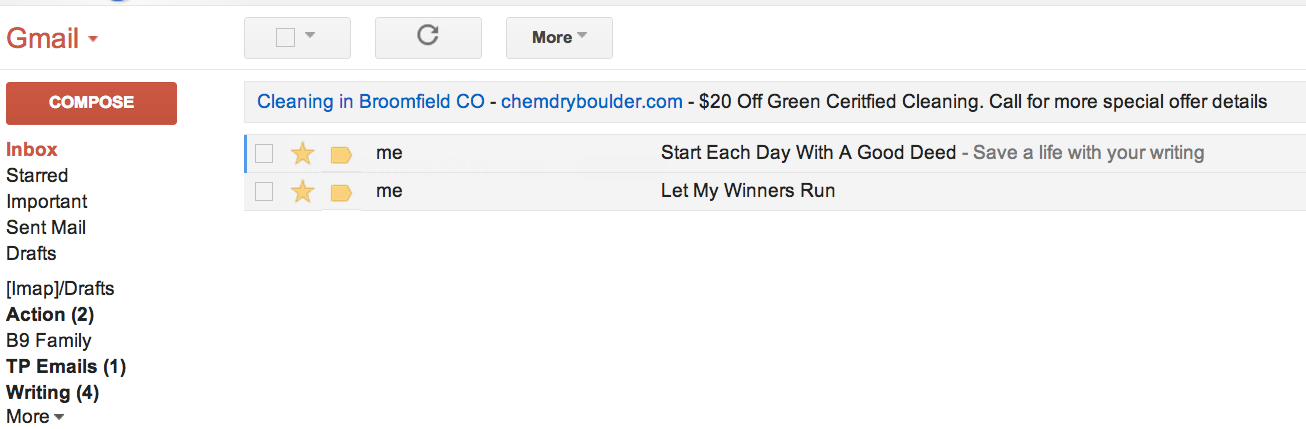
The tip about letting my winners run is so persistent in my investing errors that I’ve sent myself an email that I see every time I log into gmail. The other email is designed to make me a better man.

Inbox Almost Zero

Inbox Almost Zero

Maintain Personal Freedom – Taleb’s style is about freedom. Freedom to do what he wants. Freedom to say what he wants. I get that. I need to be cautious with choices that restrict freedom.

Debt – my family has one loan, a mortgage on a house that I could leave and rent for more than my mortgage/insurance/taxes.

Taleb, and others, challenge conventional wisdom about the use of debt, particularly with regard to College. My wife and I left college debt free and that colors our judgement. Friends of mine, that are doctors, talk about debt-free doctors being able to “do medicine right.” Statements like that, bring home Taleb’s advice to use as little medicine as possible.

Pay For Optionality & Avoid Open Ended Commitments – I’ve made both necessary, and ill-considered, commitments in my life. I pride myself on reliability so feel pain when I’m falling short on a commitment, or need to exit. As a result, I’m willing to pay a premium for flexibility and accept less success to avoid long-term attachment. The pain I feel is an Anglo-Saxon cultural phenomenon, in some Asian cultures, it is expected that relationships will change with circumstances. I smile when I think about Northern Europeans doing business in China and India.

Relationships – Taleb is big on parties, especially ones with lots of different interesting people. My goal at a party, if you can get me to go, is simple. Avoid being the most boring person there! I’m selling myself short. While it would help, the solution isn’t to liven up. The solution is to understand that exposure to many different people is helps create a life with meaning and opportunities to use our skills to help others. Networking is about using volatility to our advantage and the most valuable form of networking is having fun while sharing a mutual interest. I’ll go a far out of my way to share a bike tour with a buddy! I’ve made most of my best friends while exercising!

Insurance & Legal Structuring – insulate yourself from the improbable via insurance and appropriate legal structuring (links to blogs that tell you what I actually do).

Toxic People – have you considered the emotional payoff profile of the people that are close to you? Taleb talks about asymmetric outcomes in the financial sphere but far more common is the downside associated with certain individuals. Some people have a poor payoff profile and others consistently make me feel fantastic.

Think about the people you spend time with – how do they make you feel about yourself? Create space for great people by ditching the toxic folks.

By the way, if you’re truly courageous then think about how you make other people feel about themselves – especially people that have no recourse against you. Too often, I come up short here! When I’m tempted to criticize, I ask myself three questions:

  • What are my goals here?
  • Will criticism serve my goals
  • How am I making this person feel?

Taleb rails against bankers and senior management. Speaking as an insider, he is 100% right about how those sectors operate. The deck is stacked, and will remain stacked, in favor of the insiders.

If you find yourself in senior management, or finance, then think back to what was “enough” when you started.

Too often, the compromises associated with success are the seeds that create Black Swans in our personal lives.

Seventh Generation Thinking

This week’s theme is decisions that benefit our children’s children. Put another way, what are the most important choices I make as a parent, uncle, son, cousin, nephew and grandson.

The books of Hughes, mentioned in Readings To Strengthen Your Family discuss the concept of Seventh Generation Thinking. The idea being to make decisions that benefit citizens (or family members) 140 years down the road. Given that my life takes unexpected turns every decade, thinking 50/100/150 years in the future isn’t meaningful to me. I needed to reframe the question.

Taleb, author of The Black Swan and Antifragile, recommends thinking backwards to gain clarity. So, to learn what might really matter, I ask myself “What choices of my great-grandfather continue to echo in my life?”

The themes that I came up with:

  1. Location, citizenship & community
  2. Agreeing the role of family and renewing that covenant each generation
  3. Creating, and sustaining, traditions
  4. Teaching and facilitating good daily habits
  5. Teaching and facilitating financial wellness
  6. Teaching and facilitating effective interpersonal skills
  7. Initiating family strategic reviews and following up

While I left Canada in 1990, way way back, members of my family made a decision to emigrate and that was a key choice. Likewise, my wife’s parent’s decided to move to Colorado when she was a newborn.

Despite my respect for Canada, and occasional desires to move to Palo Alto, being American and living in Colorado provides my kids with the stability and opportunity for a successful life.

Are we in the right place for my children’s children to have a chance to live the life I wish for myself? Here in Colorado, the answer is yes.

Interestingly, up in Vancouver, my great-grandfather would have answered yes in the 1940s. However, Vancouver grew so fast that the city is a little crowded for me.

Over the last 20 years, the place that most felt like home to me was New Zealand. However, putting 12,000 kilometers between my wife and her family doesn’t make sense. Given that I searched the globe (!), to find the right woman, I should respect her roots.

So the first question to consider is, “Are we where we need to be?”

Living in Asia in my late-20s, I began to suspect that I wasn’t where I needed to be. Eventually, in my early-30s, I left Asia and moved to New Zealand. There I found a home, and people, that suited my values. As fate would have it, I met a wonderful American lady and ended up in Boulder. In my life, it’s been easier to see where I shouldn’t be, than where I should.