Early Retirement – The ratio of spending to security

thanksJustin put me onto Mr Money Mustache’s blog (“MMM”). MMM makes a point that if you have a balance sheet that equals 25x your annual spending then you should be set for life.

What prevents us from getting to the magic ratio?

At my best, I see debt and spending as where to focus.

When I’m feeling sorry for myself, I might blame taxes, lack of income or the cruelty of fate.

Like Mr. MM, I retired early. In fact, I’ve had three retirements – two voluntary and one via the insolvency of my de facto employer.

When I was living first class in my late 20s, I realized that I could slash my spending by 90% and take a year long vacation. This change didn’t get me to the magical 25x ratio but it got me close. I worked part-time (as a coach) and knew that I could tighten my spending and get myself to 40x covered.

Somewhere around 2002, I got caught up in the bull market that ran through to 2008. My spending rose, and rose, and rose, and rose. I didn’t mind as I was making good money. If you’re in a high-paying profession then you’re prone to this risk. I’m not unique. Docs, dentists, lawyers and finance professions often extend their careers by 10-25 years by cranking expenditure and borrowing.

My life came to a head in 2008 when the economy went off a cliff, my income dropped 95% and I had grown accustomed to my spending.

Boy did it hurt to stop spending money.

It hurt because I didn’t see the link between spending and the anxiety that filled my life.

Inside my head, the battle raged…

  • I DESERVE…
  • I HAVE NEEDS…
  • IT”S NOT FAIR…

What I was really saying is, “it hurts so much to change. I just want to be happy, please leave me alone.”

I see plenty of conflict in relationships over money. Historically, much of my irritation over clutter stems from an underlying financial anxiety that I’m not addressing via my own habits.

Quite often the main breadwinner delegates the financial planning function, putting their spouse on an allowance and creating a external target for internal angst.

A couple years ago, I realized that I’d done this to my wife. I had to own my fears, change my spending and redirect our family.

+++

I had the courage to take my first retirement at 31 because I remembered the freedom that came from living like a student.

I forgot that lesson, increased my net worth by 500%, and felt completely insecure at 40.

Every $10,000 of expenditure requires $250,000 of assets to buy me financial peace of mind.

What’s the true cost of your spending?

What could you achieve if you removed unnecessary anxiety from your life?

+++

I have buddies that are planning to work an extra decade – to build assets sufficient to support a spending rate that doesn’t bring happiness and strains their home life. They tell me stories of their children begging them to work less.

The pain is real.

So are the benefits from incremental change.

When 99 is more than 100

As a young man, I spent my 20s focused on taking myself to the limit. In my 30s, I discovered triathlon and shifted my life towards a devotion to personal excellence. In both periods, I was unable to understand why anyone would bother “being average” at anything.

Whether your focus is academics, finance, wealth or sport — if you spend your time in a group that consists of the top 1% then you’ll be at risk for certain errors.

The first error is a skewed definition of “average.”

Athletics is a great field to see this in action as we’re much less likely offend anyone by telling the truth! Here’s a quote from a former coach…

He’s constantly disappointed in himself because he thinks that he should be able to roll out of bed and drop an 8:35 Ironman.

In other words, our friend has a baseline that requires him to outperform 99.99999715% of the planet.

That’s an extreme case but, if you listen to the dialogue surrounding your favorite sports team then, you can see this pattern repeating itself throughout our elite classes.

As an amateur triathlete, I could beat 98.5% of the field at any Ironman race in the world, yet my performance wouldn’t even register for the top 1% of performers, who benchmark themselves on their peers.

My point, isn’t to correct the attitudes of the elites – an extreme way of thinking is useful to drive extreme action.

My point, is to encourage you to stop and ask, “Is It True?”

When your peers lack diversity, your views are at risk from becoming detached from reality. You will see it most easily in your definition of average and decent.

  • What’s a decent athlete?
  • What’s a wealthy family?
  • What’s a successful child?

Outliers living in the 1% are unable to see the extreme nature of their lives and that can lead to ruin.

It’s not just about aging athletes ruining their joints.

I had a very close friend that ended up financially ruined because he was unable to be satisfied with being more wealthy than 98% of his peers.

Others ruin relationships with children, who are unable to measure up to an unreasonable standard.

+++

Another risk – the best are lazy.

Lazy?

  • …but I train 25 hours a week
  • …but I work 65 hours a week
  • …but I read 100 books a year
  • …but I add more value than anyone at this firm

My capacity for extreme workload requires me to drop everything in my life.

In fact, dropping everything is a “secret” of success.

However, it makes me very lazy outside my domain.

As the youngest partner in my private equity firm, I had staff to shop, to sort my CDs, to open my mail, to cook my meals, to take out my trash… the list went on and on. My approach was to throw other people’s time at any issue that prevented me from spending time on my goals.

Ultimately, behaving like a plutocrat wasn’t the main drawback.

By not placing “love” as a primary goal, I created a pattern of behavior that would have driven every relationship from my life.

It wasn’t until 15 years after my divorce that my family received the dividend of a man becoming a little less successful and far less lazy.

Renewing My Vows

ax_leavesHopefully, I’ll be around so my actions teach my children this post before their first kiss.

If not, then I leave it to point them in the right direction. Read it to them annually, at graduations and at their weddings.

++

Have you ever heard couples discussing their wedding vows? Perhaps wondering if they should include “honor and obey” in the words they exchange? That seems silly to me because it overlooks the essential components of EVERY long-term relationship.

What follows is how I try to live my marriage, and through my marriage interact with everybody. It wasn’t always this way – as a young man, my greatest weakness was a lack of compassion and an inability to see the second order consequences of my habit of hurting other people.

What are the most important ways that we honor each other?

First, and most importantly, is a commitment not to hurt other people.

Relationships fail when we get caught in a cycle of keeping score, tit-for-tat and not breaking the chain.

We don’t even need to be in the same room with each other to perpetuate this cycle. When I hear about marriages through third parties, I can feel the pain that the couple is creating for each other.

So I offer: I’ll do my best not to hurt you and ask that you forgive me for the many times that I’ll fall short.

Small children understand forgiveness instinctively. Each morning, I get a fresh start and, hopefully, I see each morning as a chance to get a little better than yesterday.

Now, my children will be like me in many ways. This means that they will arrive at adulthood with habits that will torpedo their relationships if not addressed. The most toxic of these habits is enjoying subtle retribution and justified anger.

So I offer: When I feel pain, I know it will be because I you have touched one of my many limitations. I vow to turn that knowledge inwards and try to make incremental progress.

I’ve been married for close to a decade. By chipping away a little bit each day, I make progress and, together, we strengthen our marriage.

It is my improvement, not my position, that makes me fit for leadership, and shows that I’m worthy of being honored.

Being honored for experience is great but being forgiven is much more valuable than being honored.

In a successful relationship, my errors are forgiven, rather than acting as triggers on top of 5, 10 or 15 years of repressed, mutually reinforced pain.

My dearest, I promise that I can handle the truth.

In life, we are tempted to protect others from the truth. This is a mistake and you will find that your strongest relationships are built on being open. In sharing our individual truths, we can work towards understanding what rings true as a couple.

The wisdom of these lessons becomes clear when you invert them.

Relationship failure is characterized by retribution, blame outside of myself and suppression of truth.

I failed many times before I learned a better way.

In order to shape my reality, I started by accepting it.

Chose wisely.

What To Do, when you don’t know what to do

familyA couple weeks ago, I was flying Southwest and the passenger beside me was a bit unhinged. He didn’t seem dangerous, but kept inserting delusional rants into a well-informed discussion of current events.

The rest of the plane was avoiding eye-contact but, with him on the aisle and me in the middle, I didn’t have anywhere to go!

I figured that I’d put my hospice training to work and see what happened…

Six words that can profoundly change your interactions with the world, and through that, the reality that you experience with your day-to-day living.

When I think about my first response to stress, it’s the opposite of the tenets: I know you’re wrong, I want to flee you and I resist you.

My kids make my instincts obvious to me. If your kids are angels then you might have to look into other areas of your life:

  • A dying parent, or patient
  • A chatty stranger on the bus
  • A fellow citizen on the opposite side of an emotional issue
  • A kid yelling FART at my daughter’s birthday party
  • An angry family member

I get a physical signal, a tightening in my chest, before my mind kicks into high gear. The physical sensation is my chance to save myself from falling into past patterns.

These situations leave me feeling scared and unsure what to do. On the Southwest flight, I had to remind myself that the passenger had to get through security so probably didn’t have a gun, or knife, on him. Yes, I was worried that he was going to kill me!

In turn, my fear leads me to close off, or engage by digging into my existing beliefs. Classic flight or fight.

However, if I’m aware of my fears then, I can pause and try to help the other person. When I do this, I’m helping myself because I escape my cycle of fear/closing and/or fear/engaging.

Bearing witness – one of our deepest needs is to be seen, to be acknowledged. Watching how the rest of the world treats the aged, a difficult child or the crazy guy on the Southwest flight… I see that I can do the entire world (or at least my fellow passengers) a favor by acknowledging my seat mate for a little while.

Not knowing – listening to other people speak, particularly odd-ball cranks, there is another voice in my head. The inner voice is constantly disagreeing, challenging, explaining why the other person is wrong.

When I’m quiet enough to hear the other voice, I see it’s not rational. It takes the opposite side to whatever it’s hearing. Much like the initial reaction of my three-year old son!

In a situation that doesn’t matter (like talking to a stranger), play a game where you “don’t know.” You’ll find that it is relaxing to give yourself permission to not-know. In turn, a habit of not-knowing prevents needless conflict with kids, at work and in your marriage.

The “not knowing” exercise is a neat one because, when you see the power of change in areas that don’t matter, you’ll unlock an insight into how the only thing that matters is the little things!

Compassionate action – in the case of my eccentric seat mate, it was easy to see the best thing for everyone was for me to listen, with a mind that didn’t know. In fact, I’ve been doing more and more listening.

If you think about it then I’ll bet you can come up with situations where you had NO IDEA about the right course of action:

  • Friend with cancer
  • Friend who had parent die
  • Friend who had child die
  • Divorcing couple
  • Friend with child with developmental difficulties
  • Depressed friend
  • Friend with substance abuse issues
  • Bankrupt friend

When you don’t know what to do, I hope you remember Joan’s advice.

As for my pal on Southwest, he thanked me for my kindness and scurried off the plane.

He left me with a warm feeling of a job well done.

Be brave.

Money, Marriage, Kids, Family

Back in July, I caught myself fantasizing about my life in the year 2030, when my youngest graduates from high school.

Longing for a better life in the future is a sure sign that I need to make changes in the present!

My dream, of 2030, was an example of the main excuses that I give myself:

  1. Money – If only I had more…
  2. Marriage – I can’t do that, I’ll damage my…
  3. Kids – The trap of giving to the point of self-neglect and external resentment…

To the list above, I’ll add “Family” – I hear others say that they can’t do XYZ because of family considerations.

While it helps our own happiness to serve another, resentment happens when we feel bound to serve.

I know from my own experience that a resentful grandson, son, father or husband isn’t much help at all. I’m awful to live with when filled with resentment.

My antidote with relationships is straightforward.

  1. Empower each other to say “no”
  2. Always be part of the solution – much better than seeking to be THE solution!
  3. Respect other people and let them solve their own situations
  4. Consider every interaction a gift, rather than an obligation – point #1 is essential for this mindset

Now, with money, the antidote is more complicated. My best advice: start by ditching people, situations and things that makes you feel envy.

Envy distracts me from my true needs.

Recently, I spent six years working myself out of financial squeeze and wanted to share the process. When I’m not sure what to do, I start with a clean sheet of paper.

Blank Sheet Living…

Based on where I am today, where would I like to be in five years and what’s it going to take to get there?

Six years ago, I decided that it was important to reduce my family’s net cost of living. I looked at moving to where I could earn more money (Silicon Valley) and where I could live far more cheaply (Boulder County).

In the end, the US Federal Reserve drove mortgage rates to the point where I moved across town, downsized 50% and achieved my goal.

It took a surprisingly large amount of effort to take the path of least resistance!

So now I’m “there” – I achieved my plan and have the ability to reset my life again.

Additionally, I have a wonderful spouse that empowers me to do ANYTHING.

There is deep wisdom in empowering another to choose to love, and serve, us.

I’ve lost all my excuses.

It can be terrifying to lose my excuses!

+++

Goal: Strategy, Tactics

Serenity: Time Alone, Weekly overnights to the high country to explore in solitude

Connection: More Monsy, Share experiences with my spouse and strengthen my marriage, which is my best asset

Long-term Health: Use My Drive For Fitness, Exercise twice a day, watch the booze and carbs

+++

Serenity, Connection and Long-term Health => What’s Your List?

Micro Courage

axel_lionHow do I cultivate deep strength and resiliency?

We might describe resiliency as…

  • The capacity to continue despite life’s setbacks
  • The ability to become stronger due to stress (anti-fragility)
  • The strength to handle anything

They sound great, grand and completely unattainable!

I’m going to guide you through how I break it down into something that I can action in my daily living.

Start by flipping it on it’s head, what are the characteristics of the not-resilient? Think of the biggest head case you know…

  • Angry
  • Anxious
  • Depressed

When I think about anger and anxiety, they strike me as cultural expressions of fear. At some level, we see angry men and anxious women as normal. I feel both emotions all the time and they make me less effective.

What to do?

Over the last two years, I’ve been experimenting with micro-courage.

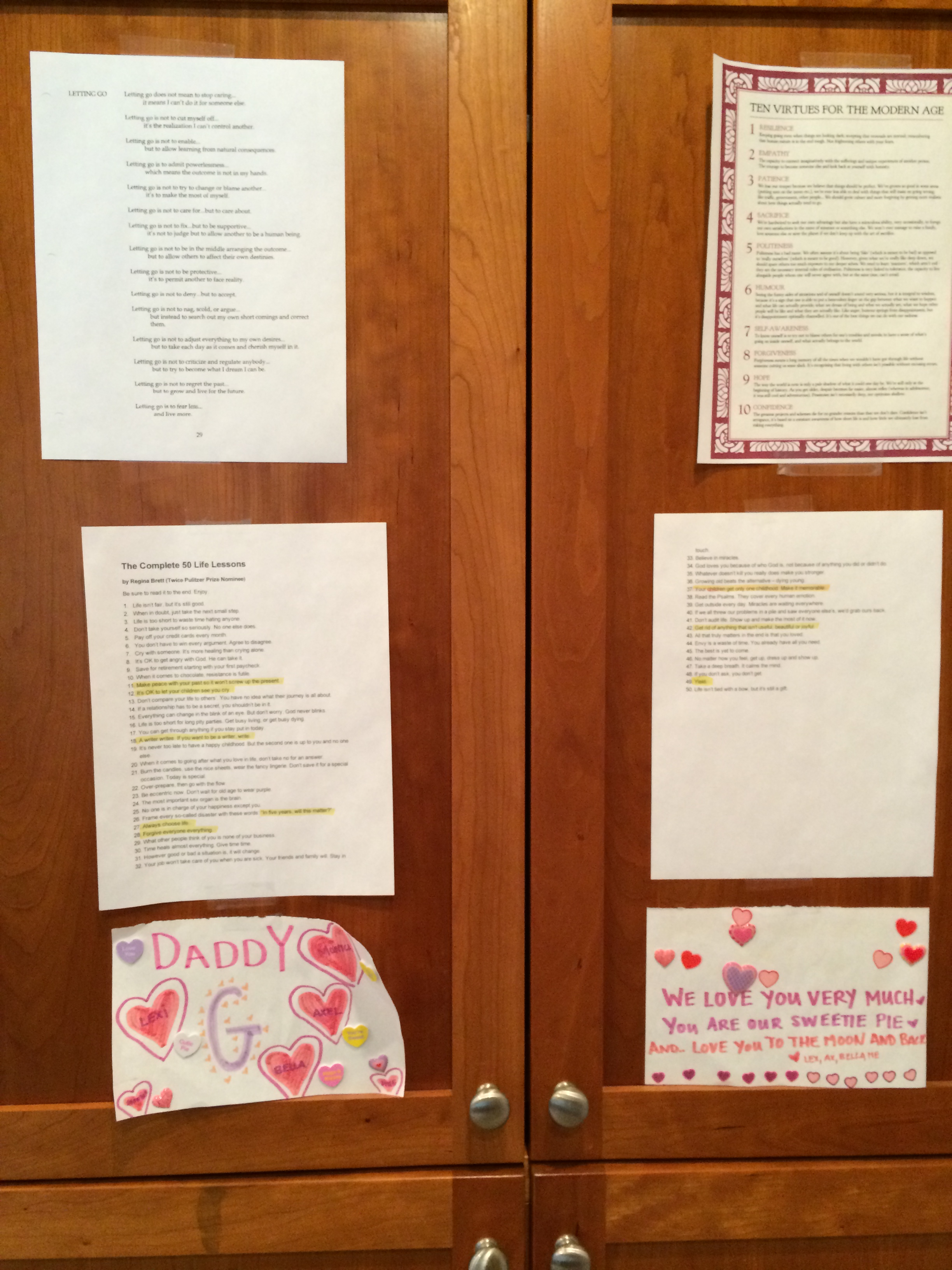
I started by printing up 50 life lessons and highlighting the ones that I wanted to focus on (11, 12, 18, 26, 27, 28, 37, 42, 49). If you come by my office, you’ll see they are taped near my printer…

lifelessonsReflecting on the lessons, I paid particular attention to three:

  • Let your children see you cry
  • Forgive everyone everything
  • Yield

I’d encourage you to find your own (triggers).

The game is to focus your actions on situations at the edge of what you can handle.

Here’s an example:

  • There are lots of homeless folks on the Boulder Creek Bike Path. Some of these folks are violent, others are mentally ill, still others are addicts. As a group, they scare the crap out of me.
  • While I have pals that work with the homeless, I don’t have any clue how to “fix” this problem and often wish the problem would go away (so I don’t have to deal with my inability to deal with it!).
  • Anyhow, there’s one guy that sits by the creek in the 28th St underpass and says good morning to everyone that runs, rides and walks past him. He’s a drinker and can get a little sloppy towards the end of the day.
  • I can’t fix the city’s homeless challenges but I can offer the guy a bit of human connection as I ride by. I look at him, smile and take a breath in. On the face of it, I’m smiling at him but, in reality, I’m staying open to the fear within myself. That’s micro-courage.

The story repeats itself in every part of my life that I want to close off.

I try to “stay open” as many times a day as I can.

The problem can be homelessness, litter, aggression, poor driving, manners, food quality… keep it small, remember to breathe in through your nose with a tiny smile.

Staying open to a small fear, a slight inconvenience, a little bit of sadness… I call it micro-courage.

The habit has been transformative in situations that I used to find overwhelming.

This is what I meant when I wrote that strength comes from staying open to little fears.

Courage is a powerful antidote to fear, anxiety and anger.

Be brave.

The Preschool Years


Lots of my pals have new arrivals so I thought I’d share from my years of living with preschoolers.

Three years ago, I can remember feeling overwhelmed. Our oldest was a terror, we had a new baby and I could see no end to the frantic energy and whining. Today, we’re up to three kids but I can see light at the end of the tunnel.

Where should a new parent focus?

Three things come to mind…

Marriage – it’s easy to lose each other in the craziness of a young family. Make time to be with each other. We try to spend 2-3 evenings with each other each week. Money spent here has the best return on my discretionary spending.


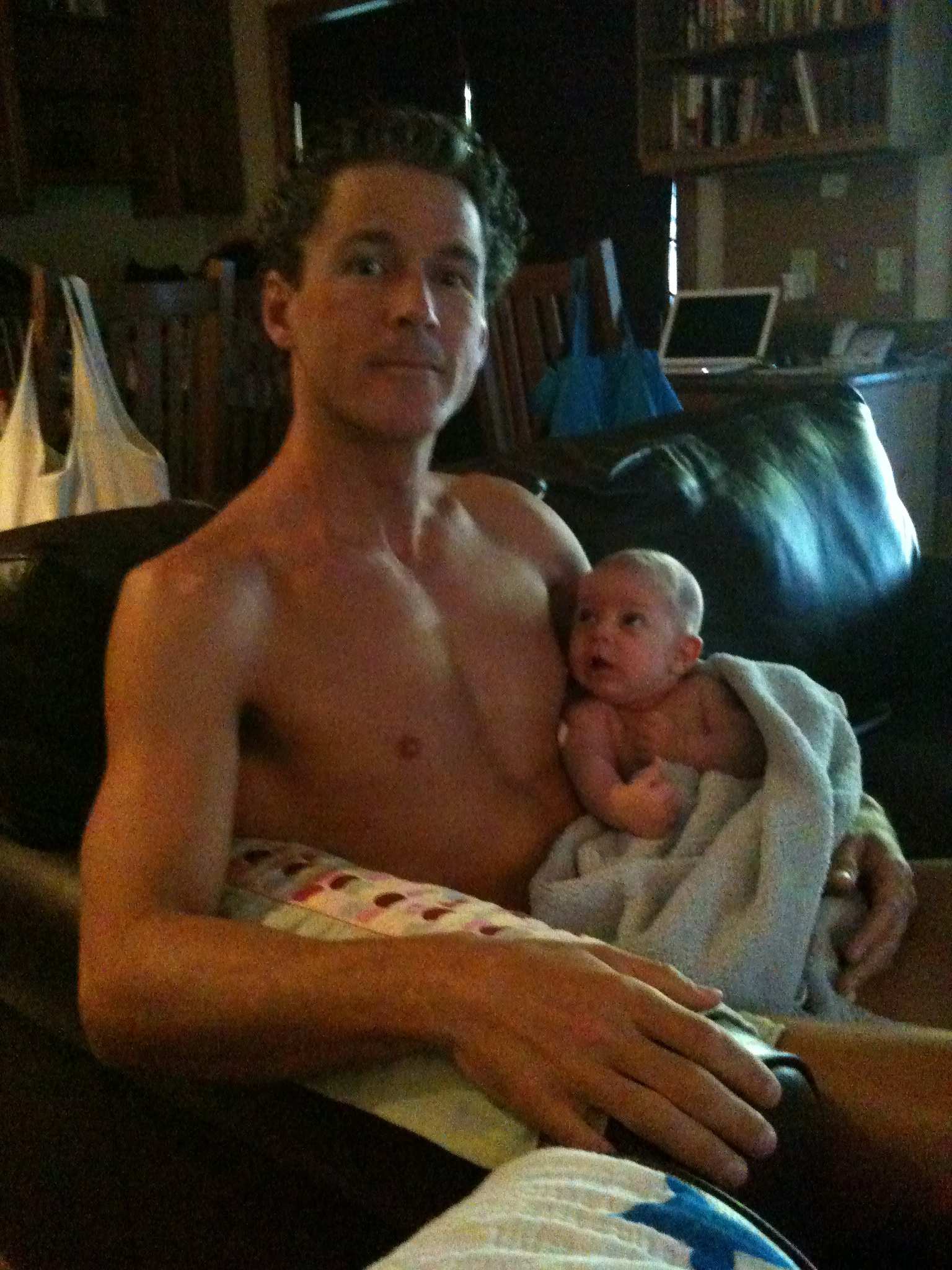
If you look closely, the baby is purple!

De-escalate – At my best, I have the skill to de-escalate my kids by relaxing myself.

How can you train yourself to not escalate when faced with a screaming child? Here’s my practical mindfulness program…

  • Courtesy to people with no recourse against me
  • Yield in traffic
  • Always polite to spouse
  • Pause when you feel anger
  • Train your relaxation reflex – perhaps by taking a big breath occasionally – here’s an app to help you learn to relax

None of the above has anything to do with kids – most of my parenting habits started far away from any toddlers!


Health – While you may, or may not, regret losing your spouse (or temper) through the preschool years, you will absolutely regret losing your health.

My trap is confusing athletic performance with health.

Other traps:

  • Confusing success with my bank balance
  • Measuring how effective I am by what I publish
  • Co-dependence, where I use serving another as an excuse to neglect myself

I share the above because our minds will convince us that there’s always a good short-term reason to ignore our long-term health. I don’t know your reasons but I know we are all prone to rationalizations.

All up, this phase of my life is going to last seven years.

1,000 days to go.

Soon they will be wiping themselves!

Five True Friends

mooseThe Philosopher’s Mail is one of my favorite sites on the web. Happiness is a recurring theme in their writing, as is social connection. As your doctor can confirm, there is a link between social connection and health.

The good people at Philosopher’s Mail shared Epicurus’ recipe for a good life. The link is to a lovely article with snazzy pics of Paris Hilton. The article is worth your time – it describes an antidote if you find that external success fails to lead to lasting satisfaction.

The philosopher’s antidote

  • Five true friends, that reinforce inner values (not the external values of city living)
  • Self-determination by escaping the tyranny of corporate serfdom, regardless of financial cost
  • Daily time for quiet reflection, ideally with low-intensity exercise in nature

It’s an interesting list because most of us will lack one aspect of the troika. In my case, it takes effort to say “yes” to social interaction.

As well, we are usually attracted to people that have external traits that we wish to emulate. This can be a good thing…

  • A politically-connected friend making us feel gratitude that we don’t have the duties that come with being a very important person.
  • A healthy friend inspiring us to start a streak of daily activity.
  • A champion friend inspiring us to persist a little longer at a difficult task.

I have different pals with all of the above and, when I’m at my best, they reinforce good traits in me.

However… I’ve also noticed that my most human, and occasionally screwed up pals, can leave me feeling grateful, useful and valued – three traits that have a strong link to personal happiness.

So while the need for pals is well known, I can lead myself astray. So it’s worth using my daily time to quietly consider…

  • Do I have five people to whom I can speak plainly?
  • Separately, who are the five people with whom I spend the most time?
  • How do those people make me feel?

Once I have insight, it’s up to me to have the courage to change.

Be brave.

Too Painful To Care

Monday I wrote about driving energy inwards to improve myself, my marriage, my family.

Related to this lesson, I’ve noticed a habit of avoiding knowledge that conflicts with my core beliefs. This isn’t anything new – human misjudgment is an ever present topic. However, spotting my own misjudgments can make me far more effective.

Being effective, and making better choices, is a more important to me than avoiding change.

A story.

The Tour de France just finished and I didn’t watch any of it. My lack of motivation was unusual and I wondered why.

The legacy of cheating has been to make it too painful to care. In my case, that manifests in a lack of interest in elite sport. In the case of the wider public, there is an element of truth-fatigue. It’s too painful to discover the reality that underlies an obsession with winning.

I’m using sport as an analogy – it’s an easy one for us to feel, and see in others. Choose your favorite sport and you’ll find a tendency to overlook it’s short-comings. If you can’t see it then ask a foreign friend their thoughts (or simply a pal that likes a rival franchise).

The lesson for daily living is deeper.

  • A friend with Alzheimer’s
  • An elder with dementia
  • A sexually abused child
  • A partner that defrauds the community

In these cases, we will feel a strong urge to “give the benefit of the doubt” to whatever causes the least pain. We will default towards inaction and strongly avoid information that compels us to face pain. I feel avoidance strongly in myself – it’s taken many setbacks for me to overcome.

One of the best lessons of hospice is that freedom lies on the other side of fear. Hospice lets me “be with” my fear of death/disease and feel grateful for today. Gratitude is powerful medicine to carry around inside.

Hospice is “easy” – it’s quiet and I’m not expected to solve anything. My home on the other hand… is often loud and I’m in charge. Maintaining serenity in my own house would be transformative for me, my wife and my kids.

So I look for small, daily, opportunities to practice equanimity:

  • Reading a conflicting viewpoint
  • Avoiding “justified” disappointment in a friend
  • Letting a commute unfold without battling my fellow drivers
  • Not playing into a negative emotional pattern with a spouse, child or myself (!)

Overcoming the smallest things, closest to us, can be powerful.

It takes courage to face pain.

Be brave.

How I Met Your Mother

Gordo and MonicaWhen I lived in Asia, I made some money, had my best friend die and blew up my marriage.

A wise friend observed that it was fortunate that the marriage exploded because I was better off waiting until I was able to offer something to a relationship. My buddy, who would spend the next decade dealing with her breast cancer, captured an essential aspect of successful relationships – that they are best avoided until you are prepared to continually offer yourself.

I look back at my writing from that time and smile at how hostile I was to relationships. Ten weeks before I met my wife, I rode across the United States with a Swedish buddy. He gave comfort that, indeed, there were “at least three women in the world” for me. When I asked, “why three and not one?” He smiled and told me, “the world’s a big place, Gordo.”

Squash Court

[This is the squash court where I met your mother]

In the middle of 2004, I conquered my fears and walked into a room of (mostly) female, triathletes. They were training under the instruction of a six-time world champion, Dave Scott. Dave personifies the old coaching adage “challenge your men and love your ladies.” He didn’t cut me any slack!

It was a complicated situation as my wife-to-be was going out with my landlord’s brother and neither of us were aware that we should be together. I played a long game, got her out of the country and we were engaged before she returned to Boulder.

Nelson, NZ in 2005

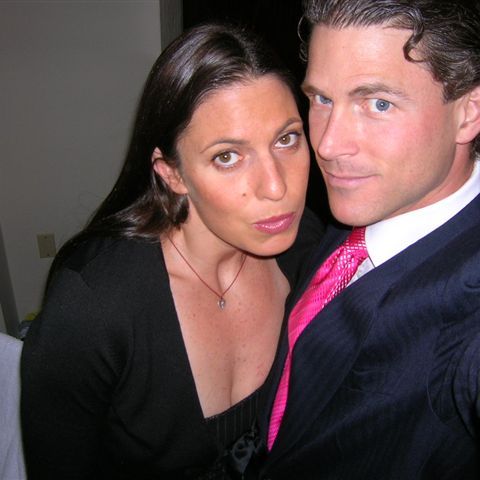
[Here’s your mother as a young woman in New Zealand. She was working as my extra-special soigneur at a stage race.]

We were lucky. We grew into each other.

+++

The journey that led to a wonderful life partner began years before I met Monica. I started by cultivating independent self-love, which sounds like something you’d hear in yoga class.

In the language of business…

To do a good deal, you have to be willing to do no deal, a fundamental component of success.

Divorce caused me enough pain to make me hostile to any form of intimacy. First a childhood divorce, then my own as an adult. There were deep feelings of failure associated with marriage. I had not learned how to strengthen a marriage and was preoccupied with the illusion of failure.

After my divorce, I made myself a better person. This was not my goal. Becoming a better person happened because I stopped living the values of other people – back then I was misled by money and assets. Later I was misled by victory and vanity. At the end, I hope to end up with kindness, good humor and service!

My introversion, and pride, fed a desire to prove that I could be happy alone. Truth be told, I was never alone – I wrote frequently and had two very close friendships. One of these was with Scott Molina and he joked that I had ’embarked on the longest dry streak known to man.’ Scott’s observation still makes me smile!

To make myself relationship worthy, I needed to create a life where I was happy without an intimate relationship. In order to have something to give, I needed to develop a source of energy outside of the relationship. I found my source in athletics and nature.

The great spiritual traditions write about love being the source. I have a long way to go there. My love for my children is a sign explaining that everything I need is within myself.

As an introvert, the teaching that I’m my own source feels natural because I’m happy when I’m alone. However, I need to be careful that I’m not alone too much. First, because there is a deep human need for intimacy. Second, because a life with meaning requires us to do good work in the world.

After five years of working on myself, I met my wife. In Monica, I discovered that I enjoyed spending time with her more than I enjoyed being alone. I’m not sure if that will make sense to an extroverted reader, who might find solitude draining. However, for the sociopathic hermit in me, it was a revelation.

To create an intention for success, I tell my wife, frequently:

  • There’s no way I am going to improve my situation through any pathway other than our marriage.
  • I’m grateful for all you do – family life is a challenge but I know that family life alone would be far, far more challenging.
  • While I accept that it only takes one person to crater a relationship, I will never speak about failure on my side. If we hit hard times then I’ll stay close and wait for you to come to your senses.
  • I hold the trust between us as sacred.

All thoughts to the contrary, of what I state above, are a sign of temporary insanity!

Ironman New Zealand 2004

[As a couple, Ironman New Zealand 2004 was our best ever. Your mother swam 2.4 miles in 46 minutes and finished 2nd overall. Living in love makes you powerful!]

Today is the 10th anniversary of the day I met your mother and I’m so grateful.

Love you, Babe!