My wife and I went skiing for a couple days. Our youngest missed her mom. So… she wrapped her stuffy in my wife’s robe! Insta-mommy.
I watch where people send their kids to school. It’s a revealed preference for their values. Amongst my pals, Boulder is one of the few locations were public schools are the default choice.
One of the challenges our district faces is declining kindergarten enrollment – we don’t have a good idea “why.” Some things I’ve noticed with the families that have gone private:
Private school is contagious, by neighborhood, by family and by peer group. It would be great to get those families back into the district. I’m not sure we’ve asked them what it might take.
As elementary school enrollments shrink, the impact of a single weak teacher increases. How we support weak teachers is not clear to me.
Having switched one of our kids to a full-enrollment, school… there is a quality of experience issue with the schools that aren’t full. The overall experience at a “full” school is better.
Thinking about the phases of our kids’ education…
New Parents: The #1 thing we got right, eventually… Listen to professional educators. My default position is seeking to understand why staff’s view makes sense. Take time in forming opinions.
Age 2 to 6 => choose your daycare/preschool/early education based on where the child will get the best socialization skills. This is particularly important if you have a high-energy kid. Early socialization trumps preschool “academics.” All three of my kids started Grade One at the bottom of the class, all three caught up in 18 months.
Parents: model the socialization techniques the kids are learning at preschool. Learn from the teachers so the child is in a consistent environment at school, and at home.
Remember during this phase… the most important money you spend is childcare that benefits your marriage. You are under more stress than you realize – make time for each other.
Age 6 to 8 => a daily focus on learn-to-read and learn-to-learn. Learn-to-learn is building on the early socialization work that happened before they arrived in Grade One.
Parents: 20-minutes a day (read-to, read-aloud) in this phase has the highest return in your kids’ education career.
No joke!
10 minutes before school (read-together). 10 minutes before bed (read-to). HUGE.
The confidence boost from being able to read provides a positive association with learning. INVERT: smart kids (who can’t read) will wonder if they are stupid.
=>100 hours per year time investment. The highest return parenting time you will ever have.
PS => the read-together before school, should morph into read-to-self each morning. I used a summer reading prize (100 mornings = $100) to establish this habit.
Age 9 to 12 => Our theme here: don’t mess with the streak!
Siblings, routine and habit form a virtuous circle of positive reinforcement.
“Read to self” every morning, summer reading prizes, consistent bedtimes, 2-3 different after school activities, consistent weekly schedules. This phase is about locking in a routine and keeping it rolling.
Be the brand.
If you’re not then they’re going to call you on it. 🙂
My expectation on the kids is “perform at grade level.” This lets them take all the credit for above-average performances.
Other thoughts
Earned Enrichment: there’s a joke that every parent thinks their two-year old is gifted. This is funny because it’s true.
In order to keep as many families in the public channel as possible… make it clear that all kids who want to accelerate their learning will be supported. Fairness of opportunity for all kids.
Related: make it clear that teachers will be supported. I’ve watched two weak teachers cause a (very polite) gradual exodus from a wonderful neighborhood school.
Some stories:
My son wants to take combined Grade 7/8 math next year. We have a simple policy, if you want to accelerate then you need an “A” in current year math. You need… A’s to Accelerate.
Seeing her older siblings ahead… our youngest wants to get ahead in math. At the start of each academic year, she gets a chance to test out. Once that test is done, we won’t intervene on the kid’s behalf. You gotta earn it, yourself. She’s been trying for two years and has a good shot next September!
Overall, I’m in no rush for the kids to accelerate their learning. Just like their sport, they have 10-20 years (!!!) of formal education ahead of them. The heavy lifting will come when I’m out of the picture and must be internally motivated. Our job is to set the schedule and not screw it up!
Same deal with sport. If school work falls apart then we will be dialing down the training load. You need to earn the right for extra training.
Fair doesn’t mean equal. My kids are always comparing who-gets-what. My focus is on supporting them, fairly, to get whatever outcome they can achieve on their own merits.
I was very unequal when they were young. In any given year, I over-allocated toward the kid who needed an early intervention of my time. I think school districts should do the same – prioritize early interventions across all demographics.
Finally, schedule time to focus on your stars. It is very easy to get wrapped up in problems.
1// One-on-one trips/special events in your best environment.
2// Acknowledge that successful parenting means getting out of their way — building their ability to live in the world — letting them go.
3// ABC => Always build confidence, or competence… depends on the situation!
INVERT: don’t crush their confidence when they are small.
The confidence point is a big one. Bad habitsdon’t take your family where you want to go.
That last point is a good one => take time to ask around…
Where do we want to go?
All too easy for strivers to keep striving, across generations.
Everyone completed the “summer” reading challenge! Across the time period, our oldest became a teenager. I’m probably done trying to “push” her at anything. Although, there has been discussion of a cash prize for getting to know the local transit system via 100 bus rides to middle school. 🙂
Like all my stuff => this is not advice to your family. Speak with local experts before making tax, legal and portfolio changes in your life.
Iñaki asked, “what to do when the world seems crazy?”
I build my life so I don’t need to be right.
Related, I want to be able to unplug for 72 hours, without worry, whenever I feel like it.
This strategy is based on knowing that I’m prone to error and don’t want to spend my life connected to the matrix.
Further, even if you have 100% confidence in yourself, your kids/spouse are going to need something robust for when you’re gone.
Across 2019, I wanted to lean into equities but there wasn’t an event that gave me an opportunity. So I rolled along, rebalancing and living my life.
In March 2020, the pandemic created an opportunity. Personally, I leaned in (fairly hard) by increasing %age exposure to equities, at a time when rebalancing alone would have triggered buying.
In a fiduciary capacity, we only leaned a little. Two members of my investment committee, with wider views of the world, advised caution. Using the principle, most conservative view rules, we were conservative with allocation.
Both decisions made sense at the time and worked out.
Time matters. “Good enough” becomes more powerful the longer your time horizon.
Returns across generations are driven by a famous Munger-ism => “just try not to be stupid.”
The family’s position, 10 years past every generational transition, is impacted more by what you burned than what you earned.
At the end of 2021, given the whacky stuff I’m seeing around me, I don’t plan in leaning in at the next correction. Rebalancing will be good enough.
Recreational Capital and Associated Spending
A dominant focus on return/allocation in your financial portfolio, misses an important source of value creation => efficient use of “recreational” capital, and associated spending.
Recreational capital is any asset that’s held for non-financial reasons. This is a material slice of many balance sheets:
Boats, RVs, Cars
Offices
Second homes, vacation properties
Sizing up personal residences
Renovation projects, furniture, collectibles and art
Charters, vacation spending, travel spending
Any asset with a negative yield
You’ll see I included a line for the expenses associated with those assets. Some assets, when bought, lead to more spending.
By way of example, INVERT and consider…
When you sell all your assets in a remote location then… the spending associated with the location will plummet. Now that we spend our summers “at home” vs commuting to/from Canada, we cut spending by a big number.
Even if you don’t buy… for skiing, we stopped renting a condo in Vail. Our 2021 ski season cost will be less than what my last rental cost me. Skiing is a choice with a stack of associated spending, and negative-return investment opportunities.
It would be nice to think that these decisions were driven by being smart. That would be a mistake! The Canadian exit was driving by local tax policy and COVID forced a change in approach for skiing.
We did not realize the true cost of our “recreational” choices. We had to remove them, and watch for a couple years.
The choices above:
Create a larger working portfolio
Reduce annual spending
Increase the flexibility to change one’s mind
Don’t involve admin, maintenance or exit costs
In our financial portfolio, conservative nature means we “missed out” on much of the run up. However, because we adjusted our recreational capital, and associated spending, we greatly increased wealth over the last five years.
The wealth gain, from shrinking the recreational portfolio, is locked in. These gains are hidden from conventional metrics, that your advisor might show you.
Now we move along to KC’s questions
GB: total debt will remain modest relative to assets and cash flow
KC: How do you define “assets” and “cash flow” here? Completely paid off asset or total value of asset? All assets – or just the assets on the investment side (excluding primary home?) Cash flow from all sources after expenses? What do you define as a modest target?
I have a spreadsheet that shows me… gross asset value, deferred taxes, tax basis (as at last tax filing year) and deferred agent’s fees (for real estate). So I can quickly look at real estate from gross to net after-tax realizable value. I compare those figures to gross rental income, and net cash flow (from my tax return).
I’m conservative with gross asset value on real estate, a discount from Zillow and my real estate agent’s estimate on value.
I assume 6.3% cost to exit, from real estate gross value, then tax the realized value at 25% of the gain over basis.
++
Cash Flow
I look at… total debt service, core cost of living, total cost of living => each of those numbers gets a little bigger, and I have less control over delaying payment/spending.
Then I look at the inflows by source…
real estate (net and gross — consider vacancy risk)
employment (by role and client — consider concentration)
passive (royalties, dividends, distributed gains)
I want to understand my concentration in expenses (what I can cut/control) as well as income (where the risks lie). I never want to be placed in a position of being a forced seller.
My total family debt stays under 10% of net assets. Assets calculated net of all taxes and agent’s fees.
++
The Role of Time
My thinking in my work, and family, is multigenerational… I look at assets, leverage, cash flow and spending at many levels…
What I actually own, owe, control, earn => me
Family level
Family & Corporate level => me, my family, my business
Multi-generational level => consolidated, over time
I think about expenses, earning power, saving power, asset utility (what benefits members) over time. I have a spreadsheet that projects the age of all living family members over time (2021, 2035, 2050). This helps me consider family asset strategy and consider when generational transitions are going to occur.
KEY for assets and cash flow => When generations stop working/saving, when kids start working/saving?
It’s not just “what you own.” It’s also when you own it, and when you sell it.
I see many people buying assets they will HAVE to sell in ten years time, mainly real estate. Now, if it’s your main home, then I get it. See below for the option value in the mortgage.
In this market, Boulder up 30% this year, it’s easy to convince yourself that you are silly not to supersize your balance sheet.
But if it’s a secondary market…
10% in/out cost for the real estate
vs…
Less than 1% cost to go variable (AirBnB, Hotels.Com)
Total flexibility with capital (you don’t deploy into a low-occupancy, negative yielding asset)
No admin hassle (I really dislike organizing maintenance and cleaning)
Why are you doing it?
If you want to dazzle peers, suppliers and key relationships… …then you might be better off with a high-end club membership.
Your mind may try to convince you the joining fee is a waste of money. Note that the club joining fee is usually < 5% of a condo cost, and club dues run <10% of the condo’s cost to own.
With leasing we compare to “do nothing” => most people with ready finance will “do something.” If you’re going to do something, regardless, then something smaller can be a better option.
Your mind doesn’t see the rest of your portfolio performing better, with less hassle, by not owning an asset that’s a drag on return.
And… my mind at least, doesn’t remember how much I hate cleaning and dealing with remote maintenance issues!
KC: Tax bill as a %age of net assets-Where do you think a healthy range should be?
Every year, I look at the tax bill relative to net assets on a consolidated basis. This lets you consider the impact of tax policy on your portfolio – smart savers free themselves from exposure to changes in tax policy. Taxes paid, as a percentage of net assets, should trend downwards over your working life.
I don’t think the taxes vs net assets number, itself, is important. What matters is trending down and asking yourself if you are worrying about the right things in your life. Lots of (wealthy) people fail to recognize how little impact the Feds have in their financial life. Others could use a nudge to save more, spend wisely.
GB: At that point, you’ll have built yourself an inflation-proof, tax-effective retirement annuity
KC: Can you help me understand the inflation-poof aspect of this strategy? Is it the income producing asset that is locked in at an low interest rate? How is RE more inflation-proof than other assets?
Real estate isn’t “more” but it can be “different”.
Local rents are influenced by local real economic growth. I like the prospects of Boulder, the Front Range and Colorado.
Local real estate values are influenced by macro (national interest rates, credit cycle) and local (replacement cost, demand) factors.
So a slice of local real estate can create an element of hedging between national, regional and local conditions. There are some other benefits…
++
Hidden Options
Here in Boulder, Colorado, I believe our real estate values have a hidden option. There is a chance the best neighborhoods explode upwards towards the highest valued parts of: the Rockies (Vail/Aspen), California (Bay Area) or NYC.
Now, I don’t have the $$$s to own trophy properties, but I don’t need to. As I wrote in The Next Doubling, it’s good enough to be nearby. For the option to pay out, we don’t need to get to the highest prices per sf => we merely need to close the gap, a bit, over time. That sort of option doesn’t exist in an index fund.
Another hidden option => we own a two-unit rental. We always have the option to move into one of the units and “live for free” by renting out the other unit.
++
Option Value of Fixed Rate Debt
30-year fixed rate debt, with an option for the borrower to repay, is a valuable (oneway) option in an uncertain world. Unlike margin debt, the lender can’t call the loan on a whim.
Long rates have been declining for 40 years, so the value of this option is overlooked by many. In an inflationary environment, having a multiple of my core cost of living in low-cost fixed rate debt is a useful position.
A mortgage on a personal residence seems like a good deal to me……and if it turns out to be a bad deal then I exit via repayment or refinance.
++
Saving 2% p.a. and giving Goldman an option to close you out…
Quick note on margin debt, even at <1% p.a. cost, seems like a very bad idea.
Smart people borrowing money they don’t need, to make money they are unlikely to spend in their lifetimes. Everyone figuring they will be able to unwind their financial structure before anything bad happens to them.
This strategy never ends well and only makes sense when you are playing with other people’s money.
A general principle, some things only make sense when you ignore the rebound. Fasting, margin debt, intensity-bias for endurance sport… I have found one gets a better long-term result from building smarter habits.
++
Optimize over time. When I started paying attention to myself, I realized I needed a whole lot less spending, which implied less capital, which gave me much more time.
INVERT that last sentence => spending you don’t need, increases the capital you think you need, to spend more time doing what you want. I broke that cycle in 2000, got wrapped back up in it in 2005, got tossed back out during the 2008/2009 recession and, these days, cycle in/out depending on my moods!
Nearing 53, I laugh because “less” is being forced on my physical life, by time.
In my early 40s, “less” happened due to kids and a nasty recession.
In my early 30s, “less” felt liberating, and made time for a lot more self-directed time.
Needles District, Canyonlands NP. If you get to Moab then do yourself a favor and spend a night under the stars (with the moon down). This pic was taken hiking back from the Confluence Overlook, 10-year bucket list destination for me. A sustainable way to enjoy longer workouts is to slow down => 10 miles in 4 hours.
I had a post queued up for Monday but it was about trust law and a bit dry!
I’ll re-work it and release it at the end of the year. A low traffic period of time.
++
Last week, I finished a book called Wanting. An easy read, filled with short anecdotes, about desire.
Having spent my life in the business of money, I know about conventional desire. My time in athletics exposed me to another aspect, Victory & Vanity.
Greed comes in many shapes and forms. As I age, one form I contend with is wanting to get back to the past – a past remembered as better, stronger, more vigorous… this longing doesn’t serve me well.
For example, a longing for vigor can cause me to do too much exercise, thereby assuring exhaustion (ie a lack of vigor)!
The Wanting book was a guided personal review => considering the source of, and the likely results of, my desires.
++
A Simple Case Study – the source of desires
A decade ago, shortly after visiting Aspen, I found myself wanting to buy a Range Rover. This desire appeared to “come out of nowhere”, but it didn’t really.
I’d been in Aspen for a training camp with three guys in my age group. Let’s call them the Three Amigos. I had visited their houses, been driven around in their cars (Range Rovers) and elevated my heart rate with some very competitive swim/bike/run.
The Three Amigos were people in whom I was able to see different aspects of myself. In many dimensions they were more than myself. With my heart rate up, this is a very powerful modeling situation – both consciously and unconsciously.
The Range Rover desire was the first thing I noticed. There was more.
Here’s the tip: I tend to notice my material desires before the deeper stuff.
When I notice that I’m wanting to buy the same socks as a buddy (Doc J you have a pair of very nice purple socks BTW)… pause and consider.
When I notice the mimetic transfer of a material desire (socks, car) then I pause and consider what else I might be sucking up from this person. Because I know it’s happening strongly in my unconscious.
++
Thinking about an earlier draft of this post. I realized that the influence of my friends runs far deeper… watch, skis, bike, entree selection, career nudging for my children… my desires are influenced, to a point of external unconscious control, by my mentors (nears and peers).
Choose (very) wisely!
++
The day after Canyonlands was a ride in the Colorado National Monument. ~30 miles, 2,500 of climbing. Real training, not in my basement!
Risk of Ruin in Close Peers
Here’s a tip about ruin => in a group of peers, the group will tend towards the risk-seeking level of its most risk-seeking member.
We drift upwards, until something goes wrong, then we blame the situation.
Smart systems avoid catastrophe – here’s a simple one, teams of three, most conservative opinion binds the group. I use this in the mountains, and on my investment committee.
Life is a game over time.
++
Anti-Desires
The power of desire works in reverse => consider people (and their specific choices) who repulse you.
The book asks the reader to consider, “Who are you not rooting for?”
It helps to be brutally honest. Owning my greed is easier than acknowledging secret envy!
It took a couple weeks (and 48 hours off my screens in Utah) to dig into my hidden desires. Part of the Wanting discussion centers around “thick” and “thin” desires.
Let’s start with a “thick” desire => do right by my kids. Where’s that going to lead us? A series of strong downstream families that endure beyond my life.
When I see someone crushing the family-side of their life, I’m happy for them => alignment with my thick values.
Compare to “thin” desires => the Range Rover, a fancy ski jacket, etc… Thin, material desires are relatively easy to spot.
Envy is less easy to spot. Disgust, however, is easy to feel => there’s the feeling again… let me consider it.
++
A story.
My kids are doing great in all domains – school, sport and social. Notwithstanding this reality, I often hear a voice in my head saying…
You could be so much more…
Funny though, the voice predates my child! It’s a voice that’s been following me around for many years.
But what does this voice want?
Fame, likes, the approval of strangers!
If you repulse me then you likely have these things, all of which I secretly want… 😮
Thin, hollow desire that, most importantly, can NEVER be satisfied.
When I started publishing, I had a desire to help 1,000 people. I wrote it down as part of The Artist’s Way, bought in July 2000. Having far exceeded my goal, you’d think the desire would wane.
My desire for recognition, when fed, only grows stronger!
I see hidden desire through my anti-desires, my envy of others. What am I thinking about when I feel disgust? How might I deal with those feelings of envy?
Don’t water the seeds of envy. Simple, not easy.
Let’s get into tactics I’ve been experimenting with…
#1 – get myself to play a different game by competing in a different environment. This started in 2000. To get myself to step outside my innate monetary greed, I had to leave my daily exposure to high finance. To think clearly, I need to power down my phone and lock it in my car for a couple days.
Reduce my drive for material consumption and constant external approval… Axing Facebook/Instagram was a huge win for me. Not easy. Like stopping drinking, what am I supposed to do with all this extra time?
Not racing => the removal of a constant incentive for “more” in my physical life. Signing up for a race is a step towards fatigue. Fatigue that works against my thick desires.
On the screen you are reading this post on… who is on my screen most often? who’s like me, but more? who’s triggering my disgust?
++
Write it down
Several times in my life, I’ve had a moment of clarity. A moment where I realized my thin desires were carrying me towards an outcome I didn’t want.
The moments are fleeting, so I write them down: the change and why I need to make it. Often, I try the change for 30-days and pay attention to how I feel.
The path forward is not always clear. I know people, who have a deep feeling “this isn’t it” and want to make a change. Other internal voices might be, “you gotta get out of here” or “this isn’t me.”
Write down what your hear.
Or maybe you wake up and realize your choices are destroying your health. In the early 1990s, I got kind of fat and didn’t like it. When I’m tempted to deviate from my system of healthy eating/exercise, I remind myself just how much I didn’t enjoy being chubby!
If you’re anything like me then your thin desires will persist and keep trying to lead you astray. The stronger they get, the more I need to slow down, reduce stress and consider where I want my choices to take me.
Strong downstream families enduring beyond my lifetime.
It simply isn’t possible to see both (a) what the future could be; and (b) the drag of accepting the way things are.
Over Thanksgiving my kids reminded me of this fact. They were amazing.
After a decade of fatherhood, they chilled the entire flight, enjoying each other.
Bickering
Earlier in the year, I told them that I was done spending time with all three. No “full family” trips.
I stuck to my guns. When it came to kids, I was 1s and 2s across the year. Much less refereeing between them.
But they missed hanging out with each other so they started a get-along campaign.
See Dad, we get along now.
Reminded me of another favorite lesson => to be sick of sickness is the only cure.
The part of me that likes to say “no” was a little sad at their improvement. Strange thing human nature!
I share the story as a holiday reminder that parents have a choice with regard to the status quo. It does take a lot of patience, skill and persistence to help everyone get along with each other.
While I can’t control the actions of others, as a parent, I can influence the incentive structure.
Even getting the incentives correct, change was slow and took many months, to become obvious.
Personal Recovery
Another thing that’s been frustrating is my lack of recovery. In my 50s, I simply do not bounce back from anything very well.
I’ve noticed that the days with “more” cardio are a whole lot easier for my mental health. So, with an eye towards “better”, I got myself an Oura ring to gain insight into resting HR, HRV and sleep quality.
This process was another reminder… Two things are necessary for progress: (a) make mistakes visible; and (b) have the courage to see, then address, uncomfortable truths.
You see, I bought the ring so it could tell me what I wanted to hear!
Unfortunately, the data has had other ideas. It’s early days, so I’ll skip the specifics until I’ve gone a full season.
Suffice to say, the message appears to be that my appetite is greater than my tolerance. The only way I’m going to fit in “more” is to go a whole lot easier (most of the time). This reminds me of an observation I shared with KP (when he was my age).
I used to do a lot more easy training than I remember.
He liked that quote so much, he hung it above his desk. As I near 53, I’m glad the memory came back to me.
Anybody over 50 who says “age is just a number” isn’t paying attention, or may be trying to sell you something. 🙂
A recurring theme across my fatherhood journey… remembering it is OK to be sensible.
Anaerobic Tolerance
Another observation, this one physiological, each time I give myself a novel anaerobic stimuli, it kicks my butt for at least a month.
The first month of something new kicks my butt. Being wrecked is obvious to me. Thereafter, the fatigue gets more subtle.
Mark Allen quote… just because you feel better, doesn’t mean you are better. At the time we were talking about over-reaching but it applies more broadly.
In other words, adaptations are continuing even when I can’t “feel” them.
A well worn race shirt
The shirt pictured above is from the last time I was “fast” in a conventional sense, August 2012. We had a 3 year old, a baby and my wife was 8-months pregnant with our youngest.
Shortly thereafter, I decided to pause the racing. That one choice started a positive cascade of consequences that continue to benefit my family.
The “pausing” racing choice was a big one to make. I had a lot of my identity tied up in my relative performance.
I also had a mistaken belief that the process of race preparation was essential to look good. As I age, I’m bumping into the same fear.
Just like with my household, changing the incentives can lead to better.
We are living through boom times in our local real estate market. Houses are selling quickly, at the equivalent of 50-100x annual rent.
Everything, other than debt pricing, looks expensive to me. So… I’m looking to move, borrow and increase the assets in my portfolio that generate cash flow.
A simple way to view this… (a) split the equity in your existing house in two parts; (b) borrow 30-year fixed and buy a new place with one part of the equity; and (c) place the other part into a rental property.
The explanation follows, with a 25-year overview at the end.
In 2010, I purchased two rental properties as a hedge. Specifically, I wanted to hedge against the risk of my family being priced out of our home market. I thought I was protecting my kids. Turns out I was protecting myself.
The idea was to get paid (via rental income) to hold: 3 units, 10 bedrooms and 20,000 sf of Boulder land. The locations were excellent, the properties dated.
The 2010 purchases worked out well, not just because they performed. The purchases put significant cash pressure on me. The pressure improved my spending choices and motivated me to sort a business which was hemorrhaging cash. In a sense, having tight cash was a form of forced savings.
In 2013, we downsized, borrowed and moved across town. By staying in the same type of neighborhood, and borrowing modestly, our equity appreciation in the smaller house ended up the same as what we would have earned in the larger, unleveraged house.
My ego likes headline numbers and struggles to accept this reality. Something about real estate => the gross, headline numbers are more emotionally salient than the net cash flow reality.
Once again, I’d like to free up time, and reduce admin, by moving. The price I’m going to pay is time/hassle from the move, bringing some deferred taxes forward and agent’s fees.
With the run up in asset values (2015-2021), my family has a much larger allocation to “dead assets.” Dead assets are assets that cost money to hold => for many readers, this is the house they live in. Given recent capital appreciation, the cash cost to hold has been ignored by many.
Downsizing, and locking in 30-year fixed debt for a portion of the new purchase, enables me to keep the amount of “dead assets” modest within the family portfolio.
My ego is tempted to size up, and add a ski place. The better financial move is to improve the quality of our rental portfolio, while reducing my housework and driving.
30-year fixed debt on the family home is one of the best deals going. Given the borrower’s option to repay, it’s a one-way option that could be worth big $$$ in the future.
A word to the leveraged.
Now, like 2005-2007, is a great time to be heavily indebted. You will take comfort in your ability to unwind any financial difficulties.
You are correct.
However, if you truly “need” to unwind financial positions then we are likely in a market like 2009, unpleasant.
So be cautious with opting-in to risks that don’t add to your long-term strategy. Most particularly, any arrangement where an outside party has the power to force a sale. While I am seeking to borrow, total debt will remain modest relative to assets and cash flow.
Breaking it down, building wealth across decades.
Resist the urge to up-size your life, particularly by adding negative yielding assets.
Rather, seek to build up 2-4 rental units. Pay attention to location, lot size and bedrooms.
Unless you want to get into the hotel management business, rent unfurnished to long term tenants. Inverting I have learned… furnished, short-term rentals bleed expenses, emotion and time.
For your long-term rentals, use a local property manager – their cost as a %age of capital value will be tiny compared to the value they add, and the hassle you avoid. This frees time to make money in a field where you have an edge => whatever you were doing when you built up the $$$ to purchase rental properties. Side Note on taxes: tax bill as a %age of net assets is a number you should track.
Use your personal home for shelter, as an entry in the best public schools in your state, as a cheap source of fixed rate debt and a tax-favored investment. If this asset appreciates to the point where you have “too much” invested in non-yielding real estate then downsize, get a new mortgage and repeat the cycle.
Aside from the roof and HVAC… spend no material capital on any of your properties. Instead, spend time with the people you love (and buy more assets that generate cash flow).
If you start the above when you get married then you’ll have 1-3 moves by the time you are empty nesters. At that point, you’ll have built yourself an inflation-proof, tax-effective retirement annuity. You can constrain your spending and pass it to your grown kids OR run down the assets as you see fit.
That’s the financial overlay. You also have the ability to use trust structures within this strategy. I’ll get to those in a future post. Put simply, when I say “you” it’s possible to put a trust in “your” place. That can protect your assets from the unexpected which, over a 25 year time horizon, is nearly certain to happen.
Ideally, you graduated debt-free from college and made a habit of maximizing your retirement contributions in the first 10 years of your career. Don’t be in a rush to get into real estate, I’d been working/saving for a decade before I had the capital, and geographic stability, for a purchase to make sense. While a favorite form of security for lenders, real estate is chunky, a pain to manage and expensive to sell.
The 50m pool at Coronado – not a hardship posting! First person who took me here was Coach KP, 20-ish years ago. The Big Dog is always with me. Love you, buddy.
I flew out to San Diego to have a chat with a friend.
I had a hunch he’d come up with something and he delivered via a well-timed question.
What would that look like?
At the time, I was stuck talking about everything other than what I was going to do about my life.
Put another way, I was talking about what life was doing to me… rather than what I was going to do with my life.
Scheduling time for our three “weeklies.” Six hours a week plus a 20-minute planning meeting => huge return on time invested.
This has been great and I have noticed a useful change in my thinking. After a month of rolling our weeklies, my thinking shifted towards my actions to improve my life.
++
With better thinking I noticed…
Time => this year I added 800 annual hours of driving to my life, without noticing!
Two schools across town, birthday parties, swim meets, swim workouts, jiujitsu, climbing… throw in dishwashing, laundry and picking up clutter… 2021 is up over 1,000 annual hours of s*** work.
Why would anyone learn to take care of themselves when they are offered catering, limo rides and daily maid service at their beck and call?
Have you ever quantified the dead miles from your commute? We are making 450 trips per school year. At 7.2 miles per round trip it is 3,240 miles. Tack on after school activities and we’re over 5,000 miles.
But wait, there’s more… cut cleaning AND driving => downsize into a place that is walking distance from where my kids will be going to school for the next TEN years.
Having lived through the challenges of running a 6,000 sf house, then a 5,000 sf house… I’d like to pull 2,500 sf out of our footprint, while reclaiming 5,000 hours over the next decade.
1//. I wasn’t able to see until I settled my mind to the point where I noticed how my time was being spent.
2//. When I am too busy, I get caught blaming the situation, rather than guiding the situation to a better outcome.
To notice, consider then act appropriately… I need empty space in my life.
Side note for my real estate pals — I’m all set, no need to drop me a line. 😉
Opening Day, Vail 2021
Something else I realized about time…
I have no more than 1,500 days left to directly impact my kids.
Somewhere beyond 2025, they are going to stop listening to me as they transition to adulthood.
So I’m going to make time for 1-on-1 trips, my best forum.
Also last week. Time well spent
Another story, this time about spending.
Just before the pandemic, my identity was stolen. It was stolen to the point where someone was able to call up my bank and get the bank to believe they were talking to me.
Huge pain in the rear. Not because I lost any money. More because I had to change every single thing I could to lock the buggers out — that took time.
Things have settled down but my security protocol means that my watch buzzes every time a nickel leaves my life. This has gradually made me miserable!
Recently, my watch died and the buzzes stopped.
It was wonderful.
I’m going to shift all notifications off my body.
++
Back to those 1,500 days with the kids. Why are we doing this?
I want my kids to be equipped with the skills to self-direct their lives.
Why?
Because if you lack these skills then you run a much greater lifetime risk of being abused – literally, figuratively and financially.
A key value of knowing the why, is being able to discard the noise that surrounds us… politics, markets, crypto, workplace drama, status anxiety…
Also, consider the noise that surrounds parenthood… popularity, college admissions, athletic performance, academic performance, status anxiety, unresolved childhood trauma (being addressed via proxy)…
If the goal is to enable a child to self-direct their life then much of the above can be jettisoned. This enables the family to focus on things that could prove useful…
Getting along with difficult people
Knowing when not to engage
Letting others be wrong
Building marketable skills
Modeling the capacity to live within one’s means
Daily movement in nature
Understanding, then avoiding, ruin
Absence of addiction, abuse, disease, ill-health
So the filter I am using with regard to my kids is… is this a reasonable constraint on my time to up-skill them?
My driving and housework are beyond reasonable, which means I’m not doing my best work with the useful.
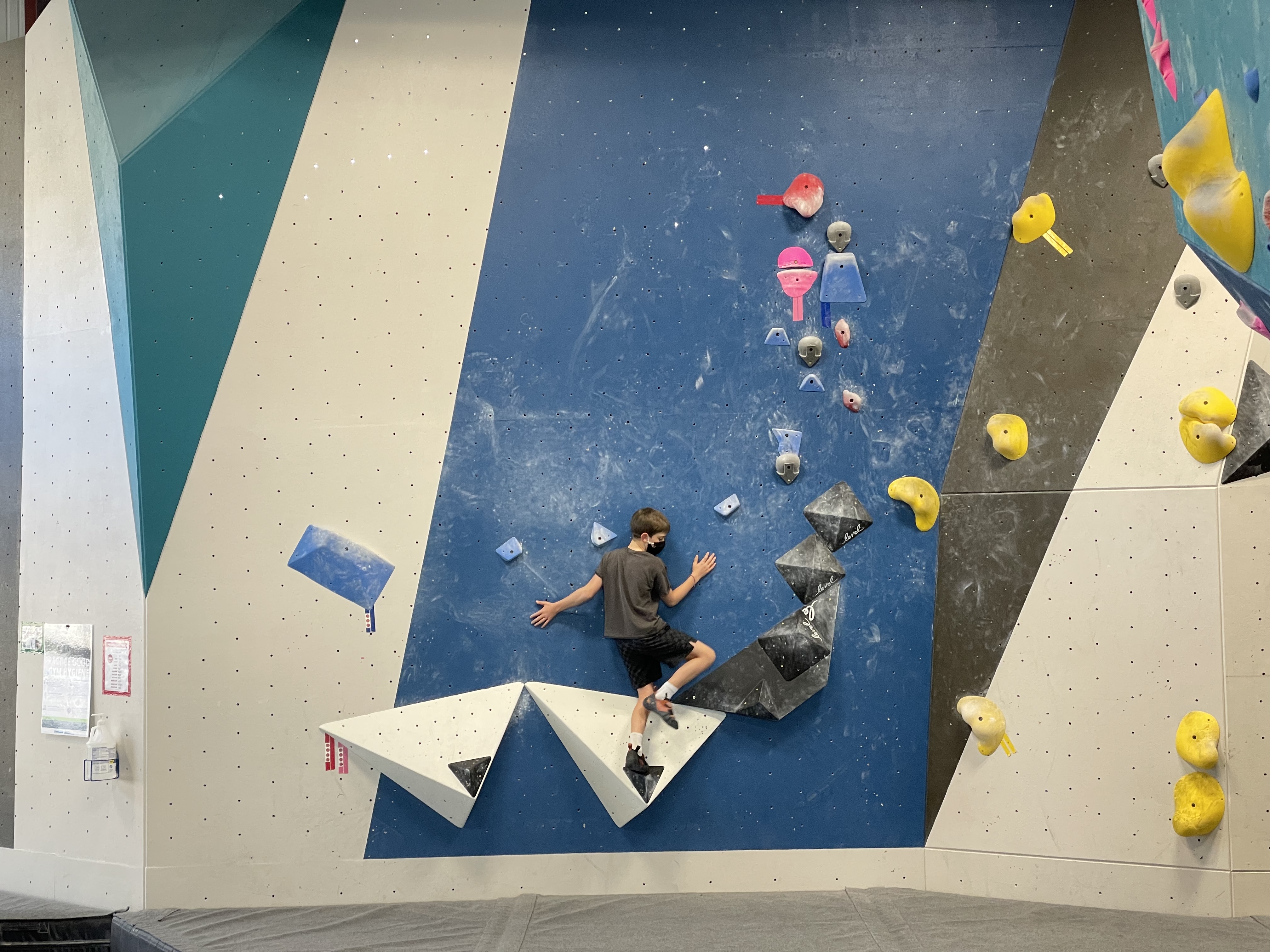
In life, and the bouldering gym, I struggle with balance moves.
To fully answer my friend’s question, “how would that look?” I need to get specific with regard to myself. I need to own the actions required to improve.
Say “yes” more often => people who are good at building capital (and fitness) receive an uncommon pleasure from deferring joy. Improving my yes-no balance requires a mental adjustment.
To create the space for better thinking, I’m going to spend 3-5 days exploring, in nature, tech-lite, each month in 2022. I failed to pull this off in 2021.
Something I learned 30 years ago, “there’s always a good reason to postpone the vacation.” In 2020 & 2021, there were many good reasons to say no to myself. Keeping myself far away from the urge to dismantle my family life is a good reason to say yes to creating some space.
Keep iterating towards better.
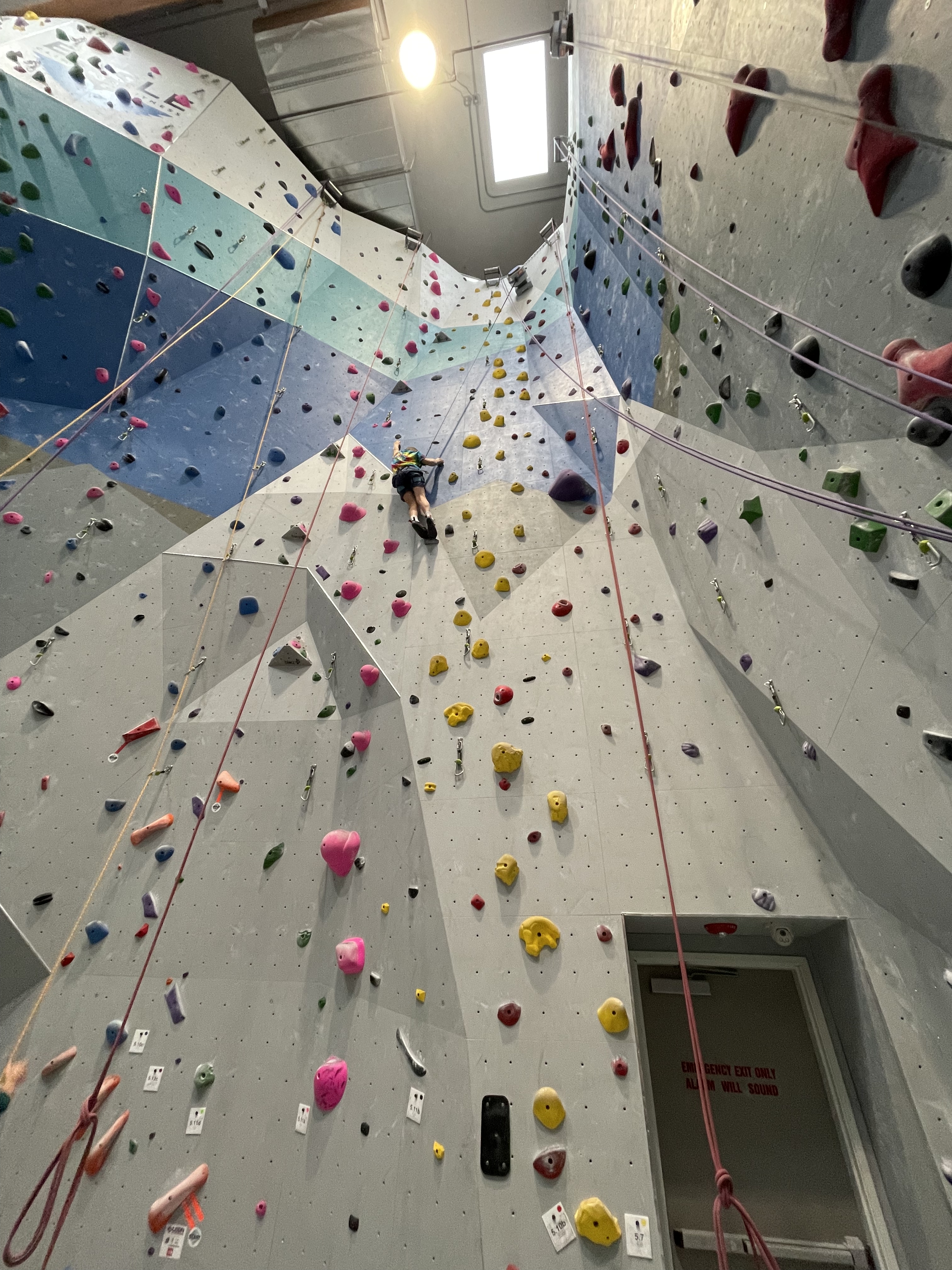
My plan for last Friday afternoon didn’t have “spend the afternoon doing autobelays with your kid” in it. I said “yes” to him and had a great time. One Positive Step.
I view my negative emotions as feedback and, when they persist, I change my approach.
My summer had some unpleasant moments. Moments which spurred the resolve to reach for better.
The first thing I noticed…
If I am going to do something mean then it’s going to happen at home, after spending the day alone.
I can’t remember a single unforced error happening after a day outside. The errors I do remember start with a slow boil starting at my desk!
So…
I have stickers facing me while I type away on my screens…
Whatever I truly need… it’s not to be found in a chair, looking at screens.
Another lesson I’ve learned, this time about marriage.
Schedule time to enjoy each other.
I don’t know if we’d gotten “too busy”, or complacent.
Either way, when I’m getting jealous of swim meets then it’s a sign we need to increase our us-time.
Tuesday – train together (outside), then lunch
Thursday – starting after Christmas break, ski together
Saturday – date night (and our oldest can handle the sitting)
Three opportunities for “together” each week.
Have fun together and avoid forming a habit of preparing a list of grievances for each encounter, yes I have done this.
The Thursday means we need to help. When I first raised the idea, it was…
I want you to get childcare so I can take an entire day off. Every. Single. Week.
My wife had no idea what, or why, this was important.
Nothing happened, for months.
When I explained the downstream idea (ski together each week), help was found within 12 hours.
Good ideas do better with effective communication.
These ideas were put together with an understanding of enduring drivers of satisfaction in my life…
Exploring, together
Being outside, together
The three “weeklies” put me in my best environment, so my wife isn’t interacting with me in my worst environment (the house after a day alone).
We had a bit of an issue with restaurant selection so we rotate choice, by week, with a no-veto policy.
Kid #2 completed their reading challenge!
John Hellemans notes there are three plans in any athlete-coach relationship. I goes something like this…
The plan the coach believes the athlete is given
The plan the athlete actually does
The plan the coach believes the athlete did
It’s a reminder to be cautious with assumptions, and pay attention to clues that point to reality being different than expected.
A version of this extends to all things in life…
What you think you need
What you actually do
What you think you did
Consider money…
What I think I need to spend to make myself happy [A]
What the family is actually spending [B]
What I think my family wants me to spend [C]
The punchline here is TIME.
When you are enjoying each other, your family will enjoy inexpensive hobbies.
INVERT => no amount of spending can overcome a lack of meaningful connection
What’s been bothering me, quite a bit as it turns out, was the ratio of B to A. The $5 of family spending that follows each $1 I find useful in my own life.
I dug deeper.
What I’ve arrived at is equity. Equity of contributions and benefits. We’re working on it. A simple change, that is difficult to implement…
I will not burden myself with the task of removing the consequences of another’s choices.
Basically, if someone calls an audible, repeats a bad habit, makes a poor choice… then I’ll limit myself to polite emotional support, while calmly showing the connection between their choice and the consequence.
Then I’ll move on.
++
Getting What I Want
With the money I think my family wants me to spend… I just smile at myself.
First, because my wants are driven by my peers, my values and the advertising industry => my family is the solution, not the issue.
A bit of effort with my media filter dials down my greed, and dials up useful traits. A simple change… unsubscribe reduces useless spending.
Second, my “wants” are transitory. They come and go, just like moods. I don’t need to take them seriously, they change all the time.
A better question:
What’s it going to take to raise my kids, the way I want, and set myself up for the next stage of my life?
The many lives we will lead are hidden from us in the present moment. Pic is Little Andy.
My wife has one angel birthday in her life, October 30th, the date of Andy’s accident. We had a memorial last week and it went well.
It’s difficult to front up to a funeral, VERY difficult to speak at one… thank you to those of you who came, and those who spoke.
++
Some thoughts on conversations from the memorial.
The concept of closure: for me, this doesn’t exist. Everything I have experienced, is carried forward and changes over time. Andy, in me, continues to evolve.
A key part of growing up is learning how to deal with loss.
I’ll share my list of Angel Birthdays to illustrate the point: Stuart, Kristy, Kevin, Dan, Andy, Henry and Gary. As we get older, many people are going to pass. The advice to “grieve the small stuff” is well made.
The picture below, is Andy with “Little Ax.” My son lives on, he’s 10, but Little Ax ain’t coming back. I miss him.
Life gives us many opportunities to acknowledge loss, both small and large.
Better to grieve the small things (than seek to close them off).
Best Toddler Ever
Michael shared an idea to re-frame our triggers.
Andy died falling from the Second Flatiron. In Boulder, we can see the Flatirons from EVERYWHERE in town.
It goes further that that, if you know where to look you can see them from Eldora, from the tops of the local canyons, flying into Denver…
One endless trigger.
Becoming aware of our memory triggers, we can take the opportunity to reframe them.
So when I look at the Flatirons, I want to remember to say “yes” more often.
Andy and I were on opposite ends of the yes/no spectrum.
There are many days where I wake up keen to say “no” – to myself, to my family, to anyone… no, no, no!
My “no” is rooted in a fear of “yes” getting out of control.
A little more “yes” will improve my life. It’s a good way to remember AC and, perhaps, I’ll give him credit when I’m less of a hardass.
Reframe the trigger to serve the life I wish to lead, the person I wish to be.
++
Andy would have wanted…
If you’d asked him, when he woke up on his final morning, if he was OK with dying in a few hours. then I am certain he would have said “not yet.” We had a look through his planner and he had lots of fun things planned for later in the week.
However, when I met him in 2004 (and many times subsequently), Andy told me he was OK with death. He went further saying he believed in a collective “duty to die”. Not to kill ourselves, by the way. Rather, Andy believed we had a duty to live life fully.
So if you’d told him he’d die in middle age, quickly, pain-free, exercising outdoors… he would have been OK with that.
Andy and I had different values when it came to risk and ruin. Two key reasons: (a) the future is invisible to our present selves; and (b) we are not autonomous beings.
He always gave me a fair hearing.
++
By way of Bob, Chris shared a letter from Hawaii. Extending my favorite part to the general…
Vibe with nature, don’t seek to challenge her.
Rock, snow, ocean, mountain, exercise, work, training load, run mileage… vibe it, don’t challenge.
The vibe is what we seek.
Another way of saying, “look deeply into the need you are seeking to fill.”
++
A final shout out to Monica’s Buddy Andrea (MBA).
MBA flew out, stayed with us and helped with continuous acts of kindness.
A lot of little things, from all of you, turned into a big assist for our family.
A good question to consider with major assets in a portfolio…
Would I buy at current prices?
Like most real estate in Colorado, Boulder capital values have been on a 7-year upswing. According to Zillow, the capital value of where we live is $2.5 million, up 36% since the start of 2020. The only way to describe how this value feels is “too high”.
One way to consider capital values is to express them in terms of cash flow and time => with real estate, the proxy is cost to rent.
With our current address, comparing rental costs with gross capital value…
$3,000 per month rental => 69 years equivalent
$4,500 per month rental => 46 years equivalent
$6,000 per month rental => 35 years equivalent
With the run-up in prices, homeowners have been rewarded for properties that are larger than their needs. Like-for-like rental, doesn’t look too crazy right now. However, we could easily fit ourselves into a location that’s 40% smaller than where we live at present (implying a gross yield of less than 2%).
On to the next example…
++
In 2021, some friends exited the Boulder real estate market. Their net sales proceeds (after taxes and agent’s fees) equate to ~100x their first year rent in their new location.
Worth repeating: they are taking a century of rental-equivalent off the table.
Put another way: by selling into this market they can do the following (in current dollars):
Cover their future cost of living on a joint-life expected basis;
Put their kids through college;
Buy an apartment as a hedge against future rental rates; and
Treat future earned income as fully discretionary.
Compelling, especially if your house is the primary asset in your balance sheet.
They aren’t “set” by any means: inflation, illness, increased spending or investment losses might derail their plan. However, the asset sale greatly reduces their financial stress and buys them a tremendous amount of time.
Stress, time and the risk of ruin.
++
Another example, vacation properties.
The house we rented in Vail (2019/2020) is valued at more than 100x the rental we paid. The condo we rented in 2018/2019 sold for 50x annual rental.
There’s never been a better time to rent assets you don’t need. 😉
If you own assets in secondary locations, or are considering buying, then the above calculation is a useful one to consider. The numbers above are using gross rental figures. From the landlord’s point of view, the net rental income would be tiny (relative to capital).
Also consider the benefits of being variable…
Rather than lock in a single location for the winter, I’ve decided to try an AirBnB season. I booked in 22 days of skiing, the dates tie to school holidays => Vail, Telluride and Jackson.
Adding a bit of airfare, gas and mileage… total cost will be $15,000 to use properties with an average value of ~$1 million. VTSAX dividend yield is 1.25%.
By not owning, it was cost-free to change strategy.
++
Other questions I like to ask:
Assume things go well and this asset doubles in price (again), who’s going to buy?
What’s going to drive the next doubling in value?
Where’s my family exposure: (a) benefiting from the next doubling; or (b) harm from the risk of a halving?
Who’s going to buy? A smaller place in a great neighborhood is much easier to sell than the best place in that neighborhood. The top places in Boulder are now selling for around $5 million. Who’s going to buy when the market goes to $10 million? Might “ability to purchase” create headwinds for appreciation in the market?
Prime Colorado real estate benefits from buyers coming from “even more expensive” markets. Boulder remains a great place to land from one of our coastal Metros. City-based housing markets benefit from local economic growth.
Vacation-markets, at 50-100x gross rental income, are reliant on continued balance sheet appreciation for the Top 1% of society.
A comparison I follow in Colorado… Boulder rental property (house with land, no HOA) vs Vail vacation property (condo w/o land rights, HOA). In the last recession, I tracked this comparison in Arizona – unfortunately, I bought condos down there instead of houses.
What’s going to drive the next doubling? See the chart at the top of this post => there’s been a multigenerational tailwind due to declining interest rates. Every store I enter, and every manager I talk to, gives multiple examples of tight labor & inflationary pressures.
Negative real interest rates might keep the party going for a bit. With Social Security COLA adjustments over 5%, it seems nuts to buy into property that’s trading on 50-100x rental income.
Family exposure. For me this is kind of like the “who’s buying” question.
If you’re a double-income family with a diversified portfolio then sticking 10-15% of assets into a vacation market is a different choice than a single-income family with 90%+ of assets tied up in a mortgaged home. The context of the choice is worth considering.
One final point, despite living at 5,500 feet (and training year round up to 14,000), I don’t sleep well above 9,000 feet. For many, ability to sleep at altitude changes as we age.
Climate, altitude, neighbors, convenience, community, quality of local schools/governance… good reasons to rent locally before you buy.
Summer reading prize – read aloud challenge. I had to offer his older sister a “bonus”… If your boss offered to pay you, AND send you on a vacation, then would you do a 100-day training program that required a mere 12-minutes per day? When she said “hell, ya”, I pointed out that she needed to get the reading challenge done before I would be paying for any out-of-state swim meets.Dressed up and out of the box! Pre-, and post-, flight COVID tests enabled us to enjoy a normal wedding in Cali. So great.
What is the underlying goal of childhood financial education?
=> Self-generated, lifelong financial stability
I’ll run through to tools we use to equip the kids to pay their own way in life.
Allowance => simple formula: weekly deposit into an account with the Bank of Dad, deposit is $1 for each year of age, and the deposit balance earns 10% per annum.
Many families view the purpose of an allowance to teach a kid how to spend.
We don’t.
The purpose of an allowance is to create a positive emotional association with the power of compounding.
Our oldest has been rolling her allowance since Kindergarten. She now earns $7 per week from compounding and $13 from being 13 years old.
Compounding is an ever growing sum. When they enter high school, I’ll run through the math behind it. I have a spreadsheet by week.
In time, I will let them know I grew my net worth by 15% per annum for many years, mainly by saving half of what I earned. This habit bought a lot of time.
++
To put off the discussion of “why am I saving?”, I have them pointed at “saving up for a car.” When we get closer, we will sit down and look at the impact of swapping their earnings (from doing nothing) with a set of bills for owning a car (insurance, maintenance, taxes).
Uber is going to look VERY attractive against 10+ years of compound interest. That lesson plan might be: keep depreciating assets variable and stay invested.
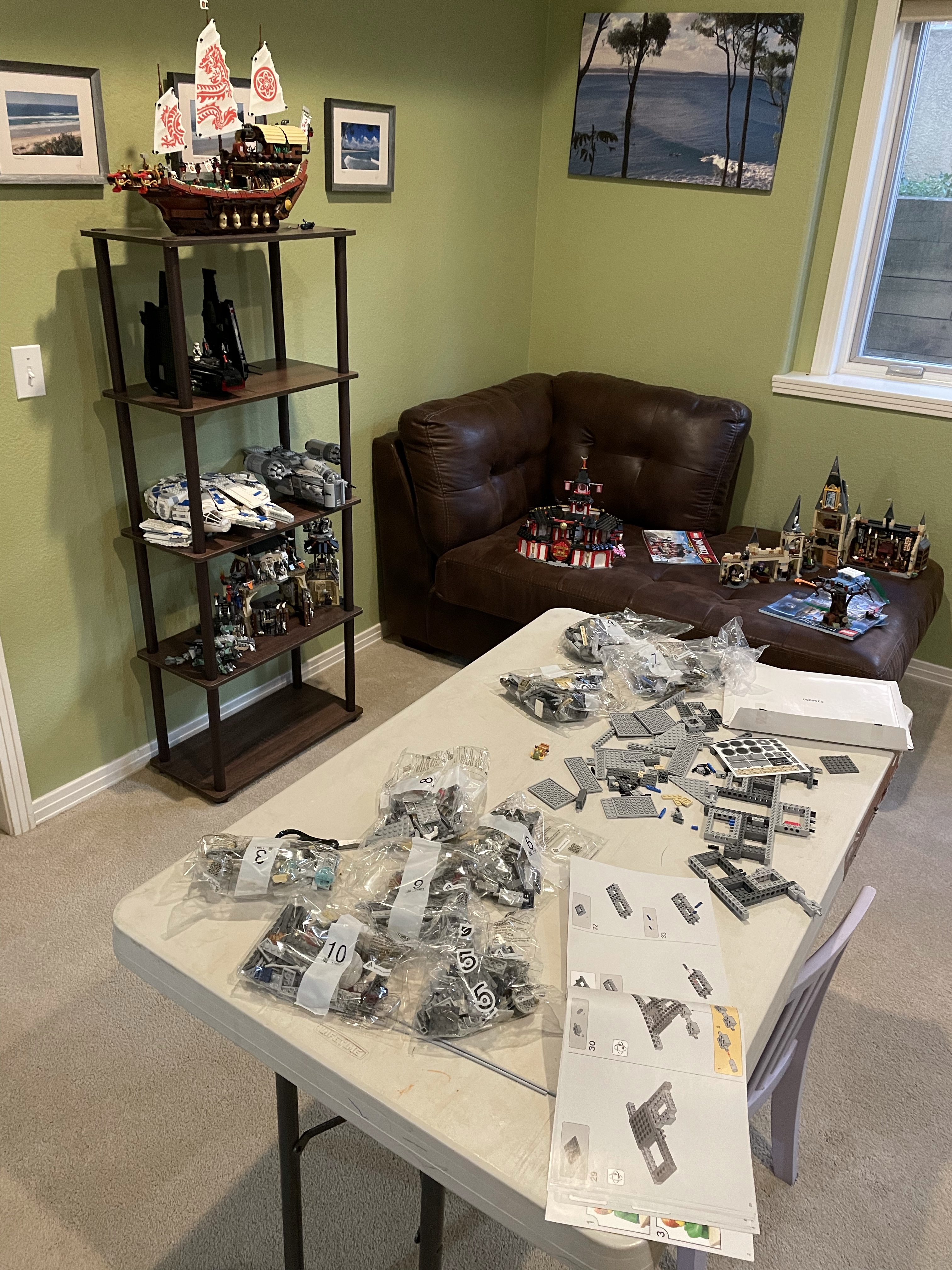
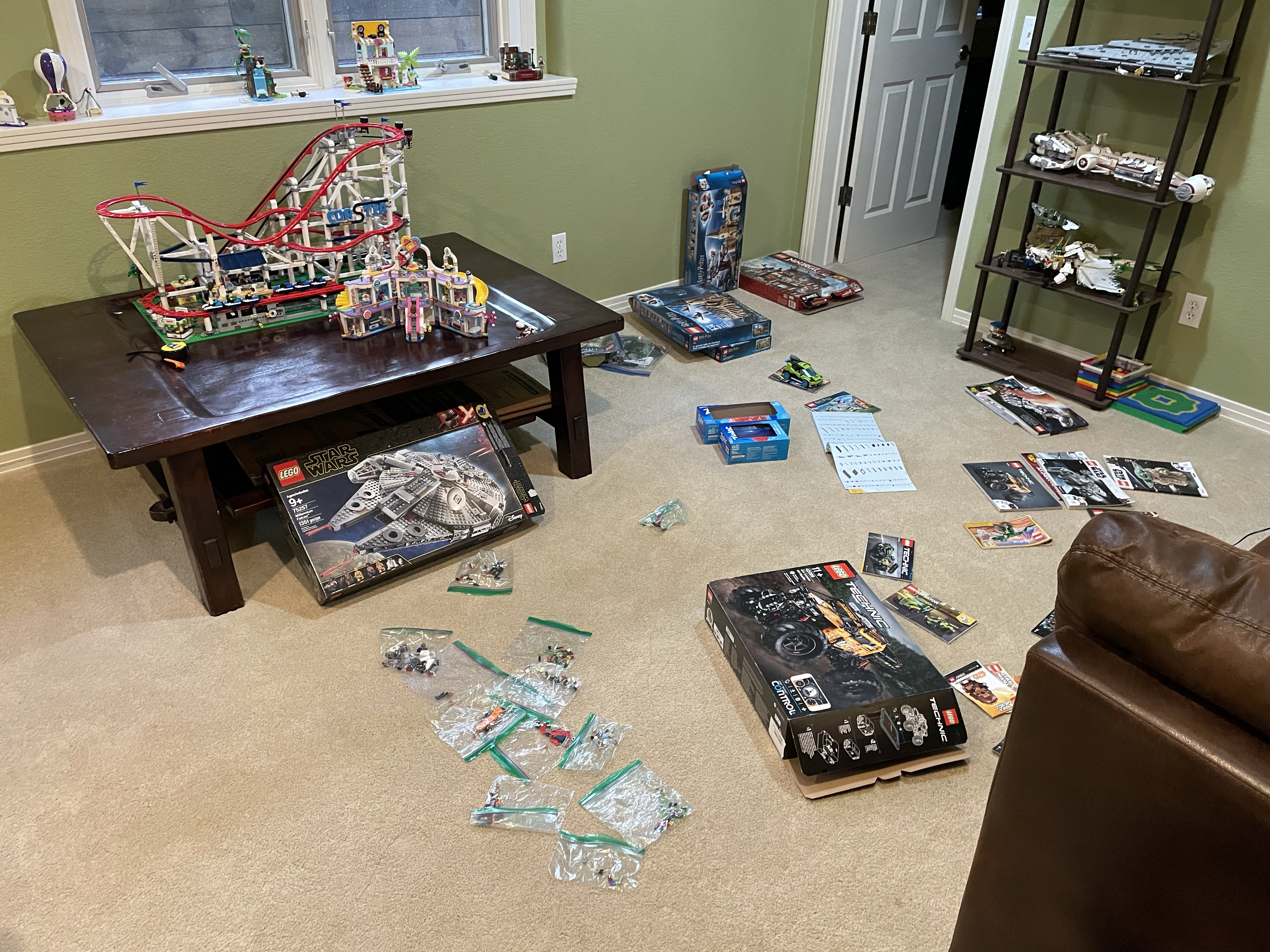
Earned money is their money – this has resulted in a house full of Lego
Earned Money Is Their Money
To effectively learn about spending, one needs to earn the money being spent.
This is because spending other people’s money feels different.
Sometimes really different…
Spending other people’s money, with a credit card where you don’t see the bill, feels better than free!
Don’t hook your kids on this form of pleasure. We tell ourselves all sorts of BS to self-justify this situation.
++
Our greatest financial achievement in 2021 happened by accident. We got our oldest off the payroll. She started babysitting and stopped asking us for money, for anything!
This opened her up to the real world of: lending money to friends, spending paycheck-to-paycheck, buying poor quality goods on impulse…
…and because it was HER money, she learned very quickly from her errors, and her friends were not (indirectly) placed on our payroll.
Self-Earned Money + Scarcity + Freedom to Err = Learning
Also… “if you want to buy friends then you’ll have to do that with your own money. Your choice. I think you are a star.”
++
Our other kids aren’t old enough to babysit, yet. They get assistant sitter gigs, and do yard work in the neighborhood. The work pays well in kid-terms. I supplement with odd jobs.
This is enough to make the whole family “kid rich” => rich enough to buy whatever they want, from their own money.
Quite often, what they wanted was LEGO and it was tempting for me to use my own money to “make them happy” thereby facilitating consumption.
One of our family values is we each pay our own way. Elders are to avoid facilitating consumption. With this in mind, I made a choice to reward my kids with time and I remember…
When you are spending other people’s moneyyou can easily get trapped into dreaming of more, more, more.
This is because we are chasing something stuff can never buy. The journey of adulthood is about discovering our personal “what.”
Quietly, I watched nothing happen with the birthday present…
With the shift towards their own money, supplemented by Christmas, birthday and summer reading prizes… they noticed…
New stuff is fun, but only for about a week, then it sits on a shelf.
I let it sit on the shelf, for years, then one day…
I never play with my Legos, they are kind of a waste of money…
Jackpot!
So the current lesson: we buy luxury goods at retail and sell them at wholesale (if we are lucky!).
Thanks to a very kind cousin, we are in the process of converting Lego sets to cash. Lesson to come will be comparing “cost to buy” against “net realized value from sale”.
Breaking down the sets and preparing for sale
“If you want an iPhone then earn the money to buy it”
In 2020, our oldest sold 200 masks, at $5 a mask, to earn the cash to buy herself an iPhone. No social media on that phone and we financed the sewing machine and materials. She handled marketing and mask production. She shut down the “business” the day after she had enough for the phone!
To recap
Allowance creates a positive association with compounding
Earned money is their money
Listen to their errors, give time and positive attention to their lessons
Celebrate “getting off the payroll” => they also make their own lunches, another big win.
Let scarcity teach and create incentives to reward work.
++
Basic Cleaning
A valuable lesson for them, weekly humility training for me…
We split the house into Five Zones:
Kitchen
Carpets
Cat Room (dirtiest room in house, done by our youngest)














 Feel The Byrn
You must be logged in to post a comment.