Too Painful To Care

Monday I wrote about driving energy inwards to improve myself, my marriage, my family.

Related to this lesson, I’ve noticed a habit of avoiding knowledge that conflicts with my core beliefs. This isn’t anything new – human misjudgment is an ever present topic. However, spotting my own misjudgments can make me far more effective.

Being effective, and making better choices, is a more important to me than avoiding change.

A story.

The Tour de France just finished and I didn’t watch any of it. My lack of motivation was unusual and I wondered why.

The legacy of cheating has been to make it too painful to care. In my case, that manifests in a lack of interest in elite sport. In the case of the wider public, there is an element of truth-fatigue. It’s too painful to discover the reality that underlies an obsession with winning.

I’m using sport as an analogy – it’s an easy one for us to feel, and see in others. Choose your favorite sport and you’ll find a tendency to overlook it’s short-comings. If you can’t see it then ask a foreign friend their thoughts (or simply a pal that likes a rival franchise).

The lesson for daily living is deeper.

  • A friend with Alzheimer’s
  • An elder with dementia
  • A sexually abused child
  • A partner that defrauds the community

In these cases, we will feel a strong urge to “give the benefit of the doubt” to whatever causes the least pain. We will default towards inaction and strongly avoid information that compels us to face pain. I feel avoidance strongly in myself – it’s taken many setbacks for me to overcome.

One of the best lessons of hospice is that freedom lies on the other side of fear. Hospice lets me “be with” my fear of death/disease and feel grateful for today. Gratitude is powerful medicine to carry around inside.

Hospice is “easy” – it’s quiet and I’m not expected to solve anything. My home on the other hand… is often loud and I’m in charge. Maintaining serenity in my own house would be transformative for me, my wife and my kids.

So I look for small, daily, opportunities to practice equanimity:

  • Reading a conflicting viewpoint
  • Avoiding “justified” disappointment in a friend
  • Letting a commute unfold without battling my fellow drivers
  • Not playing into a negative emotional pattern with a spouse, child or myself (!)

Overcoming the smallest things, closest to us, can be powerful.

It takes courage to face pain.

Be brave.

Scope Lock

It’s easy to let short-term news dominate our thinking.

  • Children killed in war
  • Lost airplanes
  • Destroyed airplanes
  • Crashed airplanes

With death, in particular, I was curious.

I asked Google, “How many people die, per day, in the world?”

Google replied, “about 150,000.”

Per DAY.

That helped me put my obsession into context.

++

Realizing that my thoughts are largely wasted can create cognitive dissonance.

…but it’s awful

…I need to care (to show I’m a kind person)

I ask myself, ‘is linking worry to goodness effective?’ In my life, worry makes me anxious, not compassionate.

++

Here’s what I’ve noticed in myself. There’s a hidden cost to obsession with others.

The more I focus on seeking to change others, the less energy I have to change myself.

What one thing, if it happened, would change everything?

In my case, kindness through daily action in my own house.

Beware of feeding what you want to leave behind. In my case, fear – anger – anxiety.

Talking About Dementia

The medical director of the hospice where I volunteer gave a lunchtime presentation on dementia.

An interesting stat she shared was 45% of people 85 or older will show symptoms of dementia. With longer life spans, we’re going to be dealing with more dementia.

The mechanisms for the various types of dementia are not well understood but she cited the following risk factors:

  • Heart disease
  • Stroke
  • Alcohol use
  • Diabetes
  • Family History of Dementia

Like most of us, I have all-of-the-above in my family tree. If I live long enough then it’s likely that I’m going to bump into dementia.

What to do?

  • Consistency and routine in daily living
  • Physical and mental stimulation – stay engaged in your family, in your community, consider part time work
  • Safety – ID bracelets, honest discussions about driving
  • Reminders & Cues – at 45 I have a system in place to manage my days – if you are used to subcontracting all your admin then consider bringing it back in-house before you become part of the elder elderly.

With my grandparents, we used atomic clocks (automatically set for time, day of week, date, month) to help them keep track. Towards the end, I ran my grandmother’s calendar and would handle arrangements for key appointments. They were both in assisted living and my grandmother commented that she would have moved in earlier if it wasn’t for her reluctance to ask for help.

There was an excellent question from the audience… Do my visits have any impact? The doc made the point that the impact of a visit might be not seen until later – when the patient is happier, more content. Don’t assume that low, or no, response means that you’re having no impact.

In my own family, the anticipation of a visit was very positive. I went as far as planning a series of rotating visits more than a year in advance. Each elder needs a champion to marshall caregiving resources.

Likewise, with demented patients, don’t assume that negative behaviors are disease related – the patient could be acting out in response to pain, lack of stimulation or excessive stimulation.

Interesting point for older athletes – the body’s thirst, and hunger, mechanisms dull with age (as well as due to dementia).

The doc shared that artificial feeding of demented patients doesn’t prolong life and changes the nature of death – this is due to complications associated with tube feeding.

++

The thought of losing one’s mind is terrifying and the topic of assisted suicide came up. We didn’t have time to explore that issue, but it’s going to be on the 2015 ballot in Colorado.

Given dementia rates in my family, it strikes me as more productive to create a care plan, rather than relying on a quick death, or euthanasia.

I was also left with the following:

Be sure to consider “who’s suffering?” 80% of hospice patients have cancer so my experience with the demented is limited. That said, be sure to look inward when you’re dealing with a family member with dementia. Our minds can torment us more than the disease torments our loved ones.

583My grandfather had advanced dementia and was fully capable of experiencing happiness and joy. He maintained his dignity, if not his memory, until the end of his life.

The death of an elder is an opportunity to make better decisions within the entire family. What did we get right? What would we change? What advance directives are needed for the next generation? for myself? Is my life structured appropriately if I start to experience symptoms of dementia?

IMG_0920Most personally, it strikes me that if I decide to kill myself then I deny my community the opportunity to learn from the end of my life.

As a society, we can learn to live better by taking care of people on the way out. My grandmother was moderately demented at death. She faced death with courage and caring for her was a gift, not a burden.

Watching a loved one unwind from Alzheimer’s is extremely difficult and I hope to have the ability to avoid judging opinions different than my own.

Real people, tough decisions.

How Am I Fooled By Fear?

Monsy in Boulder

The best antidote I know for fear is a good laugh that is followed by asking myself, “What’s best for my wife and kids?”

Once we can see our fears, we discover their impact on every decision in our lives – relationships, office politics, athletics, contract bidding, you name it.

This thinking comes from Your Money and Your Brain, which was recommended in If You Can (link to free eBook). Turns out that I’m a case study for how we fool ourselves.

Extreme Loss Aversion

Periodically, I’m stalked by a fear of being wiped out.

An antidote is to view the world through a bigger lens. Evaluate bad news with regards to my life – most “bad” news has no impact on me but I transfer remote fears into my home life.

Strike It Big!

The flip side of my risk aversion is a feeling that striking it big would solve all my problems. The voice in my head tells me, “then you won’t have to worry about anything.” However, that’s unlikely. I’ve always had fearful feelings.

The antidote is to point out the obvious:

  • we’re in a good position
  • keep doing what we’re doing
  • inappropriate, and unnecessary, risk is one of the few things that can screw us up

It’s a message that I give to others, and I’m repeating it to myself, here.


Better Thinking About Taxes

Taxation is a topic that’s guaranteed to tip most people over the edge of rational thought.

Let’s see if I can help you make better decisions by slowing down your thinking.

The first thing you need to do is add up all the taxes that you’ve paid in the last year. Your total might include:

  • Federal, state and city income tax
  • Payroll taxes, worker’s compensation premiums and unemployment insurance contributions
  • State, county and city sales and use taxes
  • Real estate taxes and rates
  • Transfer taxes and stamp duties
  • Value-added tax (for my non-American friends)

The first step is painful. It’s a big number for almost everyone.

In fact, this step alone creates a level of pain that drives many smart people to over-react. Wind farm investments, geographic relocation and massive personal overheads are often reactions to a sense of injustice with regard to tax policy.

When I moved to Colorado, I was surprised to discover that it’s a low-cost place to live. In fact, it’s a far, far cheaper to live here than London, Hong Kong or Bermuda – all locations where I’ve paid significant taxes.

Taxes are best considered in light of our total cost of living. The cost of which includes education, housing and healthcare.

At the end of 2000, I left the low-tax environment of Hong Kong and ended up in New Zealand. In New Zealand, my marginal tax rate increased significantly but my core cost of living dropped by 95%.

Years later, working in Bermuda, I spent a small fortune on travel and living expenses to keep my average tax rate down. Eventually, I did the calculation that I’m sharing in this article and had an “a-ha” moment.

Today, in Boulder, my total tax bill (all of the bullets above) is roughly equal to the cost of a single private education in London, Hong Kong or Bermuda. With three kids, the life of an expatriate would be expensive. In fact, I’d have to work so much, I’d rarely see my family.

While an American city with a good school district is a low-cost location – even better was New Zealand. Moving to NZ, I lived with roommates, was covered by single-payer health care and worked for European / North American clients. I read about young people doing similar arbitrage with a bases in Asia, South America or small North American towns.

If you’re motivated then you can find opportunities to optimize your cost of living. Rather than worrying about your marginal tax rate, focus on the best location for your current life situation.

++

As for the psychological impact of a tax increase, I often let my emotions get the better of me.

To understand your true exposure to tax rates, take your total tax bill and divide it by your net worth. That percentage is the true “take” of taxes from your family.

For example, consider a young woman earning $70,000 per annum. Her total taxes are  $17,500 and her net worth is $40,000. With an average tax rate of 25% (17,500/70,000), she’s paying 44% of net worth in taxes each year (17,500/40,000). She has a significant exposure to tax increases.

Compare the above to an older woman who’s been saving for many years. Her gross income is $165,000, her total tax payments are $50,000 and her net worth is $3.5 million. Despite having a far larger tax bill, her taxes represent 1.4% of her net worth. Her exposure to rising tax rates has been limited by decades of living below her means.

Smart savers free their families from exposure to tax policy.

++

Takeaway points:

  1. Taxes are a component of living in a civilized society
  2. Analyze your cost of living in the largest possible context
  3. Healthcare, childcare, education, housing and real estate expenses must be incorporated in any discussion of taxation
  4. To understand your true exposure, consider taxes (and all other spending) relative to your family net asset statement

Minimum Effective Dose

gordo_crunchMinimum effective dose is a concept popular in athletics. The first time I heard about it was through Joe Friel.  I think Joe defined it as, “the minimum dose of the most specific training to achieve the goal

Contrast this with my (historical) default strategy of “a little more than the maximum dose that my life can possibly withstand.” At the time Joe shared his observation, I was trying to train about five-hours per day!

Last winter, Monica started doing mini-walks when the kids were napping. We live on a hill and she’d powerwalk a quarter mile up, then a quarter mile down.

For a guy that used to aim for five hours of exercise a day, a half mile walk is a “why bother” level of activity. I’d sit at my desk, watch her leave and ask myself, “what the heck is she doing?!” At the time, she was knocking out 45 miles a week on our treadmill.

I was in a depressive funk and, perhaps, the mini-walks were her way of showing me the value of something rather than nothing.

Well, it worked. I started my mini-walks and they turned into some of the most pleasant time of my day. I moved through my funk.

The medical literature that I read is mixed on the value of exercise beyond about an hour a day. However, the value of movement (across a day) gets universal praise.

You can expand this concept beyond walking.

  • My relationship with my kids
  • Getting more efficient with my spending
  • Moderating my consumption of chocolate, beer or wine
  • Creating an ability to give a nice “no thanks”
  • Building a key relationship

A self-directed life comes from a habit of incremental change (but I have to constantly remind myself that the little things are worth it).

Should I Own Shares In My Employer?

In the late-90s, I committed half my net worth into an investment scheme sponsored by my employer. The scheme was effectively leveraged 20:1. The deal worked out and was part of how I doubled my net worth within 24 months.

Emboldened by my success, in the early 2000s, I ended up with 100% of my net worth in a startup that was effectively leveraged 30:1. Taking out a home-equity loan, to cover my living expenses, triggered a desire to sell down my exposure.

The second deal worked out OK but it was painful. My returns fluctuated between +100% and -65% per annum. The ride up was fantastic, my net worth swelled 1,500%. The ride down was far less fun. In four months, the company crashed, I was unemployed and I watched 50 years’ living expenses go up in smoke.

So my answer, about owning your employer, is, “it depends.”

Depends on what?

Age – How old are you? What’s the implication of losing everything in the company, including your job? How long will it take you to earn your capital back?

The first time that I “bet the farm” I was 28 years old and able to save five years living expenses for each year I worked.

The money that I lost with the second gamble is gone forever. I’m grateful that I restructured my life to sustain that sort of loss.

Total Net Worth – What is your exposure as a percentage of your net worth? What is your exposure in terms of years living expenses?

Annual Free Cash Generation – Put your exposure in context. Based on the cash that you can save this year, how many years savings are tied up?

ProTip: the free cash generation check is a good way to review personal debts as well as the capital that you have tied up in your home. As our earning/saving potential changes, many of us are more exposed than we realize.

The above is an important cross check. If you’re sixty years old and 10% of your net worth represents ten years worth of savings… then you’re in a very different position from a twenty year old where 30% of net worth might equal six months worth of savings.

Reserves & Undrawn Bank Lines – after you make the investment, what are your liquid reserves and undrawn bank lines? Look at these in terms of gross annual salary, core family cash needs and your family cash flow forecast. How long can you last if everything blows up?

In my case, 50 years of living expenses went up in smoke but I knew that I had five years to figure out what to do.

Not wanting to make my life too easy, I had three kids in that time, which tripled my core cost of living. I didn’t anticipate that shift, but you can.

Contingent Liabilities – Does the investment have the ability to make further cash calls? Housing Associations, home ownership, private equity funds, partially paid shares… all can make cash calls at short notice.

Finally, be ruthlessly honest when you estimate your true exposure:

  • Salary
  • Bonus
  • Vested Equity (Shares & Options)
  • Unvested Equity (Shares & Options)
  • Pension / Retirement Account Exposure
  • Cash that you’ll spend if your employer disappears

The employees of Enron, Arthur Anderson, Lincoln Savings & Loan, and Lehman Brothers experienced a severe shift in less than six months. There are many more stories but it’s human nature to talk more about the boom, than the bust!

Scoundrels and Rascals

When I lived in Asia, I was taught that desire is a necessary component of deception.

My desire to “be right” often leads me right back to another deception.

Some tactics follow that might help you avoid trouble with rascals that, truth be told, are often entertaining.

They Might Be Right – I get a guaranteed laugh when I tell my wife, “I might simply be different.” She smiles, “yes, babe. You’re different alright.”

When would the other person’s course of action be right?

If we live long enough then we are almost certain to find our present selves holding different opinions from our younger selves.

The Message Not The Messenger – we share a curious desire to bring down others and a glee in catching people being naughty. My opinion of a person can prevent me from learning from them.

What can I learn from this person? this situation?

Turn People into Adjectives – when I’m locked on a person, it’s far more useful to drill down to a description of what’s triggering me.

Think about a person that’s disappointed you and dig, dig, dig… until you move beyond the person and arrive at the behavior. There is always something inside of me that’s being touched by, what I believe is, an external trigger.

Let The Situation Move Away – hands down, the most useful thing I realized. Nearly all my “problems” move away if I stop feeding them. Usually the best course of action is to chill out and let my problems leave on their own.

This doesn’t mean that I support the injustice that I see. I means that I acknowledge that my most effective antidote is being just in my own actions.

Turn problem people into adjectives and correct their behavior in myself.

  • Honesty
  • Courtesy
  • Reliability
  • Kindness
  • Gentle
  • Loving

A Fiduciary’s Reading List

I’ve completed William Bernstein’s recommended reading from his eBook, If You Can.

The reading humbled me. With a 1st Class degree in Econ / Finance, and 20 years experience in international investing, I was left feeling intellectually arrogant and ignorant. Each of these books challenged my beliefs while explaining financial history.

I’d recommend making these books compulsory reading for your advisers and key family members.

Good people can be found in the field of finance. I appreciate the significant time that each of the authors spent to educate willing readers.

The Millionaire Next Door – introduces the key concepts of wealth, saving, investment and taxes

Your Money & Your Brain – a solid summary of the latest on behavioral psychology as it relates to finance and investment – why I will always fool myself

The Great Depression: A Diary – an inside look at what it is like for a conservative, professional family to live through a depression – 2008-2010 was easy compared to the 1930s – could your family survive on minimal income for multiple years?

All About Asset Allocation – the early chapters were the most useful – simple explanations of the role that volatility plays within a portfolio – reading this book, you’ll be tempted to seek the perfect portfolio mix – my decision has been to keep it simple

Common Sense About Mutual Funds – a wealth of information – Bogle picks apart the industry by making his case for simple and low-cost investing – the book makes one wonder how brokers and financial advisers can sleep at night – readers will learn about the industry structure that silently fleeces its customers

Side Note: if you worked in finance from 1980 to 2000 be sure to adjust your brilliance for volatility and leverage using Bogle’s updated charts. We had one heck of a tailwind. Humbling!

How A Second Grader Beats Wall Street – don’t be fooled by the child-like title – this book will save your family tens of thousands of dollars in fees and taxes

Devil Take the Hindmost – a history of financial speculation – hedge funds in the 1860s & derivatives in the 1600s (!) – as Taleb says, we’re never going to get rid of greed, the challenge is to build the system so the greedy don’t inflict suffering on the good

+++

To Bernstein’s list, I’ll add Estate & Trust Administration for Dummies – a good primer to get you thinking outside of your own self interest.

+++

If you are in an advisory, or trustee, relationship then tick off one book per meeting with your professional team.

Read a book, take notes and discuss how the book impacts your family (or your firm).

Challenge yourself with exposure to the best ideas available.

Studying new approaches can be painful but we all benefit from a bit of cognitive dissonance.

Conversations With Hollywood

Yankee Doodle Lake

I have a friend that is a Hollywood producer and is willing to visit me in Boulder.

Hollywood, LA, TV… it’s a long way from the life that Monica and I have chosen for our family. I knew that there was something I could learn.

HollywoodWhat’s good about living in LA?

The two best things are the wealth of opportunity and the diversity of humanity with whom you can work.

In a sentence, my pal summed up the benefits of working internationally.

Being social creatures, we all share a bias towards our “in-group” – whatever group that might be – gay, straight, white, hispanic, Chinese, Malay, athletic, Jewish, firm, family, team, tribe… you name it.

My pal placed his family right in the middle of one of the most diverse places in the world.

Snacks

What’s your secret?

Young people that experience significant success are often asked their secrets…

Never underestimate the value of luck

It’s takes uncommon self-awareness NOT to attribute success to individual skill. As a young man, I lacked the humility to see the massive tailwind that led to success.

Above Ten Thousand FeetGratitude

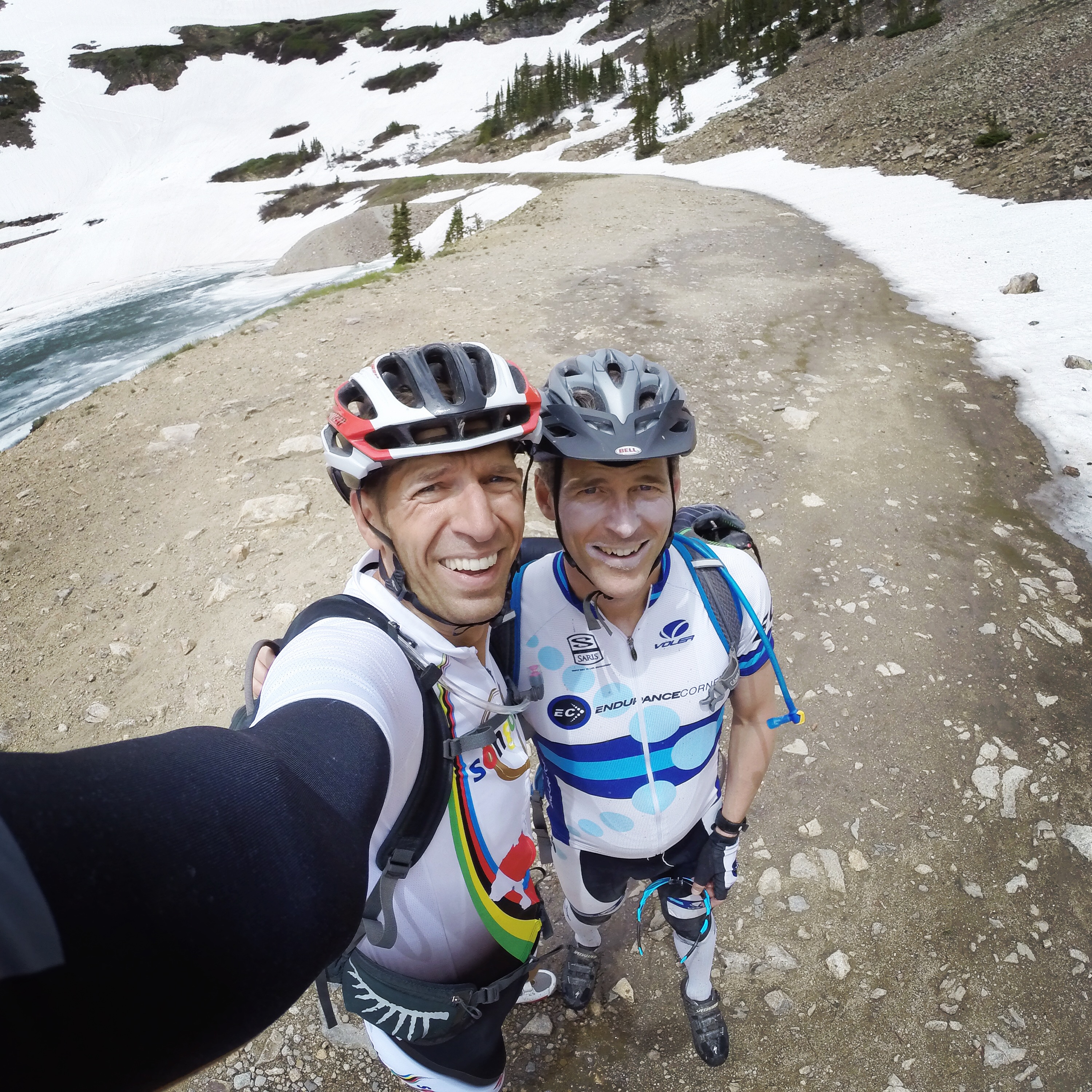
Over the last few days, we spent 20 hours riding in the mountains.

However, at the start, only one of us could truly see the view! He’s raving about the beauty of the scenery, posting up on Instagram and smiling from ear-to-ear.

At first the little voice in my head is going, “of course it’s beautiful… you frickin’ live in LA!”

However after a dozen hours, I realize that I’ve been infected by his relentless positivity.

A deep happiness combined with a genuine desire to understand my point of view. Highly addictive!

Big Air

Think big, you have nothing to lose

You’ll never find out if you don’t try. Being an inspirational figure, my buddy implores… “you MUST try.”

Keep trying until you fail – that’s the only way to learn that failure isn’t fatal.

The picture above shows that he practices what he preaches. One year into riding his mountain bike, he can crush me on all technical terrain.

I was schooled, and impressed.

Rest StopTurning the tables, he asked me a question, What’s made a difference?

When I listen to people talk about their lives, I’m impressed by the quality of their (largely unconscious) thoughts.

We share moments of deep insight. However, and most certainly in my own case, insight is brief and fleeting!

The dark periods of my life spur a desire for change. In my early 30s, I realized that I had nothing to lose, wrote down my insights and started to make small change a habit.

It takes a while but, like compound interest, 14 years of (mostly) good decisions add up.

+++

Thanks for the visit, buddy. I hope we meet again but, even if we don’t, I’m grateful for our time together.