Checking In With Your Real Estate Investments

Today’s article is longer than usual (1,150 words) but it’s worth big money to most families. I’m going to run through how you review a property investment. I use a version of this template for every property deal that I consider.

I make the cost of property ownership visible to my family. This habit keeps me from buying too large a property, or leaving valuable assets empty most of the year.

If you can’t calculate the sums before you buy then wait.

If you remember one thing from this article… act as if you will “lose” 10% of your purchase price the day you buy.

Let’s get started!

First: Calculate Net Realizable Value – What Happens If You Sell?

Start by coming to a view on current market value. To estimate market value, lay out the different options available. Be conservative, I’ve been known to fool myself with a dream value that has no chance of being realized.

In the case of the sample property, I have a wide range of options to value:

  • Dream value – $1,000,000
  • Estimate from Zillow.Com – $949,795
  • Have the owners ask local agents what they think – $925,000
  • Old appraisal – $850,000 (Nov 2012)
  • Assessment value from the city – $830,000 (end 2013)
  • Written down tax basis – $792,772

The tax basis of the property is your allowable cost, plus additions that are capitalized, less depreciation that you’ve taken against your taxes. When you buy a property, you have to allocate the cost between buildings (depreciable) and land (not depreciable). I usually use the appraisal that was done at the time of purchase, or figures from the county assessor’s office.

With this property, I know that the owners checked with local real estate agents and applied a discount to what the agents told them. So, for the purposes of this exercise, I’m going to use the Owner’s Valuation of $925,000.

When you sell, you don’t get the gross value. I account for sales expenses by taking 94% of the gross value. In our example, that leaves $869,500 (94% of $925,000).

The next step is to strip out any capital gains tax that would be payable. In this case, I know the family has an effective capital gains tax rate of 25% (including State). So we take the net price ($869,500) and deduct the taxable basis ($792,772) to get the taxable gain of $76,728. Taking 25% of the gain gives a capital gains tax liability of $19,182.

So the net realizable value for the property is $869,500 less $19,182 => $850,318.

Note that the net realizable value is FAR LESS than the gross value.

Rule of thumb: the market usually needs to rise 10% for you to get your money back.

I assume that I lose 10% of the purchase price on the day I buy. This assumption makes me reluctant to buy, which has saved me from many poor investments!

As an asset class, real estate is costly to own, illiquid and expensive to sell. Do your sums before purchasing.

Next: Figure Out The Cash Flow Before, and After Financing

For the next bit, you probably want to print the article out, grab a pencil and make notes for your own property.

If you can’t handle the pencil/paper method then this is a link to a spreadsheet that will do the calculations for you – make your own copy and fill in the Blue Cells. A picture of the spreadsheet is below.
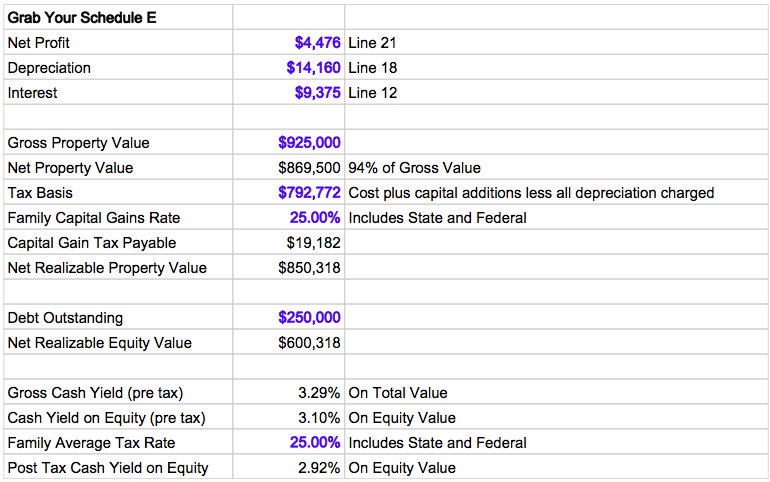
Property Data SetStart with your net income after all expenses and depreciation. If you live in the US then pull up your Schedule E and look on Line 21 – in this case the net income was $4,476.

I recommend separate bank accounts for your main house expenses and any property investments. This makes it easier to track expenses by property.

To calculate cash flow before interest, we need to add back interest – Line 12 in the US – $9,375.

At this stage, I like to make a note about the total debt outstanding and the interest rate you pay – in our example the debt is $250,000 at a rate of 3.75%. Remember that you only want to count interest paid, not principal repayments.

Revenue Less Expenses ($4,476), Add Back Interest ($9,375) gives you $13,851 of profit before interest expense.

Because depreciation is a non-cash expense, you add depreciation back to calculate cash flow before interest and depreciation. In the US see Line 18 – $14,160 for this case study.

So the total net cash flow (before interest and depreciation) is $13,851 + $14,160 = $28,011.

To check the gross cash yield on the property you divide cash flow before interest and depreciation by the gross net realizable value. $28,011  / $850,318 = 3.3%.

3.3% is the gross yield and ignores the mortgage that is in place. The gross yield tells you the cash that the asset is generating. To figure out how your equity is performing, you need to adjust for the debt that was used to purchase the property.

Let’s adjust for interest and debt.

  • $28,011 less interest of $9,375 gives $18,636 of cash flow after interest
  • Net Realizable Value of $850,318 less debt of $250,000 gives $600,318 net realizable equity value. The equity is the value of “your money” in the deal.

$18,636 / $600,318 = 3.1% return on equity

Consider Taxes

Note that the 3.1% return on equity (above) does not take into account Income Taxes (federal and state) that would be payable on the net income. I know that the owners have an average income tax rate of 25%.

With real estate, your taxable profit is reduced by depreciation charges. So you take the net profit after interest and depreciation ($4,476) and multiply by your tax rate (25%) to get taxes payable of $1,119.

Income taxes reduce the return on equity to 2.9% – calculated as  ($18,636 – $1,117) / $600,318.

If you are able to hold for a long time then property can be a tax effective way for you to invest your money. Note that, in this example, the effective tax rate is 6% ($1,117 / $18,636).

Remember to estimate your taxes on the income after interest and depreciation.

Finally: Step Back and Consider The Big Picture

Now you have the financial information required to consider the deal (buy, hold, sell, refinance).

Questions I consider:

  1. What are the family’s overall financial goals and how does this property fit into these goals?
  2. How large is this asset class as a percentage of the family’s total balance sheet?
  3. What are the alternative uses of the equity in this property?
  4. Are there debts that cost more than this property is yielding?
  5. Are there large capital sums that will be paid in future years (roof, structural, local energy regulations)? If yes, then consider if you need to adjust value or increase future expense budgets.
  6. Consider the sustainable yield. Know that by adding back the depreciation, you have made an assumption that you won’t have to replenish the building any faster than your current year repairs budget. If the current year was a light expense year then are fooling yourself on the true yield that you’ll be receiving.

Ideally, you will have done ALL these calculations BEFORE you bought the property. If you did the calculations then pull them out and compare your budget to actual experience.

Update your numbers each May and track your investment over time.

You can find more about property investing in my free book available for download here.

If you’re curious about my thoughts… I like this deal because it sits beside a downtown core with strong economic growth. It’s yielding nearly 3% after tax and has excellent prospects for continued capital growth. Down the road, owners can retire to this property, rent out one of the units and live in the other at a low net cost.

The Trap Of Fixing

Camping With My SweetieSome say hate is a sign that you’re having an impact.

I’m not sure.

I think it’s more accurate to say that hate is a reaction to what I’m sending out. It’s an opportunity to pause, consider and learn.

When I’m focused on helping people, my ratio of positive to negative interactions is 500:1.

I find being told to change extremely painful. It’s like I let the World down, which is a major trigger for me.

The best antidote that I’ve found for dealing with my own negative feelings is to pause, not react, and ask myself, I’ll be happy when…

  • all dopers are caught
  • all frauds are punished
  • you change, rather than me
  • you. stop. that. right. now.
  • you close your sport, business, site, magazine because it bothers me
  • everyone, like me, has equal justice, from bigots like you
  • you break those friendships off

Are you sure that you’ll be happy if they change?

I won’t be happy when you change. I’ll pat myself on the back and move on to the next target. It is a path that’s guaranteed to make ME miserable and strengthen whomever is happens to be “wrong.”

My reality is that I will either be happy now, or not at all.

I share this because the 500:1 ratio is a compelling case that we can have a much greater impact by helping, rather than correcting, each other.

The positive interactions are what make us happy.

Break the chain.

More Than Money – Sharing Time

It’s common to think of volunteering as giving time to a cause.

The most powerful lesson of hospice is the reality that, short of organ donation, I can’t give time to anyone.

What I can do is share time.

+++

In most of our roles, we can be swapped out. Absent someone to love, this can be a lonely reality. Family roles, particularly parenting children, is an area where it’s more difficult to replace us. Interestingly, these are roles where love dominates. Kids can survive just about anything if they are supported by the knowledge that they are loved.

My family is central to my life’s work. It’s the most direct way I can influence the world. Volunteering is most useful when it makes me a better member of my family. By “better” I mean wise.

Given that I’m married to a woman where “the tone is the message,” I want to spend time in situations that improve my soft skills. My family, and my marriage, doesn’t receive much benefit when I improve my technical knowledge.

Gordo and the Easter BunnyVolunteering puts me in situations where I am truly clueless. For at least a few hours a week, it’s good to realize that I’m clueless! Specific to hospice:

  • there’s no ability to fix anything
  • I’m not empowered to do anything other than serve
  • my best course of action is nearly always “quiet presence”
  • I create a habit of doing what needs to be done
  • I do my work without expectation of being thanked, or paid

If you have young kids, or elderly parents/grandparents, then you may find a lot of similarities with my list and your role.

Most of the friction that I observe in families is due to someone seeking to fix a situation that isn’t their domain, or doesn’t have a solution.

In terms of self-improvement:

  • Volunteering rewards me if I act in a manner completely different than my typical persona. Until I started volunteering, I had never received positive feedback for being a quiet, humble helper.
  • Caring for the sick has an unavoidable benefit of increasing tolerance. You can’t help but change your opinion of people when you’re serving them.
  • Making a habit of good deeds gives me ammunition to take on the voice in my head that tells me that I’m falling short.
  • Pushing my fear envelope is exciting and increases my ability to think clearly in situations that are emotionally charged.
  • Work that challenges the heart leaves me feeling grateful and gratitude is an effective antidote for most everything that ails me.

Whatever your field, when you hear the call, I urge you to follow it.

Goodness through action.

Hidden Costs of Investing

My career in finance was built on our collective reluctance to act on what I’m about to explain.

I know that it’s a pain to change who manages your assets. However, you give up a TON of money by not forcing yourself to choose the lowest cost provider.

How much? Let’s see if we can find out!

Active

I’m 45 years old and I want to draw down my retirement assets at 70. For each $100,000 of my portfolio, what does it cost me to use active management vs the lowest cost provider of passive management?

The table above assumes that you’re not getting (legally) ripped off. A fee/expense differential of 1.2% per annum isn’t out of the ordinary. I’ve worked with vehicles that had total fees and expenses of up to 5% per annum.

The number that should catch your eye is $131,853 OF LOST RETURN per $100,000 OF INVESTMENT. The extra 1.2% of fees means you miss out on the equivalent of 131% of your initial investment over the life of this deal.

By the way, when I help people review the true cost of their portfolios, their fees and expenses are usually more than this scenario. I know it hurts to think that you’re being ripped off but please read through to the end!

What about professional investors? They must be smarter, right?

I don’t know about smarter, but I do know that large institutions are treated very well by their managers.

Government pensions, insurance companies and high-net worth families. They have invested with the firms that taught me finance, and we did very well for them. However, we also did very well for ourselves.

We did this by offering terms called “two and twenty” – we received an annual fee of 2% of the assets that we advised and 20% of the gains that we generated. What’s that look like?

Fund

With 10 years at 7%, a passive investor would receive $195,797 for each $100,000 invested. Using the terms of a professional manager, the money back falls to $150,312 per $100,000 invested. The reduction is due to the impact of fees ($32,908) and profit sharing ($12,577).

The pros are giving away 48% of their return. I’ll leave the “why” for Michael Lewis, Taleb and Kahneman to explain.

But it gets better!

If you live in a large American state then, odds are, your state pension invests in something called a “fund-of-funds.” A fund-of-funds is an active manager that invests in “two and twenty” funds. Two sets of fees. The scale of the resulting underperformance is breathtaking.

Why does this matter to you?

Here’s why. A financial adviser that invests your money in a pool of active managers is delivering a fund-of-funds approach to your portfolio (and you’re probably getting screwed by fees).

All of this is legal and has to be disclosed to you (as investor and/or state taxpayer).

If you ask about total, look through cost of investment and your adviser starts stalling, then you have a problem. 

Also be wary when advisers produce a fee example for a “tax-free investor.” You and I pay taxes and most changes in portfolio mix have a cost to us.

TIP: The best investment you can make is knowing the true cost of your investment strategy. Get it done this week!

“Little” percentages cost you big dollars over time.

+++

Make the call and ask… “Fees, expenses, transactions costs, taxes – please tell me everything that I’m paying all the way through to the final investment.”

When you get the information, go compare to what a company like Vanguard can do for you.

The Most Beautiful Man In The World – Talking To Kids About Dying

Orion

Did you know that Orion was the most beautiful man in the world? Here’s a link to his story – a personal favorite of mine.

How can I talk about death without freaking out my kids? First up, I don’t start the conversation. However, I don’t avoid it either.

There is a split between older (4-6 years old) and younger preschoolers (2-3 years old) and my approach differs between the kids, as well as how they are feeling when they bring up mortality.

My first conversation about death with my son (2.75 years old) started when he picked up a line that stuck in his head, “David’s Daddy Died.” At two, death doesn’t have meaning and I don’t want him to get locked onto thinking that mom/dad might disappear on him.

From an early age, we’ve taught him that “we will be coming back” when we leave him. Indeed, a key milestone of childhood development is the ability to self-comfort when separate from our parents for 1, 3, 5 and 7 hours. We started this process, gradually, with all our kids as soon as possible.

Axel’s nature means that he experiences less separation anxiety than our other kids. Still, he looked to me for an explanation about “David’s Daddy Died.” Here’s what I do each time…

  • I go down on one knee
  • I look him in the eyes
  • I open my arms for a hug
  • I say, “YOUR Daddy’s right here”
  • I give him a huge hug

Sometimes it takes a couple repeats of… “Your Daddy’s right here” but it always works to bring him to the present, give him reassurance and shift us back to whatever we were doing.

With a 4-6 year old, the conversation is different. My oldest understands death and can have questions about it. She remembers her great-grandmother (who died on this day one year ago) and has asked me about it.

  • What’s death – your body stops working
  • Is she coming back – no, her body is finished
  • Is it like sleeping – no, it’s different
  • Daddy, are you going to die – Sweetie, everything ends
  • How long until you die – likely more than 40 years

And the biggie… Daddy, where will you be when you die?

  • Once again, I look her in the eyes
  • Put my hand over her heart
  • And say, “I will always be with you. Even when I’m not with you, just close your eyes and you will feel me in your heart.”

I then choose a person – perhaps my grandmother, or her mother – and we both put our hands on our hearts and think about that person. “See you can feel the person, even when they aren’t in the room. That’s where you go.”

When they get a little older, I’ll teach them how to spot Orion in the sky and share that he was the most beautiful man in the world.

When they see Orion, I’ll tell them to always remember that I love them.

See me beautiful.

What’s Your Source – A Game

In my early 30s, I gave up climbing as a favor to my family. It was a choice that left me starved of my core need to exercise alone in nature. The “gift” I gave my family had the unintended consequence of starting me down a path that lead to triathlon, as well as my divorce.

Do you know what provides deep personal satisfaction?

Anger, drug and alcohol abuse, fear, depression, gluttony… in my life, these are a sign that I’ve fallen away from a life with meaning.

As a husband, and father of three young kids, I can feel good about putting marriage and family first in the short term. However, if I lose track of my own needs then I end up depressed, angry and full of resentment for the people I was trying to help!

Here’s a game that you can play to stay on track.

Think of yourself and fill in this blank 2 or 3 times…

I am most myself when__________

In my case, I came up with when… I’m riding, uphill, at altitude, in a forest, on a cool day.

Another visualization was when… I’m standing on a ridge line, far above the valley, in the sun.

Another… I’m standing in a forest, it’s snowing and very quiet.

When I see my essential self, I tend to be alone and up high. Mountaineering was a good fit for me.

Then shift your focus to your spouse. In my case…

Monica is most herself when__________

You are likely to find that you skew your view of your spouse based on how you see yourself. I saw my wife swimming (alone) in a pool.

After you’ve had a chance to think through each other, compare notes. I found out that I got my spouse-vision completely wrong!

Monica’s self-image surprised me (at first) because the visions were about helping people. She’s in a good spot as a mom and swim coach – those roles are how she sees her true nature and consistent with some profiling that we’ve done (Myers Briggs).

I hadn’t realized that swim coaching was feeding a core aspect of her personality. It turns out that coaching is a source of energy, satisfaction and meaning for her. It was an important realization for our marriage – we’d be smart to keep that work!

With a young family, you’ll be tempted to lose yourself for the benefit of the kids, or your spouse. You will need your spouse’s support to keep your essential nature in the marriage. The visualization game is one way to start the conversation, and far better than the trouble we cause ourselves when lost in a relationship.

If you keep a daily dose of your essential nature then you’re likely to be a better, and happier, parent and partner.

And now, I’m off for my walk in the forest (uphill, alone, at dawn) after writing my article (quiet, alone, sharing).

It’s important for me to remember that the value of time alone isn’t in the leaving. The value lies in my ability to continue to do work in the world.

+++

Further Reading: How To Make Love All The Time by De Angelis (yes, I read it)

Moving Through A Depression

Tropic Coffee

50 is coming and I can feel that I’m spending my ‘middle’ worrying about money and getting yelled at by my kids.

The challenging thing about depression, or any of my other irrational feelings, is my inability to shake them via conscious thought.

Sharing my fears and concerns helps put them into a more rational context but my cure is always based around actions, rather than more thinking.

I smile when I re-read the paragraph above because (of course) thinking about “thinking too much” doesn’t work!

What does work?

Most helpful was the realization that I needed to make my life more difficult, while not adding stress.

I did this by purchasing a light alarm clock and changing my life so I get up two hours before my kids, who are thankfully good sleepers. By pulling the two hours from the end, to the beginning, of my day – I was able to write, exercise and sit without disruption. Writing, silence and exercise are the best antidote to the despair that I feel around kid noise.

In the heart of winter I reached out for help and attended a parenting workshop. The workshop gave me insight on how fantastic my kids are – nothing like listening to other parents to make me grateful for my own kids! However, despite my kids being normal (and desirable), I find their noise debilitating and draining.

What about the noise?

Some families cope by having constant background noise (TV and radio). For instance, the best parent that I know wears a radio walkman while she works in her house.

Other families ‘cope’ by yelling at the kids and emotionally beating them down. Effective, but not me.

I’ve been wearing earplugs to take the edge of the most intense moments, which rarely add up to more than 90 minutes a day.

People that cope well with noise will tend to find my choice of earplugs rude. Their reality is incapable of understanding what kid noise does to my internal life. I ask them for forgiveness and share the story of the great parent with the walkman.

+++

My son goes to school with the child of a social worker, who shared that her professional training hits a wall when she meets the reality of her own children. Her advice: stay two-steps back from the breaking point.

In applying this advice, I dropped lunch time workouts and replaced them with working in an absolutely quiet environment. This change took a lot of fatigue out of the back-end of my day. On Monday, Wednesday and Friday – I was swimming so intensely that I’d be mentally flat in the afternoons and exhausted by the evenings. Swapping my swim training into an early morning forest jog does nothing for my athletic fitness but it makes a huge impact on my overall mood.

Not swimming is complicated (in my head) because my swim coach is my wife and not spending time with her triggers my fear that my marriage will end and it will be my fault!

So…

The other bit of stress release is to tell my spouse the whole truth with how I am feeling, especially my fears (spending concerns, that I’ll act when I feel despair, that she will leave me, that I’m not a good man).

I have persistent themes that build internal stress – these all get shared with her (and pretty much everyone through my blog).

Most of this is article is to remind myself what to do – I had a tough 48 hours and started writing at 5am in a quiet house!

+++

What makes a difference?

Do something physical and spend a bit of quiet time in advance of the most stressful times of your day. For me that means short, solo, moderate workouts in nature done early morning and late afternoon. Each workout is short enough that the endurance coach in me wants to repeat the entire thing. Physical release and balancing the noise of my home life with quiet periods in my work life.

For the parents that deal with commutes and live in crowded cities – I don’t know how you do it. I’d be at risk for heavy self-medication and persistent deep sadness.

If you’re in that position then wait it out and don’t act on despair.

If I take responsibility for doing what I know works then I always move through a depression. When I’m really beat down it means that I’m very close to things improving.

See the beauty in the good moments.

+++

Serious athletes might find value in an article I wrote about athletic depression and training mania.

How Far We’ve Come

CryI love this picture. Mom’s rushing out of the house, baby Lexi is scarlet and everyone has a sense of panic.

Back then, my daughter’s crying could reduce me to tears. With her younger sister, I’d calmly put her down, let her chill out (or not) and keep moving forward.

My two favorite baby mantras to remind myself that nothing is wrong…

  • Babies cry
  • When they are crying, they are alive

Barf

Here’s another good scene. My first solo overnight trip with my daughter. She’s wearing my hoodie because she just barfed her Mac & Cheese all over herself, her car seat and our van. Good times!

This was a key moment for me. I knew that I could quit and no one would blame me. Instead, Lex and I decided to stick with our plan to overnight and visit the zoo. She still talks about the bad Mac & Cheese – it was orange and man (!) did it stink!

When you’re in the craziness of the day to day, be sure to look around and see the progress that you will make.

Give your kids what your parents need.

I’ll Be Happy When

Tucson Camp

The article is not about my friends in the photo.

I put them in the article because we’re happy when we ride together. So… I will be happy when I ride with my friends.

That’s a start.

+++

A story about a friend that, like me, can struggle with happiness. In his case, extreme athletic success leaves him feeling empty. To top it off, he has a large public profile which leaves him exposed to the people that hate us for no reason.

We spent an evening talking and I shared the best things that I learned by leaving a career that paid me a lot of money.

If you’re not happy with your current success then you’re unlikely to be satisfied with more.

In a couple years, you will forget why you needed to change and trick yourself into coming back to something that wasn’t able to satisfy you in the first place.

Be sure to write it down.

All of these apply to my life. I’ll be happy when…

  • I graduate from school
  • I get into school
  • I’m promoted to partner
  • I run sub 60, 45, 40, 35 minutes for a 10K
  • I race sub-9 at an Ironman triathlon
  • I get my weight under 190, 180, 170, 160 pounds
  • I win a race
  • I win another race
  • I win a world championship
  • I pay off my loans
  • I borrow more loans
  • I save $1,000 / $10,000 / $100,000 / $250,000 / $1,000,000 or more
  • I find someone to love me
  • I buy a big house
  • I sell a big house
  • I own an Alfa Romeo Spider
  • I sell an Alfa Romeo Spider

Make it real, write it down, see how it makes you feel. This tip works like magic!

When you do it, PAY ATTENTION.

Did it work?

After 30 years of ticking off goals, I’ve come to see a pattern that amuses me.

  • I have to admit that achieving goals fails to provide lasting satisfaction
  • There seems to be chronic dissatisfaction stalking one side of my personality
  • But I tell myself that’s OK because dissatisfaction helps me strive towards my goals
  • And by achieving my goals…
  • I’m likely to continue to be dissatisfied

And, I watched my wife and kids – who are deeply happy.

And, I realized that the “things that make me unhappy” don’t happen all that often. Just like the happy things, they are temporary. What makes them linger is carting them around afterwards.

And I could see my internal voice constantly tempting me towards dissatisfaction by saying I need to get more and more stuff done.

Here’s what I know is likely to work most days – run in the morning, write, ride in the afternoon. Between those three things, do what needs to be done, ideally by helping others.

Zoo

Miniature train rides (above) also seem to work well – for us and the train conductor! I’m happy for that guy.

What’s your formula?

Helping Kids Under Stress

While a certain amount of tears are inevitable, half of my kids’ meltdowns can be diffused by a simple technique.

  • Ground Yourself – two deep breaths for me
  • Slow It Down – give both of us a chance to chill
  • Mirror It Back – being understood is a basic human need

You’ll be amazed at the healing effect this has on the kids (and adults) around you. I’ve tried to make this my default response pattern and it works great.

The opposite method (quick automatic reactions) escalates most situations.

Let your kid be the hero – give her a chance to show you that she can handle whatever she faces.

Here’s a simple script…

  • Daughter takes a spill and is on the edge of a meltdown.
  • Dad: Wow! You just hit your knee
  • Daughter: Sniffle, sniffle
  • Dad: That must have really hurt when you hit your knee. You need ice?
  • Daughter: It’s OK Dad, I’m alright
  • Dad: You are a strong girl, Lexi.

I’m amazed by the number of times that my kids comfort me when I acknowledge what they are feeling.