Celebrate Success

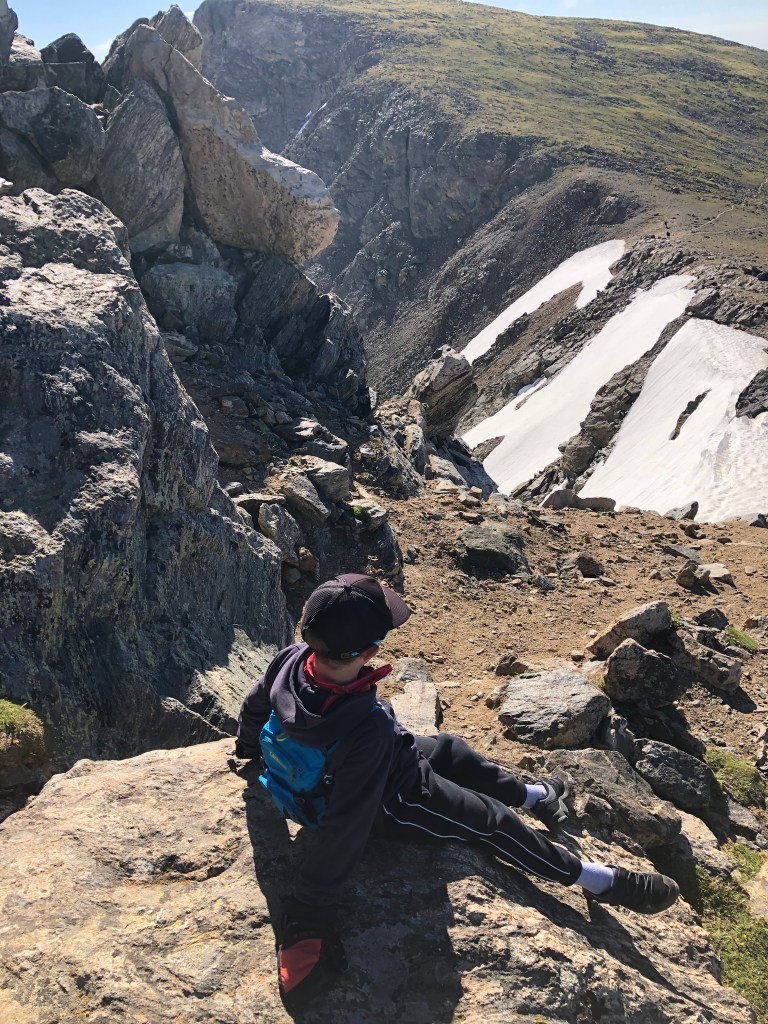
South Arapahoe Peak, yesterday

Given the simultaneous outbreaks we have in the US, our media is going to have plenty of fodder for negative stories this month.

If you follow the news cycle closely, then this could be a tough few weeks for you.

Consider scheduling a few days offline.


The route follows the left skyline – it was at my limit for “unroped spicy with two of my favorite people”

If you’re sucking in a lot of negativity then you might find spillover inside your head. The spillover may manifest as a negative voice beating you down internally.

A lot of us aren’t able to “hear” the soundtrack in our heads. As a coach, I would notice it when my athletes had a habit of negative expression in voice and written words.

To counter a habit of negativity, I’d assign an excerise => buy a small notebook and end each day by writing down one positive thing that happened.

Every single day.

Life happens where you focus.

Change your focus, change your life.


Ax-man was a little buried by the end of the weekend. When it comes to fatigue, he has developed excellent coping skills.

Our Science Fair was a huge hit.


Secret ingredients to the traditional vinegar/baking soda lava recipe – a little dish soap, a little water and red food coloring – you can see the red chunks in the lava

Public speaking starts at home – learning to listen (and not correct) also starts at home

Spoiled is when you think your life is difficult but it isn’t.

Living under COVID is difficult in many ways. We are learning to embrace and enjoy our challenges.

It would have been very difficult for me to engineer rapid positive change without the challenges of closures, home school and social isolation.


Byrn Family Fitness Center – if there’s a will then you can figure it out. Picture is our Saturday morning fitness program. My son is finishing his “walk back” – I’m running my hill repeat in the background. The local college kids have embraced our street and we see some spectacular runners blaze past.

Personal responsibility is a key value of mine. In the past, this was to the exclusion of maintaining relationships. My kids have helped me do better with finding a balance between hard and soft skills.

Lots of personal responsibility was on display this past weekend: packing our own gear for a climb, learning to recover from a deep bonk (with grace and without blaming anyone), taking care of siblings.

The habit of having to take care of ourselves at home is spilling over into our larger lives.


Ax looking down the wrong turn I was about to make for my family. Thankfully, we managed an upward traverse back onto the main route.

Money and Kids

The basics:

  • An unconditional allowance set at $1 per week, per year of age
  • Money sits with Bank of Dad and yields 10% APR – I want my kids to get very excited about compound interest – we have a generation of kids growing up in a no-yield environment – this will have a HUGE impact on our societies – don’t know specifics but do know it will change finance for a long time
  • I hold a veto on any spending out of the “allowance account” – there is no obligation for me to be reasonable – if you disagree with my decision then…
  • Buy it yourself, kids can earn their own money – own money equals own choices – I want my kids to get excited about providing value to others and earning money for themselves – this is much more important to me than winning in sport
  • Summer reading prize – read every day across the summer and get a very good prize – it costs me $100 per kid, per summer, to create a habit of morning reading, without being asked!

The incentive structure has been successful.

Our latest addition is babysitting – our oldest taking care of our youngest. We’ve settled into $7 per hour for the oldest with $2 per hour to the youngest at the same time. We give them a written schedule with some easy chores to complete. This is the easiest “kid combo” for us to manage – the older sister/younger brother dynamic hasn’t been figured out, yet.

Another popular product is exterior cash wash at $5 per car, per kid.

Our oldest makes scrunches, masks and children’s stuffies. Orders, pricing, manufacturing, delivery… all sorted by her. Since school ended, she is averaging $75 per week of supplemental income.


Dawn breaks near the 4th of July Mine, Indian Peaks Wilderness

Assets with high holding costs

2020-05-13 13.49.25-1

With all the talk of indoor transmission being more likely (than outdoor), we’re moving martial arts outside whenever possible.

+++

I’m going to chat you through the financials of a rental property I used to own in Tucson.

This will help you understand the situation facing airbnb hosts and other owners of assets with high holding costs.

  • Picture a condo, bought and furnished for $75,000.
  • The condo has a current value of $100,000.
  • The condo doesn’t have a loan against it but costs $8,500 per annum to hold (8.5% of value). The high cost to hold is due it being a fully furnished rental => things like taxes, HOA, cable, insurance, utilities…
  • The furnished rental does great and yields net cash flow of $4,500 per annum after all expenses, taxes and commissions => 6% of cost.

This was a good investment but I sold out, and switched into Boulder real estate, with a mortgage. Here’s what I switched into:

  • Cost to hold the house (mortgage, taxes, insurance and maintenance) => 3% per annum vs 8.5% for the condo. Without the mortgage, the cost to hold the house drops to 1.25%.
  • Worth emphasizing the debt-free annual cost to hold comparison => condo 8.5% vs house 1.25%
  • House has rights to land, condo doesn’t include any land rights.
  • House has alternative uses… can live in it for the cost to hold, or rent and receive a net yield of 1.5% (2.75% excluding the mortgage).

Both locations worked out.

I checked on the condos yesterday and they were selling at ~$150,000 pre-virus, up significantly from 2008-2010 crisis values.  Boulder housing has seen similar appreciation.

What concerned me in 2012, when I sold, was the high cost of ownership, which can bite in a downturn.

Picture the condo debt financed => this is the issue facing aggressive airbnb hosts

  • A $75,000 purchase, with a mortgage of $65,000 against the property
  • To buy the place, you needed $10,000 of equity, which appreciates to $35,000 as the capital value rises (on paper) to $100,000.
  • The paper profit is 3.5x your money (yay) => you get this from 33% market appreciation, similar to what has been seen in many markets over the last 3-5 years.
  • But… the Virus pops up and the property is going to cost you $7,500 of new cash to hold for the 1st year of the crisis => 7,500 / 35,000 is a negative 21% return on equity.

All of a sudden, the warm feeling of paper profits is replaced by the reality of writing checks, monthly, for a vacant rental.

Depending on your tax bracket, one year cost to hold might be the equivalent of the last three years profits.

+++

The high cost to hold can bite in different situations.

Club Memberships => $50,000 to $250,000 membership initiation fees with annual dues of $5,000 to $25,000.

You can find yourself in a contractual relationship where you are required to pay 5-20% of membership value in a downturn.

Now picture a club with 10-20% of the membership unemployed, or ill with COVID.

+++

In a world with: (a) very low discount rates; and (b) professional compensation under pressure, the “penalty” for paying through a downturn/crisis is accentuated.

Many asset owners are likely telling themselves they are simply facing “one bad season” and things will get back to normal soon.

Perhaps.


Corona Diary 5 May 2020

2020-05-04 10.14.02

Write a kid, it will do you good.

+++


“If you want to determine the nature of anything, entrust it to time: when the sea is stormy, you can see nothing clearly.” Seneca — Daily Stoic (@dailystoic) May 5, 2020

I noticed that Buffett sold out of airlines, completely. Elsewhere, I read about his concern about being an owner of businesses that consumed cash.

The quote above is another Buffett/Munger point => how difficult it is to wait, watch and be patient.

The challenge of no-action, waiting for the sea to calm => made easier by a combination of cash-generative assets and cash.

+++

I was asked for my opinion about inflation/deflation.

Before offering thoughts I want to share a portfolio. The ratios can be tailored to your personal situation.

  • Net Cash Generative Real Estate [See Note 1, below] => 2 years core cost of living
  • Equities => 3 years core cost of living
  • Bonds/Cash => 2 years core cost of living
  • Recourse Leverage => none

(a) I like to think in terms of “years” because it provides a big incentive to keep my spending aspirations modest. (b) The 3:2 ratio, above, implies a 60:40 equity/bond portfolio. (c) Core cost of living => cash it takes you to survive one year.

Pause and think about the above portfolio in deflationary, as well as, inflationary environments.

  1. The portfolio is not optimized for any scenario, there are aspects that will get hit hard. This is OK and to be expected.
  2. The portfolio can survive different scenarios.
  3. You can spend a lot of time tinkering at the efficient frontier but it won’t get you much in the real world.
  4. Get yourself to a position that’s “good enough” and lets you sleep at night => then go out and focus on living your life as best you can.
  5. Pay careful attention to decisions that impact time, rather than money => time you have in your week, time you have in your life, the quality of your time and what you will spend your time thinking about.

The portfolio need not contain solely financial assets: education, time, youth and other options are important sources of family wealth.

About the likelihood of hyperinflation and depression-style deflation…

  • …the levers being pulled have no historical precedent => from this morning, US Federal Government borrowing $1 Trillion per month this quarter
  • …the levers are being pulled different directions by governments, corporations, consumers and central banks
  • …the levers impact the price of goods, services and capital in different ways

The system is complex and opaque, with feedback loops, 2nd and 3rd order effects => the system is fundamentally unknowable => I should constantly remind myself of the truth of unknowability and avoid people who have a vested interest in impairing my thinking.

In lockdown…

  • my most challenging work is increasing human capital via home school, while modeling a strong marriage for my kids; and
  • not decrease human capital by becoming a casualty, myself!

+++

I’ll end with a picture of what I saw when I came downstairs this morning.

Our youngest, mirroring what she sees around her.

Warms my heart!

2020-05-05 06.39.53

[Note 1] Real estate that is a net cash drain can be a source of stress (for you) and fragility (for your family).

One of the two best investment decisions I made in the last 24 months was renting in Vail. The other solid decision was not redeveloping a site, at a time when people were making (on paper) $1 million per flip with high-end renovations.

Capital, used wisely, gives you to ability to not-act and be comfortable sitting in an enviable position.

2020-05-05 06.39.56

Fear and Panic

Yesterday, my local CostCo sold out of Charmin in 15 minutes.

My cognitive capacity is so lit up I can’t remember my daily calendar.

Stress makes us stupid.

So…

#1 – execute my strategy, made before the current crisis

One of the nice things about following a rebalancing strategy is you are very likely to have sold (a little) at the peak. My pre-crisis rebalancing happened January 4th and I sold enough to cushion the psychological impact of recent declines.

I rebalanced on Monday and again today.

Limit down opens => phew!

#2 – lean into fear

Since 2014, my portfolio assets have been 60/40 in equities/bonds. For the last six years, I’ve expected bonds to get hammered by rising rates. It didn’t happen. Been wrong the entire time but it didn’t hurt me.

For my long-term capital, I’d rather use a 90/10 strategy (90% in equities). The trouble is getting there. I have zero confidence in my ability to pick the right time to shift. So I created a re-weighting strategy based on VTSAX/SP500.

A simple rule: as the market moves from 20% down to 50% down, I will rebalance equities upwards from 60% to 90% of portfolio holdings.

Today’s rebalance moved me to 63/37. The 63 is held 42/21 VTSAX/VTIAX.

Simple to execute => each time, I rebalance I check the %age off the peak, if we’ve set a new low then adjust the equity weighting upwards. Otherwise, steady as she goes.

This simple strategy is not easy to do => either I want to rush more money in (FOMO) or hold money back (plain old fear).

#3 – real estate

When your neighbors are stocking up on TP in preparation for the end times… it’s generally not a good time to be selling real estate.

What about buying? Real estate prices respond much more slowly to feelings/sentiment. At the last downturn, local real estate didn’t “get cheap” until 18-24 months after the crisis.

I suspect we’re going to see the residential market stop dead for a few months.

After that? I have no idea.

#4 – family

My family has been watching me stock the house for three weeks. They were amused but now we are ready.

I’ve been reassuring the kids they are going to be OK. There’s a lot of fear around.

At school, our youngest heard that “old people” were dying. She took me to one side and asked if I was going to be ok => Yes, Sweetie, I’m going to make it.

That said, a finance background is useful for understanding the impact of compounding. Our state saw a 33% increase in positive tests today. Keep that going through the end Spring Break and we will have 4,200 positives in 16 days (from 44 at Noon today).

Notwithstanding an absence of positive tests in Boulder County, I’m going to start home schooling on Monday. A significant burden on myself but a small price to slow the spread.

#5 – community

Will Colorado’s experience follow Italy, Hong Kong or Taiwan? I don’t know.

What we know for certain is there will be a large, sudden burden on the lower end of our communities. Consider giving a sizable donation to your local food bank.

We also know we will save lives by staying away from each other.

#6 – immunity

Something simple, but not easy, for readers of this blog => cut your training in half.

Take your program, cut it in half and watch what happens with the infection rate in your state.

If your state is on a log-scale infection rate then it will become apparent far more quickly than any fitness loss.

Your immunity will get a boost from this change and you’ll preserve all the health benefits from exercise.

#7 – cash, debt and leverage

If you have an emergency fund then this would be a good time to make sure it is liquid. I have three-months expenses sitting in my checking account.

Not willing to lean into the market downturn? Consider using surplus cash to pay down debt.

If the downturn persists then do you know what can ruin you? There are many types of leverage => I’ve written about this a lot.


Diversity of Thought – Things we can’t imagine

2020-01-05 14.39.11-1.jpgA popular theme in the media is handwringing about the divisive nature of political discussion. Everything would be much better “if we could just get along.”

I’m not sure.

Social systems tend to overshoot, overreact, over-everything. When we have widespread agreement (think totalitarian states) humans tend to drive the bus off the road.

Can you name an area where we have wide-spread agreement across the political spectrum?

I can.

Deficits, borrowing, bonding.

Left-right, north-south, east-west, up-down, local-state-national-continental => near total agreement on the benign nature of government debt.

Because disagreement limits the size of potential errors, total agreement worries me.

A surprise in my 2019 was my state’s voters not approving a change to our taxpayer’s bill of rights. It is the only constraint, on the ambitions of government, I noticed last year.

We should not expect government (or friends & family) to “do the right thing” in advance of a crisis. Human nature isn’t designed to work that way. An increase in our collective tolerance of regulation and taxation (ie pain) doesn’t happen until after a crisis.

Our collective problems won’t be addressed until after they blow up.

My individual risks, however, can be addressed right now.

A collective belief in the benign nature of debt is self-reinforcing. While the debt cycle expands, asset values are inflated, consumption is pulled forward and economic growth is nudged upwards. Because of its ability to feed on itself, debt expansion can continue for a very long time, particularly with interest rates near zero. Ultra-low rates enable lenders to fool themselves about the credit quality of the marginal borrower.

What to do?

Life is not filled with only bad news! Am I able to take advantage of unexpected positive surprises?

It’s counterintuitive but I’m positioning myself to borrow a lot of money. My 2020 project is creating an option to borrowing 30-years fixed at an interest rate that none of us can currently imagine.

How might unexpected negative surprises wipe me out?

Consider who is getting out of hand with their current borrowings. What’s the credit quality of… your employer? your family? your largest customers? your local/state/national government?

Do you work for a high-leveraged company, in a state with massive unfunded pension liabilities, while rolling your credit card balance each month?

Hidden liabilities lie (mostly) hidden. Ponzi schemes, unfunded retirement benefits, promises for future spending, fixed price contracts… think about your life. Where do you have exposure to a single person, CEO, manager, employee, fund, investment? In an easy-money environment, it is possible to hide significant liabilities.

Things we can’t imagine are likely to be underpriced.

Kinda tough to imagine the unimaginable! What seems impossible to imagine? Inflation, interest rates at historical norms, rapid nominal growth, credit crisis in a large sovereign, large hot-war…

For me, the goal is not to predict the outcome. My main goal is to protect my lifestyle from shocks and surprises.

To make it real, I ask, “what could blow up ski season?” Health, injuries, illness => my current risks are more human, than financial. Think beyond the money.

To focus on new ideas requires us to reduce the noise in our lives. Are you engaging in a policy of constant distraction?

There is a lot we can do to manage our exposure to the errors of others. Bad companies, bad relationships, bad government… many of us have the ability to pack up and leave. I’ve lived and worked in eight different countries, on three continents. Gradually working towards a situation where the main person who can hurt me is myself!

As a young man, I spent many years exposed to the errors of a single individual (my bosses and my business partners). More common is exposure to the errors of a single corporation.

With preparation, you can benefit in times of stress, but first you must survive.

Rent vs Buy in Vanity Markets

2019-12-07 09.28.44A vanity market is one where the main benefit you gain from ownership is telling your pals that you own.

Similar to my observation that I was wired to buy a “big” house, there are other purchases our ego gravitates towards: cottage at the lake, ski chalet, big-city pied-a-terre, beach house, farm…

Our ego’s weaknesses depend on our cultural background, childhood memories, current mood and social situation.

My ego can lead me far astray, particularly with non-yielding real estate, and depreciating assets.

I’ve been battling with myself since I first visited Vail, Colorado. I’ll illustrate with real figures from the neighborhood of East Vail. It is a niche market, which I’ve been following for 16 years.

The “buy” => $1 million buys you the opportunity to spend another $375,000 to renovate, and furnish, a property that was build in the 1970s. After your renovation is done you pay ~$25,000 per annum in taxes, insurance, HOA and running costs.

The “rent” => $25,000 to $40,000 all-in rental cost for the same property.

Something we noticed about skiing, most skiers don’t ski.

Put this observation another way… there’s a lot of empty real estate around.

I’m sure every empty place has a history of buyers, who were certain they’d use the property more often than they do.

A useful rule of thumb is to assume that every $1 million, in a vanity property, costs your family $50,000 per annum. Renting makes (some of the) opportunity cost real, and allows you to calculate the cost-per-night of what you’re using.

Above is what you can see and calculate.

What about what you don’t see?

#1 => the option to change your mind, without cost or hassle. This is a powerful argument when framed correctly.

Honey, the kids are going to grow up and leave. When that happens, our life will change in ways that are impossible to predict. We should maintain the flexibility to change our minds.

#2 => the option to buy in a downturn. About once a decade, property values snap downward. Waiting does not feel like a valuable option but it is. I’ve seen brief, 50% markdowns numerous times.

#3 => what I think I will like does not match what I actually like. I am a master at fooling myself. Fooling myself with regard to location, views, amenities, garages, layouts… you name it.

Renting “forces” me into different types of properties. Because mistakes are so expensive, I write down the lessons from every new property.

Here’s the best lesson of all…

Assets don’t create the life you want to lead.

Focus on shared experiences with the people you love.

2019-12-07 13.11.17

Family Real Estate 2019

2019-12-01 17.07.49I like investing in residential real estate for several reasons:

  • The market is dominated by unsophisticated buyers/sellers, who are often driven by external events and emotions;
  • The availability of long-term fixed-rate non-recourse finance; and
  • Favorable tax treatment.

There are some drawbacks:

  • It is extremely expensive to buy and sell => a mistake will cost me 10% (gross), if I am lucky. If borrowing, even conservatively, then I can lose 35-50% of my equity in a year.
  • It is lumpy => if you need the money back then it is very difficult to gradually drawdown your investment.
  • It is illiquid => if we _really_ need to cash out then we won’t be able to cash out
  • Humans are hardwired to over-buy => as soon as I could afford a huge home, I bought one. It took me years to get my capital back. I was very lucky => I purchased with a large margin of safety (no leverage, big site, big building, prime neighborhood).

Taking the above, together, real estate is a useful core holding for money that won’t be needed for 10+ years.

2019-11-14 14.33.15

I follow two types of markets:

Markets where growth in prices is driving by “wealth feelings” in the top 0.01% of society => Vail mountainside homes, Boulder view properties. These properties have done well, appreciating to levels where implied yields are -2% to 2%.

I prefer to invest in traditional markets => markets where price growth is backed by a combination of real-economic growth (ability to pay), construction inflation (replacement cost) and discounted cash flow (net yields above my cost of capital).

Both markets are influenced by the availability of credit. Both markets benefit from scarcity and desirability in location selection.

Remember that even a “cash buyer” is influenced by easy credit. Credit conditions influence the value of ALL assets => wealth effects. These wealth effects cut both ways => highly wealthy people can feel “poor” when their balance sheets are shrinking.

2019-12-02 06.29.25

When I buy, I create a margin of safety by seeking:

  • Land for cheap => is there extra land I could sell off or am I buying in a very desirable location.
  • A lot of square footage for cheap => ideally, I’d like to get the land for “free” by paying less than the replacement cost for the building. Even if you never build, it helps to know building costs.
  • Distressed seller => life happens, often at inconvenient times.
  • Closed credit markets => by ensuring I have the ability to hold through tough times, I can use unallocated capital to buy during down markets.

I’ve been preparing for my next deal by improving my credit worthiness:

  • Building up a capital reserve.
  • Improving my credit rating – paying credit cards early, taking advantage of a 60-month 0% car loan offer, always paying my mortgage on time => taken together these strategies added 80 points to my credit score from 2012 to 2019.
  • Reducing leverage => paying down my mortgage and car loan. Closing out my second mortgage.

2019-11-21 08.02.40

We’ve seen significant house price inflation in Boulder => supported by: (a) rising construction costs, (b) local economic growth, (c) inward migration of wealthy coastal buyers, and (d) easy credit terms.

In 2019, I looked at deals to increase investment in Boulder (buying apartments and renovating houses). In the end, we decided to decrease investment in real estate through a sale-and-leaseback of our home. 

The leaseback costs me some tax (today) and positions me to borrow long at favorable terms. The option also costs me the future capital appreciation of my home, which won’t be mine any more. We retain exposure to the Boulder market through rental properties we own.

I’ve structured the deal with vendor finance, allowing a gradual drawdown of the proceeds. The net monthly cash flow covers our cost of living through my youngest daughter’s high school graduation. Having our cost of living covered protects my ability to control my schedule => highly valuable to my family in a way that’s difficult to quantify.

This is the cheapest way for me to sell real estate and positions us to buy when conditions swing in our favor.

Raise money before you need it.


#RWRI Thoughts on the business model and cleaned up notes

RWRI has a fantastic business model.

  1. Make the faculty your friends and investment committee
  2. Get paid to meet for a week each trimester // you have a no-cost central office, you are getting paid to bring your international (virtual) business together for a week
  3. Record your talks to capture new ideas, spontaneous content
  4. Train the students who will take your work forward when you are gone
  5. Receive feedback about how your work is being used in the world
  6. Up-sell your most passionate (book) customers => Robbins model
  7. Create an environment where you expand your network with people likely to engage and help you => HUGE self-selection bias in student population
  8. Invite world-class speakers in areas where you’d like to learn

This business works well for its owners and they are (more than) smart enough to see that.

Keep it small, sell out each meeting, avoid the temptation to expand and remember why you started.

I cleaned up my handwritten notes via the creation of a Google Doc.

Mistakes remain my own.

Considering Wealth at the Real World Risk Institute

2019_HalloweenTo shake up my thinking and expose myself to highly-believable people, I attended the two-day program at Nassim Taleb’s – Real World Risk Institute.

You can find my daily notes here. Cleaned up digital version of my notes here.

What follows is my thinking on wealth inspired by what was presented. Mistakes are my own. I can hear things differently than what was actually spoken, so don’t assume my attributions are strictly accurate.

To prepare for the clinic, I re-read the Incerto and I’m glad I did it. Each pass through Taleb’s work provides additional insight. You can find his lectures and lessons on YouTube => well worth your time!

We live in a world where a single bad decision can have massive costs => a few thousand dollars and four days of my time is a small price to (try to) think better.


One of the aspects of my job is guiding the transition of wealth between generations. This sounds sophisticated but it’s a role played by elders and parents in every family system.

My personal greed makes me too focused on financial wealth. It takes effort to step back to see wealth as including:

  • The ability to say “no” to others
  • The ability to keep promises to myself
  • Control of my schedule
  • Health, athletic functionality and contentment within my body
  • Love and companionship – the ability to share experiences
  • Engagement via teaching (my kids, my students, anyone who’s open to implementing what I’ve learned)

What I’m shooting for is creating a strategy, so effective, so straightforward, that an idiot could execute it and preserve wealth access generations.

This is what Taleb calls “Zero Intelligence Investing” but we are focusing on a broad definition of family wealth, across generations, through time.


The impossibility of prediction

Joe did an excellent job of demonstrating how complex systems (even those built on very simple rules, defined by the observer) can be impossible to predict. More specifically, certain systems can only be understood, defined, by running them forward in time. He laid out a host of reasons, any one of which could prove the folly of prediction.

Consider your own life. Cut your age in half, how would you have defined wealth at that age? In my case (25 years ago) the list might have looked like:

  • Wine, women and song
  • A ton of work that pays well
  • Watching my personal balance sheet grow
  • Being very strong in the gym
  • Travel to new places

There was no way to predict my values (today) without living through the 25 years from then to now (the divorces, the insolvencies, the setbacks, the pain of toddlers, the post-traumatic growth).

Because of the role of time in life, we can not predict the future.

However, we can have useful ideas about what not to do. We can get a handle on what might ruin our families.


So if my goal is to preserve, ideally grow, the collective wealth of my family system what can I do.

  • Be vigilant about ruin (in fat tailed environments)
  • Spot, discuss and remove fragilities
  • Position the family to benefit from positive optionality

One of the things Taleb does best is consider his best ideas across domains, gain insight then translate his insight to the reader via real-world examples. It is the secret sauce of his success.

BUT, reading great ideas doesn’t improve my life! I need to go the next step and tinker with a limited number of outstanding ideas.

Who gets the benefit of your best ideas?

Taleb’s best ideas…

Ruin via the fat tail hitting my fragilities => fancy way of saying don’t blow yourself up! I’ve written about this a lot: Taleb’s written about Russian Roulette => his 1,000,000 chamber gun story in Fooled by Randomness changed the direction of my life.

In the seminar we talked about the non-zero risk of a “zero-risk first cigarette.”  Why does a (near) zero-risk choice have a non-zero risk in our lives?

“In life, you must assume that you’re going to take the risk again, and again, and again.”

This completely changes the calculation with regard to the “first” taste of risks that might ruin you: alcohol, rage, opiates, cocaine, sleeping pills, infidelity, felonies, roulette, recourse leverage, luxury spending, unnecessary capital projects… things with the potential for large and unpredictable downsides. Bad habits are always trying to seep into my life!

So, to preserve wealth, you need a process to remove your fragilities, because these are what’s going to ruin you. My family history has persistent, recurring fragilities that hit us hard.

The first step is to gain control of your schedule and create space so that you’re able to think more clearly about what can ruin you. Simplify.

Another great insight – life is not about avoiding risk…

“Take chances, lots of them, and focus on areas where volatility works for you.”

In an uncertain world, one of the best sources of optionality is non-recourse finance.

My first career (Private Equity) could be described as getting overpaid to hold a call option over other people’s work, using other people’s money, without recourse.

Negative action is powerful medicine, with low side effects.

It’s tempting to ask Taleb “what to do.” I did, twice, and he didn’t seem keen on advising positive action with regard to an unknowable future. That’s probably good, as I’m not equipped to implement, or even understand, his technical advice. However, his negative advice (on what to remove) generated huge wealth for me => my total cost was the price of buying Fooled by Randomness on Amazon ($10.17 in December 2005 – my Christmas 2005 reading list, you can skip the flat earth book, the rest were great).

There are many sources of optionality:

  • where I have limited competition
  • where I understand the domain as well as anyone
  • where the cost to enter is small

A few ideas:

Get married, have kids, then take excellent care of everyone (!) => dementia is in my family tree => doing well by my family is the “cost” of a call option for times of future stress => an option that has a constant payoff in companionship, personal growth and a semi-captive audience for teaching.

Technical education in a robust field => look back in time for Lindy professions => spend time and effort for continuous education

But be careful, the “honors” part of my college education (1st class honors Econ/Fin) proved to be technically useless. However, it helped get me a seat at the table in Private Equity. The overall degree taught me valuable skills with regard to financial accounting, programming, mathematical finance and calculus.

Knowing how to count, and being exposed to the way people seek to cheat you, these are useful life skills to prevent ruin. – quote mine

Other sources of optionality => tinker within your social network, attend conferences (and force your introverted self to speak to people), write (then publish), talk to believable people that disagree with you, donate time to people who might benefit from your technical skills (especially within your local community)…

Your body can be a call option on: future mates, future physical experiences, the ability to lift your carry-on overhead as you age…


So the “how do I stay wealthy” answer is about removing fragilities => cutting back a high cost of living, habits with large potential downsides, physical weakness…

The “how do we best grow wealth” answer is about exposure to opportunities that open up the possibility of growing True Wealth (connection, experience, engagement) => each generation can, and should be encouraged) to, contribute based on their current, unpredictable and changing definition of wealth.

Together the family creates its own definition of wealth.

Each generation re-defines wealth based on its collective values.

I would have learned more if I stayed for the entire week but it’s Halloween tomorrow and I got more than enough from the experience.

Hidden Debt – Hidden Risk

IMG_5565.JPG

This is the debt story of zip code 80301-80305.

As many won’t follow this post, I’ll give you a rule of thumb.

If you are under 50 years old then reduce your social security and defined-benefit pension assumptions by 35%.

…and plan on working an extra five years.

What follows is why.


Back in 2005, I came across covenant free loans => banks lending money without rules or restrictions. That observation, combined with reading Fooled By Randomness, started a process of de-risking my life.

Despite taking a whack to my family’s net worth in the last recession, life has worked out well.

It worked out because I had reserves to get me through the tough years.

Collectively, our reserves are being spent on our behalf.


This fall Colorado is asking voters to approve a modification to TABOR, our state’s “bill of rights” for taxpayers. The supporters have a strong pitch, if you vote in favor then the money goes to schools and roads => I love schools and roads!

At the last recession, I was burned because I increased spending to the top of the cycle. So I’m inclined to keep the state’s powder dry for other uses.

What other uses?


PERA => our public employees retirement fund => we’ve been told the fund was fixed last year. The fix assumed net returns of 7.25% per annum going forward. However…

if PERA’s actual returns are 6.75 percent, the debt grows by $5 billion.

Round numbers, every 1% shortfall in PERA net returns creates a need for an additional $10 billion. As I publish this article the 30-year treasury is trading at 2.24%. A net return of 5% over treasuries strikes me as unlikely.

How does that potential shortfall compare to State Tax & Excise Receipts?

Fiscal year 2019/20 Colorado revenue receipts are forecast to be $12.6 billion.

Now, you don’t need to fund a pension deficit immediately. It can be dealt with gradually with a mix of benefit cuts, increased employee contributions and increased government funding. That’s what all parties did with the 2018 fix.

It’s a safe bet that state taxes are going up and benefits are going down.


In the last recession, my unemployment resulted from the credit markets slamming shut and creating a liquidity crisis…

  • The bank went bust
  • The developer went bust
  • The general contractor (and many of its subs) went bust
  • The management company went bust
  • The equity went to zero (within 90 days)

All of the above, culminated with the CEO going bust.

Chains of debt are lethal in recessions.


Noticing the debt bomb sitting in Colorado PERA, I asked myself, “Where else have people borrowed on my behalf?”

  • School district borrowing => ~$800 million in my district => money very well spent to strengthen our future tax base
  • CU Boulder is my neighbor => ~$1.5 billion on their books => the university has a big impact on my local economy and real estate market
  • City of Boulder => ~$225 million => big ballot initiative coming as they want to borrow big, take technology risk and purchase utility assets on our behalf
  • County of Boulder => ~$200 million at the end of 2018
  • State Level => ~$10 billion at the middle of 2018 => over $50 billion if PERA used a rate of return similar to my own

Sitting above it all => $1 trillion Federal Deficit and $22.8 trillion of National Debt.

There could be some double counting and I might have missed another public entity that can issue bonds on my behalf. The precise numbers don’t matter.

This is what matters…

#1 – there is leverage through the entire taxpayer chain with no consolidated visibility or oversight. No consolidated financial statements for you, the taxpayer. The ratings agencies have the entire debt chain rated as very safe. Does this sound familiar?

#2 – every single government entity that touches me has a debt-financed cash flow deficit and off-balance sheet commitments. This sounds familiar as well.

Debt financed, cash flow negative entities blow up.


I remind myself:

  • As a society, we can’t increase taxes at every level simultaneously. This counters my thought, “it will work out, I’m lightly taxed right now.”
  • 600,000 members of PERA are at risk and probably taking comfort from 2018’s fix.
  • If you are planning on receiving a defined-benefit pension then cut your assumptions and plan on working (at least part time) until you are 70 years old.
  • People are going to be pissed when financial reality hits their benefits.

What to do?

Protect your family by saving, investing conservatively and reducing your “total tax bill” as a percentage of net assets => this limits the government’s ability to hurt you via tax increases. I’ve been doing this since 1990 and it works.

Let’s say that again because your financial advisor will not focus you on this number…

“Total family taxes” as a percentage of “total family net assets” is a number you should manage downwards across your career.

Knowing that the system is highly leveraged:

  • keep personal borrowings low
  • be careful with long term obligations (leases)
  • don’t issue personal guaranties
  • don’t capitalize luxury spending

Being able to take pain => how might these scenarios impact your family?

  • 6 months unemployment
  • retirement benefits being cut by a third
  • social security benefits being cut by a third
  • portfolio value cut by a third

I’ve lost jobs, written down portfolios (65% in 90 days, ouch!), put my employer into insolvency (on my 40th birthday) and muddled through multi-year cash crunches (2009-2012).

Bad things happen and life remains pretty good even when they are happening => my wife’s companionship and leadership got me through.

Be careful out there.