A coach is someone who can offer correction without causing resentment
– John wooden
When I notice someone has been triggered, I stop.
My life goals do not require me to change other people.
Inverting, being prickly reduces the world’s ability to help us out.
If you struggle to learn from experience then ASK…
What is it going to take for me to trust the process?
What is it going to take for me to trust the coach?
For me, It was watching Nils & Johan take everything I learned about sport and make it better. I wanted to take my knowledge to the next level.
In February, one small choice by Johan, set off of positive chain that brought us together.
Big thanks to you @Alan_Couzens and @feelthebyrn1 for sharing knowledge on the web. It's been a big part of my "studies" culminating in helping NVDP reach his world class performances the last 2 years. /Johan Röjler (personal trainer/coach NVDP since 2019)
Think back, who gets through to me, without resentment?
Combine with goals & VALUES alignment, and you have the ingredients for a valuable long-term relationship.
My marriage
My investment committee
My close friends
My board
All contain people who are able to get through to me. I am surrounded by elite coaches.
In our lives, we will come across people who have the capacity to make us want to improve, and the vision to make incremental suggestions that we can implement.
Pay attention when you feel their positive influence.
2002 / 2006 / 2010 Three Consecutive Swedish Olympic Teams
There are themes that repeat in the LTAD literature.
From 7-10 yo the local parents set up a “sports school.” One day a week, they’d have a couple hours and try different activities
Very active childhood, but no early specialization, Johan’s skate focus started ~13 yo
Continued to play organized soccer/tennis, and lots of spontaneous ball sports, through his mid-teens. His skating coach supported all general training and encouraged him to continue
Ran, cycled, raced Swedish Nationals (road race)
Grew up in a small city, 125,000 population at present
Surprising to me, Johan didn’t come from a Skate Family.
His Dad was a Regional Class soccer player. As the family grew, his father’s focus shifted from his own sports to being a soccer and bandy coach for kids. He continued to run and race 1-2x per year. Johan’s mom was artistic and both parents worked full-time through this childhood.
His entry to the sport of speed skating was via a local club that handled training, talent development and races.
VERY independent in approach – the local club organized bus trips to race in the Netherlands and Germany in his Tweens, without parents, staying with locals.
Johan was the key driver in getting himself to a very high level. The Swedish Club system and local coaching infrastructure gave him the opportunity to train himself to a world class level.
Johan, and I, are very interested in helping our kids excel at sport. It was the #1 topic for our call.
0-2 years old: we are a swim family, our babies all started out very comfortable in the water. If you want your kids to swim then, ideally, continue their natural-born comfort via positive experiences in the water, from birth.
2-6 years old
Movement skills via gymnastics – we didn’t progress into pre-team, very basic balance, agility and movement for all our kids
Swimming – a swim lesson, once a week, every week – from a coach, who wasn’t us.
Soccer Tots – from preschool age, coordination, bit of running, general play
Preschool – three years, play-based preschool where they learned skills to get along with other kids – early socialization in a play-based environment
7-12 years old
Just like Johan, lots of different sports: Thai Boxing, Jiu Jitsu, Indoor Climbing, Swimming, Soccer, Hiking, Running, Downhill Skiing, Uphill Skiing, Water Polo, Indoor Skiing
Some sports come-and-go, continue at least once per week swimming lesson.
Family policy is “do something” – we are willing to change what they do each season.
Lots of activity – competition mostly absent
In this phase, build self-confidence.
Two examples are indoor climbing and skiing. Both sports involve: movement skills, problem solving, fear management and young kids can be better than many adults. Huge confidence boosters for our crew.
No judges, no scoring, we SHARE athletic experiences with our kids.
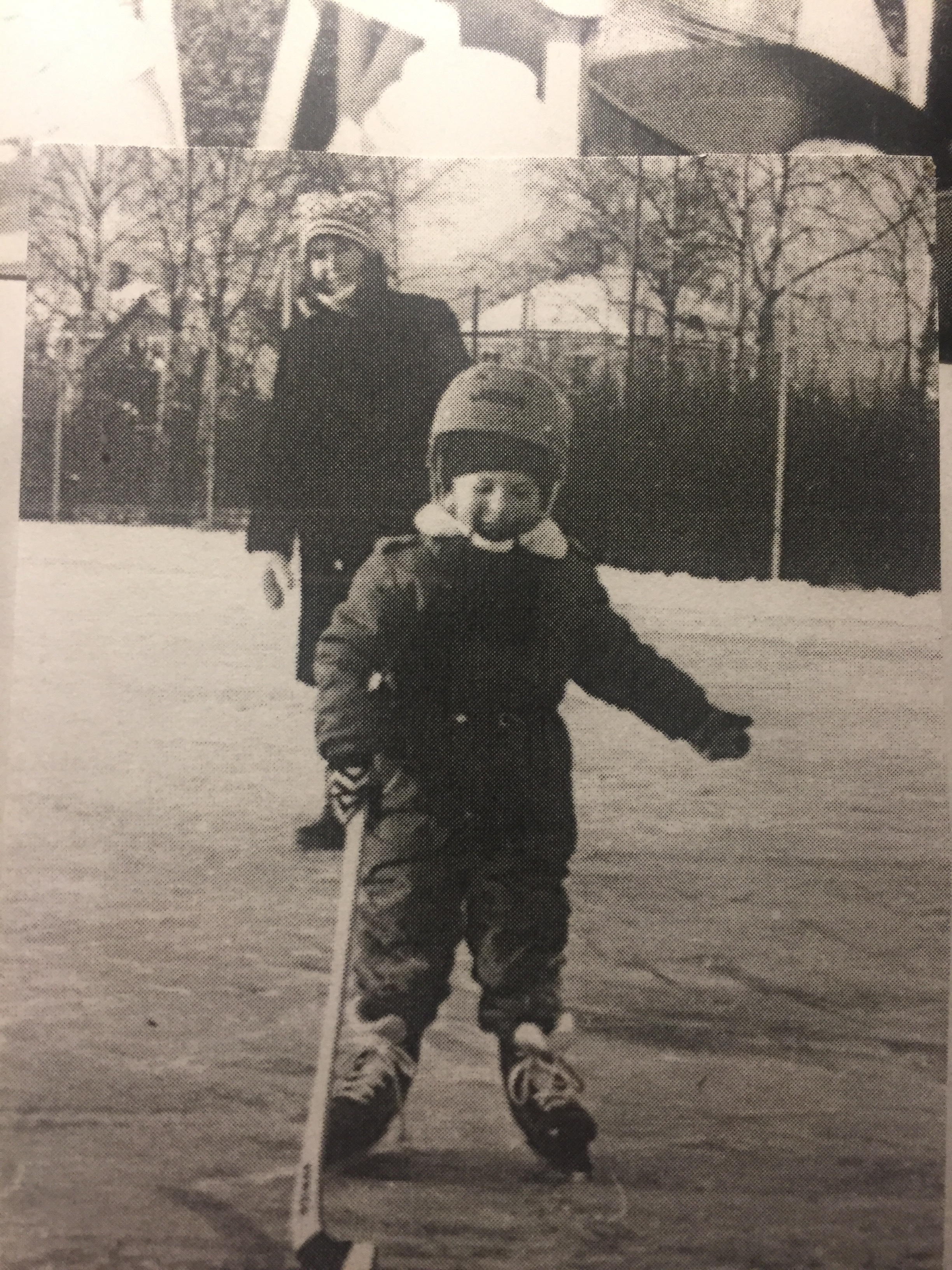
Little Johan in full flight
Race Experience
Something a little different.
Summer Swim League from a very early age (5 yo) for each of our kids.
Intense 10 week summer season where they swim M-F and have a dual meet on Saturday
Touch the water ~80 days across their summer holiday
Finals event with 100s of kids, gives them big venue experience
Positive early race experience by winning ribbons at the dual meets, and eventually medals at the Finals event
Teen Years – like Johan, specialize if THEY want.
Our only policy is that everyone does something, including us.
Our oldest is a swim specialist and soon-to-be 14 yo. She still does extracurricular cross-country running, track and skiing. Her summer swim focus, continues since 5 yo.
We only have negative-control.
In other words, we can screw things up, but we cannot make it happen.
What makes it happen?
Positive experiences
Wide range of movement skills
An environment to excel – access to skilled coaches and motivated teammates
The child’s, and eventually the teen’s, inherent drive
It’s a long road to the top!
Final questions => be brutally honest with yourself…
What do I want for my kids, and why do I want it?
A lifelong enjoyment of daily exercise NOT a self-identity wrapped up in winning!
Am I seeking to compete, or win, through them?
I want to enjoy nature alongside them. Many parents care far too much about results.
Understand my values & biases
We try to keep our kids, and ourselves, grounded by exposure to a WIDE range of field strengths. There is a benefit from getting our butts kicked every so often.
As parents, we are mostly positively reinforcing.
We offer immediate, negative feedback (and event venue removal) when we witness poor sportsmanship. We’ve left sports when we didn’t like the peers.
I did the Rich Roll Podcast this past week (not out yet, I’ll let you know).
We started the podcast with…
My story is proof we all have hidden skills, paths we never see, never take.
I wasn’t setting Summer Swim League records as a kid, I didn’t walk-on to the Stanford Swim Team. I thought I was an average athlete. Turned out, I was an Ultraman Champion.
Every single one of us has a skill, a path, that can dramatically improve our lives.
But we have to start.
That was followed by two-and-a-half hours of chatting!
To wrap up, Rich asked me to give him one last tip. I thought a bit and came up with…
Keep small promises to yourself.
Everything I’ve achieved comes from the credibility I’ve established with myself.
When I started my journey, I had no idea where it would take me.
My elite athletic career dates back to a single choice in 1993 (24 yo).
I was living in London and decided to go for a walk.
One walk led to two.
Soon I was bike commuting to work.
Eventually, I was hiking longer on the weekends.
Years later, I made the decision to do “something everyday.”
Many choices, many years.
Roll forward, ~30 years, I have two promises I’m working on:
Try to help someone online via Twitter
Give it my best shot to get back in outstanding aerobic shape
Both done daily, on a 1,000-day time horizon.
I have no destination in mind.
I’m going to do the work, pace myself, and see what happens.
#1 came from calling my bluff with some feelings of envy I had.
#2 came because my life is more enjoyable with superior aerobic fitness.
Where do you need to face your fears and go for it?
What one thing, if it happened, would change everything?
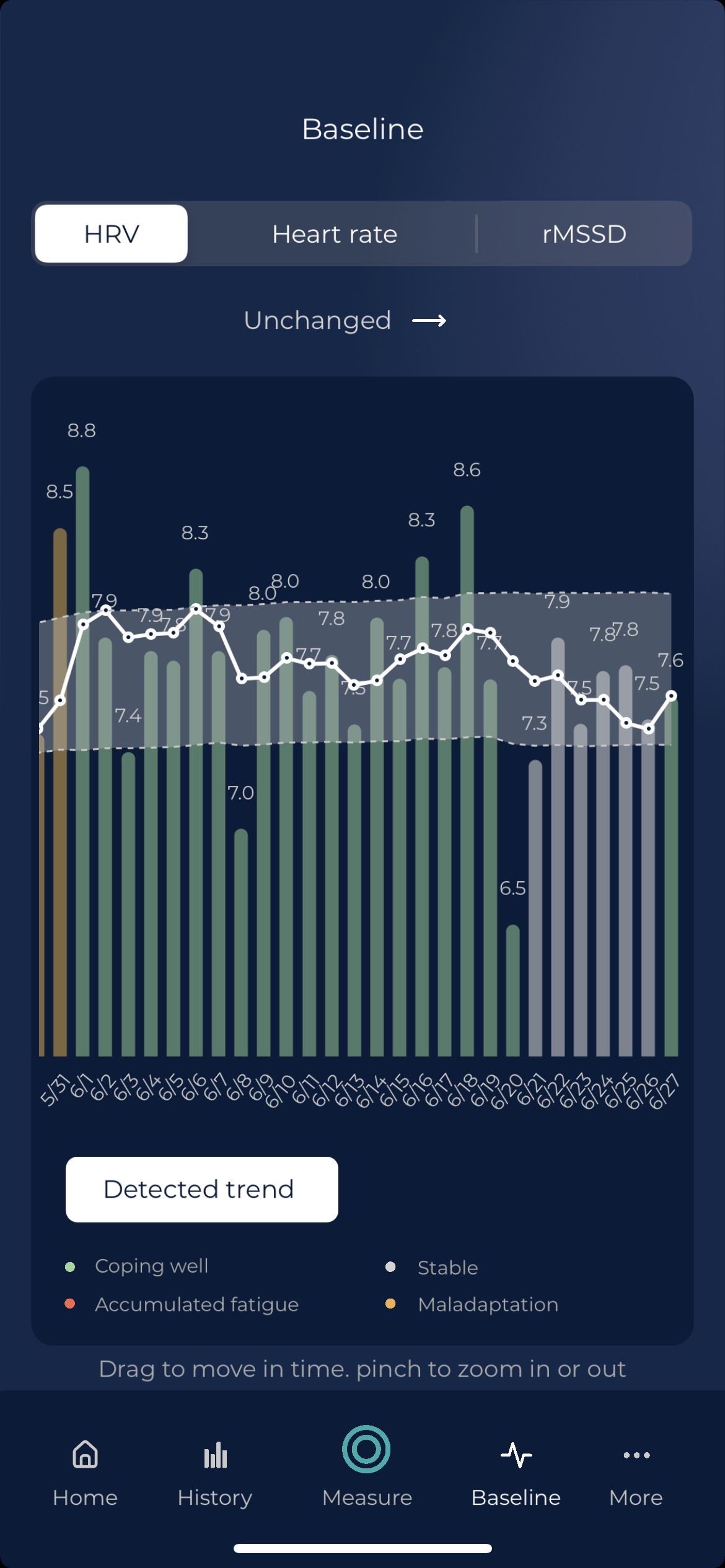
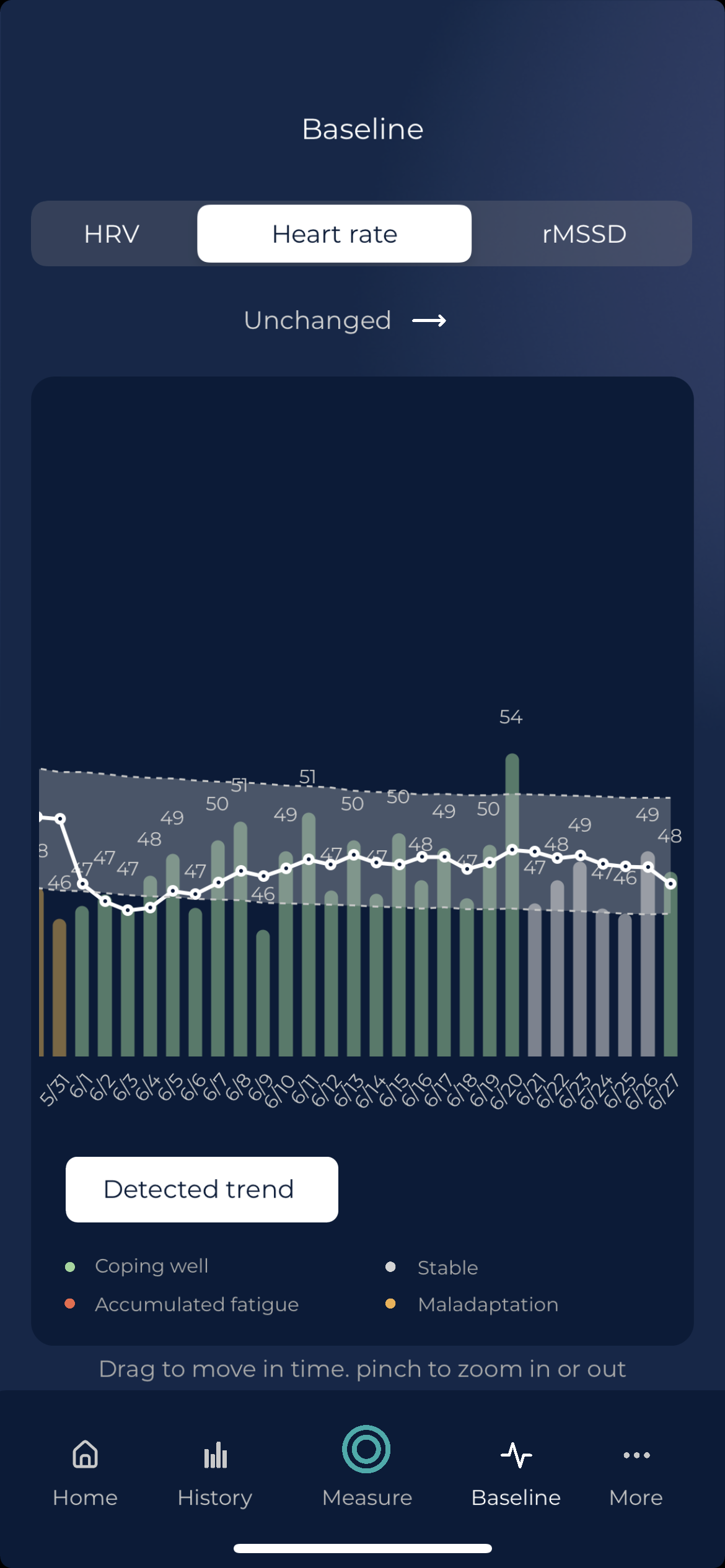
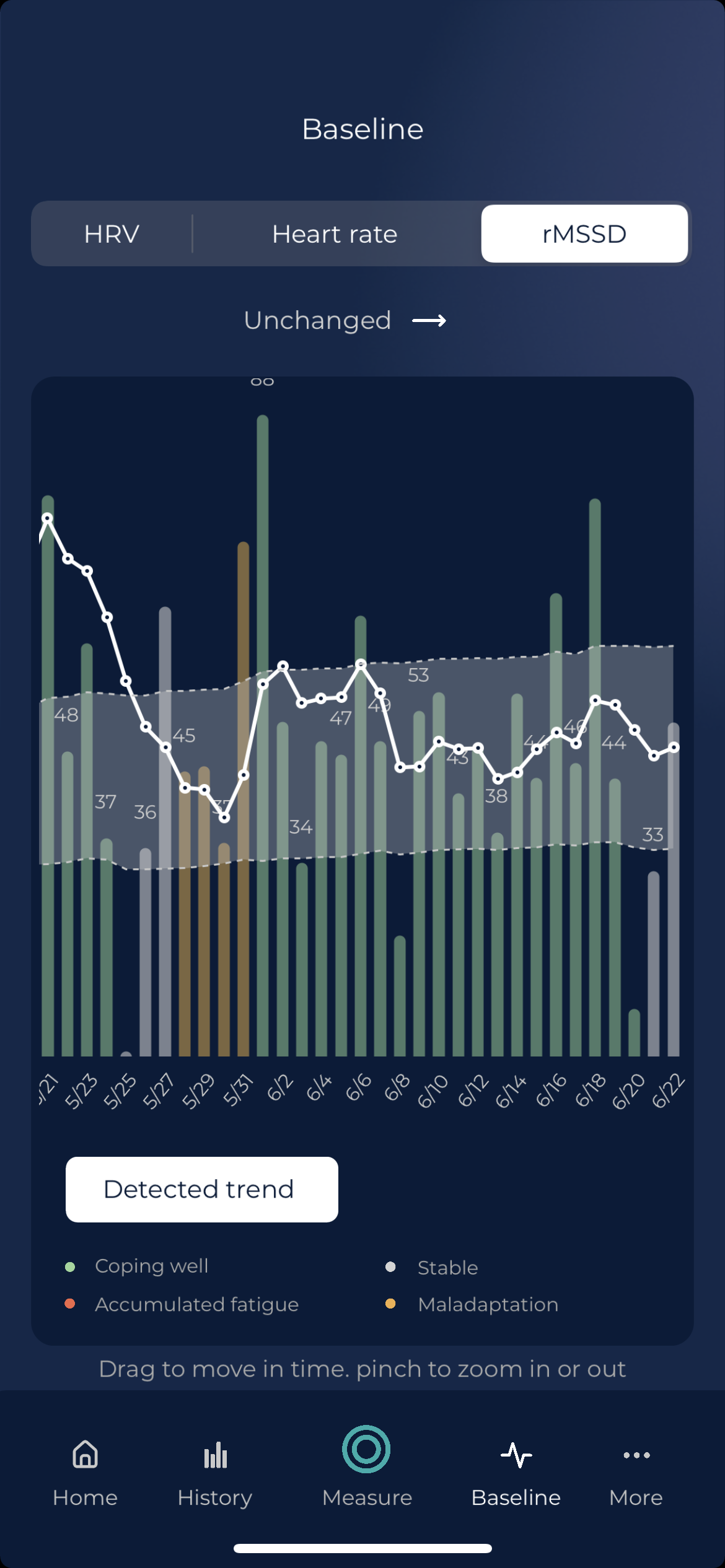
If you pay for the PRO level (HRV app), then normal ranges are calculated and shown with baseline (below).
HRV with trend and normal range – you can pinch to show more daysMorning Resting HR with trend and normal range. COVID recovery was May 25 – June 11
Overnight and Morning are passive metrics – I’m either asleep or lying down. There are good reasons for passive assessments (see Marco’s articles linked at the end).
My advice, start collecting the morning metrics and learn your healthy baseline.
These baseline metrics were a big part of my being able to return to training relatively quickly after catching COVID (link is my day by day return diary).
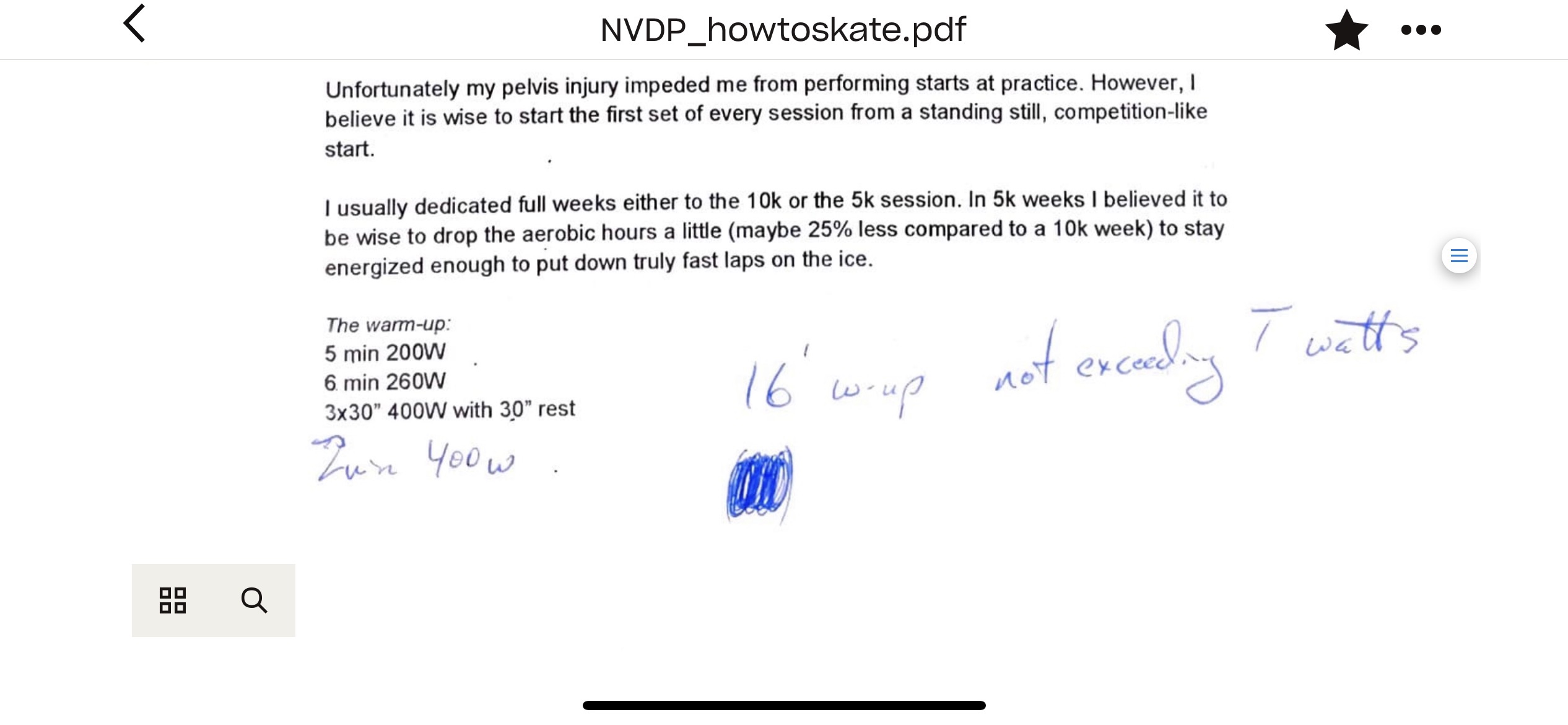
My active readiness test is based on an Olympic Champion’s warm-up routine.
The 400w segments are done only in Threshold & Specific Preparation More in Nils’ Document Linked Below
SWEDISH ACTIVE READINESS TEST (SART)
I have been working with an Olympic Coach, Johan Röjler. Johan had the idea for me to perform a daily assessment based on NVDP’s warm-up.
My bike numbers are FAR below Nils’ level. However, the principles are the same.
Six minute steps
Start at 50% of “fit” Threshold watts
End at 65% of “fit” Threshold watts
Nils did his Threshold at 400 watts. At 53, I picked 300w.
The key isn’t the Threshold number.
What’s important is getting a 50%/65% number that is NOT demanding. You want to have a test you can get through at every level of fitness and fatigue.
I’m using 3 steps (150w/165w/180w). Power via Favero Assioma Duos and total test takes ~20 minutes. Johan is testing himself with a run-based protocol.
We are looking for heart rate suppression and “jumpiness.”
Day One of the training cycle – we expect HR to be responsive and jumpy following the 2 off days
Across the micro cycle – we expect some HR suppression BUT when there is material suppression, combined with other factors (mood, HRV, MRHR, soreness, energy) we gauge the risk/benefit for loading
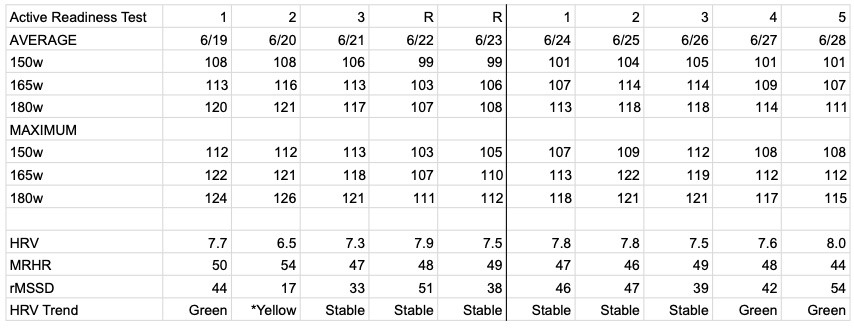
The chart shows two cycles – one where I pulled the plug after three days, and the other where I pushed through fatigue (D2 & D4) and finished strong.
The SART is a nice warm up. My total output is 200 kj and no matter how wrecked I am (see June 22 & 23 above) – the test is doable.
With Passive Metrics (HRV, MRHR), the Red & Strong Green days are obvious.
What’s less clear is the signal for the Yellow and Weak Green days. Yellow and Weak Green days are where I make most of my mistakes.
Our hypothesis is fatigue (not-readiness) will manifest via heart rate suppression at submax levels.
By learning my normal response to training, I can decide if I’m in a “better to rest” or “train through” situation. The idea being to back off when my body isn’t in a position to absorb more load.
My readiness metrics, when combined with my training log, let me see the sessions that most kick my butt.
Are those sessions “worth it”?
Could there be a more effective way of loading?
These are judgement calls and part of the art of loading.
Overall => make mistakes visible, and learn from them.
15 years ago, I was trying to hang with my elite competition. These days, my focus is keeping up with this guy. My training partner reminds me of my younger self.
What one thing, if it happened, would change everything?
Protein, especially with good fats, moderates my appetite and keeps my digestion happy.
Dairy
I tolerate it well but I’m careful not use as a sugar crutch.
There can be a lot of added sugar in dairy (especially “vegan” yogurts).
There is information in cravings and binges.
Cravings => usually a depletion signal. High-performance athletes need to train the ability to process food for fuel. Long sessions provide enough depletion, even when eating.
Binges => a sign of too much – too much intensity, too much stress, too much load.
To make progress with your body, and counter your binges/cravings, trade stress for the ability to lose fat.
A stable weight is a sign you have your act together.
Get to a stable, strong weight and stay there.
Effective nutrition is defined by what is not there:
Swings
Cravings
Binges
Injures
Illness
Where to focus:
Eat less sugar – sweeteners are everywhere. Do not restrict whole fruits, they fill you up and reduce processed food intake.
Protein with every meal – all day long
Incremental change – lifetime journey!
Start by improving the quality of your non-training nutrition
Appropriate levels of carbohydrate – fuel the burn





 Feel The Byrn
You must be logged in to post a comment.