I was very fortunate Scott Molina took an interest when I moved to New Zealand. Not that he had much of a choice, I turned up at his garage (ready to ride) most mornings. Scott has studied, and applied, what works for his entire life.
One of my favorite follows (Elias Lohtonen) was writing about the differences between Beginners and Elites. The context was metabolic fitness, as determined in his lab.
This got me thinking about my journey as a new athlete.
When I started out, I disliked intense training:
It crushed me
It hurt
I wasn’t very good at it
However, I thought I “needed it.”
Turns out I was lucky I didn’t bother with it for many years.
We now have a better idea why.
I’ll take you back 25 years.
Lactate As A Fuel Source, Not Waste Product
When I learned exercise physiology in the 1990s, lactic acid was presented as the athlete’s enemy – causing pain and slowing us down.
Difficult, searing training was believed necessary to teach our bodies to buffer and tolerate this acidic compound.
We used to think lactate would form crystals in our muscles, causing post-exercise muscle soreness. Hours, and days, later we would “flush the legs” to remove these waste products. We’d get massages to “break up the lactate.”
Turns out we were wrong.
Lactate is essential, and extremely useful, once we’ve trained our bodies to use it.
Lactate is also a key regulator of intermediary metabolism, regulating substrate utilization. It decreases and inhibits the breakdown of fat for energy purposes (lipolysis), as well as the rate of glucose utilization by cells (glucolysis).
The bold part is mine.
What does this mean for you?
Athletes who start fast, and perform “intense” endurance training impair their ability to burn fat
Every human I’ve ever met (!) wanted to burn more fat.
What are the implications for your training?
Slow your endurance sessions down.
Endurance training needs to feel light (link is to an article on “aerobic threshold feel”).
Endurance adaptations favor duration.
We all share a bias towards thinking that “more intense is better.”
Intensity is not better, it is different…
…and a key difference is you are burning less fat.
You already have plenty of capacity to generate lactate. If you want to improve performance (and burn more fat) then you need to focus primarily on the low-end.
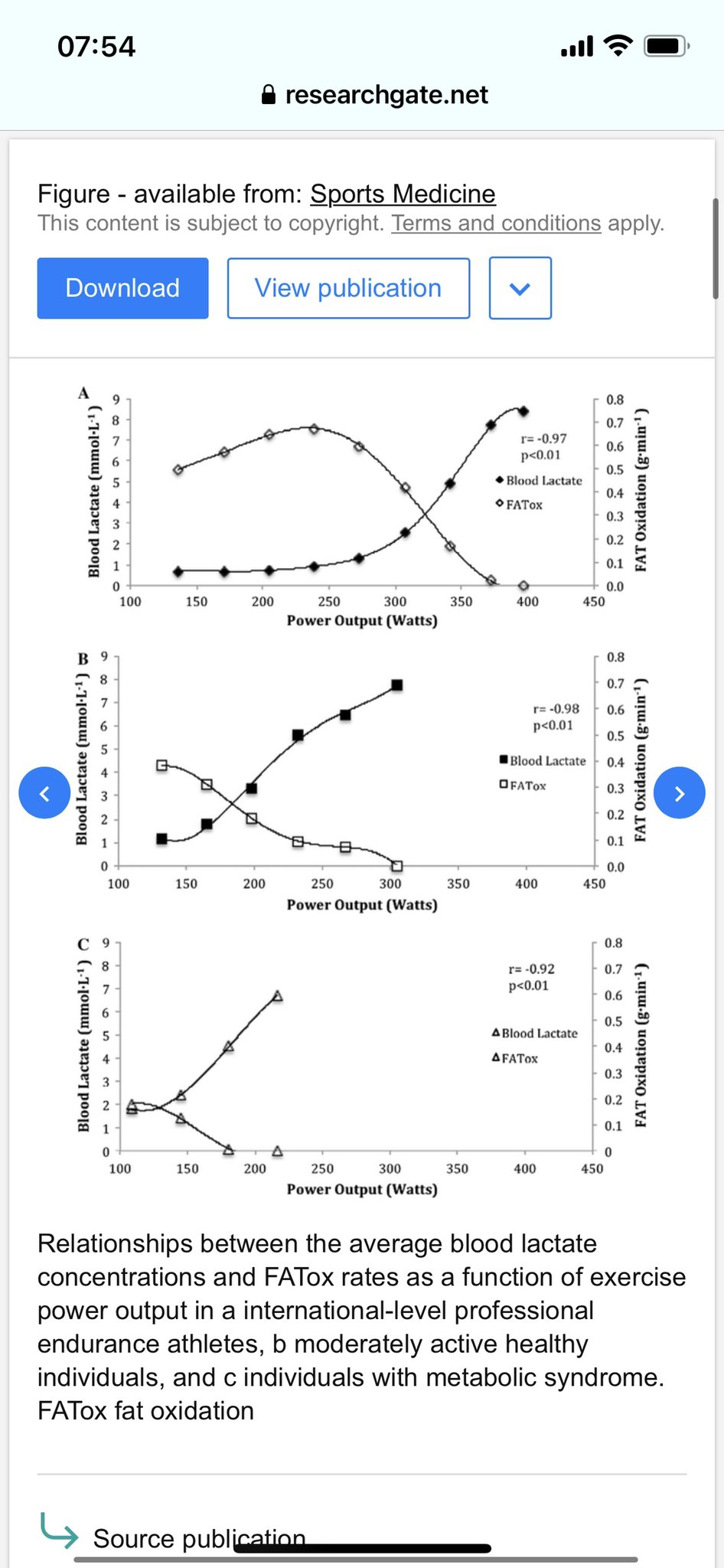
2// Next up, Dr. San Millán’s paper on Metabolic Flexibility is a fascinating read on the differences between three groups: elite athletes, recreational athletes and individuals with metabolic syndrome.
From the article linked above
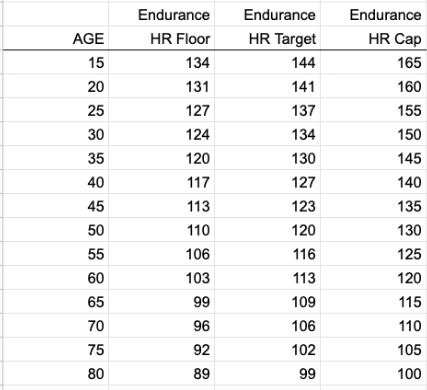
3// Overcoming our shared bias towards intensity : One of the way’s to retrain your mind is to focus on submax performance. At 53, I’m very interested in my paces, and powers, at 130 bpm. This is ~35 beats below max (the “top of”cap” in the table below, approximately).
4// How do you know what’s “intense enough?”
From Last Week’s Thread on Training Zones The table is a good starting point, you can dial in more accurately using the resources in the thread
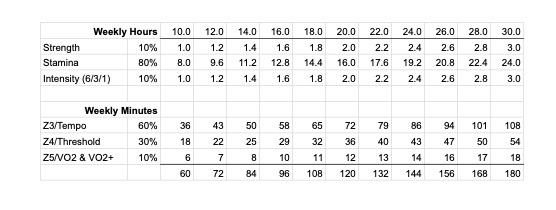
Let’s see what that implies for my last week: 15 hours total => 900 minutes
Strength => 90 minutes
Stamina => 720 minutes
Intensity => 90 minutes
Tempo => 54 Minutes
Threshold => 27 minutes
VO2 & VO2+ => 9 minutes
Is there a training segment that I’m avoiding?
Think outside the box, there are many interesting sessions that are hybrids of strength/intensity.
Use the small allocations wisely and have fun with them.
++
What Trades Make Sense?
First Two Tips:
Repeat don’t progress
Hit the minimums
If I want to ADD then do a TRADE.
Example #1: I like to run in the hills. However, I don’t need to run up a mountain every week! Across a week, a fortnight, a month… I manage my “elevation load” between weeks.
Example #2: I’m relatively strong for my age and category. I trade Strength load to accommodate more Stamina within my week.
Example #3: Max HR test last week? Add more Zone 1 to start the following week. Balance the intensity mixes across more than just the week. Give yourself time to fully absorb your highest intensity sessions. Same thing applies for sessions that cause significant muscle damage (plyometrics, downhill run load).
Example #4: get to the source of your life stress:
Sleep
Alcohol
Energy deficits
Spontaneous tempo
Over-reaction
Excessive load
Too many goals
If I want to better absorb training then reduce the stress caused by choices outside my core goals.
Endurance training, done to the best of our ability, offers an incentive to straighten out our lives.
++
Avoiding Ruin – What Might Screw Up Next Week?
In the acute sense… Avoid The Injury!
Take time to address the little niggles while they are still little!
Dial the program DOWN before the injury is created.
Trade low quality days for high quality weeks.
In the chronic sense… going down an unsustainable path feels great, ride up to the day before you fall apart!
Consider, then address, areas of instability:
Relationships
Sponsors
Finances
Emotions
Habits
How to make this happen?
Put it in your calendar!
Make an appointment with yourself, daily.
Example: 10 minutes every day on mobility and one positive action to reduce long term stress.
Little positive steps have big impacts when applied over long time horizons.
The ability to bring these habits into your athletic life gives you a skill set to improve all aspects of your life.
The “programer” is not aware of my background load:
I scale the sessions (downwards) to fit into my strength allocation for the week
I spread the sessions out to avoid too much load in a week
The benefit of using someone else’s program is variety. For me, the only way to make that happen is someone else designing the program.
Your personal tolerance for strength will vary over time. The 10% guideline is a minimum. Many athletes will tolerate, and benefit from, a greater emphasis on strength (particularly in the winter).
I score traditional strength at 1 TSS point per minute and plyometric/work capacity sessions at 2 TSS points per minute. These scores include rest periods.
When resting between work sets, do mobility work!
So that leaves us with Endurance Training
80% Stamina
6% Tempo
3% Threshold
1% VO2 & VO2+
I titled this piece with intent.
The Ambitious Athlete’s Guide
I am assuming you truly want to see what’s possible with regard to endurance sport.
I’m assuming you want long term gains rather than whatever payoff you’re receiving from your current approach.
To see what’s possible, you’re going to have to overcome certain aspects of your Human Operating System and past habits.
One of these aspects is what I call “training like an age grouper” => instead of the 9% allocation to Tempo/Threshold we often have a burning desire to get that number closer to 90%!
Tempo/Threshold is what we expect exercise to feel like. Our breathing rate is up, we’re sweating, the work rate is high… we think it’s more beneficial.
Well, it is and it isn’t.
The ability to benefit from “work rate” training is linked to our capacity to do, and recover from, work.
Stamina is our endurance capacity over time and fully developing this capacity takes years.
Best effort for an hour scores 100 points (5th gear)
Threshold effort 85 points per hour (4th gear)
Tempo effort 75 points per hour (3rd gear)
Steady effort 65 points per hour (2nd gear)
Easy effort 50 points per hour (1st gear)
If you think in Fahrenheit then you probably won’t be that far off.
Exercise scientists spend their lives debating the different gears, the transitions between the gears and the best gear to use for where you want to take yourself.
It matters, and it doesn’t matter.
Why?
Because most people never stay focused long enough for their protocol to limit their performance.
What you need is a simple way to keep yourself from over-doing-it.
TSS works for this task.
++
Each day, I push my workouts up to TrainingPeaks and a TSS score is generated for the day.
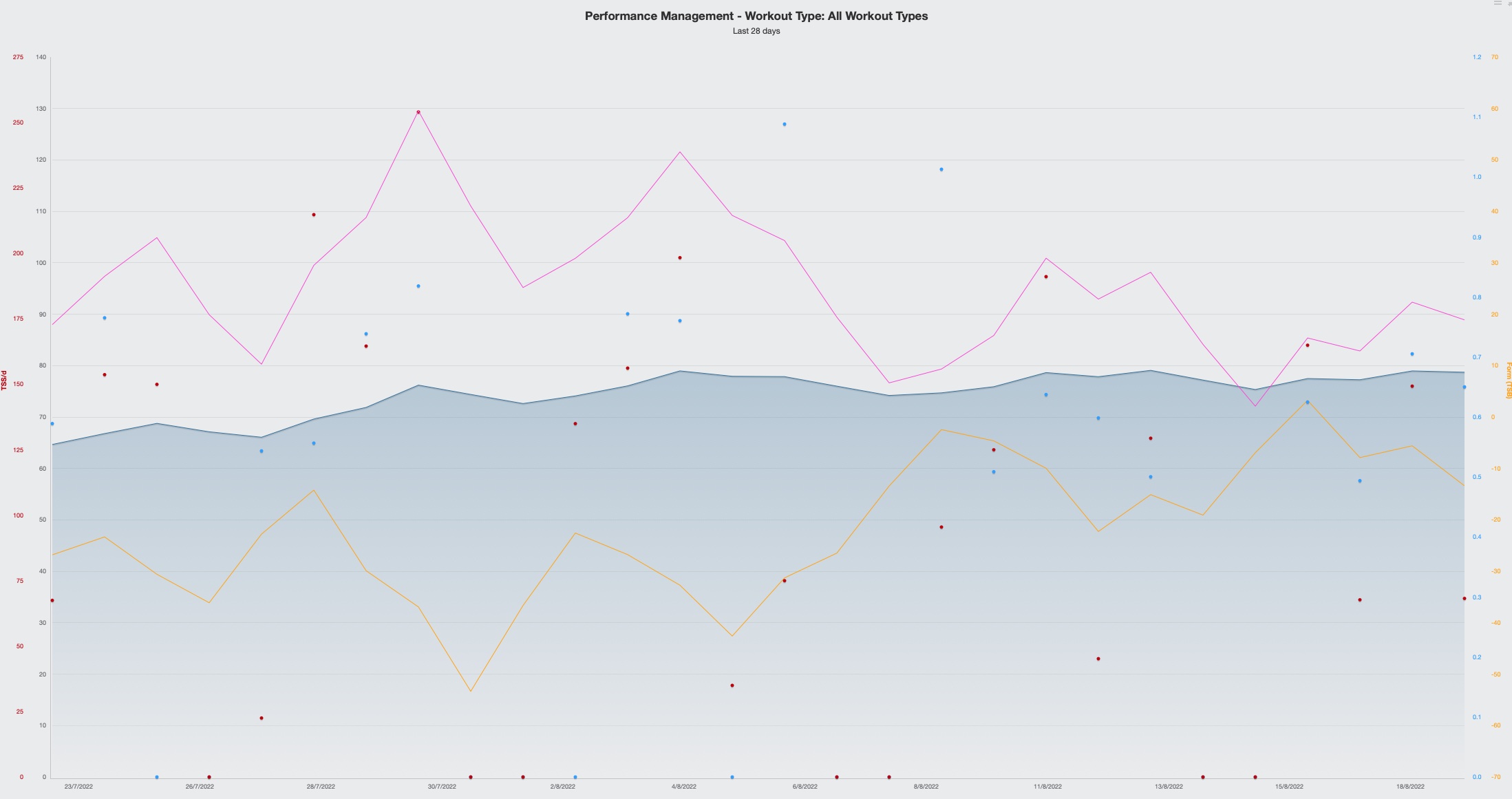
CTL is a proxy for fitness – it’s what you’ve actually managed to do for the last six weeks.
TIP: the speed your CTL increases is called your “load ramp” – a common error for athletes is too quick a load ramp.
++
CTL should be fairly stable – if it is not then look deeper.
Do you have unplanned misses? injuries? illnesses?
Your mind will try to wrap a story around the misses.
Don’t worry about why.
Instead, assume:
Your training zones are set too high
Your loading days are too big
You have too many loading days
Two loading days each week, a stable CTL, a life that’s under control…
Gives you plenty to work with.
++
In the TP world, “fatigue” is measured by Acute Training Load, ATL. This is your average score for the last week (7 days).
If we take your CTL (fitness) and subtract your ATL (fatigue) then we can see how “fresh” you are. TP calls this your “form.”
Each athlete will have a personal tolerance for how negative they can take their form.
When you get “too tired” have a look at your “form” score and see how negative it was before you tipped over the edge.
We ALL make mistakes – the framework gives you a way to see if there is a pattern to your loading mistakes.
How it comes together – Blue Shaded is CTL, Red line is Acute Load and Yellow Line is Form – this table is called the Performance Management Chart I’ve been working my CTL upwards so my form has been negative in the last 28 days
If it the above seems too much then you can simplify your approach!
Use HRV4Training and taking a morning HR measurement. Marco’s app will help you decide if it is a good day to load, recover, or rest.
Green light (load), Yellow light (maintenance or easy), Red light (recovery).
For now, I don’t recommend other company “readiness metrics” – they don’t work, yet.
To show how the week comes together, let’s dig into a case study – my current situation
My CTL is ~75 points.
Easy day – 25-50 points (below CTL)
Maintenance day – 75 points (around CTL)
Loading day – 150 points (2x CTL)
The key error here is one you’ve heard before…
Keep your easy days easy
In order to give yourself capacity to absorb your Loading Days, you need to recover from them!
This means you need to limit:
Number of loading days in a week
The size of the loading day, relative to CTL (your “average” day)
Many athletes load themselves into the ground, go stale, recover, then repeat the cycle, perhaps with injury/illness for variety!
This pattern will leave you undertrained because you are doing too much training.
More Tips:
When I was younger, I tolerated bigger Loading Days – start with two days a week at 2x CTL
The game with CTL is to gradually build sustainable load – that’s a superior game to seeing how hard you can smash yourself every single weekend.
CTL will seem like a long game to you. Six weeks is NOTHING – barely enough time to create an overuse injury.
1,000 days is the shortest cycle you should be thinking about. Amateur athletes should be thinking on an Olympic Cycle – 2 years base building, 1 year performance-focused, 1 year health-focused – repeat forever!
The majority of your load should be Moderate Domain aerobic load (Zone 1 and Zone 2). This is very different to what you will think you need. You are going to be battling your urge to “go hard” and self-sabotage.
Training Peaks helps make mistakes visible – it’s up to you to address your mistakes.
Now we are ready to discuss the week, itself.
Similar to the Big Picture, write down what you are trying to achieve. From my week just past:
Elevation change run
Hill sprints
Bike long ride (2,000kj)
Those were specific workouts I wanted to include.
Why?
Something important I didn’t do last week
Something I want to add
Correcting an error from prior week (2,800kj was too much)
All the other sessions stay the same: (a) endurance training focus; and (b) strength sessions.

 Feel The Byrn
You must be logged in to post a comment.